
Playtime Indoors: Fun Games for Kids to Boost Skills & Confidence
 By Speech Blubs Team•Jan 19, 2026•26 min.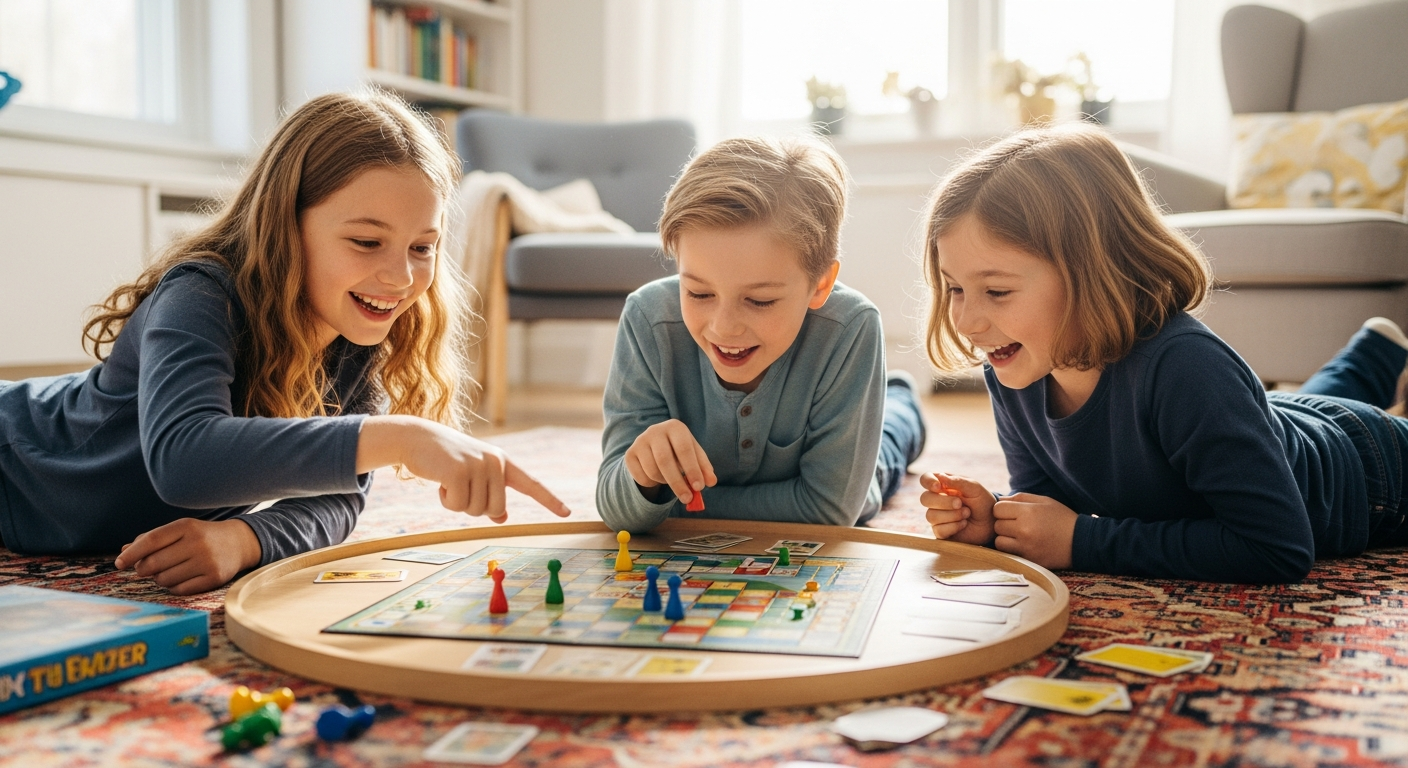
Table of Contents
- Introduction
- The Undeniable Magic of Indoor Play
- Beyond the Wiggles: Active Indoor Games for Movement and Language
- Sparking Imagination: Creative & Pretend Play for Rich Language
- Brain Boosters: Games for Cognitive & Conversational Skills
- Speech Blubs: Your Partner in Joyful Communication
- Getting Started with Speech Blubs: Value and Features
- Conclusion
- Frequently Asked Questions
Suddenly, the weather changes, a sniffle keeps everyone home, or perhaps it's simply too hot or cold to venture outside. Whatever the reason, indoor days can quickly feel long and challenging for parents trying to keep their children engaged, active, and away from passive screen time. We all want our kids to thrive, grow, and communicate effectively, but sometimes finding the right activities to spark that growth indoors feels like a daunting task. The good news is that your home is a treasure trove of learning opportunities, and with a little creativity, indoor games can be far more than just time-fillers; they can be powerful catalysts for development, especially for speech and communication.
This post is dedicated to transforming those indoor days into exciting adventures. We'll explore a wealth of fun, interactive games that not only burn energy and stimulate imagination but also naturally foster crucial developmental milestones, particularly in language and communication. From active gross motor challenges to quiet, imaginative play, we'll show you how to turn everyday moments into meaningful learning experiences. At Speech Blubs, we believe in empowering children to "speak their minds and hearts," and many of these games lay the perfect groundwork for the kind of confident, joyful communication we champion.

Introduction
Picture this: Rain is drumming against the window, or a heatwave has turned your backyard into a no-go zone. Your child, buzzing with energy, looks up at you with that familiar plea for "something to do." The temptation to resort to endless cartoons might be strong, but deep down, you know there’s a better way to nurture their growing minds and bodies. Indoor play isn't just about passing the time; it's a vital, often underestimated, component of a child’s holistic development. It’s where creativity takes flight, problem-solving skills are honed, and, most importantly, where language blossoms in spontaneous and meaningful ways.
In this guide, we'll dive into an exciting collection of fun games to play with kids indoors, designed to keep them engaged, active, and learning. We'll move beyond simple entertainment to explore how each activity contributes to motor skills, cognitive development, emotional regulation, and especially, speech and language acquisition. By integrating these joyful play experiences into your routine, you’re not just battling boredom; you're building a foundation for confident communicators and fostering incredible family connection. Get ready to transform your living room into a hub of discovery and delightful conversations!
The Undeniable Magic of Indoor Play
When the great outdoors is off-limits, the indoors becomes a stage for endless possibilities. While structured activities have their place, the real magic often happens in free-flowing, child-led play. This type of engagement isn't just about amusement; it's a critical component of a child's developmental journey.
Holistic Development in Every Corner
Indoor play offers a unique environment for children to explore, experiment, and learn. Unlike outdoor settings which might focus more on gross motor skills, indoors can provide a rich blend of physical, cognitive, social-emotional, and linguistic development opportunities within a confined yet imaginative space.
- Gross Motor Skills: Even indoors, children can engage in activities that build strength, balance, and coordination. Think crawling through tunnels, jumping over pillows, or dancing freely. These movements are essential for developing body awareness and laying the groundwork for more complex physical tasks.
- Fine Motor Skills: Many indoor games naturally incorporate activities that refine small muscle control in the hands and fingers. Building with blocks, drawing, manipulating playdough, or threading beads all contribute to dexterity, which is crucial for self-care skills like dressing and academic tasks like writing.
- Cognitive Development: Problem-solving, critical thinking, memory, and spatial awareness are constantly at play during indoor games. Scavenger hunts challenge children to follow clues, obstacle courses require planning, and building forts involves understanding spatial relationships and engineering principles.
- Social-Emotional Growth: Indoor play, especially with siblings or caregivers, provides rich opportunities for social learning. Children practice turn-taking, negotiation, empathy, and conflict resolution. Role-playing games allow them to explore different emotions and perspectives in a safe environment.
- Language and Communication: This is where indoor play truly shines as a catalyst for growth. Every interaction, every game, every shared laugh presents an opportunity for language development. Children learn new vocabulary, practice sentence structures, ask questions, give instructions, narrate stories, and express their feelings. The focused environment often encourages more detailed verbal exchanges than a sprawling outdoor setting.
From Passive Screens to "Smart Screen Time" and Beyond
In our modern world, screens are an undeniable part of daily life. While passive viewing (like cartoons) has its place, it often lacks the interactive elements crucial for deep learning and language development. The indoor games we'll explore offer a powerful screen-free alternative, promoting active engagement and imaginative exploration. However, it's also worth noting that when used thoughtfully, "smart screen time" — like that offered by Speech Blubs — can become an incredibly valuable educational tool. At Speech Blubs, we are committed to providing an immediate, effective, and joyful solution for the 1 in 4 children who need speech support, blending scientific principles with play into one-of-a-kind "smart screen time" experiences. We were born from the personal experiences of our founders, who all grew up with speech problems and created the tool they wished they had. Our unique approach of teaching complex communication skills through "video modeling," where children learn by watching and imitating their peers, offers a powerful, interactive counterpoint to passive viewing.

Ready to bring more connection and learning to your indoor days? Download Speech Blubs and start exploring a world where play and purpose meet.
Beyond the Wiggles: Active Indoor Games for Movement and Language
Energy doesn't just disappear when you're stuck inside! Channelling that boundless enthusiasm into structured, yet playful, activities is key. These active indoor games are fantastic for gross motor development and offer countless opportunities to naturally integrate language practice.
Body & Balance: Building Strength and Vocabulary
Physical activity is vital for children's overall well-being, even when confined indoors. These games not only help burn off steam but also create rich contexts for communication.
Obstacle Courses: Navigate, Describe, and Direct
Transform your living room into an adventurous landscape! Use pillows as stepping stones, blankets draped over chairs for tunnels, and painter's tape to create lines for balancing.
- How it helps: Obstacle courses develop gross motor skills, balance, coordination, and spatial awareness. They also foster problem-solving as children figure out how to navigate each challenge.
- Language Opportunities: This is a goldmine for language!
- Vocabulary: Introduce words like over, under, through, around, crawl, jump, step, balance, soft, hard, fast, slow.
- Following Directions: "Crawl under the blanket," "Step over the pillow," "Balance on the tape."
- Giving Directions: Encourage your child to create a course for you and give instructions. "Mommy, go through the tunnel!"
- Descriptive Language: "This tunnel is dark," "The pillow is squishy."
- Relatable Scenario: For a child who might be hesitant to try new physical activities, setting up a simple tunnel with a blanket and chairs can be an inviting first step. You can crawl first, narrating your actions ("I'm going in! It's dark! I'm coming out!"), prompting them to imitate and use those action words.
Animal Walks & Yoga: Roar, Stretch, and Imitate
Encourage children to move like different animals – a crab, a bear, a frog, or a snake. Or, explore simple animal yoga poses.
- How it helps: Animal walks build strength, bilateral coordination (using both sides of the body), and imaginative play. Yoga improves flexibility, balance, body awareness, and can be calming.
- Language Opportunities:
- Animal Sounds: "What does a lion say? Rrrroooaaar!" "What sound does a frog make? Ribbit!"
- Action Verbs: Crawl, hop, slither, pounce, stretch, wiggle.
- Descriptive Language: "The bear is heavy," "The snake is long and slimy."
- Imitation: The very act of imitating animal movements and sounds is a powerful pre-speech skill. In Speech Blubs, our video modeling methodology harnesses this natural inclination, allowing children to learn new sounds and words by watching and imitating their peers, similar to how they mimic animal actions.
- Relatable Scenario: If your child loves animals but is a "late talker," the "Animal Kingdom" section within Speech Blubs offers a fun, motivating way to practice sounds like "moo" and "baa." You can then take these practiced sounds and integrate them directly into real-life animal walk games, reinforcing learning through play.
Dance Parties & Musical Freeze: Rhythm, Expression, and Impulse Control
Put on your child's favorite music and let loose! When the music stops, everyone freezes in a funny pose.
- How it helps: Dancing boosts gross motor skills, rhythm, coordination, and provides an outlet for self-expression. Musical freeze adds an element of impulse control and listening skills.
- Language Opportunities:
- Action Verbs: Spin, jump, wiggle, shake, clap, stomp.
- Music Vocabulary: Fast, slow, loud, quiet, song, beat.
- Following Directions: "Freeze!" "Spin around!"
- Emotional Expression: Encourage children to dance like they're happy, silly, or sleepy.
- Relatable Scenario: For a child who struggles with transitions, using a "dance party" to release energy before a calmer activity, ending with a "freeze," helps practice stopping on command, a crucial skill for following instructions.
Targeted Movement & Focus: Precision and Specific Language
Some active games require more focus, blending physical movement with cognitive engagement.
Target Toss & Supersized Bowling: Aim, Count, and Name
Set up plastic cups or water bottles as bowling pins, or use a laundry basket as a target for soft balls or rolled-up socks.
- How it helps: Improves hand-eye coordination, fine motor skills (grasping and throwing), and spatial reasoning.
- Language Opportunities:
- Counting: "How many pins fell down?" "Let's count them: one, two, three!"
- Colors/Shapes: "Throw the red ball at the blue cup."
- Action Verbs: Throw, roll, hit, knock down.
- Turn-Taking: "My turn, your turn!"
- Relatable Scenario: If your child enjoys counting, making each pin a different number or color can add an extra layer of learning, prompting them to say "I hit number three!" or "I knocked down the yellow one!"
Balloon Volleyball: Keep it Up and Talk It Up
Blow up a balloon and try to keep it from touching the ground by gently hitting it back and forth. You can even use a string as a makeshift net.
- How it helps: This classic improves visual tracking, hand-eye coordination, motor planning, and quick reaction time. It's also great for cooperative play.
- Language Opportunities:
- Spatial Concepts: Up, down, high, low, over, under.
- Action Verbs: Hit, tap, bounce.
- Encouragement: "Good job!" "Keep it going!" "Mine!"
- Prediction: "It's going up!" "It's coming down!"
- Relatable Scenario: This is perfect for practicing simple words like "hit" or "up." For a child who uses single words, encourage them to say "Hit ball!" or "Ball up!" as they play, reinforcing these core concepts.
Sparking Imagination: Creative & Pretend Play for Rich Language
Some of the most profound language development happens when children immerse themselves in imaginative worlds. These games encourage creativity and naturally invite detailed storytelling and expressive communication.
Storytelling & Role-Playing: Building Narratives and Empathy
When children pretend, they’re not just playing; they’re building their understanding of the world, practicing social scripts, and expanding their linguistic horizons.
Put On a Play or Puppet Show: Characters, Dialogues, and Emotions
Using stuffed animals, sock puppets, or even themselves as actors, children can create and perform their own stories.
- How it helps: Encourages imaginative play, narrative skills, sequencing, emotional expression, and collaboration.
- Language Opportunities:
- Character Voices: Experimenting with different voices helps children understand vocal modulation and prosody.
- Dialogue: Creating conversations between characters builds sentence structure and conversational turns.
- Story Elements: Beginning, middle, end, characters, setting, problem, solution.
- Emotional Vocabulary: "The princess is sad," "The monster is angry."
- Relatable Scenario: For a child who enjoys mimicking, setting up a simple puppet show provides a low-pressure environment to try out new words and phrases in character. You might have one puppet ask, "What are you eating?" prompting the other puppet to say, "Apple!"
Action Storytime: Bringing Books to Life
Choose a favorite book and act out parts of the story as you read. If a character runs, you run in place; if they jump, you jump.
- How it helps: Enhances comprehension, brings stories to life, and encourages active listening and physical engagement.
- Language Opportunities:
- Verbs in Context: Physically acting out verbs like run, jump, sleep, eat, fly reinforces their meaning.
- Adjectives: Describing characters and settings as you act them out ("a big bear," a sleepy cat").
- Sequencing: Understanding the order of events in a story.
- Relatable Scenario: When reading "Brown Bear, Brown Bear, What Do You See?" you can have your child act out each animal as it's named, solidifying animal names and actions, potentially linking back to the animal sounds they might practice in Speech Blubs.
Indoor Camping or Fort Building: Adventures and Descriptions
Use blankets, pillows, and furniture to build a cozy fort or a pretend campsite.
- How it helps: Encourages imaginative play, spatial reasoning, problem-solving, and collaboration. It also provides a comforting, enclosed space for focused play.
- Language Opportunities:
- Negotiation & Planning: "Where should this blanket go?" "Do we need more pillows?"
- Descriptive Language: "Our fort is dark and cozy," "The flashlight is bright."
- Pretend Play Vocabulary: Tent, sleeping bag, campfire, stars, spooky.
- Narrative Creation: "Let's pretend we're exploring a cave."
- Relatable Scenario: Building a "secret hideout" can be an ideal setting for whispering secrets, which helps develop quieter vocalizations and encourages intimate conversation, moving beyond just loud, boisterous play.
Remote Control Freeze Game / Copycat Mirror Game: Non-Verbal and Emotional Cues
In Remote Control Freeze, pretend your child is a TV and you control their "channels" (zoo animal, robot, superhero), freezing them with a "pause" button. In Copycat, stand face-to-face and take turns copying each other's movements and facial expressions.
- How it helps: Remote Control Freeze works on impulse control, imaginative play, and understanding categories. Copycat Mirror enhances non-verbal communication, emotional recognition, and body awareness.
- Language Opportunities:
- Categorization: "Let's be a zoo animal."
- Emotional Vocabulary: Happy, sad, surprised, angry (through facial expressions).
- Action Verbs: Walk, jump, crawl, stomp.
- Sounds: Animal sounds, robot noises, superhero exclamations.
- Relatable Scenario: For children working on recognizing emotions, the Copycat game can be a playful way to practice identifying and naming feelings. "Can you make a happy face? Now a surprised face!"
Art & Craft Adventures: Expression, Description, and Creation
Art projects are inherently language-rich, offering concrete visuals to accompany new vocabulary.
Making Books or Scrapbooks: Author, Illustrator, Narrator
Staple pages together or use a blank notebook and let your child write, illustrate, or dictate their own story or memories.
- How it helps: Fosters creativity, fine motor skills (drawing, writing), sequencing, and narrative development.
- Language Opportunities:
- Storytelling: Developing a plot, characters, and settings.
- Descriptive Language: "The monster has sharp teeth and green skin."
- Vocabulary: Introducing words related to colors, shapes, actions, and emotions in their story.
- Sequencing: "First, then, next, last."
- Relatable Scenario: If your child struggles with expressing sequences of events, helping them create a simple "My Day" scrapbook with pictures or drawings can guide them through narrating their day in order.
Sensory Bins: Explore, Describe, and Categorize
Fill a container with materials like rice, pasta, beans, water beads, or sand, along with small toys, scoops, and cups.
- How it helps: Stimulates the senses, develops fine motor skills, encourages imaginative play, and provides a calming activity.
- Language Opportunities:
- Descriptive Vocabulary: Soft, hard, smooth, bumpy, wet, dry, cold, warm, crunchy, slippery.
- Action Verbs: Pour, scoop, dig, hide, find, mix.
- Quantity Concepts: More, less, empty, full.
- Categorization: Sorting items by color, shape, or texture.
- Relatable Scenario: For a child who is exploring new textures, a sensory bin with dried pasta and scoops allows them to talk about "crunchy" sounds and "long" pieces of pasta, expanding their vocabulary related to sensations. You can find all the inspiration you need for your sensory bin in this blog post: Sensory Bins for Toddlers: Our Favorite Ideas and Items.
Brain Boosters: Games for Cognitive & Conversational Skills
These games challenge children's minds, encouraging critical thinking, memory, and sophisticated use of language in a playful context.
Problem-Solving & Logic: Thinking and Talking Through Challenges
Engaging children's minds with puzzles and riddles sharpens their cognitive abilities and provides a context for verbal reasoning.
Scavenger Hunts & Color Quests: Follow, Find, and Categorize
Create a list of items for your child to find around the house (pictures for younger kids, words for older). For a color quest, ask them to find multiple items of a specific color.
- How it helps: Develops problem-solving skills, critical thinking, visual discrimination, and following directions.
- Language Opportunities:
- Prepositions: "Is it under the bed? Behind the couch?"
- Descriptive Language: "I found a small, blue, soft blanket."
- Categorization: "Can you find five red things?"
- Question Asking: "Where should I look next?"
- Relatable Scenario: For a child working on identifying colors, a "color quest" where they find all the red items in the room is highly motivating. You can then ask them to name each item they find, reinforcing both color and object vocabulary.
Puzzles & Giant Game Boards: Piece It Together and Narrate
Work on jigsaw puzzles together or use masking tape to create a giant hopscotch, tic-tac-toe, or even a race track on your floor.
- How it helps: Puzzles develop spatial reasoning, fine motor skills, problem-solving, and persistence. Giant floor games encourage gross motor movement, following rules, and turn-taking.
- Language Opportunities:
- Spatial Concepts: Edge, corner, fit, turn, next to.
- Descriptive Language: "This piece is blue and has a straight edge."
- Strategy Talk: "Where do you think this piece goes?" "Let's try putting it here."
- Counting & Number Concepts: If using a board game, count spaces, dice rolls.
- Relatable Scenario: While building a puzzle, narrating your actions ("I'm looking for a blue piece," "Does this fit here?") models valuable problem-solving language for your child.
"What's on My Butt?" / Sound Safari: Guessing, Listening, and Describing
For "What's on my butt?", lie down and have your child place various objects on your back for you to guess. For Sound Safari, use a phone recorder to capture household sounds, then play them back for guessing.
- How it helps: Encourages imaginative play, tactile exploration, auditory discrimination, and deductive reasoning.
- Language Opportunities:
- Descriptive Vocabulary: "Is it hard or soft?" "Is it round or square?" (for "What's on my butt?")
- Sound Recognition: Identifying and naming sounds (e.g., squeak, clunk, water running).
- Question Asking: "Is it an animal?" "Does it make a noise?"
- Inferencing: Using clues to guess the object or sound.
- Relatable Scenario: A child who is developing their listening skills can greatly benefit from a "Sound Safari," where they have to actively pay attention to different sounds and then verbalize their guesses. "Was that the washing machine or the dishwasher?"
Word & Concept Games: Expanding Vocabulary and Understanding
These games specifically target linguistic skills, making learning new words and concepts engaging and fun.
Alphabet Exercise Cards / Bookworm Workout: Letters, Actions, and Vocabulary
Create cards with letters of the alphabet and corresponding exercises or actions (e.g., "A" for "Arm Circles," "B" for "Balance on one foot"). For Bookworm Workout, pick an exercise to do every time a specific word is mentioned in a book.
- How it helps: Connects letters/words with physical actions, aids memory, and builds early literacy skills.
- Language Opportunities:
- Letter Sounds: Reinforcing phonological awareness.
- Vocabulary Expansion: Learning new verbs and nouns.
- Following Multi-Step Directions: "Find the 'J' card, then jump five times."
- Relatable Scenario: For a child learning their alphabet sounds, creating "letter action cards" and having them jump for 'J' or make a growling sound for 'G' can make abstract letter sounds more concrete and memorable.
Charades (Animal, Emotion): Non-Verbal to Verbal Bridge
Act out animals, emotions, or simple actions without speaking, and have others guess.
- How it helps: Enhances non-verbal communication, expressive language, and imaginative thinking. Great for understanding and conveying emotions.
- Language Opportunities:
- Expressive Language: Encouraging the child to use words to guess what is being acted out.
- Emotional Vocabulary: Identifying and naming emotions like happy, sad, surprised, scared.
- Animal Names & Sounds: Reinforcing learned concepts.
- Descriptive Words: "Is it a big animal?" "Does it feel scared?"
- Relatable Scenario: If your child struggles to express emotions, playing "emotion charades" can provide a safe space to practice showing and naming "angry" or "silly" faces, building their emotional vocabulary.
Broken Telephone: Listening, Memory, and Humor
Sit in a circle and whisper a message from person to person. The last person says the message aloud, often with hilarious distortions.
- How it helps: Develops active listening skills, auditory memory, and highlights the importance of clear communication.
- Language Opportunities:
- Articulation: Practicing clear speech to ensure the message is understood.
- Auditory Discrimination: Paying close attention to individual sounds and words.
- Sentence Repetition: Reinforcing sentence structure.
- Vocabulary: Learning new words if the message involves them.
- Relatable Scenario: This game is wonderful for children who might rush their speech or have difficulty listening carefully. The funny outcomes reinforce the need to slow down and listen, all in a lighthearted context.
Speech Blubs: Your Partner in Joyful Communication
As you explore these fun indoor games, you'll find countless moments where they naturally open doors for communication. These organic, play-based interactions are exactly what we champion at Speech Blubs. Our mission is to empower children to "speak their minds and hearts," providing an immediate, effective, and joyful solution for the 1 in 4 children who need speech support. We understand the challenges because our company was born from the personal experiences of our founders, who all grew up with speech problems and created the tool they wished they had.
Blending Science with Play for "Smart Screen Time"
We believe that learning to communicate should be an adventure, not a chore. That's why our app blends scientific principles, like our unique "video modeling" methodology, with captivating play. Children learn by watching and imitating their peers, a method backed by extensive research into mirror neurons and child development. This isn't passive viewing; it's active, engaging "smart screen time" that builds foundational speech and language skills.
Think of Speech Blubs as a powerful tool for family connection, complementing your indoor play efforts. For instance:
- Expanding Vocabulary: After a game of "Animal Walks," you can open Speech Blubs to our "Animal Kingdom" section, where your child can see and imitate peers making specific animal sounds and words, reinforcing what they've learned in play.
- Practicing Sounds: If your child is working on a specific sound, like 'M' in the "Yummy Time" section, you can then integrate those 'M' words into a pretend kitchen play, making "Mmm, yummy cookies!"
- Building Sentences: Our app encourages children to build longer phrases and sentences. These practiced structures can then be applied during a "Put On a Play" activity, helping them craft simple dialogues.
- Emotional Expression: After a "Copycat Mirror" game, you can explore the "When I Grow Up" section in Speech Blubs, which features different professions and the emotions associated with them, helping children connect expressions with words.
We focus on the benefits of the process: fostering a love for communication, building confidence, reducing frustration, developing key foundational skills, and creating joyful family learning moments. Speech Blubs is a powerful supplement to a child's overall development plan and, when applicable, professional therapy. It's a screen-free alternative to passive viewing, offering a dynamic and interactive experience that parents and children can enjoy together. Explore Speech Blubs’ unique approach and see how we're making a difference.
Is Speech Blubs Right for Your Child?
Sometimes, as parents, we just need a little guidance. If you're wondering whether your child could benefit from a structured, yet playful, approach to speech development, we offer a quick 3-minute preliminary screener. This simple tool asks 9 questions, providing you with an assessment and a personalized next-steps plan. It's a fantastic way to gain clarity and decide if Speech Blubs is the right fit for your family.
Our app is not just a tool; it's a community. We're proud of our high MARS scale rating and the impact we've had on countless families. Don't just take our word for it; read inspiring stories from other parents who have seen their children's communication skills flourish with Speech Blubs.
Getting Started with Speech Blubs: Value and Features
We believe in transparency and making our powerful tools accessible to as many families as possible. We offer flexible plans designed to suit your needs, but one stands out for its incredible value and comprehensive features.
Our Pricing Plans
- Monthly Plan: For those who prefer month-to-month flexibility, our Monthly plan is available at $14.99 per month.
- Yearly Plan: This is by far our most popular and recommended option, offering significant savings and exclusive benefits. The Yearly plan costs just $59.99 per year, which breaks down to an amazing $4.99 per month. That's a saving of 66% compared to the monthly option!
Why the Yearly Plan is Your Best Choice
The Yearly plan isn't just about saving money; it's about unlocking the full Speech Blubs experience and giving your child every advantage. When you choose the Yearly plan, you receive:
- A 7-Day Free Trial: Experience the full power of Speech Blubs before committing. This trial is exclusive to the Yearly plan, allowing you and your child to explore all the features and see the magic of video modeling firsthand.
- The Extra Reading Blubs App: Beyond speech, language, and early reading skills are deeply intertwined. With the Yearly plan, you'll gain access to our companion Reading Blubs app, providing even more educational value to support your child's literacy journey.
- Early Access to New Updates: Be among the first to experience exciting new features, content, and improvements as soon as they're released, ensuring your child always has fresh and engaging material.
- 24-Hour Support Response Time: Our dedicated support team is there for you. With the Yearly plan, you'll receive priority assistance, ensuring any questions or concerns are addressed promptly within 24 hours.
The Monthly plan, while flexible, does not include the 7-day free trial, the Reading Blubs app, early access to updates, or the priority 24-hour support response time.
To truly empower your child's communication journey and gain access to all these incredible benefits, we highly recommend choosing the Yearly plan. It's not just a subscription; it's an investment in your child's future, offering unparalleled value.
Ready to get started and unlock a world of communication and learning for your child? Get Speech Blubs and choose the Yearly plan to begin your 7-day free trial today!
Conclusion
Indoor days, far from being a challenge, are a golden opportunity to nurture your child's development in profound ways. From boisterous obstacle courses that build physical strength and confidence to quiet storytelling sessions that spark vivid imaginations, these fun games to play with kids indoors offer a holistic approach to learning. They foster cognitive skills, emotional intelligence, and crucial social interactions, all while naturally cultivating a rich environment for language and communication.
Every "I spy," every animal sound, every shared laugh in a blanket fort builds essential foundational skills for confident speaking. At Speech Blubs, we are honored to be a part of this journey, offering a powerful complement to your child's play-based learning. Our unique video modeling methodology and commitment to "smart screen time" are designed to empower children to "speak their minds and hearts," turning potential frustration into joyful expression.
Don't let rainy days or scorching afternoons limit your child's potential. Embrace the power of indoor play and watch their communication skills flourish. Ready to embark on this exciting adventure? We invite you to experience the transformative power of Speech Blubs. Download Speech Blubs on the App Store or Google Play Store today! To get the most out of your experience, including a 7-day free trial and access to our Reading Blubs app, remember to choose the Yearly plan when you sign up on our website. Let's unlock a world of confident communication, together.
Frequently Asked Questions
Q1: How can I encourage my child to play independently indoors?
A1: Start by setting up an inviting play space with appealing materials related to the games you want them to play (e.g., fort-building supplies, art materials, puzzles). Introduce the activity together, show them how to get started, and then gradually step back. Providing open-ended activities, like sensory bins or building blocks, often encourages longer periods of independent exploration. For children who struggle with initiating play, offer choices ("Do you want to build a fort or do animal walks?") to empower them.
Q2: My child always wants screen time. How can I transition them to active indoor games?
A2: Transitions can be tricky! Try setting clear expectations for screen time duration and offering an exciting alternative activity immediately after. You could say, "After this show, we're going to build the biggest fort ever!" Involve them in the planning of the next activity to build anticipation. For "smart screen time" that still engages them, consider apps like Speech Blubs as a bridge. Its interactive video modeling helps children learn while staying engaged, and can be paired with real-world activities to reinforce learning.
Q3: What if I don't have many toys or craft supplies?
A3: You don't need a lot of fancy equipment! Many of the best indoor games use everyday household items. Pillows, blankets, laundry baskets, plastic cups, painter's tape, pots and pans, old magazines, and even socks can become props for obstacle courses, musical instruments, or craft projects. The key is creativity and encouraging your child to use their imagination to transform ordinary objects into extraordinary playthings.
Q4: How do I know if these games are actually helping my child's speech development?
A4: Observe and engage! Pay attention to your child's vocabulary, sentence length, and ability to express ideas during play. Are they using new words? Are they asking questions? Are they engaging in back-and-forth conversations? Even non-verbal cues like pointing and imitation are forms of communication. For more structured insights, consider taking our quick 3-minute preliminary screener to get an assessment of your child's communication skills and personalized next steps, which could include integrating apps like Speech Blubs into your routine.
About the author