
Playtime Power: Fun Activities for Kids at School
 By Speech Blubs Team•Jan 13, 2026•18 min.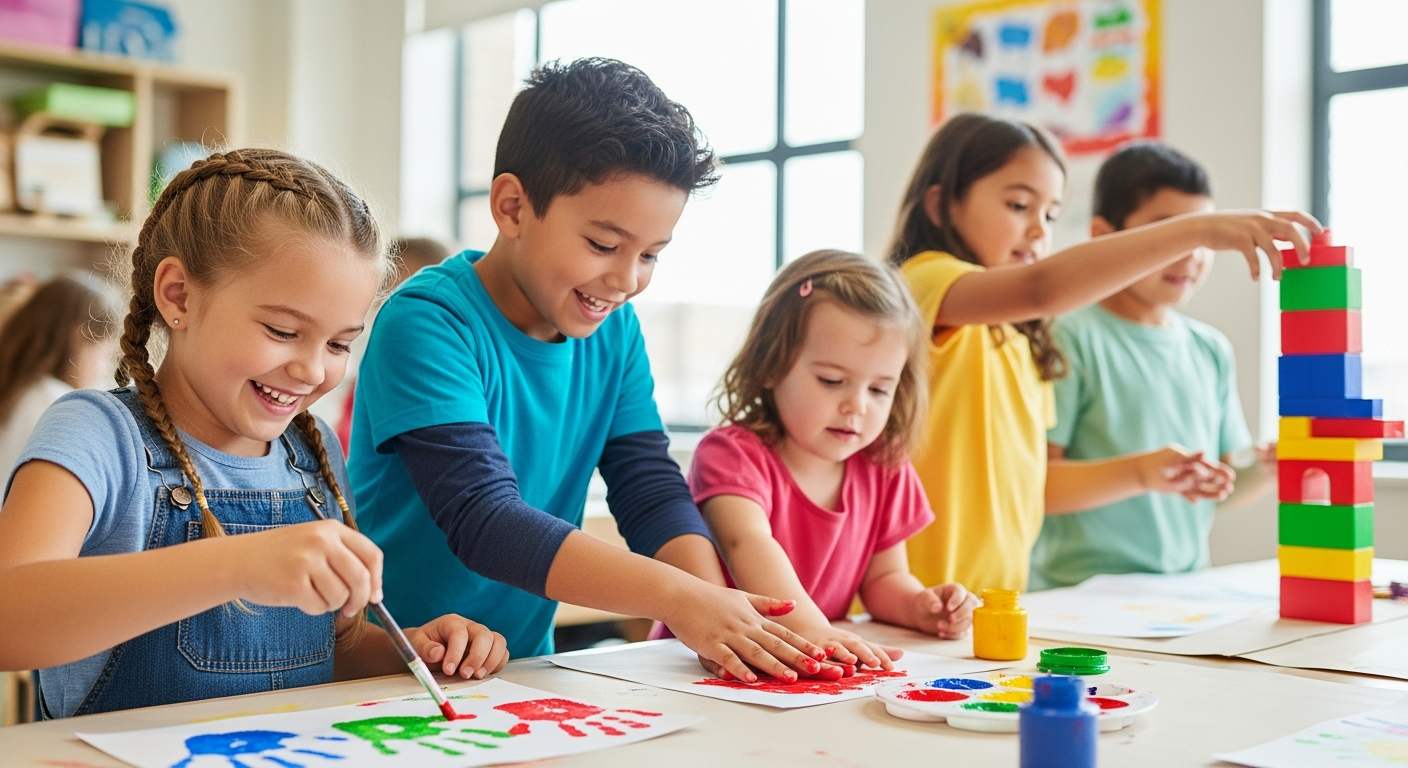
Table of Contents
- Introduction
- The Indispensable Role of Play and Fun in School
- Breaking the Ice: Activities for Connection
- Cultivating Collaboration: Team-Building Challenges
- Unlocking Creativity: Arts, Crafts & Expressive Play
- Energizing Minds and Bodies: Movement & Physical Games
- Quieter Moments: Games for Focus & Strategy
- The Speech Blubs Difference: Empowering Communication Through Play
- Conclusion
- FAQ
Imagine a school day where every child is not just learning, but genuinely thriving, their voices echoing with laughter and confident communication. It might sound like a dream, but the truth is, integrating truly fun activities for kids at school can transform the educational experience, fostering not only academic growth but also vital social, emotional, and communication skills. Far from being mere breaks, these engaging moments are powerful catalysts for development, helping children to build friendships, express themselves clearly, and tackle challenges with creativity and resilience. This post will explore a diverse range of enjoyable activities that enrich the school environment, from icebreakers that spark connections to team challenges that build confidence, and how these experiences, alongside targeted support like that offered by Speech Blubs, empower every child to unlock their full potential and truly speak their minds and hearts.

Introduction
Have you ever noticed how a child's eyes light up when learning becomes a game? The school environment, while primarily focused on academics, holds immense potential for holistic development when infused with joyful, interactive experiences. Beyond textbooks and lectures, engaging children in fun activities for kids at school is not just about entertainment; it’s a crucial strategy for nurturing well-rounded individuals. These activities cultivate essential social skills, spark creativity, enhance problem-solving abilities, and build the foundational communication confidence that children need to navigate their world successfully. In this article, we’ll dive into a treasure trove of exciting ideas that teachers and parents can champion to make every school day an adventure in learning and connection, illustrating how these playful moments can be seamlessly integrated with tools designed to empower every child's voice, ensuring they are ready to engage, interact, and thrive.
The Indispensable Role of Play and Fun in School
For generations, play has been recognized as the primary language of childhood. In the structured environment of a school, integrating fun activities elevates learning from a passive reception of facts to an active, immersive experience. This isn't just about blowing off steam; it's about building critical pathways for cognitive, social, and emotional development.
Fostering Social-Emotional Growth
Fun activities inherently require interaction, negotiation, and empathy. When children play together, they learn to share, take turns, understand different perspectives, and resolve conflicts. These are the building blocks of healthy relationships and emotional intelligence. A child who learns to collaborate on a classroom project or manage disappointment in a game is developing resilience and social competence that will serve them far beyond the school gates. Such experiences are particularly vital for children who may struggle with social cues or expressing their feelings, offering them a safe, low-stakes environment to practice these complex interactions.

Boosting Cognitive Development
Many seemingly simple games are, in fact, sophisticated cognitive exercises. Activities that involve problem-solving, strategizing, memory recall, or creative thinking directly stimulate different areas of the brain. From figuring out how to build the tallest tower to deducing clues in a scavenger hunt, children are constantly processing information, adapting to new rules, and innovating solutions. This active engagement makes learning stick in a way that rote memorization often cannot, transforming abstract concepts into tangible experiences.
Enhancing Communication Skills
Perhaps one of the most significant benefits of fun activities is their power to unlock communication. When children are excited and engaged, they are more motivated to express themselves, whether through verbal language, gestures, or facial expressions. They practice active listening, learn to articulate their thoughts clearly, and gain confidence in their ability to be understood. This is where the magic truly happens, laying the groundwork for children to confidently express their unique ideas and feelings. At Speech Blubs, we believe that empowering children to "speak their minds and hearts" is paramount, and fun, interactive experiences are at the core of achieving this. Our mission, born from the personal experiences of our founders who faced their own speech challenges, is dedicated to providing joyful, effective tools that support this essential development.
Breaking the Ice: Activities for Connection
The first step in any successful group dynamic, especially at school, is creating a sense of belonging. Icebreaker games and "get-to-know-you" activities are invaluable for helping children feel comfortable, make new friends, and build a positive classroom community from day one.
Fun Icebreaker Ideas
- Beach Ball Bonanza: Write a different "getting to know you" question on each panel of a beach ball (e.g., "What's your favorite animal?", "What's your favorite color?", "What do you like to do on weekends?"). Children sit in a circle, toss the ball, and answer the question their right thumb lands on. This simple game encourages quick thinking and sharing in a relaxed, playful way.
- Classmate Scavenger Hunt: Provide students with a list of characteristics (e.g., "Find someone who has a pet," "Find someone who loves to read," "Find someone with a birthday in the summer"). Children move around the room, asking peers questions and collecting signatures from those who match the criteria. This gets them up and moving while initiating one-on-one conversations.
- Two Truths and a Lie: Each student comes up with three statements about themselves—two true and one false. They share these with a small group or the whole class, and others guess which statement is the lie. This game encourages creative thinking, careful listening, and self-expression, often leading to surprising revelations and laughter.
- Wipe That Smile Off Your Face: A silent, hilarious game where one child tries to make others laugh using only their smile. This is fantastic for non-verbal communication and observing subtle expressions.
How Speech Blubs Can Help Young Communicators Shine
For a child who might be a "late talker" or struggles with initiating conversations, these activities can sometimes feel daunting. This is precisely where Speech Blubs steps in. Our app offers themed sections like "What's Wrong?" or "People," which allow children to practice identifying emotions and describing individuals in a safe, engaging environment. For example, a child who loves animals might practice sounds like "moo" or "baa" in our "Animal Kingdom" section. This playful exposure and practice can build their confidence in using their voice, preparing them to participate actively in a "Beach Ball Bonanza" or "Two Truths and a Lie." We provide immediate, effective, and joyful solutions for the 1 in 4 children who need speech support, blending scientific principles with play. We believe in "smart screen time" that actively engages children, unlike passive viewing experiences. Download Speech Blubs on the App Store or Google Play today!
Cultivating Collaboration: Team-Building Challenges
Teamwork is a cornerstone of success in school and life. Activities that require children to work together, communicate effectively, and rely on each other are invaluable for developing collaborative skills, leadership, and problem-solving.
Engaging Team Challenges
- Human Knot: Small groups of students stand in a tight circle, reach their hands into the middle, and grab two different hands from two different people. The goal is to untangle themselves into a single circle without letting go of anyone's hands. This activity demands clear communication, spatial reasoning, and collective problem-solving.
- Marshmallow and Toothpick Challenge: Divide students into teams and provide each with a set number of marshmallows and toothpicks. Challenge them to build the tallest, strongest, or most creative free-standing structure in a given time. This promotes strategic thinking, engineering principles, and group decision-making.
- Caterpillar Race: Teams of 4-10 students line up one behind the other, placing their hands on the shoulders of the person in front. They then crouch down and, without letting go, race from a starting line to a finish line. This silly but effective activity highlights the need for synchronized movement and clear, non-verbal communication.
- Collaborative Storytelling: Start a story with a few words, then each child adds a sentence or two, building upon the previous contributions. This fosters creativity, active listening, and the ability to adapt to a shared narrative.
Strengthening Communication for Group Success
Effective teamwork hinges on robust communication. Our unique "video modeling" methodology, where children learn by watching and imitating their peers, is particularly powerful here. Observing other children articulate words, sentences, and social cues helps build confidence. This means that a child who practices clear articulation and understanding multi-step instructions within Speech Blubs is better equipped to contribute effectively to a "Human Knot" where precise verbal directions are key, or to collaborate seamlessly in a "Marshmallow and Toothpick Challenge" where ideas must be clearly shared. We've received incredible feedback from parents, read testimonials about how Speech Blubs helps children thrive and build these essential skills.
Unlocking Creativity: Arts, Crafts & Expressive Play
Creative expression is fundamental to child development, allowing children to process emotions, develop fine motor skills, and explore their imagination. Integrating arts and crafts into the school day provides invaluable outlets for self-expression and innovative thinking.
Inspiring Creative Outlets
- Directed Drawing/Painting: Instead of just free drawing, guide students through a step-by-step drawing of an animal, object, or scene. This builds confidence in artistic skills and demonstrates how complex images can be broken down into simpler shapes.
- Collage Creation: Provide old magazines, newspapers, fabric scraps, glue, and scissors. Challenge students to create a collage representing "My Favorite Things," "My Dream World," or "What Makes Me Happy." This encourages personal reflection and visual storytelling.
- Playdough Sculptures: More than just squishing, challenging children to sculpt specific objects, animals, or even abstract representations of emotions encourages imaginative thinking and fine motor development.
- Origami Challenges: For older students, following instructions to create intricate paper folds can be a calming and satisfying activity, honing patience and precision.
- Journaling & Drawing: Offer notebooks and encourage students to draw a picture or write a few sentences about their day, their feelings, or a creative story idea. This bridges visual art with literacy.
Connecting Expression and Communication
Children often find it easier to express themselves non-verbally before they can articulate complex thoughts verbally. Activities like drawing, painting, or sculpting provide a visual language. Speech Blubs supports this by offering vocabulary sets related to colors, shapes, animals, and common objects, which can directly inform and inspire creative projects. For example, after exploring the "Colors" section in the app, a child might be more enthusiastic about painting a picture using those newly learned color names. This link between visual and verbal expression can be incredibly powerful in fostering a child's overall communication abilities. Explore our research page to learn more about the science behind our effective methodology.
Energizing Minds and Bodies: Movement & Physical Games
Children have boundless energy, and channeling it constructively is vital for their well-being and academic readiness. Movement-based activities not only get the wiggles out but also enhance gross motor skills, coordination, and the ability to follow directions.
Active Fun for All
- Directed Dancing / Freeze Dance: Put on upbeat music and let students dance freely. For freeze dance, when the music stops, they must freeze in place. Anyone caught moving is out. This is a fantastic energy release that also practices listening skills and impulse control.
- Balloon Volleyball: Blow up a few balloons and let students play "volleyball" indoors. This is a low-impact, high-fun activity that encourages cooperative play without the intensity of a real ball. Teams can be formed, or it can be a free-for-all.
- Indoor Obstacle Course: Use classroom furniture, cushions, and masking tape to create a simple obstacle course. Students might crawl under tables, step over pillows, or follow a taped line. For an added communication challenge, pair students, with one blindfolded and the other providing verbal directions. This really hones descriptive language and listening skills.
- Musical Chairs (or Hula Hoops): A classic for a reason! Arrange chairs (or hula hoops for a less chaotic option) in a circle, one less than the number of players. Play music, and when it stops, everyone finds a spot. One chair is removed each round. This is great for quick reactions and managing anticipation.
The Role of Listening and Following Directions
Active games encourage children to listen to instructions, process them quickly, and respond physically. These are all skills that are directly supported by the interactive nature of Speech Blubs. Our app engages children in imitation and repetition through video modeling, which reinforces the connection between what they hear and what they say or do. This practice is crucial for following multi-step directions in complex games like an indoor obstacle course or reacting swiftly in "Musical Chairs." We help children develop the receptive and expressive language skills necessary to thrive in dynamic, active environments.
Quieter Moments: Games for Focus & Strategy
While active play is essential, there's also a place for quieter, more focused activities that build concentration, strategic thinking, and turn-taking skills. These games can be a wonderful way to wind down or engage in more structured cognitive play.
Engaging Mind Games
- Board Games & Card Games: Classics like checkers, chess, Go Fish, Old Maid, or even simple matching games are excellent for fostering strategic thinking, patience, and social interaction. They teach turn-taking, following rules, and gracious winning/losing.
- Pictionary / Charades: These games require children to describe or act out words without speaking, or to guess what others are depicting. They are fantastic for vocabulary development, creative problem-solving, and understanding non-verbal cues.
- Kids' Trivia Games: Tailored to age-appropriate knowledge, trivia games encourage memory recall, critical thinking, and friendly competition. They can be themed around school subjects or general knowledge.
- Guessing Games (e.g., "Heads Up, Seven Up"): These low-prep games create an element of mystery and interaction, keeping children engaged while also practicing memory and deduction.
Expanding Vocabulary and Descriptive Language
Many of these quieter games benefit immensely from a rich vocabulary and the ability to describe concepts clearly. For instance, excelling at "Pictionary" requires a broad word bank and the skill to break down an idea into visual components. Speech Blubs, with its vast library of words, phrases, and categories, is designed to expand children's word banks and improve their descriptive language. Through engaging, interactive exercises, children gain the tools to articulate more complex thoughts and concepts, making them more confident and effective participants in any game that relies on verbal cues or descriptions. Our app is a powerful tool for family connection, turning screen time into a shared learning experience. Learn more about Speech Blubs and our mission on our homepage.
The Speech Blubs Difference: Empowering Communication Through Play
At Speech Blubs, our mission is to empower children to "speak their minds and hearts." We understand that communication is the key to unlocking a child's full potential, enabling them to connect, learn, and express their unique personality. Our company was born from the deeply personal experiences of our founders, all of whom grew up with speech problems and recognized the desperate need for an effective, joyful, and immediate solution – the very tool they wished they had as children.
We are committed to helping the 1 in 4 children who need speech support by providing a groundbreaking approach that seamlessly blends scientific principles with play. We call it "smart screen time," a one-of-a-kind experience that stands in stark contrast to passive viewing options like cartoons. Our methodology, backed by research and a high MARS scale rating, harnesses the power of "video modeling." This means children learn by watching and imitating their peers, activating mirror neurons in their brains, and making learning to speak a natural, engaging, and highly effective process. This approach is not about guaranteed overnight transformations; rather, it's about fostering a lifelong love for communication, building unwavering confidence, reducing the frustration often associated with speech challenges, developing key foundational skills, and creating countless joyful family learning moments.
We offer an unparalleled opportunity to jumpstart your child's communication journey. With Speech Blubs, you’re not just getting an app; you’re joining a community dedicated to celebrating every step of your child’s speech development.
Choosing Your Path to Confident Communication
We believe in transparency and value, and we offer two simple plans to fit your family's needs:
- Monthly Plan: For $14.99 per month, you get access to our core speech therapy app.
- Yearly Plan: Our most popular and highly recommended option, priced at an incredible $59.99 per year. This breaks down to just $4.99 per month, allowing you to save 66% compared to the monthly plan!
The Yearly Plan isn't just about significant savings; it's about unlocking the full Speech Blubs experience with exclusive, high-value features designed to accelerate your child's progress and enrich their learning:
- 7-Day Free Trial: Only with the Yearly Plan do you get a full week to explore every feature and see the magic of Speech Blubs firsthand before committing.
- Extra Reading Blubs App: This bonus app helps build early literacy skills, complementing your child's speech development.
- Early Access to New Updates: Be among the first to experience our latest features and improvements.
- 24-Hour Support Response Time: Get your questions answered quickly and efficiently by our dedicated support team.
The Monthly Plan, while flexible, does not include these incredible benefits. We encourage you to choose the Yearly Plan to start your 7-day free trial and gain access to the complete suite of tools designed to help your child thrive. Ready to embark on this exciting journey? Create your account and begin your 7-day free trial today!
Conclusion
The integration of fun activities for kids at school is far more than a recreational indulgence; it's a strategic imperative for nurturing well-rounded, confident communicators. From lively icebreakers that spark initial connections to collaborative challenges that build teamwork, and from creative arts that foster self-expression to quiet games that hone focus, each activity contributes to a child's holistic development. These moments of joyful engagement are crucial for building social-emotional resilience, enhancing cognitive abilities, and most importantly, empowering children to find and use their voice.
At Speech Blubs, we are deeply committed to complementing these invaluable school experiences. Our app provides "smart screen time" that actively engages children through video modeling, fostering clear articulation and confidence that translates directly into their interactions within these fun school activities. By supporting foundational communication skills, we help ensure every child is ready to fully participate, express themselves, and thrive in every aspect of their school life and beyond.
Don't let speech challenges hold your child back from experiencing the full joy and benefit of these enriching activities. Give your child the gift of confident communication. We invite you to experience the Speech Blubs difference yourself! Download Speech Blubs on the App Store or Google Play today and start your 7-day free trial by selecting the Yearly plan. This is the best way to access the full suite of features, including the extra Reading Blubs app and priority support, ensuring your child gets the most comprehensive and joyful support possible.
FAQ
Q1: How do fun activities specifically help children with speech development?
A1: Fun activities create low-pressure, engaging environments where children are motivated to communicate naturally. Whether it's verbalizing needs in a team game, describing a drawing, or answering questions in an icebreaker, these contexts provide authentic opportunities for practice. For children needing extra support, tools like Speech Blubs complement this by building foundational skills and confidence in a structured, playful way, making them more ready to participate actively in school activities.
Q2: Are these activities suitable for all age groups in school?
A2: Yes, the activities discussed can be adapted for various age groups. Younger children might enjoy simpler versions of games and more guided craft projects, while older students can engage in more complex team challenges, strategic board games, and in-depth discussions. The key is to choose activities that match their developmental stage and interests, ensuring they are challenging yet achievable.
Q3: How much screen time is appropriate for kids, especially with educational apps like Speech Blubs?
A3: The appropriate amount of screen time varies by age and individual needs. For educational apps like Speech Blubs, we advocate for "smart screen time" – active, engaging, and supervised use that promotes learning and interaction, rather than passive viewing. Our app is designed to be highly interactive, often encouraging parent-child co-play. We recommend integrating app use as part of a balanced daily routine that includes a variety of physical, social, and creative activities, always encouraging adult supervision and interaction during screen time.
Q4: My child is shy and struggles to participate in group activities. How can Speech Blubs help them feel more confident?
A4: Speech Blubs is designed to build confidence by making communication practice fun and effective. Our unique video modeling allows children to learn by imitating peers in a non-intimidating environment. By practicing sounds, words, and sentences within the app, children develop stronger articulation, expand their vocabulary, and improve their ability to express themselves. This foundational confidence can then empower them to gradually participate more actively in group activities at school, knowing they have the tools to communicate effectively. We offer a quick 3-minute preliminary screener to help you assess your child's needs and provide a personalized next-steps plan.
About the author