
Playtime Power-Up: Fun Kids Board Games for Growing Minds
 By Speech Blubs Team•Jan 19, 2026•17 min.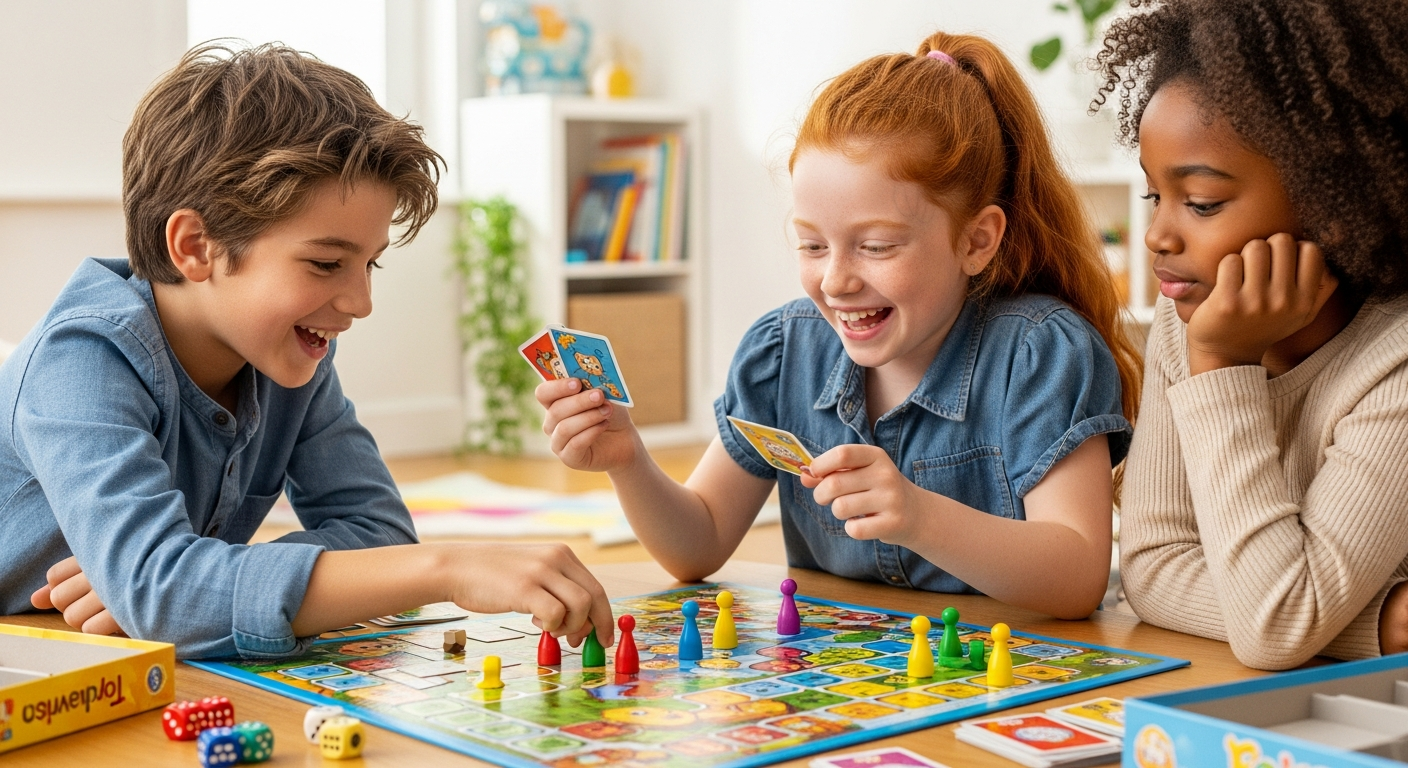
Table of Contents
- Introduction
- The Unseen Magic of Board Games for Child Development
- How Board Games Boost Speech & Language Skills
- Engaging Board Games for Early Language & Pre-Reading Development
- Games to Spark Conversation & Social Skills
- Board Games for Logic, Strategy, and Critical Thinking
- Math & STEM Games: Verbalizing Concepts and Building Foundations
- Maximizing the Impact: Adult Involvement is Key
- Speech Blubs: A Complement to Your Child's Learning Journey
- Unlock More with Speech Blubs: Our Value-Packed Yearly Plan
- Conclusion
- Frequently Asked Questions (FAQs)
Introduction
Imagine a quiet afternoon, filled not with the passive glow of a screen, but with the joyous clatter of dice, the focused furrow of brows, and the triumphant shouts of a child who just outwitted their parent. This isn't just a fantasy; it's the profound, everyday magic of board games. Beyond mere entertainment, board games are dynamic tools that sculpt young minds, nurture emotional intelligence, and, crucially, ignite the spark of communication. At Speech Blubs, we believe in empowering every child to "speak their minds and hearts," and we've seen firsthand how the right kind of play can be a powerful ally in that journey. In this post, we'll dive deep into the world of fun kids board games, exploring how these timeless treasures offer far more than just amusement – they provide fertile ground for cognitive development, social connection, and significant strides in speech and language skills. Get ready to discover how family game night can become a cornerstone of your child's developmental growth, seamlessly blending learning with laughter.

The Unseen Magic of Board Games for Child Development
In an age dominated by digital distractions, the humble board game might seem like a relic of the past, yet its developmental benefits are more relevant than ever. Board games offer a multi-sensory, interactive experience that digital-only platforms often can't replicate. They demand attention, encourage interaction, and celebrate shared experiences, transforming play into a powerful learning opportunity.
We often talk about "smart screen time" at Speech Blubs, distinguishing our active, engaging app experiences from passive viewing. Board games offer a similar kind of "smart play." Instead of simply consuming content, children actively participate, make decisions, and interact face-to-face. This direct engagement is crucial for fostering robust cognitive and social-emotional skills. From understanding rules to negotiating turns, predicting outcomes to managing frustration, board games are mini-laboratories for life skills. They create a rich context for families to connect, communicate, and grow together, aligning perfectly with our mission to support comprehensive child development. To learn more about our comprehensive approach to nurturing young learners, visit our Speech Blubs homepage.
How Board Games Boost Speech & Language Skills
While board games might not seem like explicit "speech therapy" tools, their inherent structure makes them incredibly effective for nurturing communication. Every roll of the dice, every card played, and every strategic move provides an opportunity for language practice and development.
Vocabulary Expansion
Many board games introduce new objects, places, actions, and concepts, naturally expanding a child's vocabulary. As they play, children learn to identify and name pieces, describe game scenarios, and understand instructions filled with new terms. For instance, a game about space travel might introduce words like "galaxy," "astronaut," or "orbit."
Storytelling & Narration
Games often have narratives or create them through gameplay. Children naturally describe their turns, predict what might happen next, or recount past plays. This helps them practice sequencing events, developing a plot, and using descriptive language – foundational skills for both verbal and written storytelling.

Following Instructions
Understanding and following multi-step instructions is a critical language skill. Board games are built on rules, requiring children to listen carefully, process information, and execute actions in a specific order. This directly strengthens auditory processing and receptive language skills.
Turn-Taking & Social Communication
Perhaps one of the most significant benefits for speech development is the explicit practice of turn-taking. Board games are inherently structured around waiting, listening, and then responding. This teaches children the rhythm of conversation, the importance of listening to others, and how to express their thoughts respectfully, all vital components of pragmatic language.
Problem-Solving & Critical Thinking
As children strategize and solve problems within a game, they often verbalize their thought processes. Encouraging them to explain why they made a certain move or how they plan to win helps them articulate complex ideas and use reasoning language.
Emotional Regulation
Game play isn't always smooth sailing. There will be wins and losses, moments of frustration and triumph. Board games provide a safe space for children to experience and express these emotions, learning to articulate their feelings, negotiate with others, and cope with setbacks. This emotional vocabulary is just as important as any other.
Engaging Board Games for Early Language & Pre-Reading Development
For our youngest learners, or those who are just beginning their speech journey, specific board games can lay crucial groundwork for language and pre-reading skills. These games focus on foundational concepts, repetition, and simple interactions.
Consider a parent whose 3-year-old is a "late talker," struggling with initial sounds or simple word recognition. Games that reinforce sound-to-picture associations or prompt simple verbal responses can be incredibly motivating.
- Zingo!: This "Bingo with a ZING!" game helps pre-readers and early readers recognize words and pictures. As cards are revealed, children shout out the matching word, building crucial connections between visual and auditory cues. It's fantastic for practicing common sight words and encourages quick word recognition.
- Rory's Story Cubes: These dice feature simple images. Children roll them and create a story using the pictures that land face-up. This is an unparalleled tool for fostering imaginative play, vocabulary expansion, and narrative skills. Even children with limited verbal output can point to pictures and vocalize sounds, while older children can craft elaborate tales. It truly encourages children to use their voices to create.
- Memory Games: Simple matching games, whether with pictures of animals, shapes, or everyday objects, are excellent for vocabulary and auditory memory. As a child flips cards, encourage them to name the items, describe their features, and articulate if they found a match. For instance, "I found the red car and the red car! They match!"
At Speech Blubs, we leverage a similar principle through our video modeling methodology. Just as children learn game rules and strategies through observation and interaction, our app helps them learn complex communication skills by watching and imitating their peers. This natural learning process makes acquiring new words and sounds fun and intuitive.
Games to Spark Conversation & Social Skills
As children grow, the focus shifts to developing more complex social communication skills, including expressing opinions, negotiating, and understanding different perspectives. These games are perfect for encouraging extended conversations and fostering social etiquette.
Imagine a child who is hesitant to speak up in group settings or struggles to express their feelings clearly. Games that prompt discussion and interaction can be wonderfully transformative.
- Apples to Apples Junior: This game is a fantastic icebreaker and vocabulary builder. Players match "description" cards to "noun" cards, often leading to hilarious and thought-provoking comparisons. It encourages descriptive language, explaining reasoning, and even a bit of playful persuasion, all while expanding vocabulary.
- Table Topics: Specifically designed to spark conversation, these cards feature a range of silly to profound questions. They provide a structured way for children to practice articulating their thoughts, listening to others' responses, and engaging in reciprocal dialogue without the pressure of a "winner."
- Cooperative Games (e.g., Forbidden Island, Flash Point Fire Rescue): In cooperative games, everyone works together against the game itself. This eliminates individual competition and fosters true teamwork and negotiation. Games like Forbidden Island (where players work to collect treasures from a sinking island) or Flash Point Fire Rescue (where players save people from a burning building) require constant verbal communication, shared strategizing, and mutual support. Children learn to articulate plans, offer suggestions, and listen to their teammates – invaluable social communication skills.
At Speech Blubs, our mission is to empower children to "speak their minds and hearts," providing a safe and engaging platform for them to practice and gain confidence. These types of games create real-world opportunities for that empowerment. To explore how our app can further support your child's social communication journey, we invite you to download Speech Blubs on the App Store or Google Play and discover features designed to build these vital skills.
Board Games for Logic, Strategy, and Critical Thinking
Beyond direct language practice, board games excel at cultivating logic, critical thinking, and strategic planning – cognitive abilities that are deeply intertwined with effective communication. A child who can think clearly can often articulate more clearly.
Consider a child who understands a concept but struggles to verbalize their problem-solving steps or explain cause-and-effect. These games encourage them to break down problems and articulate their reasoning.
- Mastermind: This classic code-breaking game challenges players to use deductive reasoning. One player creates a secret code, and the other tries to guess it through a series of logical deductions based on feedback. It forces children to articulate their hypotheses ("I think it's red, blue, green, yellow because...") and refine their strategies.
- Sequence for Kids: This simpler version of the adult game teaches logical sequencing and spatial awareness. Players aim to create a row of four chips by matching cards to spaces on the board. It encourages children to plan their moves ahead and explain their strategy ("If I put my chip here, then next turn I can get a sequence!").
- Catan Junior: A fantastic introduction to resource management and negotiation, this game involves collecting resources to build pirate lairs and ships. Children learn basic economics, strategic planning, and the art of trading with other players, which demands clear communication and persuasive language.
Developing strong cognitive skills through play can significantly reduce the frustration children might experience when facing communication challenges. When they can think through a problem, they are better equipped to find the words to express their solutions or questions. At Speech Blubs, we recognize that confidence in one area often spills over into others. Our app helps children build foundational speech skills, allowing them to better articulate their strategic thoughts and engage more fully in these stimulating games. If you're wondering if your child could benefit from targeted speech support, why not take our quick 3-minute preliminary screener? It involves 9 simple questions and provides an assessment and a next-steps plan, along with a free 7-day trial to experience our engaging approach.
Math & STEM Games: Verbalizing Concepts and Building Foundations
Math and STEM (Science, Technology, Engineering, and Mathematics) might seem far removed from speech development, but these games offer incredible opportunities for children to verbalize abstract concepts, explain their reasoning, and develop precise language.
Think about a child who understands math concepts intrinsically but struggles to explain their reasoning to a teacher or peer. These games provide a context for that verbalization.
- Monopoly / Monopoly Deal: Both versions, the classic board game and the quicker card game, are excellent for practicing money math, counting, and strategic financial planning. Children engage in buying, selling, and trading, requiring them to verbalize transactions, count money, and negotiate with others. Phrases like "I'll trade you this property for $500 and that utility" are rich with mathematical and economic vocabulary.
- Balance Beans: This brilliant game introduces pre-algebraic concepts in a fun, visual way. Players set up beans on a seesaw according to challenge cards, trying to keep it balanced. When balanced, they are essentially solving an equation. Encouraging children to explain how they balanced the seesaw ("I put two red beans on one side, and one purple bean on the other because it weighs the same") strengthens their ability to verbalize abstract mathematical relationships.
- Sushi Go!: This fast-paced card game reinforces strategic planning and probability. Players aim to collect the best combinations of sushi dishes to score points. Children must quickly assess their options and make decisions, often needing to justify their choices ("I'm taking the sashimi because I already have one, and I need two to score points!"). This practices rapid decision-making and verbalizing simple probability.
These games demonstrate that learning is holistic. The more a child engages their brain in different ways – through numbers, shapes, and strategy – the more robust their cognitive framework becomes, supporting all areas of development, including communication.
Maximizing the Impact: Adult Involvement is Key
For board games to truly unlock their potential for speech and language development, adult involvement is paramount. This isn't about "teaching" during play but rather about facilitating a rich, language-filled environment.
- Be an Active Participant: Don't just supervise; play with genuine enthusiasm. Your engagement signals that this activity is valuable and fun.
- Model Language: Use clear, descriptive language during your turn. Narrate your actions ("Now I'm going to roll the dice, and I landed on the blue space!").
- Ask Open-Ended Questions: Instead of "What do you do?", try "What's your plan for this turn?" or "Why did you choose that card?" This encourages more than a one-word answer.
- Encourage Storytelling: Prompt your child to describe their moves, recount what happened, or predict future events.
- Praise Effort, Not Just Wins: Focus on participation, good sportsmanship, and creative thinking, rather than solely on winning. This fosters a positive, low-pressure learning environment.
- Adapt Rules if Needed: For younger children or those with specific developmental needs, don't be afraid to simplify rules, play in teams, or even just focus on one aspect of the game (e.g., just rolling dice and moving pieces, without worrying about strategy).
- Connect to Real Life: Talk about how the skills learned in the game (like counting, sharing, or planning) relate to everyday situations.
When adults actively participate and thoughtfully guide the play, board games become powerful catalysts for development, transforming simple leisure into invaluable learning moments and cherished family memories.
Speech Blubs: A Complement to Your Child's Learning Journey
While board games offer incredible benefits, we understand that some children may need targeted support to help them along their speech and language journey. That's where Speech Blubs comes in. Our company was born from the personal experiences of our founders, who all grew up with speech problems and created the tool they wished they had. At Speech Blubs, our mission is to empower children to "speak their minds and hearts," providing an immediate, effective, and joyful solution for the 1 in 4 children who need speech support.
We blend scientific principles with play, creating one-of-a-kind "smart screen time" experiences that are far from passive viewing. Our unique approach utilizes video modeling methodology, where children learn complex communication skills by watching and imitating their peers. This natural, engaging process encourages active participation, boosts confidence, and reduces frustration, much like the positive interactions experienced during board game play. We are committed to fostering family connection and providing a powerful tool that complements the rich, hands-on learning you facilitate through activities like board games. Don't just take our word for it; see what other parents are saying about their child's success with Speech Blubs.
Unlock More with Speech Blubs: Our Value-Packed Yearly Plan
We believe in transparency and providing the best value to families. When you choose Speech Blubs, you're investing in your child's future, and we want to make that investment as rewarding as possible.
Our plans are designed to fit your family's needs:
- Monthly Plan: For $14.99 per month, you get access to our core Speech Blubs app.
- Yearly Plan: Our most popular and highly recommended option, priced at just $59.99 per year. This breaks down to an incredible value of just $4.99 per month, which means you save 66% compared to the monthly plan!
But the savings are just the beginning. The Yearly plan isn't just cheaper; it comes packed with exclusive, high-value features designed to supercharge your child's development:
- A 7-day free trial: Experience the full power of Speech Blubs before committing, risk-free.
- The extra Reading Blubs app: Double the fun and learning with our companion app focused on early reading skills.
- Early access to new updates: Be the first to enjoy new features and content as they are released.
- 24-hour support response time: Get prompt assistance whenever you need it, ensuring a smooth experience.
The Monthly plan does not include these fantastic benefits. We highly encourage you to choose the Yearly plan to get the free trial and the full suite of features that will provide the most comprehensive support for your child's communication journey. Create your account and begin your 7-day free trial today and make the smart choice for your child's development!
Conclusion
Board games are far more than just "fun kids games"; they are vibrant ecosystems of learning, connection, and growth. They offer an unparalleled opportunity to nurture crucial developmental skills, from vocabulary expansion and storytelling to critical thinking and emotional regulation, all within the warm embrace of family interaction. By integrating these playful challenges into your family routine and actively participating alongside your child, you're not just playing a game – you're building foundational skills, fostering confidence, and creating an environment where your child can truly begin to speak their minds and hearts.
Combine the joy of traditional board games with targeted, scientifically backed support, and watch your child flourish. We at Speech Blubs are here to walk alongside you on this journey, providing the innovative tools that empower children to communicate effectively and joyfully.
Ready to embark on a transformative adventure for your child's speech and language development? Don't miss out on the incredible value and exclusive features of our Yearly plan. Download Speech Blubs today on the App Store or Google Play and choose the Yearly plan to unlock your 7-day free trial, the bonus Reading Blubs app, and continuous support for your child's growth!
Frequently Asked Questions (FAQs)
1. Are board games really educational for young children?
Absolutely! Board games are incredibly educational. They naturally develop a wide range of skills including counting, color and shape recognition, problem-solving, strategic thinking, patience, and turn-taking. For language, they boost vocabulary, narrative skills, and the ability to follow instructions. They also teach children about winning and losing gracefully, fostering emotional regulation and resilience.
2. How can I adapt board games for my child who has speech delays?
Adapting games is key! Simplify rules, focus on one or two learning objectives, and play collaboratively rather than competitively. Encourage vocalizations by asking open-ended questions related to the game ("What color is that piece?"), narrating your actions, and modeling clear speech. You can also use visual cues, repeat key words, and allow for non-verbal responses like pointing. The goal is engagement and communication, not perfect play.
3. What if my child doesn't like competitive games?
Many children thrive in cooperative environments! Explore cooperative board games where everyone works together against the game itself to achieve a common goal. These games are fantastic for fostering teamwork, communication, and shared problem-solving without the pressure of individual wins or losses. They allow adults to gently guide and coach, which can be very beneficial for children developing communication skills.
4. How does Speech Blubs complement traditional play like board games?
Speech Blubs offers targeted, expert-designed support that seamlessly integrates with your child's overall learning journey. While board games provide a rich, natural environment for communication practice, Speech Blubs offers structured exercises for specific sounds, words, and language concepts using our engaging video modeling technique. It's a powerful "smart screen time" tool that fills the gaps, reinforces skills learned through play, and provides consistent practice, empowering children to "speak their minds and hearts" with confidence in all aspects of their lives.
About the author