
Simple & Fun Craft Ideas for Kids at School
 By Speech Blubs Team•Jan 13, 2026•20 min.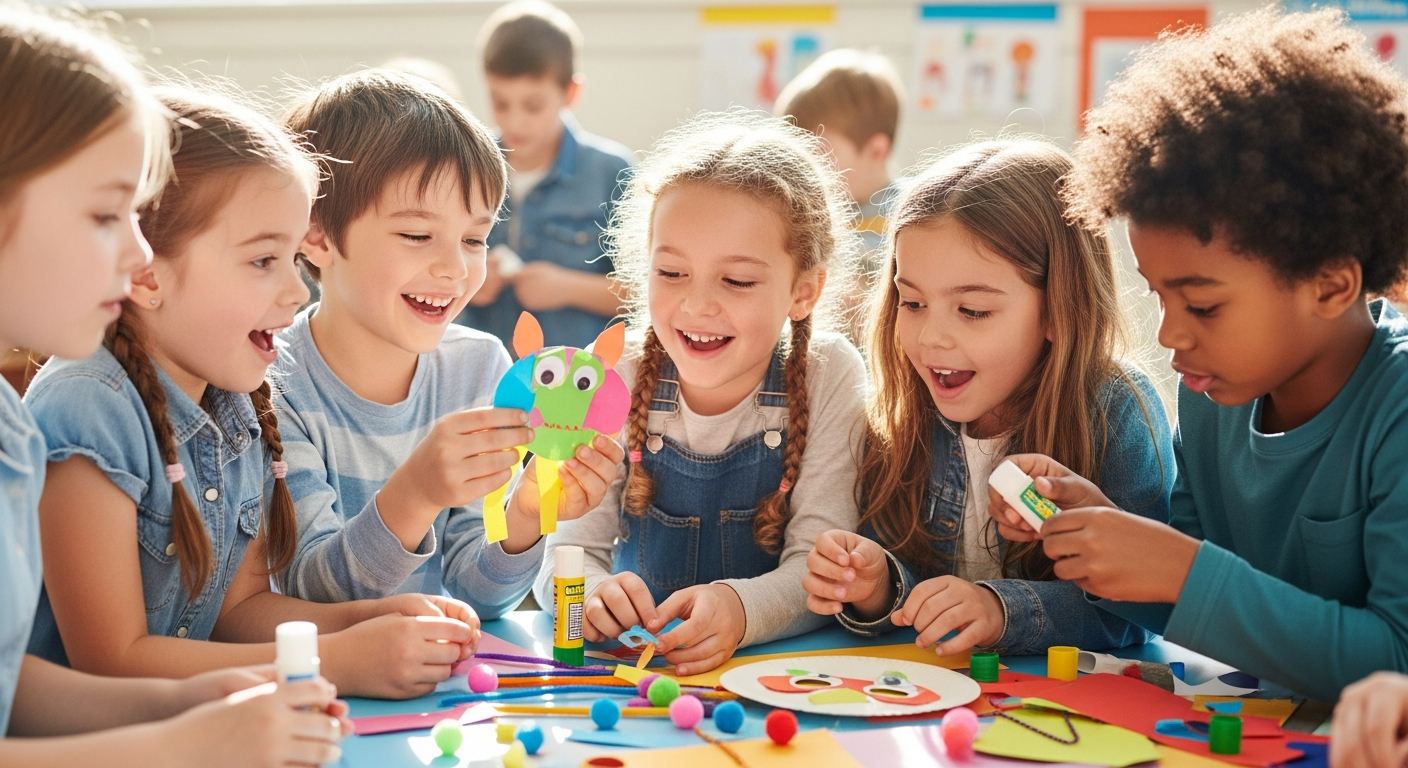
Table of Contents
- The Power of Playful Creation: Why Crafts Matter
- Essential Craft Supplies: Keeping it Simple and Sustainable
- Our Favorite Easy Craft Ideas for Every Young Learner
- Crafting for Communication: How Speech Blubs Can Help
- Making Craft Time a Family Connection Opportunity
- Unlocking Your Child's Potential with Speech Blubs: Our Commitment to Families
- Conclusion
- FAQ
Have you ever watched a child intently focused on gluing glitter onto a cardboard cutout, their tongue poking out in concentration? Or perhaps heard the proud announcement, "Look what I made!" accompanied by a beaming smile? These moments are more than just cute photo opportunities; they are windows into the powerful world of child development, where imagination, fine motor skills, and even language blossom. In a world increasingly dominated by screens, hands-on activities like crafting offer a vital avenue for children to explore, create, and communicate.
This blog post will delve into the incredible benefits of engaging children in easy, accessible craft ideas, perfect for both school and home environments. We'll explore how these simple projects can foster everything from cognitive growth to emotional expression. We'll also provide a wealth of practical, low-cost craft ideas using materials you likely already have. Most importantly, we'll uncover the often-overlooked connection between creative play and speech development, demonstrating how intentional crafting can significantly boost your child's communication skills and how a tool like Speech Blubs can seamlessly complement this journey. Our goal is to empower you with ideas and strategies to transform everyday materials into opportunities for joyful learning and meaningful communication.

The Power of Playful Creation: Why Crafts Matter
Crafting is often seen as mere entertainment, a way to keep little hands busy. While it certainly excels at that, its true value lies much deeper. Engaging in crafts is a holistic activity that nurtures a child's entire being, laying crucial foundations for their future learning and development. It's about empowering them to become active participants in their world, rather than passive observers.
Beyond the Mess: Developmental Benefits
Every snip of the scissors, every dab of glue, and every stroke of a crayon contributes to a rich tapestry of developmental gains.
Fine Motor Skills and Coordination
From gripping a paintbrush to threading beads, crafts are a fantastic workout for small hands and fingers. These activities refine fine motor skills, which are essential for tasks like writing, buttoning clothes, and even using utensils. When a child carefully places a pom-pom onto a paper plate, they are practicing hand-eye coordination and developing the dexterity needed for countless future activities. The precision required for cutting along a line or folding paper accurately builds muscle memory and control. These aren't just isolated skills; they are foundational for academic success and daily independence.
Cognitive Growth and Problem Solving
Crafts often present mini-challenges that encourage children to think creatively and solve problems. "How can I make this stick to that?" "What colors will look good together?" "How do I turn this flat piece of paper into a 3D animal?" These questions, big or small, stimulate critical thinking. Children learn about cause and effect, spatial reasoning, and sequence. They experiment with different materials and techniques, learning from their "mistakes" and adapting their approach. This iterative process of trying, failing, and trying again builds resilience and a growth mindset, invaluable traits for lifelong learning.
Emotional Expression and Confidence
Art is a powerful outlet for emotions. Children can express joy, frustration, curiosity, and imagination through their creations. A child who feels shy speaking up might pour their feelings into a vibrant drawing or a whimsical paper creation. The act of bringing an idea to life, from concept to completion, fosters a tremendous sense of accomplishment and pride. When parents celebrate their child's efforts and unique creations, it boosts self-esteem and encourages further exploration. This positive reinforcement builds confidence, not just in their artistic abilities, but in their capacity to create and contribute.

Language Development: A Hidden Gem
This is where crafts truly shine in ways many parents might not realize. Crafting offers a natural, low-pressure environment for language development. As children engage in crafts, they are constantly exposed to new vocabulary, from colors and shapes to action verbs ("cut," "glue," "fold," "draw") and descriptive adjectives ("shiny," "rough," "smooth"). Parents can narrate the process ("First, we'll cut the blue paper, then we'll glue it onto the round plate"), ask open-ended questions ("What are you making?" "Tell me about your alien!"), and encourage their child to describe their work. This conversational exchange expands vocabulary, strengthens comprehension, and improves narrative skills.
For children who might be hesitant to speak or are developing their speech at a slower pace, crafts provide a concrete focus for conversation. It's much easier to talk about the "red car" you just made than to simply invent a story from scratch. At Speech Blubs, we understand that empowering children to "speak their minds and hearts" begins with joyful and engaging experiences. Our app complements these hands-on activities by providing scientifically-backed "smart screen time" that focuses on clear speech models. Imagine a child creating a paper plate lion. When they want to practice the roaring sound or the word "lion," they can turn to Speech Blubs' "Animal Kingdom" section, where they'll see real children demonstrating the sounds and words, making imitation fun and effective. This blend of tactile play and targeted speech practice creates a powerful learning synergy.
Essential Craft Supplies: Keeping it Simple and Sustainable
You don't need a dedicated craft room or a fortune spent at the art supply store to unleash your child's creativity. Many of the most engaging crafts can be made with items you already have around the house or can easily acquire. The key is to start simple and build your collection gradually.
The Core Kit: What You Likely Already Have
Before you even think about heading to the store, take a look around. You might be surprised by the treasures you already possess.
- Paper: Construction paper in various colors, white printer paper, cardboard from old cereal boxes, paper plates, paper bags, newspaper. These are the canvases and building blocks for countless projects.
- Adhesives: Child-safe glue sticks, liquid school glue, tape (masking tape, clear tape).
- Cutting Tools: Kid-safe scissors. This is crucial for developing hand strength and coordination.
- Coloring Tools: Crayons, washable markers, colored pencils, tempera paint (washable is a lifesaver!).
- Recyclables: Toilet paper rolls, paper towel rolls, plastic bottles, bottle caps, egg cartons. These are fantastic for turning "trash" into treasure and teaching resourcefulness.
- Nature's Bounty: Leaves, twigs, pebbles, pinecones. A walk in the park can yield a wealth of free, inspiring craft materials.
With just these basic items, the possibilities are virtually endless. For a parent whose child is just beginning to explore communication, holding up a red crayon and saying "red" while coloring can be a powerful language lesson. Similarly, asking them to "pass the glue stick" encourages two-step instructions and object recognition.
Smart Additions: Boosting Creativity Without Breaking the Bank
Once you have your core kit, you might consider adding a few extra items that can elevate your crafts without significant investment.
- Googly Eyes: These instantly bring characters to life and add a touch of whimsy.
- Pom-poms: Great for adding texture, color, and practicing fine motor skills by gluing them on.
- Yarn or String: Useful for hanging crafts, creating hair for characters, or practicing weaving.
- Pipe Cleaners: Flexible and colorful, perfect for sculpting, attaching parts, or adding decorative elements.
- Stickers: Simple, instant gratification for younger children and great for practicing grasping and peeling.
- Sequins or Glitter: Use sparingly for a touch of sparkle, especially with older children. (A block of glitter glue can be less messy!)
Remember, the goal is not to accumulate vast quantities of supplies, but to have a versatile collection that sparks imagination. We encourage parents to think of these materials as tools for discovery and expression. For children who are developing their speech, describing these new textures and colors ("sparkly glitter," "fuzzy pom-pom," "bendy pipe cleaner") provides rich linguistic input and opportunities for descriptive language practice.
Our Favorite Easy Craft Ideas for Every Young Learner
Now for the fun part! Here’s a collection of simple, engaging craft ideas that are perfect for kids in a school setting or right at home. These projects are designed to be adaptable for various age groups and skill levels, ensuring that every child can experience the joy of creation.
Nature-Inspired Creations
Bringing the outdoors in fosters appreciation for nature and provides unique textures and forms.
- Leaf Rubbings & Collages: Gather leaves of different shapes and sizes. Place a leaf under a piece of paper and rub a crayon over it to reveal its intricate patterns. For a collage, glue collected leaves onto paper to create animals, landscapes, or abstract art. Benefits: Fine motor control, observation skills, vocabulary for nature elements.
- Rock Painting: Find smooth, flat rocks. Wash them thoroughly, then paint them with acrylics to create ladybugs, monsters, mandalas, or storytelling stones. Benefits: Creativity, color recognition, sharing stories through art.
- Twig Weaving: Use small twigs as a frame and weave yarn, string, or even strips of fabric through them. Benefits: Fine motor skills, pattern recognition, patience.
Paper Plate Wonders
The humble paper plate is an incredibly versatile and affordable craft material.
- Paper Plate Animals: Cut out shapes for ears, eyes, and noses from construction paper and glue them onto a paper plate to create lions, pigs, frogs, or even fantastical creatures. Paint or color the plate. Benefits: Shape recognition, imaginative play, animal sounds and names. For a child who loves animals, this is a perfect opportunity to use Speech Blubs. While creating a paper plate lion, they can practice saying "roar!" by watching the video models in our Animals Section.
- Paper Plate Masks: Cut eye holes in a paper plate, decorate with paint, markers, feathers, or glitter. Attach elastic or a popsicle stick handle. Benefits: Imaginative play, emotional expression (creating characters), self-expression.
- Paper Plate Donut: Paint a paper plate a donut color, cut out the center. Use small strips of colored paper or draw sprinkles to decorate. Benefits: Fine motor skills, color practice, understanding circles.
Recycled Art Adventures
Turning everyday discards into art teaches resourcefulness and environmental awareness.
- Toilet Paper Roll Characters: Transform empty toilet paper rolls into animals, superheroes, or tiny people by painting, gluing on paper features, and adding yarn hair. Benefits: Creativity, 3D construction, narrative play. For a child working on consonant-vowel combinations, making a "moo" cow or a "baa" sheep from a toilet paper roll can be paired with the direct sound imitation opportunities in Speech Blubs, strengthening those early sounds.
- Cereal Box Art: Cut open cereal boxes to use the plain cardboard inside for painting, drawing, or constructing small buildings. Benefits: Spatial reasoning, recycling awareness, building skills.
- Newspaper Kites or Hats: Fold and decorate newspaper to make simple kites or hats. Benefits: Following instructions, folding skills, imaginative play.
Storytelling Through Crafts
Crafts can be powerful prompts for verbal expression and narrative development.
- Handprint/Footprint Art: Create a "memory book" of handprint or footprint art. Turn a handprint into a turkey, a monster, or a bouquet of flowers. Benefits: Body awareness, creative expression, discussing growth and memories.
- DIY Bookmarks: Decorate strips of cardboard or heavy paper with drawings, stickers, or even yarn tassels. Benefits: Encourages reading, fine motor skills, personalization.
- Puppet Making: Use paper bags, socks, or popsicle sticks to create puppets. Then, put on a show! Benefits: Imaginative play, dramatic expression, storytelling, dialogue practice. This is especially fantastic for speech development, as children naturally use different voices and tones for their characters, stretching their vocal range and articulation.
Sensory Crafts
These crafts engage multiple senses, providing rich learning experiences.
- Easy Fake Snow: Mix baking soda and white conditioner (or shaving cream) for a soft, moldable "snow." Add glitter for sparkle. Benefits: Sensory exploration, texture vocabulary, imaginative play.
- DIY Playdough: Making playdough from scratch (flour, salt, water, cream of tartar, oil, food coloring) allows children to be involved in the creation process before the play. Benefits: Following a recipe, sensory exploration, fine motor skills through kneading and shaping.
- Textured Collages: Provide various materials like cotton balls, fabric scraps, sand, pasta, and leaves. Children glue them onto paper to create collages that are rich in tactile input. Benefits: Sensory discrimination, vocabulary for textures, abstract art.
These crafts are just a starting point. The real magic happens when you encourage your child to personalize, experiment, and talk about their creations. Every project is an opportunity for learning, laughter, and connection.
Crafting for Communication: How Speech Blubs Can Help
While hands-on crafts are invaluable for development, complementing them with targeted, engaging speech support can create an even more powerful impact. This is where Speech Blubs steps in, offering a unique blend of scientific methodology and playful "smart screen time."
Connecting Art & Words: Practical Scenarios
Consider these real-world scenarios where crafts and Speech Blubs can work together:
- For the "Late Talker" Who Loves Animals: A child who is hesitant to make sounds might be captivated by creating a colorful paper plate fish. As they glue on scales, you can talk about the "fish swimming" and "bubble sounds." Then, for focused practice, open Speech Blubs to the Animal Kingdom section to watch and imitate their peers saying "fish" or making a "splash" sound. The app's video modeling provides clear, motivating examples.
- For Expanding Descriptive Language: When a child makes a "monster" from a toilet paper roll, you can ask, "Is your monster spiky or fluffy? Does it have big eyes or little eyes?" After this creative conversation, you can use Speech Blubs sections focused on adjectives or body parts to reinforce these descriptive words through engaging activities.
- For Practicing Specific Sounds: If your child is working on the "s" sound, making a "snake" craft from a paper chain is perfect. You can emphasize the "s-s-s" sound of a snake. Then, reinforce this with Speech Blubs' pronunciation practice, which breaks down sounds and words, allowing children to record themselves and hear their progress.
These practical connections turn every craft session into a rich language-learning opportunity, seamlessly transitioning between hands-on play and targeted speech development.
"Smart Screen Time" with Speech Blubs: A Complementary Approach
We know parents are concerned about screen time. That's why at Speech Blubs, we've designed our app to be a screen-free alternative to passive viewing, making it a truly "smart screen time" experience. Our core methodology, video modeling, where children learn by watching and imitating their peers, is based on scientific principles. This active engagement contrasts sharply with passive entertainment like cartoons.
Our mission, born from the personal experiences of our founders who all grew up with speech problems, is to provide an immediate, effective, and joyful solution for the 1 in 4 children who need speech support. We combine scientific principles with play, creating a unique tool that feels like a game but delivers real developmental benefits. For parents seeking to understand more about the science behind our approach, you can explore our research page, which details our high MARS scale rating and methodology.
Speech Blubs acts as a powerful supplement to your child's overall development plan and, when applicable, professional therapy. It's designed to be a tool for family connection, encouraging parents to play and learn alongside their children, fostering a love for communication, building confidence, and reducing frustration.
When to Seek Extra Support: Recognizing Speech Development Needs
Sometimes, despite all the engaging activities and encouragement, you might still have concerns about your child's speech development. It's completely natural to wonder if your child is on track. That's why we offer a simple, helpful resource: our quick 3-minute preliminary screener. This involves just 9 simple questions and provides you with an assessment and next-steps plan. It’s a great, pressure-free way to gain some clarity and decide if further support, like exploring Speech Blubs, might be beneficial for your child.
Making Craft Time a Family Connection Opportunity
Crafting isn't just for children; it's a wonderful way for families to connect, create memories, and strengthen bonds. Your involvement is key to maximizing the developmental benefits.
Tips for Engaging Your Child in Crafting
- Be Present and Participate: Sit with your child, join in the activity, and show genuine interest in their creations. This models engagement and makes the experience more meaningful.
- Focus on the Process, Not Just the Product: Emphasize the joy of making and experimenting, rather than striving for perfection. Celebrate effort and creativity.
- Offer Choices (Within Limits): Instead of dictating every step, offer choices: "Would you like to use blue or green paper?" "Should we add glitter or pom-poms?" This gives children a sense of control and ownership.
- Talk, Talk, Talk: Narrate what you're doing, ask open-ended questions, and encourage your child to describe their work. This is where immense language development happens.
- Display Their Art: Showcase your child's creations. This validates their efforts and boosts their confidence, reinforcing their identity as a capable and creative individual.
- Keep it Low-Pressure: If your child isn't interested one day, don't force it. Keep the materials accessible and try again another time. The goal is enjoyment, not obligation.
For a family whose 4-year-old struggles with frustration during communication attempts, a calming craft session followed by focused practice within Speech Blubs can make a huge difference. The shared activity reduces pressure, and the app's encouraging interface helps them build confidence in a fun, non-judgmental way.
Unlocking Your Child's Potential with Speech Blubs: Our Commitment to Families
At Speech Blubs, we believe every child deserves the opportunity to speak their minds and hearts. Our commitment is to provide an immediate, effective, and joyful solution for families navigating the journey of speech development. We’ve poured our personal experiences and scientific expertise into creating a tool that truly makes a difference.
When you choose Speech Blubs, you’re not just getting an app; you’re joining a community dedicated to your child's growth. We offer flexible plans to suit your family’s needs, but we truly want to highlight the incredible value of our Yearly Plan.
Our Monthly Plan is available for $14.99 per month. However, for the best value and to unlock the full suite of features designed to accelerate your child's communication journey, we highly recommend our Yearly Plan for just $59.99 per year. That breaks down to an incredible $4.99 per month, allowing you to save 66% compared to the monthly option!
The Yearly Plan isn't just about savings; it comes with exclusive, high-value benefits that are essential for a comprehensive and enriching experience:
- A 7-day free trial: Experience the full power of Speech Blubs before committing.
- The extra Reading Blubs app: An invaluable tool to support early literacy skills, complementing speech development.
- Early access to new updates: Be among the first to explore new features and content.
- 24-hour support response time: Get prompt assistance whenever you need it.
Please note that the Monthly Plan does not include these fantastic benefits. We believe that consistent engagement over time yields the best results, and the Yearly Plan is designed to support that commitment by offering more value and more tools for your child's success.
Ready to embark on a joyful journey of communication and creativity with your child?
Conclusion
Easy craft ideas offer far more than just a way to pass the time; they are powerful catalysts for your child's holistic development. From strengthening fine motor skills and boosting cognitive abilities to fostering emotional expression and, crucially, enriching language development, crafting provides a rich, hands-on learning experience. By embracing simple, accessible materials and encouraging active participation, parents can transform everyday moments into opportunities for growth, connection, and joyful discovery.
When combined with innovative tools like Speech Blubs, which provides "smart screen time" through video modeling and targeted speech practice, the impact is even greater. We are committed to empowering children to "speak their minds and hearts" by blending scientific principles with playful activities.
Don't let another day pass without exploring the incredible potential of creative play. Take the first step towards unlocking your child's communication potential today! Start your free 7-day trial and experience the full range of features designed to help your child thrive. Download Speech Blubs on the App Store or Google Play, or create your account and begin your journey on our website. Remember to choose the Yearly Plan during sign-up to gain access to your free trial, the extra Reading Blubs app, and exclusive benefits that provide the very best value for your child's development.
FAQ
Q1: How do easy craft ideas specifically help with speech development?
A1: Easy craft ideas are fantastic for speech development because they provide concrete subjects for conversation. As children create, they learn new vocabulary (colors, shapes, textures, action verbs like "cut," "glue"), practice following instructions, and have a natural context to describe their work, ask questions, and share their ideas. This interactive process stimulates language use in a fun, low-pressure way. When paired with Speech Blubs, children can practice specific words and sounds related to their crafts by imitating peers through video modeling, reinforcing their verbal skills.
Q2: My child isn't interested in crafts. How can I encourage them?
A2: If your child isn't initially interested, try starting with very simple, low-mess projects that have an immediate, satisfying result, like sticker collages or drawing with fun markers. Offer choices to give them a sense of control ("Do you want to paint or draw today?"). Most importantly, join in and make it a shared, joyful experience without pressure. Focus on the process of creation rather than the end product, and celebrate their efforts no matter how small. Keep materials easily accessible, and don't force it; sometimes a child just needs to see you enjoying it first.
Q3: When should I be concerned about my child's speech, and how can Speech Blubs help?
A3: It's natural for parents to have questions about their child's speech development. If you notice your child isn't meeting typical speech milestones for their age, has difficulty being understood, or seems frustrated when trying to communicate, it's a good idea to seek guidance. Our quick 3-minute preliminary screener is a great starting point, offering a simple assessment and next steps. Speech Blubs then provides engaging, scientifically-backed activities using video modeling to help children learn sounds, words, and sentences by imitating their peers, complementing any professional therapy or early intervention efforts.
Q4: What makes Speech Blubs different from other educational apps for kids?
A4: Speech Blubs stands out because it's built on a foundation of scientific principles, particularly video modeling, where children learn by actively imitating real children, not just animations. This makes learning social and engaging. Our app is not passive screen time; it's "smart screen time" designed to be an active learning tool that fosters communication, confidence, and family connection. Born from the personal experiences of our founders who faced speech challenges, our mission is deeply personal: to empower children to "speak their minds and hearts." We also offer unique features like the extra Reading Blubs app and dedicated support with our Yearly Plan, providing comprehensive value. You can learn more about our unique approach on our homepage.
About the author