
Snowy Fun: Easy Winter Paper Crafts for Kids
 By Speech Blubs Team•Jan 13, 2026•18 min.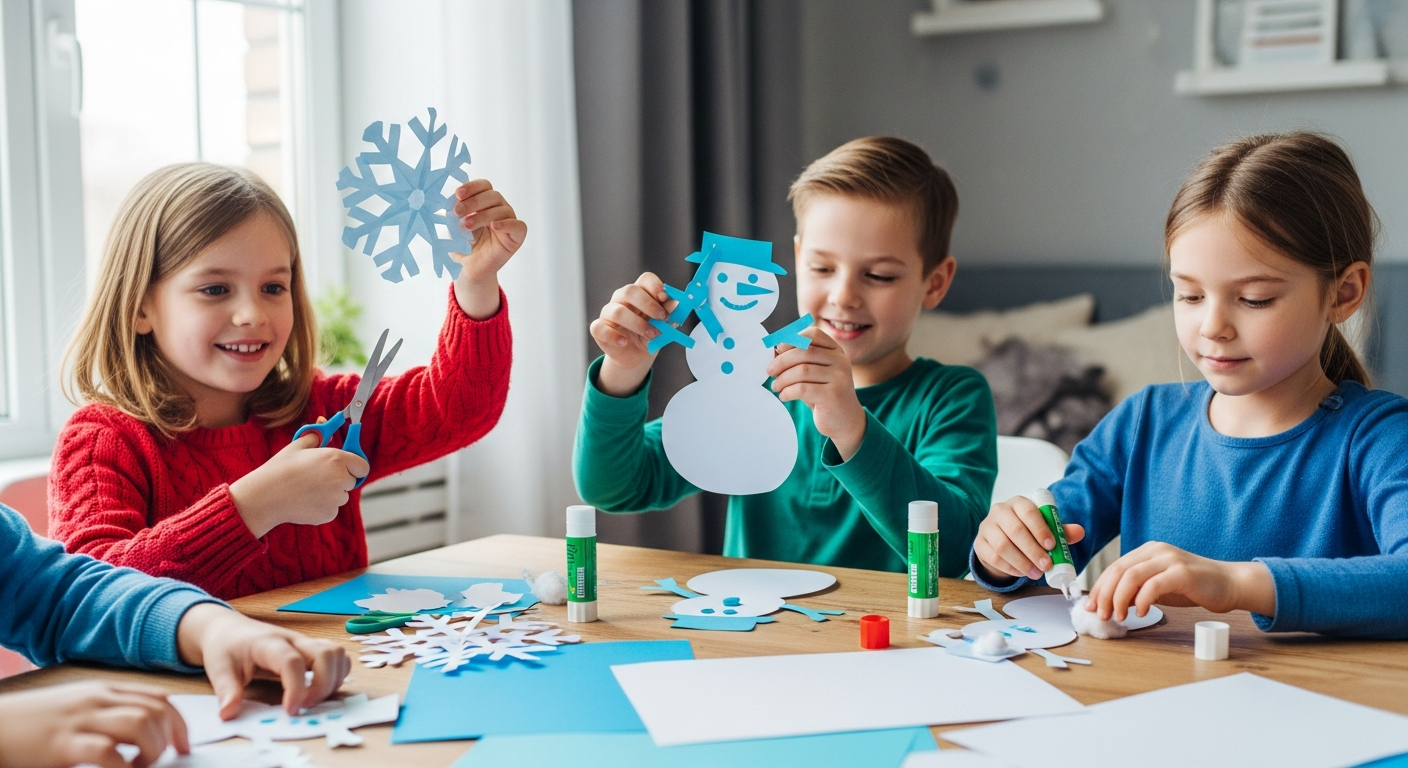
Table of Contents
- The Unseen Magic: How Paper Crafts Boost Child Development
- Gearing Up for Crafting Fun: Essential Supplies
- Our Top Easy Winter Paper Crafts for Kids (with Communication Boosters!)
- Integrating Speech Blubs into Your Crafting Journey
- Choosing the Right Craft for Your Child's Age and Stage
- Troubleshooting Common Crafting Challenges
- Taking Your Child's Speech Development Further
- Conclusion
- FAQ
As the temperatures drop and crisp air fills our mornings, there's a unique magic that settles in during the winter months. For many families, this season brings cozy evenings, warm drinks, and, perhaps, a bit more indoor time. While snuggling up with a good book or movie is always a treat, it's also a fantastic opportunity to ignite creativity and foster crucial developmental skills in our children. What better way to embrace the chilly season than by diving into the wonderful world of easy winter paper crafts?
You might think of paper crafts as just a fun way to pass the time, but as child development experts, we know they offer a treasure trove of benefits, especially for communication and early learning. From strengthening tiny fingers to sparking imaginative storytelling, these activities are far more than just "craft time." They are powerful platforms for growth, expression, and invaluable family connection. In this comprehensive guide, we'll explore a variety of simple paper crafts perfect for kids of all ages, delve into the hidden developmental advantages of each, and show you how to seamlessly integrate these joyful activities into your child's speech and language journey. Get ready to transform ordinary paper into extraordinary memories and meaningful learning moments this winter!

The Unseen Magic: How Paper Crafts Boost Child Development
Before we jump into the glue and glitter, let's unpack why these seemingly simple paper projects are so incredibly valuable for growing minds and developing voices. Crafting engages multiple areas of a child's brain, laying foundational groundwork for everything from academic success to confident self-expression.
Nurturing Fine Motor Skills and Pre-Writing Readiness
Every snip of the scissors, every careful fold, and every dab of glue is a workout for small hands. These actions require precision, coordination, and strength in the tiny muscles of the fingers and wrists. This isn't just about making a pretty snowflake; it's about developing the dexterity essential for:
- Holding a pencil: The grip needed for cutting and folding translates directly to a proper pencil grasp, making future writing tasks much easier.
- Buttoning clothes and tying shoes: Everyday self-care tasks rely on the same fine motor control refined through crafting.
- Oral motor control: Believe it or not, the fine motor skills in the hands are connected to the muscles used for speech production. Developing one often supports the other, enhancing overall muscular coordination.
Sparking Cognitive Growth: Problem-Solving and Sequencing
Crafting is a series of mini-challenges, each requiring thought and planning. Children learn to:
- Follow instructions: Whether verbal or visual, understanding and executing steps in a sequence ("first fold, then cut") is a critical cognitive skill.
- Problem-solve: What happens if the glue doesn't stick? How can I make this shape? These small hurdles encourage creative thinking and adaptation.
- Spatial reasoning: Visualizing how a 2D piece of paper will transform into a 3D object helps children understand spatial relationships, a key concept for math and science.
Unlocking Language and Communication Through Play
This is where the magic truly aligns with our mission at Speech Blubs. Paper crafts are dynamic communication opportunities waiting to happen. As children craft alongside an adult or peers, they naturally engage in:

- Descriptive Language: "What color paper should we use?" "This glitter is so sparkly!" "The snowman has a bumpy nose." They learn to articulate observations about colors, shapes, textures, sizes, and actions.
- Vocabulary Building: Introducing new words like "crease," "overlap," "fringe," "decorate," "template," "assemble." Imagine making a polar bear craft and discussing words like "arctic," "fur," "paws," and "cold."
- Sequencing and Storytelling: Describing the steps of the craft ("First, we cut the circle. Next, we glue the eyes.") builds narrative skills. Later, they can tell stories about their creations – "My snowman is going to visit the North Pole!"
- Asking and Answering Questions: "Can you pass the glue?" "What's next?" "Why did you choose that color?" This fosters conversational turn-taking and strengthens question formation and comprehension.
- Expressing Emotions: The pride of a finished project, the frustration of a miscut piece, or the excitement of a new idea – all provide opportunities to label and discuss feelings.
- Joint Attention: Both adult and child focusing on the same object or activity, like a paper snowflake, is crucial for early language development. It creates a shared experience and context for communication.
At Speech Blubs, our mission is to empower children to "speak their minds and hearts," and we believe that enriching, play-based activities like paper crafting are fundamental to this. Our company was born from the personal experiences of our founders, who all grew up with speech problems and created the tool they wished they had. We are committed to providing an immediate, effective, and joyful solution for the 1 in 4 children who need speech support, blending scientific principles with play into one-of-a-kind "smart screen time" experiences. These hands-on crafts are a perfect complement to our approach, offering a screen-free alternative to passive viewing and a powerful tool for family connection.
Gearing Up for Crafting Fun: Essential Supplies
You don't need a professional art studio to enjoy paper crafts. Many items are likely already in your home! Here’s a basic list to get your winter crafting nook ready:
- Paper, Paper, and More Paper: Construction paper (various colors), white printer paper, cardstock, paper plates, even old magazines or newspaper for tearing.
- Kid-Safe Scissors: Crucial for developing those fine motor skills.
- Glue: Glue sticks (less mess!), white school glue, or even a small amount of hot glue (for adult use only, for quick fixes).
- Drawing & Coloring Tools: Crayons, markers, colored pencils, paint (tempera or watercolors).
- Embellishments: Cotton balls, pom-poms, googly eyes, glitter, stickers, pipe cleaners, buttons, ribbons.
- Recycled Items: Toilet paper rolls, paper bags, cardboard scraps.
- Work Surface Protection: An old tablecloth or newspaper to protect your table.
Always supervise children, especially with scissors and glue, ensuring a safe and enjoyable crafting experience.
Our Top Easy Winter Paper Crafts for Kids (with Communication Boosters!)
Let’s get those hands busy! Here are some fantastic, easy winter paper crafts, each paired with specific ideas to boost your child’s speech and language development.
1. Classic Paper Snowflakes: A Winter Wonderland of Words
The timeless paper snowflake is a true winter classic. Every fold and snip yields a unique design, making each creation a delightful surprise.
How to Make Them:
- Start with a square piece of paper.
- Fold it diagonally to make a triangle.
- Fold the triangle in half again to make a smaller triangle.
- Fold it one more time, bringing one pointed end to meet the other, creating an even smaller, narrower triangle.
- Trim the wide edge into a rounded or pointed shape.
- Cut small shapes (triangles, half-circles, squares) from the folded edges, avoiding the center crease.
- Slowly unfold to reveal your unique snowflake!
- Decorate with glitter, paint, or markers if desired.
Speech & Language Boosters:
- Action Verbs & Sequencing: "Fold," "cut," "snip," "unfold," "reveal," "decorate." Use sequencing words: "First, we fold. Next, we cut. Then, we unfold."
- Descriptive Language: "Pointy," "round," "jagged," "symmetrical," "delicate," "sparkly." "What kind of shape did you cut?"
- Comparative Language: "This one is bigger/smaller," "Mine has more points than yours."
- Cause & Effect: "If we cut a big hole, what do you think will happen when we unfold it?"
- Emotional Expression: "Wow! Look how beautiful your snowflake is!" "Are you surprised by how it turned out?"
2. Adorable Paper Snowmen: Building Language, Piece by Piece
From simple cut-and-paste snowmen to those with personalized touches, these frosty friends are perfect for practicing shapes and body parts.
How to Make Them (Simple Cut & Paste):
- Cut three white circles of varying sizes (large, medium, small) from paper.
- Glue the largest circle at the bottom of a blue or black piece of construction paper, then the medium, then the smallest on top.
- Cut out smaller pieces for facial features (orange triangle for nose, black circles for eyes/mouth, small buttons).
- Add stick arms, a hat, and a scarf using construction paper scraps.
- Optional: Glue cotton balls for a fluffy snowman, or add a photo of your child's face for a personal touch.
Speech & Language Boosters:
- Body Parts & Attributes: "Head, body, nose, eyes, mouth, buttons, arms, hat, scarf." Discuss their colors and shapes: "a big red scarf," "three small black buttons."
- Size Concepts: "Big, medium, small." "Which circle is the biggest?"
- Positional Words: "On top," "in the middle," "at the bottom."
- Storytelling & Pretend Play: "What is your snowman's name? Where does he live? What does he like to do?"
- Functional Language: "Can you hand me the glue stick?" "I need the orange paper."
For a child who is expanding their vocabulary related to sizes and body parts, making a snowman provides immediate context. You can then reinforce these concepts by using Speech Blubs, where our "Animal Kingdom" or "Yummy Time" sections use video modeling to help children imitate and practice words for different parts and attributes. Download Speech Blubs on the App Store or Google Play to explore fun, interactive ways to build vocabulary.
3. Handprint Polar Bears & Penguins: Animal Sounds & Articulation
Creating animal crafts using handprints is a delightful way to engage young children and connect art to animal sounds and names.
How to Make Them:
- Polar Bear: Trace your child's hand on white cardstock. Cut it out. Use the thumb as the snout. Add googly eyes, a black pom-pom for the nose, and draw a mouth. You can glue it onto a blue background and add cotton balls for snow.
- Penguin: Trace your child's hand on black cardstock. Cut it out. Cut a white oval for the belly and glue it on. Add googly eyes, an orange triangle for the beak, and orange feet.
Speech & Language Boosters:
- Animal Names & Sounds: "Polar bear," "penguin." Practice animal sounds ("roar," "waddle, waddle") or words associated with them ("brrr" for cold, "fish" for penguin food).
- Body Parts (Human & Animal): "Hand, finger, thumb, paw, wing, beak, eyes, nose." "My hand makes the bear's body!"
- Action Verbs: "Trace," "cut," "glue," "waddle," "swim."
- Descriptive Words: "Fluffy," "white," "black," "orange," "cold," "cute."
- Repetitive Phrases: "Here comes the polar bear!" "Waddle, waddle, waddle."
For a parent whose 3-year-old 'late talker' loves animals, making a handprint polar bear or penguin offers a fun, motivating way to practice "cold" or animal sounds. Afterward, they can transition to the "Animal Kingdom" section of Speech Blubs, where children learn by watching and imitating their peers, reinforcing those new words and sounds. Our unique "video modeling" methodology is scientifically proven to be highly effective.
4. Folded Paper Icicles: Concepts of Length and Texture
These elegant hanging decorations are surprisingly simple to make and offer great opportunities to discuss physical attributes.
How to Make Them:
- Cut strips of light blue, white, or silver paper (about 1-inch wide).
- Fold each strip accordion-style, or simply curl it around a pencil.
- Glue or tape the top of the strip to a piece of string or yarn.
- Decorate with glitter, puffy paint, or markers to add sparkle.
Speech & Language Boosters:
- Concept Words: "Long," "short," "straight," "curvy," "sparkly," "dull," "smooth," "bumpy." "Let's make a long icicle!"
- Action Verbs: "Cut," "fold," "curl," "hang," "glue."
- Prepositions: "Hang from the ceiling," "put on the window."
- Sequencing: "First, we cut the strip. Next, we fold it."
- Sensory Language: "Feel how smooth the paper is," "Look at the glittery shine!"
5. Paper Bag Luminaries: Light and Dark Concepts
These simple luminaries create a warm, inviting glow, perfect for discussing light, dark, and feelings.
How to Make Them:
- Decorate plain white or brown paper bags with winter designs (snowflakes, stars, trees) using markers, glitter, or paper cut-outs.
- Punch holes with a star-shaped hole punch or regular hole punch to let light through.
- Place a battery-operated tea light inside each bag. Never use real candles!
Speech & Language Boosters:
- Opposites & Concepts: "Light/dark," "bright/dim," "inside/outside," "up/down."
- Descriptive Words: "Warm," "cozy," "glowing," "soft," "sparkling."
- Emotional Language: "These lights make me feel cozy/happy."
- Predicting: "What do you think will happen if we turn off the room lights?"
6. Birch Tree Tape Resist Art: Artistic Exploration and Vocabulary
Tape resist art is a fantastic way for children to explore negative space and different textures, while also creating beautiful, unique pieces.
How to Make Them:
- Place strips of painter's tape vertically on a piece of white or light-colored construction paper to create "birch tree" trunks and branches.
- Using sponges or paintbrushes, paint over the entire paper with acrylic or tempera paint in winter colors (blues, grays, purples, greens). You can add splotches of darker brown or black for tree bark texture.
- Let the paint dry completely.
- Carefully peel off the painter's tape to reveal the white "birch trees" underneath.
Speech & Language Boosters:
- Color Names & Mixing: "What happens if we mix blue and white?" "Let's use light blue and dark blue."
- Action Verbs: "Tape," "paint," "press," "peel," "reveal," "mix," "dry."
- Texture Words: "Smooth" (tape), "rough" (bark), "wet" (paint), "dry" (paper).
- Spatial Concepts: "Over," "under," "around," "between." "Paint around the tape."
- Describing Process: "Tell me how you made your birch trees."
Integrating Speech Blubs into Your Crafting Journey
While hands-on activities are essential, Speech Blubs offers a powerful complement, turning screen time into "smart screen time." Here's how our app can enhance your child's developmental journey alongside these fun crafts:
- Reinforcing Vocabulary: Just made a polar bear? Head to the "Animal Kingdom" section of Speech Blubs to practice animal names and sounds with engaging peer models. Crafted a colorful snowflake? Explore the "Colors" or "Shapes" sections to solidify those concepts.
- Video Modeling for Imitation: Our unique approach leverages the power of video modeling, where children learn by watching and imitating the facial movements and sounds of their peers. This is especially helpful for children who struggle with articulation or producing new sounds.
- Active Engagement: Unlike passive cartoons, Speech Blubs requires active participation. Children mimic, practice, and respond, fostering crucial communication skills. This aligns perfectly with the active engagement of crafting.
- Building Confidence: Successfully completing a craft gives children a sense of accomplishment. Similarly, mastering new words and sounds in Speech Blubs builds communication confidence, empowering them to "speak their minds and hearts" in all aspects of life.
- Family Connection: Both crafting and Speech Blubs are designed for interactive use. Our app provides conversation starters and opportunities for parents to engage directly with their child, strengthening bonds while learning.
Many parents wonder if their child could benefit from extra speech support. If you're unsure, take our quick 3-minute preliminary screener. It involves 9 simple questions and provides an assessment along with a personalized next-steps plan. It's a great starting point for parents seeking guidance.
Choosing the Right Craft for Your Child's Age and Stage
The beauty of paper crafts is their adaptability. Here's a general guide to help you select activities appropriate for your child:
Toddlers (1-3 years old)
- Focus: Exploration, sensory experience, gross motor skills, simple cause-and-effect.
- Activities: Tearing paper, crumpling paper, sticking large stickers, gluing large pre-cut shapes, finger painting (with paper).
- Supervision: High. Prioritize safety with non-toxic materials.
- Speech Tips: Focus on single words, sound effects, action verbs ("tear," "stick," "glue"), and naming colors/objects.
Preschoolers (3-5 years old)
- Focus: Developing fine motor skills, following 1-2 step instructions, naming shapes/colors, expressing preferences.
- Activities: Simple cutting with kid-safe scissors, folding paper in half, decorating pre-made shapes, using glue sticks, making simple collages.
- Supervision: Moderate to high, depending on the activity.
- Speech Tips: Encourage descriptive language, sequencing ("first, next"), asking "wh-" questions ("What are you making?"), and expanding sentences.
Early Elementary (5-8 years old)
- Focus: Refining fine motor skills, following multi-step instructions, independent work, creative expression, planning.
- Activities: More intricate cutting, accordion folding, creating 3D elements, designing their own patterns, combining multiple materials.
- Supervision: Moderate.
- Speech Tips: Engage in storytelling about their craft, discuss problem-solving ("How can we fix this?"), encourage detailed descriptions, and use comparative language.
Always remember, the process is more important than the product. Celebrate their effort and creativity, no matter the outcome.
Troubleshooting Common Crafting Challenges
Crafting with kids can be messy, unpredictable, and sometimes frustrating for both child and parent. Here are a few tips:
- Embrace the Mess: Lay down newspaper or an old tablecloth. Remind yourself that mess often equals engagement and learning.
- Manage Frustration: If your child is struggling, offer help without taking over. Break down steps into smaller chunks. "Let's try just one cut first." Sometimes, a break is all that's needed.
- Lack of Interest: Don't force it. If a child isn't interested in a particular craft, try another time or a different activity. Connect the craft to something they already love (e.g., if they love animals, do an animal craft).
- Expecting Perfection: Gently guide them to focus on having fun and trying their best, rather than achieving a "perfect" result. Their unique creation is special because they made it.
At Speech Blubs, we understand that every child's journey is unique, and sometimes progress isn't linear. Our approach is designed to be a supportive tool, complementing your efforts and professional guidance. We believe in providing realistic expectations: fostering a love for communication, building confidence, reducing frustration, developing key foundational skills, and creating joyful family learning moments. We are proud of the science behind our method and our high MARS scale rating. You can learn more about our research and methodology here.
Taking Your Child's Speech Development Further
While paper crafts are a wonderful starting point, consistent engagement in a variety of activities is key for robust speech and language development. Beyond crafting, remember to:
- Read Together Daily: Point to pictures, ask questions, discuss the story.
- Engage in Conversational Play: Talk about what your child is doing, thinking, and feeling during everyday activities.
- Limit Passive Screen Time: Choose interactive, educational apps like Speech Blubs over passive viewing.
- Seek Professional Advice: If you have concerns about your child's speech, consult with a pediatrician or speech-language pathologist.
At Speech Blubs, we are committed to being a partner in your child's journey. We hear incredible stories from parents every day about the progress their children are making. Read what other parents are saying about their child's success with Speech Blubs. Our app helps bridge the gap, providing immediate, accessible support that children genuinely enjoy.
Conclusion
This winter, transform those chilly indoor days into vibrant opportunities for creativity, connection, and communication. Easy winter paper crafts for kids offer a playful, low-cost, and highly effective way to stimulate fine motor skills, cognitive development, and, most importantly, speech and language. From the joyful unfolding of a paper snowflake to the careful construction of a paper snowman, each activity is a step forward in your child's developmental journey.
By engaging in these activities, you're not just making pretty decorations; you're building a foundation for confident communication, reducing frustration, and fostering a lifelong love for learning and self-expression. Pair these hands-on moments with the "smart screen time" provided by Speech Blubs, and you create a comprehensive environment where your child can truly thrive.
Ready to embark on a journey of playful learning and empower your child to speak their minds and hearts?
Start your 7-day free trial today!
When you sign up, be sure to choose our Yearly plan for the best value! For just $59.99 per year (that's only $4.99/month!), you'll save 66% compared to the Monthly plan ($14.99/month). The Yearly plan includes your 7-day free trial, the extra Reading Blubs app, early access to new updates, and a 24-hour support response time. The Monthly plan does not include these incredible benefits, so choose Yearly to unlock the full suite of features and maximize your child's learning.
Download Speech Blubs on the App Store or Google Play Store now and bring the magic of speech development into your home!
FAQ
Q1: What age are these easy winter paper crafts suitable for?
A: Many paper crafts are adaptable for a wide range of ages. Toddlers (1-3) can enjoy tearing and crumpling, preschoolers (3-5) can practice simple cutting and gluing, and early elementary children (5-8+) can tackle more intricate designs and independent projects. We've provided specific age-appropriate tips within the blog post to help you choose.
Q2: How do paper crafts specifically help with speech development?
A: Paper crafts boost speech development by enhancing fine motor skills (which connect to oral motor control), building vocabulary through descriptive language, improving sequencing and storytelling abilities, encouraging question-asking and answering, and fostering emotional expression and joint attention during co-play. All of these contribute to stronger communication foundations.
Q3: What if my child gets frustrated during a craft?
A: Frustration is a normal part of learning. If your child gets frustrated, offer gentle assistance without taking over the task. Break down the steps, simplify the activity, or suggest taking a short break. The goal is to make it an enjoyable experience, so focusing on the process rather than a perfect outcome is key.
Q4: How can Speech Blubs enhance our crafting time?
A: Speech Blubs acts as a powerful complement to hands-on crafting. After making an animal craft, you can reinforce new vocabulary and sounds in Speech Blubs' "Animal Kingdom" section. The app's video modeling methodology helps children imitate sounds and words, while its interactive nature reinforces active engagement, building confidence and making screen time productive and fun.
About the author