
Solving Fun: Mystery Party Games for Kids
 By Speech Blubs Team•Jan 28, 2026•22 min.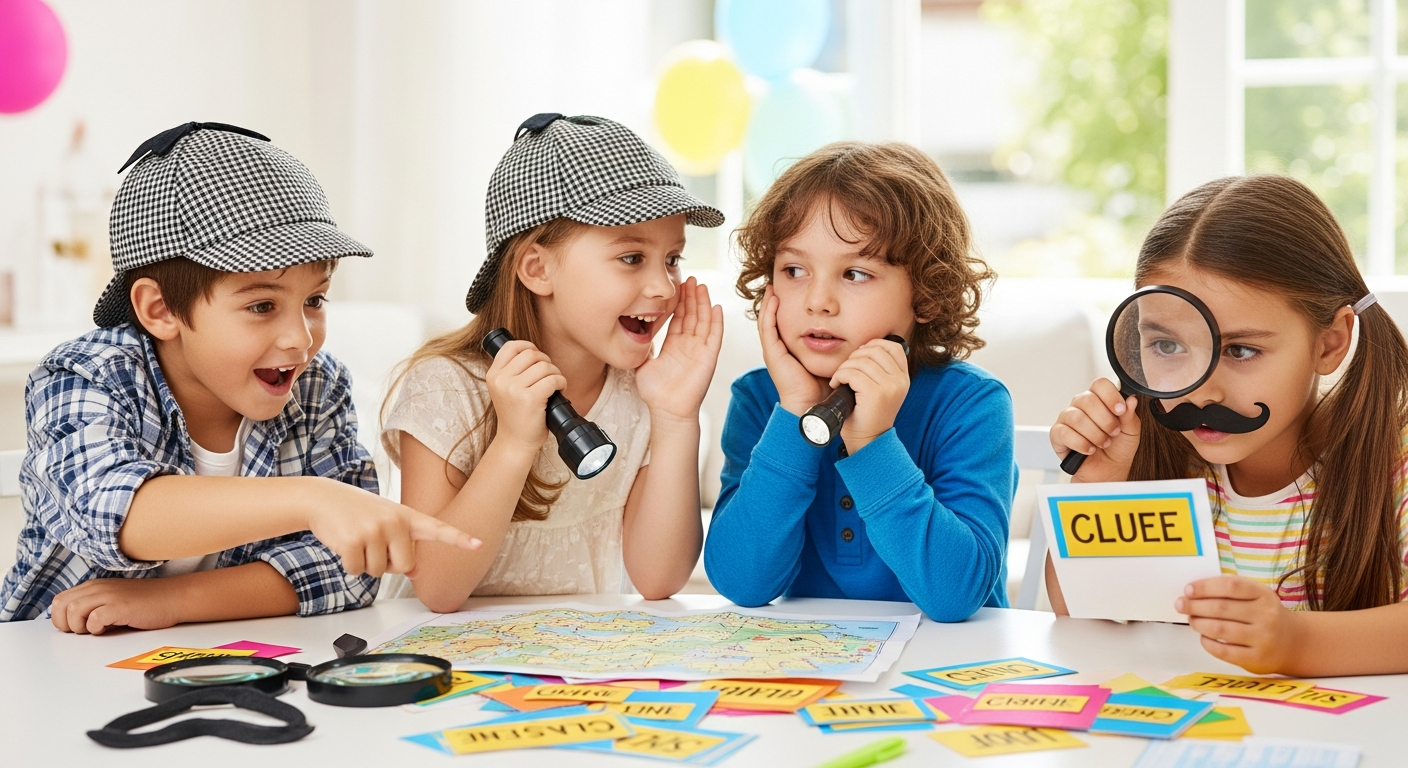
Table of Contents
- What Are Mystery Party Games for Kids?
- Why Host a Mystery Party for Kids? The Hidden Benefits
- Choosing the Perfect Mystery Game for Your Child
- Planning Your Unforgettable Kid's Mystery Party
- Becoming the Master of Mystery: Hosting Tips
- Weaving Communication and Learning into Play
- Diving into Specific Mystery Party Game Ideas
- The Speech Blubs Advantage: Building Foundational Communication
- Conclusion
- FAQ
Ever watched your child get lost in a world of make-believe, weaving intricate stories with their toys and friends? That innate curiosity and imaginative spirit are precisely what make mystery party games for kids such a powerful and engaging experience. Far from just simple entertainment, these immersive adventures transform an ordinary gathering into a thrilling quest for clues, encouraging children to think critically, communicate effectively, and collaborate as a team.
In this comprehensive guide, we'll delve into the magic of mystery party games, exploring not only how to plan and host an unforgettable event, but also the incredible developmental benefits they offer. We'll show you how these games foster vital communication skills, from active listening and verbal expression to problem-solving and social interaction. Our aim is to equip you with everything you need to spark your child's inner detective, creating joyful learning moments and building confidence along the way. These immersive experiences are not just about finding a culprit; they're powerful catalysts for language development, critical thinking, and social growth, all while creating unforgettable memories.

What Are Mystery Party Games for Kids?
At their core, mystery party games for kids are interactive storytelling adventures where children assume the roles of characters to solve a central enigma. Unlike passive entertainment, these games require active participation, critical thinking, and social engagement. The "mystery" can range from finding a lost treasure, identifying a prankster, or solving a "mock crime" (like a stolen trophy or a missing pet), all crafted to be age-appropriate and fun.
Players receive character profiles, clues, and objectives, then interact with each other to piece together the narrative. Sometimes, a game might involve a scavenger hunt to uncover physical clues, while others are more role-play heavy, relying on dialogue and deduction. These games are designed to captivate young minds, drawing them into a world where they are the heroes, the investigators, and the storytellers, making them far more than just a party activity – they are a journey into shared imagination and collaborative problem-solving.
Why Host a Mystery Party for Kids? The Hidden Benefits
Beyond the sheer fun and excitement, mystery party games offer a treasure trove of developmental advantages for children. They provide a unique environment where learning happens naturally through play, addressing various aspects of a child's growth.
Cognitive Development
Mystery games are a fantastic workout for young brains. Children are constantly challenged to:
- Critical Thinking and Deduction: They must analyze clues, connect disparate pieces of information, and form logical conclusions. This is a foundational skill that transfers to academic success and everyday problem-solving.
- Problem-Solving: Faced with an unknown, children strategize, test theories, and adapt their approach, mirroring real-world challenges in a safe, playful setting.
- Memory and Attention to Detail: Recalling character information, clue details, and conversations is crucial for solving the mystery, sharpening these vital cognitive functions.
- Sequencing and Cause-and-Effect: Understanding how events unfold and how one action leads to another is key to unraveling the plot, developing a child's grasp of narrative structure.
Language and Communication Skills
This is where mystery games truly shine as powerful tools for development. Active participation in a mystery party inherently boosts a child's ability to express themselves and understand others.

- Active Listening: To discover clues and understand character motivations, children must pay close attention to what others are saying, enhancing their receptive language skills.
- Verbal Expression: Articulating theories, asking clarifying questions, describing observations, and even role-playing their characters' personalities all require strong expressive language. For children who might be hesitant to speak in other settings, the playful context of a mystery can lower inhibitions.
- Vocabulary Expansion: Depending on the theme, children encounter and use new words related to detective work, historical settings, or fantastical creatures, naturally enriching their lexicon.
- Narrative Skills: Understanding the plot, character backstories, and the flow of events helps children develop a stronger sense of storytelling, which is vital for comprehension and creative writing.
- Turn-Taking in Conversation: The structure of a mystery game often requires players to take turns sharing information, asking questions, and responding, teaching invaluable conversational etiquette.
Social and Emotional Growth
In a world where digital interactions often dominate, mystery games provide rich opportunities for face-to-face social learning.
- Cooperation and Teamwork: While each child might have individual clues or objectives, solving the mystery always requires working together, fostering a sense of shared accomplishment.
- Empathy and Perspective-Taking: Stepping into different character roles encourages children to consider motivations and feelings different from their own, building empathy.
- Negotiation and Persuasion: To gather information or convince others of a theory, children practice negotiating and persuasive communication.
- Confidence Building: Speaking up, presenting ideas, and seeing their contributions lead to progress significantly boosts a child's self-esteem and public speaking confidence.
- Role-Playing: Exploring different personas allows children to experiment with social scripts and emotional expressions in a fun, low-stakes environment.
- Managing Frustration: When a clue is tricky or a theory doesn't pan out, children learn resilience and perseverance, important emotional regulation skills.
Creativity and Imagination
The open-ended nature of many mystery games encourages children to expand on their character's backstory, improvise dialogue, and think creatively about solutions. They can invent details, develop personalities, and truly bring the story to life, enhancing their imaginative capacities.
These multifaceted benefits make mystery party games an exceptional choice for any parent looking to combine education with entertainment. They don't just fill an afternoon; they actively contribute to a child's holistic development.
Choosing the Perfect Mystery Game for Your Child
Selecting the right mystery game is key to ensuring a fun and developmentally appropriate experience. Consider these factors:
Age Appropriateness and Complexity
- Younger Detectives (Ages 6-9): Look for simpler plots, fewer characters, and more clear-cut clues, often involving scavenger hunts. Themes should be lighthearted, like finding a lost pet or a missing toy, rather than complex "thefts." The focus here is on participation and basic deduction.
- Middle School Sleuths (Ages 10-12): These children can handle more intricate plots, a larger cast of characters, and clues that require a bit more critical thinking. "Theft" or "prankster" themes work well. They enjoy a balance of role-playing and puzzle-solving.
- Older Teens (Ages 13+): They can tackle more elaborate storylines, subtle clues, and complex character motivations. "Mock crime" scenarios, including those with a touch of drama or intrigue, are often appealing. They appreciate the depth of role-playing and strategic thinking.
Theme and Storyline
The theme sets the mood and captures interest. Consider your child's passions:
- Fantasy: Wizards, dragons, enchanted forests, missing magical artifacts.
- Adventure: Pirates, jungle explorations, ancient ruins, treasure maps.
- Classic Detective: Old mansions, secret agents, missing jewels.
- Animals: Farmyard mysteries, zoo escapes, pet detectives.
- Holiday-Specific: Halloween, Christmas, or birthday themed mysteries.
Duration and Structure
- Short & Sweet (30-60 minutes): Perfect for younger kids or as part of a larger party. Often more scripted, with clear objectives.
- Moderate Length (1.5-2 hours): Ideal for ages 9+; allows for more interaction and clue-gathering. Many pre-made kits fall into this category.
- Full Evening (2+ hours): Suitable for older teens who enjoy deep immersion and elaborate role-playing. These often involve multiple rounds of clue distribution and character interaction.
- Scripted vs. Freeform: Some games provide detailed scripts for characters, while others offer outlines and encourage improvisation. Freeform games are great for creative kids who love to think on their feet.
- Scavenger Hunt Elements: Incorporating a physical hunt for clues adds an exciting, active dimension, especially beneficial for children who love to move.
Group Size
- Small Groups (4-8 players): Excellent for a more intimate experience, allowing each child ample opportunity to shine. Good for first-timers.
- Medium Groups (8-16 players): The most common size, offering a good balance of interaction and varied character roles.
- Large Groups (16+ players): Requires more organization and often involves "investigator" roles for additional players who aren't primary suspects. Can be chaotic but incredibly dynamic.
Preparation Level: DIY vs. Kits
- Ready-to-Play Kits: These offer convenience with pre-written scripts, character booklets, clues, and instructions. Many are instant downloads, meaning you just print, prepare, and play. They often include helpful online resources and guides to make setup a breeze.
- DIY Adventures: For creative parents, designing your own mystery allows for ultimate personalization, incorporating inside jokes or specific interests of the children. This requires more time and effort for plot creation, clue writing, and character development.
By carefully considering these aspects, you can choose a mystery game that not only thrills your child but also maximizes the educational and developmental benefits.
Planning Your Unforgettable Kid's Mystery Party
Once you've chosen your game, the fun of planning begins! A well-organized party enhances the immersive experience for everyone.
Invitations: Setting the Scene
Your invitation is the first clue! Make it exciting and themed.
- Wording: Use language that hints at the mystery, perhaps a "top-secret briefing" or an "urgent summons."
- Character Information: If roles are pre-assigned, include a brief description of their character and their starting secrets.
- Costume Suggestions: Encourage guests to come dressed as their character or in theme-appropriate attire to kickstart the role-playing.
- RSVP: Ask for RSVPs with costume intentions so you can tailor the experience.
Setting the Scene: Decorations & Atmosphere
Transforming your space instantly transports kids into the mystery's world.
- Theme-Specific Decor: If it's a pirate mystery, hang skull and crossbones, nets, and treasure maps. For a wizard theme, think faux cobwebs, potion bottles, and dimmed lighting.
- Clue Placement: Strategically place some initial "found" clues around the party area, in plain sight but requiring observation.
- Music: Background music that matches the theme (e.g., jaunty pirate tunes, spooky melodies, suspenseful instrumentals) can significantly enhance the atmosphere.
Costumes and Props
Encourage guests to embrace their roles.
- Simple Suggestions: Provide easy costume ideas that don't require elaborate outfits, like a detective hat and magnifying glass, or a princess dress for a royal mystery.
- Shared Props: Have a box of general props available (hats, scarves, fake mustaches) for kids who don't come in full costume.
- Character Tags: Simple nametags with character names can help everyone remember who's who, especially at the beginning.
Food and Drinks: Themed Treats
Snacks can be part of the theme without being complicated.
- "Detective Doughnuts" or "Pirate Punch": Simple names make ordinary food special.
- Finger Foods: Keep it easy to eat while mingling, like mini pizzas, fruit platters, or small sandwiches.
- "Mystery Mix": A bowl of various snacks that kids can pick from adds to the fun.
Character Assignment
Thoughtful character assignment can make a big difference.
- Match Personalities: Assign roles that align with a child's natural tendencies (e.g., a leader for a detective role, a more reserved child for a mysterious, quieter character).
- Allow Choices: If possible, offer a few options for characters and let kids choose to increase their buy-in.
- Friends as Allies: Where possible, cast real-life friends as in-game allies to encourage comfortable interaction.
By meticulously planning these elements, you'll create an immersive and memorable environment where the mystery can truly come to life.
Becoming the Master of Mystery: Hosting Tips
As the host, you're the guide, the facilitator, and the master of ceremonies. Your role is crucial in ensuring the game runs smoothly and everyone has a fantastic time.
Pre-Game Preparation
- Know the Story Inside Out: Read through the entire game multiple times. Understand the plot, character motivations, and all the clues. You don't need to memorize everything, but a thorough understanding will help you guide players without giving away solutions.
- Organize Your Materials: Print and sort character booklets, clues, and any other game components. Having everything clearly labeled and easily accessible prevents fumbling during the party.
- Set Up the Play Area: Arrange furniture to facilitate mingling and small group discussions. Place any initial clues as planned.
Setting the Stage: The Introduction
- Engaging Kick-off: Gather all the children and set the scene with enthusiasm. Explain the premise of the mystery, introduce the characters (or have them introduce themselves), and clearly state the main objective.
- Go Through Rules Clearly: Explain any specific game mechanics, how clues are distributed, and what the "winning" condition is. Since kids might not read pre-party information thoroughly, a longer, interactive introduction is often beneficial.
- Encourage Role-Play: Remind kids to "be their character" and interact with others as their character would.
Guiding, Not Solving
- Facilitator, Not Solver: Your primary role is to facilitate the game, not to solve the mystery for them. Let the kids do the work!
- Offer Gentle Hints: If players are stuck, provide subtle nudges rather than direct answers. "Have you talked to [Character Name] about [Specific Topic]?" or "What does that clue really mean?"
- Answer Private Queries: Kids, especially younger ones, might be shy about asking questions in front of the group. Be available for private whispers or one-on-one clarifications. This helps build their confidence without putting them on the spot.
Managing Group Dynamics
- Encourage Participation: Keep an eye out for quieter children and gently draw them into conversations. You might ask them a direct question their character would know or pair them with a more outgoing child.
- Help Shy Players: For kids who are self-conscious, suggest simple actions their character can take, or give them a specific, easy-to-deliver line or clue to share. Sometimes, having them "perform" a short interaction can help them loosen up.
- Manage Conflict (In-Game & Out-of-Game): Remind players that any in-game accusations are part of the story. If real-life disagreements arise, step in to mediate and refocus on the game.
Keeping the Momentum
- Shorter Running Time: Be prepared for kids to move through the game faster than adults. They often blast through plots and secrets with energy and enthusiasm.
- Break Points: Plan for natural breaks if the game is long, for snacks or a quick energy burst, before returning to the investigation.
- Mini-Challenges: If the energy dips, introduce a small, unrelated challenge or a quick clue distribution to re-engage everyone.
The Big Reveal
- Build Suspense: As the game nears its end, gather everyone for the final accusations. Create a sense of anticipation.
- Review Clues: Briefly review the key clues and deductions that led to the solution.
- Celebrate Success: Regardless of whether they solved it perfectly, celebrate their teamwork, clever thinking, and participation. Every child is a winner for engaging in the adventure!
By being an active, supportive, and enthusiastic host, you'll ensure that your kid's mystery party is not only a success but also a memorable experience that reinforces valuable life skills.
Weaving Communication and Learning into Play
Mystery party games inherently demand strong communication skills. Kids must listen carefully to clues, articulate their theories, ask probing questions, and understand different perspectives to solve the puzzle. These interactions naturally foster expressive and receptive language development, critical thinking, and social communication.
For example, imagine a child who is just beginning to put two words together. A mystery game encourages them to say "found clue!" or "who next?" Even these simple phrases are monumental steps in their language journey. For a child working on specific sounds, like the "k" in "key" or "clue," practicing these sounds within the context of a thrilling game can be incredibly motivating. They’re not just repeating words; they’re using them purposefully to advance the story.
This is where Speech Blubs steps in to complement the fun. At Speech Blubs, we understand that every child deserves to speak their minds and hearts. Our company was born from the personal experiences of our founders, who all grew up with speech problems and created the tool they wished they had. We’re committed to providing an immediate, effective, and joyful solution for the 1 in 4 children who need speech support. Our app offers thousands of engaging activities designed to help children master sounds, expand vocabulary, and build sentences, using our unique video modeling methodology where children learn by watching and imitating their peers. This active, engaged screen time transforms devices into powerful learning tools, creating a wonderful alternative to passive viewing experiences like cartoons.
If you’re unsure if your child could benefit from targeted speech and language support, take our quick 3-minute preliminary screener. It involves 9 simple questions and provides an assessment and a personalized next-steps plan. Our method is backed by science, placing us in the top tier of speech apps worldwide, as detailed on our research page.
We believe that by building strong foundational communication skills, children can more fully engage in and enjoy complex social games like mysteries, empowering them to express themselves with confidence. For more information about our mission and how we help, visit our homepage.
Diving into Specific Mystery Party Game Ideas
Drawing inspiration from popular themes and classic scenarios, here are some adaptable mystery party game ideas for kids, focusing on their communication-boosting potential:
The Case of the Missing Mascot
- Scenario: The beloved school or team mascot has gone missing just before the big championship game or school fair! Each player is a student, teacher, or team member, and everyone has a reason to want the mascot found—or maybe a secret reason they don't.
- Communication Focus: Encourages asking "who, what, where, when, why" questions, describing observations (e.g., "I saw a muddy footprint"), and expressing urgency. Children practice convincing others of their character's innocence or guilt.
- Clue Ideas: A "ransom note" with misspelled words, a lost item near the mascot's last known location, a witness who heard a strange sound.
The Enchanted Forest Mystery
- Scenario: A vital magical artifact (e.g., a glowing fairy dust container, a dragon's lost scale) has disappeared from the Enchanted Forest. Players take on roles like a mischievous gnome, a wise fairy, a grumpy troll, or a curious human visitor. They must interrogate each other and explore the forest (your decorated room) to find the item before magic runs out.
- Communication Focus: Excellent for imaginative vocabulary ("sparkle," "whisper," "ancient," "spell"), role-playing different voices or mannerisms, and creative storytelling about magical events. Promotes listening for fantastical details.
- Clue Ideas: A trail of glitter, a tiny footprint, a riddle left by a forest spirit, a "magical ingredient" that only one character can identify.
Dinosaur Egg Detective
- Scenario: Junior paleontologists are at a dig site when they discover a priceless dinosaur egg has vanished overnight! Players are rival paleontologists, camp chefs, or local guides, all with unique relationships to the dig. They must interview each other and piece together events to locate the egg before it's too late.
- Communication Focus: Teaches descriptive language for scientific terms (e.g., "fossil," "excavation," "prehistoric"), sequential recounting of events (e.g., "First, I dug; then, I saw..."), and careful questioning to discern facts from speculation.
- Clue Ideas: A forgotten digging tool, a map with a suspicious X-mark, a journal entry about a strange sound, a "dinosaur-like footprint."
The Great Bake-Off Sabotage
- Scenario: It’s the final round of the Junior Bake-Off, and someone has sabotaged the ingredients, ruining the cakes! Players are bakers, judges, or show hosts, each with a motive (jealousy, a secret ingredient swap, a misunderstanding). They must figure out who caused the mix-up.
- Communication Focus: Encourages polite questioning, expressing opinions (e.g., "My cake tasted sour because..."), and discussing processes (e.g., "I added flour, then sugar"). It’s a great way to practice explaining cause and effect in a relatable context.
- Clue Ideas: A dropped ingredient bag, a "recipe card" with a peculiar note, a witness who saw someone near the ingredients, a strange stain on an apron.
The Sleepover Spookfest
- Scenario: During a spooky sleepover, a beloved item (a teddy bear, a favorite game, a special blanket) goes missing, and mysterious sounds are heard. Is it a ghost, a prankster, or just a misunderstanding? Players are friends trying to solve the mystery together, perhaps camping out in the living room.
- Communication Focus: Great for expressing feelings (e.g., "I was scared," "I felt confused"), sharing observations in a group, and distinguishing between facts and fears. It encourages comforting and reassuring others, building empathy.
- Clue Ideas: A "ghostly" message written in glow-in-the-dark paint, a dropped item of clothing, a "map" to a secret hiding spot, a diary entry about a planned prank.
These game ideas can be adapted for various ages and group sizes, emphasizing how each scenario naturally cultivates essential communication and social skills, making learning an exciting adventure.
The Speech Blubs Advantage: Building Foundational Communication
While mystery games provide a fantastic platform for children to practice and refine their existing communication abilities, strong foundational speech and language skills are the bedrock for truly flourishing in such interactive environments. Speech Blubs plays a crucial role in laying this groundwork, ensuring children have the vocabulary, pronunciation, and sentence-building capabilities to fully participate, express their thoughts, and understand others during these engaging games.
At Speech Blubs, we go beyond passive viewing, transforming screen time into "smart screen time" – an active and engaged learning experience. Our unique video modeling method, where children learn by watching and imitating their peers, is scientifically validated and incredibly effective. This approach targets specific speech sounds, expands vocabulary, and helps children construct sentences with clarity and confidence. Imagine a child who, through Speech Blubs, has practiced saying words like "detective," "clue," "solve," or "found" with enthusiasm. When they encounter these words in a mystery game, they are not only familiar but also ready to use them purposefully.
We are proud of the positive impact we have on families, and we invite you to see what other parents are saying about their child's success with Speech Blubs. Our app provides a powerful tool for family connection, offering a playful and structured environment for practicing speech and language, bridging the gap between imaginative play and targeted skill development. We empower children to speak their minds and hearts, fostering a love for communication, building confidence, and reducing frustration in their everyday interactions, including the thrill of solving a mystery.
Ready to empower your child with the joy of clear communication? Speech Blubs offers flexible plans to support your family's journey:
- The Monthly plan is available for $14.99 per month.
- For the best value and a comprehensive experience, we highly recommend our Yearly plan at $59.99 per year, which breaks down to just $4.99 per month. That's a 66% saving compared to the monthly option!
Choosing the Yearly plan isn't just about saving money; it unlocks a full suite of benefits:
- A 7-day free trial to explore all our features.
- Access to the extra Reading Blubs app for literacy development.
- Early access to new updates and a 24-hour support response time for any questions you might have.
The Monthly plan does not include these exclusive benefits.
Start your 7-day free trial today by choosing the Yearly plan, and unlock a world of confident communication and joyful learning for your child!
Download Speech Blubs on the Apple App Store or Google Play Store to begin. Alternatively, you can create your account and start your free trial on our website today!
Conclusion
Mystery party games for kids are more than just a fun way to spend an afternoon; they are dynamic, engaging platforms for fostering critical thinking, social-emotional growth, and, most importantly, crucial communication skills. By stepping into different roles, analyzing clues, and collaborating with peers, children naturally enhance their verbal expression, active listening, and problem-solving abilities. These immersive experiences build confidence, reduce frustration, and create lasting memories, proving that learning can indeed be an exhilarating adventure.
To truly maximize these benefits, ensuring your child has strong foundational communication skills is key. Speech Blubs offers a joyful and effective solution, providing thousands of engaging activities through our unique video modeling methodology. We empower children to speak their minds and hearts, giving them the tools they need to confidently engage in all aspects of life, including the thrill of solving their next big mystery.
Ready to embark on a journey of confident communication and unforgettable adventures with your child? We invite you to experience the transformative power of Speech Blubs. Start your 7-day free trial today by selecting our Yearly plan, which offers the best value at just $59.99 per year (saving you 66%!) and includes exclusive features like the Reading Blubs app and early access to updates. Download Speech Blubs now on the Apple App Store or Google Play Store, or create your account on our website to begin your free trial and unlock a world of joyful communication for your child!
FAQ
Q1: What age group are mystery party games best for?
A: Mystery party games are generally best for children aged 7 and up, as they require a certain level of cognitive and social maturity to understand plots, follow clues, and engage in role-playing. However, games can be adapted for younger children (e.g., simple scavenger hunts for a "missing" toy), and more complex scenarios are perfect for pre-teens and teenagers.
Q2: Do I need a special kit, or can I create my own mystery party game?
A: Both options are great! Pre-made kits offer convenience with ready-to-use scripts, character profiles, and clues, making setup much easier. Many are instant downloads. If you're feeling creative, designing your own mystery allows for ultimate personalization, incorporating specific interests, inside jokes, and unique twists tailored to your child and their friends.
Q3: How do these games specifically help with communication challenges?
A: Mystery games naturally encourage a wide range of communication skills. Children must practice active listening to gather information, use verbal expression to articulate theories and ask questions, engage in turn-taking during discussions, and expand their vocabulary based on the game's theme. Role-playing also helps children explore different social scripts and emotional expressions in a fun, low-pressure environment, which is invaluable for children developing their social communication.
Q4: How does Speech Blubs support my child's development for these games?
A: Speech Blubs builds the foundational speech and language skills that make participating in and enjoying complex games like mysteries much easier and more rewarding. Our app helps children master specific sounds, expand their vocabulary, and construct sentences with confidence through engaging video modeling. By strengthening these core communication abilities, Speech Blubs empowers children to more fully engage in active listening, articulate their thoughts clearly, and confidently interact with others during mystery games, fostering a deeper level of engagement and enjoyment.
About the author