
Spark Joy: Pipe Cleaner Christmas Crafts for Kids
 By Speech Blubs Team•Dec 22, 2025•20 min.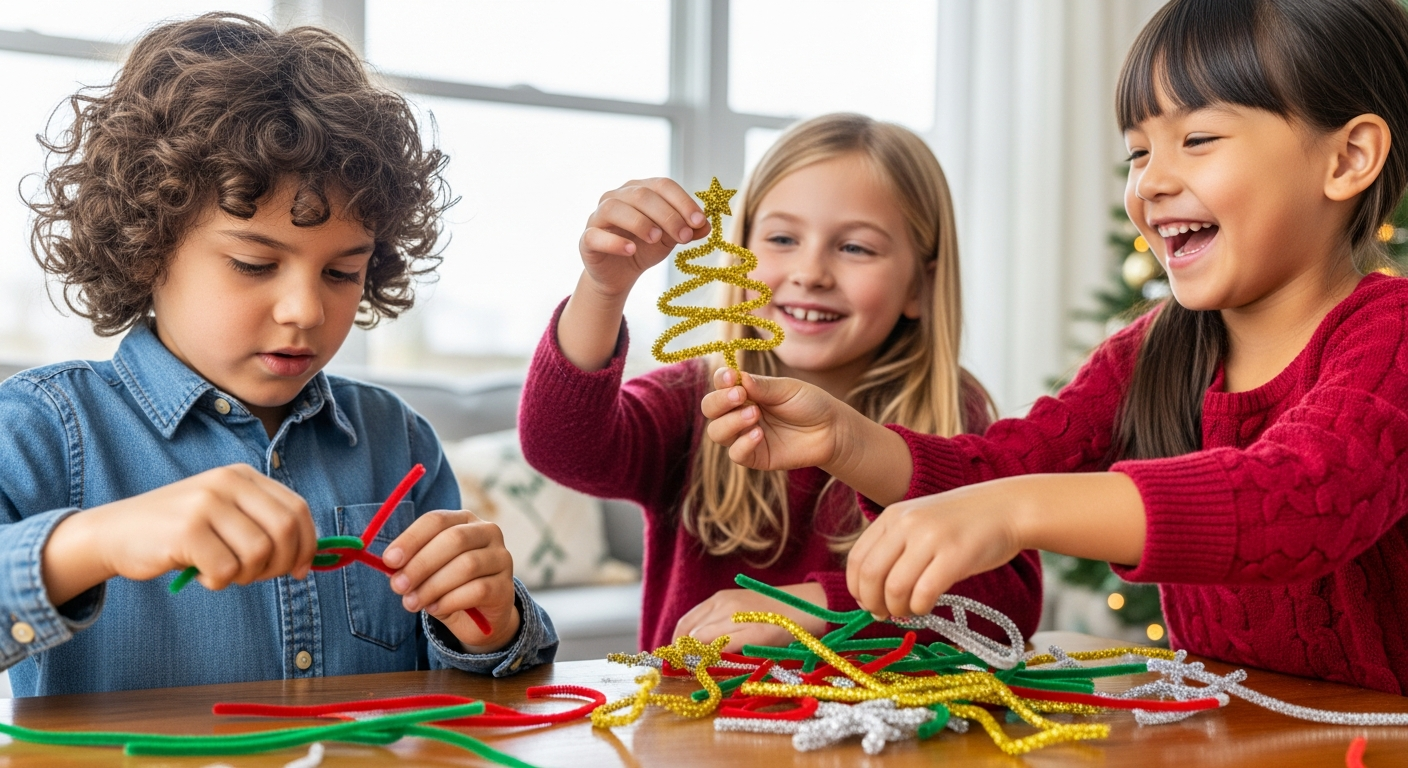
Table of Contents
- Introduction
- The Unseen Benefits of Pipe Cleaner Crafts: More Than Just Play
- Speech & Language Boosters in Every Craft
- Our Favorite Pipe Cleaner Christmas Crafts for Kids
- Tips for Crafting Success and Language Growth
- When to Seek Additional Support
- How Speech Blubs Nurtures Communication Beyond the Craft Table
- Investing in Your Child's Voice with Speech Blubs
- Conclusion
- Frequently Asked Questions
The air crackles with excitement as the holidays draw near, and for many families, this season sparks a desire for connection and creativity. Imagine the pure delight on your child's face as they twist, bend, and shape colorful pipe cleaners into festive treasures, their little fingers working diligently, their minds buzzing with ideas. But what if these joyful crafting moments could offer more than just a pretty ornament? What if they could be powerful opportunities to nurture your child's blossoming communication skills, helping them to speak their minds and hearts with greater confidence and clarity? This post isn't just about making beautiful holiday decorations; it's about harnessing the magic of Christmas crafting to unlock your child's potential for speech and language development, all while creating cherished family memories. We'll explore a sleigh-full of engaging pipe cleaner craft ideas, delve into the unexpected developmental benefits, and show you how to transform simple supplies into rich language-learning experiences.

Introduction
As parents, we cherish moments that combine fun with meaningful growth. Christmas, with its vibrant colors and endless possibilities for imaginative play, provides the perfect backdrop for such experiences. Pipe cleaner crafts, in particular, stand out as a wonderfully versatile activity for children of all ages. They are inexpensive, easy to handle, and offer immediate gratification, making them ideal for little hands. More than just a way to decorate the tree or create a handmade gift, these crafts are a fantastic, hands-on medium for encouraging fine motor skill development, fostering creativity, and, perhaps most importantly, boosting crucial speech and language abilities. From naming colors and describing textures to following multi-step directions and narrating stories about their creations, every twist and turn of a pipe cleaner can become a launchpad for communication. In the following sections, we'll dive deep into specific craft ideas, outline their unique developmental advantages, and provide practical tips for turning craft time into powerful language-learning sessions.
The Unseen Benefits of Pipe Cleaner Crafts: More Than Just Play
At first glance, pipe cleaner crafts might seem like simple fun, a way to keep little hands busy. However, beneath the surface of glittering tinsel and fuzzy wires lies a treasure trove of developmental benefits that profoundly impact a child's overall growth, including their communication skills. Engaging in these hands-on activities offers a holistic approach to learning, touching upon fine motor skills, cognitive development, social-emotional growth, and, critically, speech and language acquisition.
Fine Motor Skill Development
Working with pipe cleaners is an excellent workout for tiny fingers. The act of bending, twisting, wrapping, and cutting helps children develop their fine motor skills, hand-eye coordination, and dexterity. These are the foundational skills necessary for tasks like holding a pencil, buttoning a shirt, and even articulating sounds properly. Strong fine motor control can indirectly support speech clarity, as the same muscle groups that control finger movements are often linked to the intricate muscle movements required for speech. For instance, when a child practices twisting a pipe cleaner around a finger to make a spiral, they are refining the precise motor control that will later help them master complex speech sounds.

Cognitive Growth and Problem-Solving
Crafting with pipe cleaners isn't just about following instructions; it's an exercise in critical thinking and problem-solving. Children learn to plan their steps, adapt when things don't go as expected, and think creatively to achieve their desired outcome. They might ask, "How do I make this reindeer stand up?" or "Which color should I use next?" These questions stimulate cognitive processes and encourage children to verbalize their thoughts and plans, strengthening their ability to sequence ideas and express complex thoughts.
Social-Emotional Development
Crafting together is a powerful way to foster social-emotional growth. It encourages cooperation, sharing materials, and celebrating each other's creations. When children work alongside parents or siblings, they learn to communicate their needs, express their preferences, and resolve small conflicts. The shared experience builds connection and allows for open-ended conversations about feelings, ideas, and accomplishments. Completing a craft provides a sense of achievement, boosting self-esteem and confidence, which are vital for a child to feel empowered to speak up and express themselves.
Speech and Language Acquisition
This is where pipe cleaner crafts truly shine as an unsung hero for communication development. The multi-sensory nature of handling the fuzzy, colorful wires naturally invites language.
- Vocabulary Expansion: Children learn new words as they describe colors ("red," "green," "sparkly"), shapes ("circle," "star," "spiral"), actions ("bend," "twist," "wrap," "cut," "glue"), and textures ("fuzzy," "soft," "smooth").
- Following Directions: Each craft provides an opportunity to practice listening and following multi-step instructions, enhancing receptive language skills. "First, take a red pipe cleaner. Next, bend it into a candy cane shape."
- Expressive Language: As they create, children naturally narrate their actions, ask questions, and describe their progress, boosting expressive language. "I'm making a long garland!" "Can I have another blue one?"
- Storytelling and Imaginative Play: Once crafts are complete, they become props for imaginative play. A pipe cleaner reindeer isn't just an ornament; it's a character in a festive adventure, encouraging storytelling and dialogue.
- Articulation Practice: Certain sounds can be naturally integrated. For example, making a "snowflake" can emphasize the "s" sound, while a "reindeer" offers practice with "r" and "d" sounds.
By consciously incorporating language prompts and engaging in conversation during crafting, parents can significantly amplify these benefits. For a parent whose 3-year-old "late talker" loves animals, crafting a pipe cleaner reindeer offers a fun, motivating way to practice "r" sounds, "deer" vocabulary, and actions like "jump" or "run." This hands-on, playful approach helps cement new words and concepts in a memorable way.
Speech & Language Boosters in Every Craft
Transforming a simple crafting session into a potent language-learning opportunity requires just a little intentionality. Here’s how you can weave speech and language development into every pipe cleaner twist and turn:
- Pre-Linguistic Skills: Even before words emerge, younger children can benefit. Encourage pointing to colors, making eye contact, and responding to simple commands like "Give me." Vocalizations like "ooh" for a sparkly color or "uh-oh" if a piece breaks are excellent pre-speech practice.
- Vocabulary Building: Introduce new words constantly. "Look at this shimmering pipe cleaner!" "We need to secure this part." Use descriptive adjectives for colors, shapes, and sizes.
- Sentence Structure: Model complete sentences. Instead of just saying "Red pipe cleaner," say "I am using a long, red pipe cleaner." Encourage your child to do the same. Ask open-ended questions that require more than a yes/no answer: "What are you making next?" "How does that feel?"
- Sequencing and Narrating: Talk through the steps: "First, we bend. Next, we twist. Last, we decorate." This teaches sequencing, a critical skill for storytelling and organizing thoughts.
- Requesting and Directing: Empower your child to request materials: "May I please have the blue pipe cleaner?" or direct you: "Put the eye here."
- Sound Focus: If your child is working on specific sounds, integrate them. Making a "star" can focus on the "st" blend, or a "snowman" for "sn" and "m."
Remember, the goal is not perfection in the craft, but rich interaction and joyful communication. These interactions are invaluable. However, we also know that sometimes, children need a little extra, targeted support. That's why at Speech Blubs, we are deeply committed to empowering children to speak their minds and hearts. Our founders, all of whom experienced speech challenges as children, created the tool they wished they had: an immediate, effective, and joyful solution for the 1 in 4 children who need speech support. We blend scientific principles with play to provide one-of-a-kind "smart screen time" experiences, offering a powerful, screen-free alternative to passive viewing.
Our Favorite Pipe Cleaner Christmas Crafts for Kids
Get ready to transform simple pipe cleaners into a gallery of festive masterpieces! Each of these crafts is designed to be engaging, easy for little hands, and packed with opportunities for language development.
1. Sparkly Candy Canes
What you'll need: Red and white pipe cleaners (or any two contrasting colors), small beads (optional).
How to make it:
- Take one red and one white pipe cleaner.
- Twist them together tightly from one end to the other.
- Bend one end down to form the hook of a candy cane.
- Optional: Thread small beads onto the pipe cleaners before twisting for added sparkle and fine motor challenge.
Language Boosters:
- Colors: "Red," "white," "sparkly."
- Counting: "How many twists?" "Count the beads."
- Spatial concepts: "Twist together," "Bend down."
- Describing: "My candy cane is swirly and sweet."
2. Wobbly Worm Ornaments
What you'll need: Various colored pipe cleaners, googly eyes, glue.
How to make it:
- Take a pipe cleaner and wrap it tightly around a pencil or your finger to create a spring-like coil.
- Carefully slide it off.
- Bend one end slightly to form a head.
- Glue on two googly eyes.
- Bend the other end into a small loop for hanging.
Language Boosters:
- Action verbs: "Wrap," "slide," "bend," "glue."
- Size concepts: "Long worm," "short worm."
- Body parts: "Eyes," "head," "body."
- Imaginative play: "My worm is wiggling! Where is he going?"
3. Tiny Tree Decorations
What you'll need: Green pipe cleaners, small pom-poms, beads, sequins, glue.
How to make it:
- Take a green pipe cleaner and coil it into a flat spiral to form the base of the tree.
- Take another green pipe cleaner, bend it in half, and twist the ends together to make a loop for hanging.
- Attach this loop to the top of your spiral base.
- Decorate the "tree" by gluing on pom-poms, beads, and sequins.
Language Boosters:
- Shapes: "Spiral," "circle."
- Textures: "Fuzzy," "smooth," "bumpy."
- Quantifiers: "Many pom-poms," "a few sequins."
- Location words: "Put the star on top," "Decorate all over."
4. Festive Figures: Reindeer, Snowmen, or Elves
What you'll need: Brown, white, or red pipe cleaners; small pom-poms for noses, googly eyes, tiny bells, glue.
How to make it (Reindeer example):
- Take one brown pipe cleaner and fold it in half for the body.
- Take two more brown pipe cleaners, cut them in half, and twist two halves around the body for legs.
- Twist two small pieces for antlers onto the head end.
- Glue on googly eyes and a red pom-pom nose (Rudolph!).
Language Boosters:
- Nouns: "Reindeer," "snowman," "elf," "antlers," "nose," "eyes," "legs."
- Action verbs: "Twist," "glue," "stand."
- Comparisons: "My reindeer is taller than yours."
- Storytelling: "What does your reindeer do? Where does it live?" This is a wonderful opportunity to build narrative skills.
5. Pipe Cleaner Christmas Trees
What you'll need: Green pipe cleaners, a small brown pom-pom or a piece of brown pipe cleaner for the trunk, beads or tiny buttons for ornaments, glue.
How to make it:
- Take one green pipe cleaner and bend it into a triangular shape. Twist the ends together to secure.
- Repeat with 2-3 more green pipe cleaners, making them progressively smaller.
- Stack the triangles from largest to smallest, twisting them together at the top and bottom to form a tree shape.
- Add a small brown pipe cleaner piece or pom-pom for the trunk at the bottom.
- Decorate with beads or buttons, gluing them onto the "branches."
Language Boosters:
- Sizes: "Largest," "smaller," "smallest."
- Shapes: "Triangle."
- Sequencing: "First, the big one. Then, the medium one."
- Spatial relationships: "Stack on top," "Put the star at the top."
6. Garland Galore
What you'll need: Multiple pipe cleaners of various colors, scissors.
How to make it:
- Cut pipe cleaners into 2-3 inch pieces.
- Show your child how to link them together by twisting the ends, creating a chain.
- Encourage creating patterns: "Red, green, red, green!"
Language Boosters:
- Patterns: "What comes next in our pattern?"
- Repetition: Practicing color names repeatedly.
- Length: "Our garland is getting longer!" "That's a short piece."
- Negotiation: "I want the blue one!" (Practicing polite requests).
7. Reindeer Rings
What you'll need: Brown pipe cleaners, tiny googly eyes, small red pom-poms, glue.
How to make it:
- Take one brown pipe cleaner and form a circle large enough to fit on a child's finger. Twist the ends to secure.
- Bend two small pieces of another brown pipe cleaner for antlers and twist them onto the top of the ring.
- Glue on googly eyes and a red pom-pom for the nose.
Language Boosters:
- Body parts: "Finger," "nose," "eyes," "antlers."
- Action verbs: "Wear," "put on," "twist."
- Role-playing: "Hello, Mr. Reindeer! What's your name?"
8. Snowflake Twisters
What you'll need: White or blue sparkly pipe cleaners, beads, scissors.
How to make it:
- Take three pipe cleaners and twist them together at their centers to form a six-pointed star.
- Bend and shape each "arm" of the snowflake, twisting them into curls or loops.
- Thread beads onto the ends of the arms for extra sparkle.
Language Boosters:
- Shapes: "Star," "circle," "loop."
- Concepts: "Symmetry," "pattern," "cold," "winter."
- Describing: "My snowflake is unique and sparkly."
9. Star Toppers
What you'll need: Gold or yellow pipe cleaners, glitter glue (optional).
How to make it:
- Take two pipe cleaners. Bend one into a "V" shape and the other into an inverted "V" shape.
- Interlock them and twist the ends together to form a five-pointed star.
- Add glitter glue for extra shine.
Language Boosters:
- Shapes: "Star," "point," "triangle."
- Positions: "Put it on top of the tree."
- Adjectives: "Shiny," "golden," "bright."
10. Pipe Cleaner Finger Puppets
What you'll need: Various colored pipe cleaners, small pom-poms, googly eyes, felt scraps, glue.
How to make it:
- Take a pipe cleaner and wrap it around your child's finger a few times to create the body, leaving a little excess at the top.
- Twist the excess into a head shape.
- Add features: glue on googly eyes, a pom-pom nose, felt ears or a hat.
- Use other pipe cleaner pieces for arms, legs, or tails.
Language Boosters:
- Role-playing: Encourage children to make their puppets talk and interact. "What does your snowman say?"
- Dialogue: Practice turn-taking in conversation.
- Character voices: Experiment with different tones and pitches.
- Emotional vocabulary: "Happy snowman," "sleepy elf."
Tips for Crafting Success and Language Growth
To maximize the developmental impact of these festive crafts, remember these key strategies:
- Be Present and Engage: Sit with your child, participate in the craft, and make eye contact. Your active involvement is the biggest motivator for language.
- Narrate Your Actions: Talk about what you're doing. "I'm twisting the red and white together to make a candy cane. See how it spirals?"
- Ask Open-Ended Questions: Instead of "Do you like it?" ask "What's your favorite part?" or "Tell me about your snowflake."
- Follow Their Lead: If your child wants to make a blue reindeer, embrace it! This fosters creativity and ownership, making them more likely to talk about their unique creation.
- Be Patient and Positive: Focus on the process, not just the finished product. Praise effort and participation, not just perfection.
- Adapt for Age: For younger children, pre-cut some pieces or simplify instructions. For older children, introduce more complex designs or encourage them to draw their own plans.
- Safety First: Always supervise children, especially with scissors or small beads, which can be choking hazards for very young children.
- Display Their Art: Show off their creations! This validates their efforts and gives them another opportunity to talk about their work with others.
These crafting sessions are more than just holiday traditions; they are building blocks for communication and confidence.
When to Seek Additional Support
While engaging in these rich, hands-on activities significantly supports language development, it's also important for parents to be aware of typical speech and language milestones. Every child develops at their own pace, but if you have concerns about your child's communication progress, early intervention can make a world of difference. Signs that might warrant further investigation include:
- Limited vocabulary for their age.
- Difficulty understanding simple instructions.
- Lack of eye contact or reciprocal social interaction.
- Frustration when trying to communicate.
- Speech that is difficult for family members or strangers to understand.
If you're unsure whether your child could benefit from targeted support, we've developed a quick, helpful tool. You can take our quick 3-minute preliminary screener which involves just 9 simple questions. It will provide you with an assessment and a next-steps plan, along with a free 7-day trial of Speech Blubs.
How Speech Blubs Nurtures Communication Beyond the Craft Table
At Speech Blubs, we deeply understand the journey of helping children find their voice. Our company was born from the personal experiences of our founders, who all grew up with speech problems and created the tool they wished they had. We are driven by the mission to empower children to "speak their minds and hearts," providing an immediate, effective, and joyful solution for the 1 in 4 children who need speech support.
While hands-on activities like pipe cleaner crafts are wonderful for encouraging interaction and language in a screen-free setting, we also recognize the reality of modern parenting. That's why we've pioneered a unique approach to "smart screen time," transforming passive viewing into an active, engaging, and scientifically-backed learning experience. Our methodology is rooted in the power of "video modeling," where children learn by watching and imitating their peers. This is incredibly effective because mirror neurons in the brain activate when observing others, making imitation a natural and powerful learning tool for complex communication skills.
Our app offers a vast library of activities, organized into themed sections like "Animal Kingdom," "Yummy Time," and "Outdoor Fun," designed to encourage pronunciation, vocabulary, and early reading skills through play. Imagine your child practicing the word "tree" while watching a peer pronounce it, then repeating it themselves, all within a playful, encouraging environment. Speech Blubs serves as a powerful supplement to your child's overall development plan and, when applicable, professional therapy, fostering a love for communication, building confidence, and reducing frustration. It’s a tool for family connection, turning screen time into meaningful interaction and a shared learning adventure. You can explore the science behind our methods and see why we are consistently rated among the top speech apps worldwide by visiting our Research page.
Investing in Your Child's Voice with Speech Blubs
We believe that every child deserves the opportunity to communicate effectively and joyfully. That's why we've made Speech Blubs accessible and transparent with our pricing structure. You can choose the plan that best fits your family's needs:
- Monthly Plan: For just $14.99 per month, your child can access our core features and a wealth of engaging activities designed to boost their speech and language skills.
- Yearly Plan: This is by far our most popular and value-packed option! For only $59.99 per year, you save a significant 66% compared to the monthly plan, breaking down to just $4.99 per month.
The Yearly plan isn't just about saving money; it unlocks an even richer experience for your child. It includes:
- A comprehensive 7-day free trial, giving you ample time to explore all the amazing features and see the magic of Speech Blubs firsthand.
- Access to our complementary Reading Blubs app, helping to lay crucial foundational literacy skills alongside speech development.
- Early access to new updates and features, ensuring your child always has the freshest content.
- 24-hour support response time, so you always have quick assistance when you need it.
The Monthly plan, while providing great value, does not include these additional high-value benefits. We encourage you to choose the Yearly plan to get the free trial and the full suite of features designed to help your child thrive. Ready to embark on this empowering journey? Many parents have seen remarkable progress; you can read about their experiences on our Testimonials page.
Conclusion
The holiday season is a magical time, filled with warmth, wonder, and countless opportunities for connection. By engaging in simple yet profound activities like pipe cleaner Christmas crafts, we not only create beautiful decorations and lasting memories but also actively foster our children's fine motor skills, cognitive abilities, and most importantly, their burgeoning speech and language development. Every fuzzy twist, every colorful bend, and every shared giggle during craft time becomes a valuable step on their communication journey. These are the moments that truly help children gain confidence, reduce frustration, and build the foundational skills to express themselves fully.
As parents, we are our children's first and most influential teachers. Embracing these joyful, hands-on activities provides a rich foundation for communication. And for those moments when targeted support can make an even greater impact, Speech Blubs is here to empower your child's voice with scientifically-backed, playful learning. Our unique video modeling approach, created by founders who understand speech challenges firsthand, offers "smart screen time" that complements your family's efforts, helping your child speak their minds and hearts.
Don't miss out on the incredible benefits and comprehensive features that Speech Blubs offers. Ready to see the difference for yourself? Begin your 7-day free trial today by choosing our best-value Yearly plan! Download Speech Blubs on the Apple App Store or Google Play Store. Alternatively, you can create your account on our website to get started immediately. Let's work together to nurture your child's communication skills and unlock their full potential!
Frequently Asked Questions
Q1: What age group are pipe cleaner crafts best for?
Pipe cleaner crafts are wonderfully versatile and can be adapted for a wide range of ages. Toddlers (18-36 months) can practice simple bending and twisting with adult supervision, focusing on sensory exploration and naming colors. Preschoolers (3-5 years) can follow multi-step directions and create more complex figures. School-aged children (6+) can design intricate creations, work independently, and develop more detailed narratives around their crafts. Always adjust the complexity and supervision level to your child's developmental stage.
Q2: How can I make these crafts even more beneficial for speech development?
Beyond the tips provided in the post, focus on labeling emotions your child might be feeling during the craft ("Are you feeling proud of your star?"). Use comparative language ("My snowman is bigger than yours, but yours is sparklier!"). Incorporate singing and rhymes while you work, as music is a powerful tool for language acquisition. Most importantly, ensure the crafting time is a no-pressure zone for speech, allowing your child to experiment and express themselves freely, which builds confidence.
Q3: Are pipe cleaners safe for young children?
Yes, when used with appropriate supervision. For very young children (under 3 years old), ensure that they are not putting pipe cleaners in their mouths, as the wires can poke, and small pieces could be a choking hazard if cut. Always supervise the use of scissors. Some pipe cleaners have glitter or tinsel which can shed, so be mindful of children rubbing their eyes. Choosing high-quality, non-toxic pipe cleaners is always a good idea.
Q4: How does Speech Blubs complement hands-on activities like crafting?
Speech Blubs offers targeted, engaging support that enhances the foundational skills built through hands-on play. While crafting strengthens fine motor skills and encourages natural conversation, Speech Blubs provides structured practice for articulation, vocabulary expansion, and sentence building through our unique video modeling approach. It gives children the opportunity to observe and imitate peers, reinforcing correct pronunciation and communication patterns in a fun, "smart screen time" environment. It acts as a powerful supplement, ensuring that children receive comprehensive support for their speech and language development, whether they're twisting pipe cleaners or engaging with our interactive app.
About the author