
Speak Up: Fun Therapy Activities for Kids
 By Speech Blubs Team•Jan 13, 2026•17 min.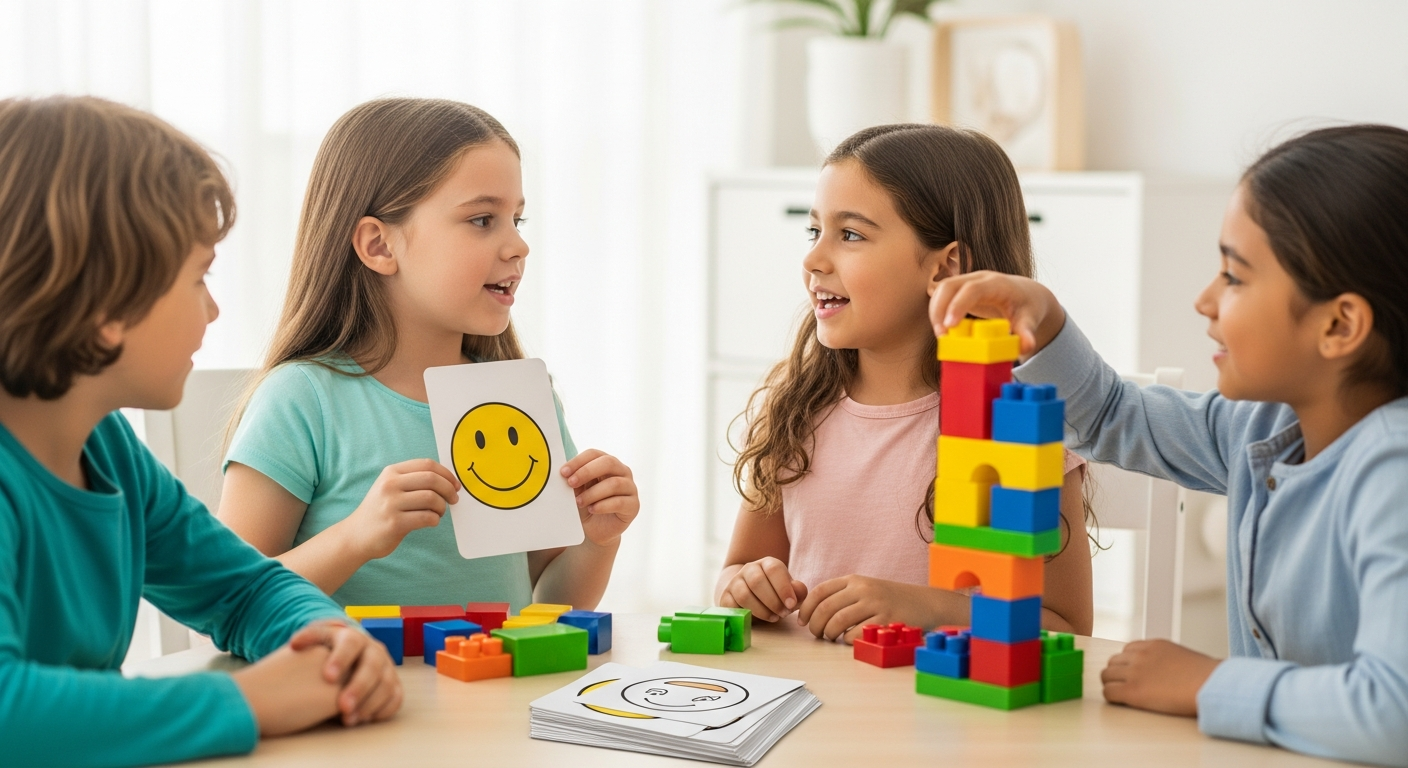
Table of Contents
- Introduction
- Understanding the Power of Play in Therapeutic Learning
- Beyond the Clinic: Fun Therapy Activities You Can Do at Home
- The Science Behind Playful Learning: How Speech Blubs Helps
- When to Seek Professional Guidance
- Getting Started with Speech Blubs: Your Partner in the Communication Journey
- Conclusion
- Frequently Asked Questions
Imagine a world where your child’s thoughts and feelings bubble to the surface, free and clear, without the struggle of finding the right words. For many parents, this vision can feel distant, especially when their little one faces challenges with speech and language. The journey to clear communication doesn’t have to be paved with frustration or rigid drills. In fact, it can be filled with laughter, discovery, and joy! Therapeutic activities for kids, especially those focused on speech and language, are most effective when they feel like play, not work. This post will explore a treasure trove of engaging, play-based activities you can weave into your daily life, transforming communication support into an adventure, and showing how innovative tools like Speech Blubs can seamlessly integrate into this delightful process.
Introduction
Has your child ever pointed frantically at something they want, their eyes wide with urgency, while words simply won't form? Or perhaps they get easily frustrated when their friends don't understand what they're trying to say? These moments, though challenging, are powerful indicators of a child’s desire to connect and express themselves. Learning to communicate effectively is one of the most vital developmental milestones, impacting everything from social skills to emotional well-being and academic success. But what if the path to clear speech could be as fun and natural as playing their favorite game? We believe it can be.

This blog post is designed to empower you with practical, enjoyable, and effective "fun therapy activities for kids" that support speech and language development right in your home. We'll dive into the profound benefits of play-based learning, share a variety of hands-on activities, and introduce you to how Speech Blubs enhances this journey with its unique, scientifically-backed approach. Our mission at Speech Blubs is to empower children to "speak their minds and hearts," and we're committed to providing an immediate, effective, and joyful solution for the 1 in 4 children who need speech support. Get ready to discover how combining everyday play with smart, engaging tools can unlock your child's communication potential, fostering confidence and creating precious family learning moments.
Understanding the Power of Play in Therapeutic Learning
Play is far more than just fun and games for children; it is their primary language, their natural classroom, and their most effective tool for development. When children engage in play, they are not just passing time; they are actively exploring their world, testing boundaries, solving problems, and developing crucial cognitive, social, emotional, and physical skills. For speech and language development, play is absolutely paramount.
Through play, children learn:
- Vocabulary: Naming toys, actions, and objects naturally expands their lexicon.
- Sentence Structure: Constructing narratives during pretend play, giving instructions to dolls, or describing their creations encourages the formation of complex sentences.
- Social Communication (Pragmatics): Taking turns, understanding non-verbal cues, making eye contact, and negotiating roles are all integral parts of cooperative play.
- Articulation: Imitating sounds, animal noises, or character voices refines their ability to produce various speech sounds.
- Listening Skills: Following instructions, understanding rules, and responding to questions during games hones auditory processing.
Traditional therapy settings, while invaluable, can sometimes feel intimidating or overly structured for young children. By bringing therapeutic activities into the playful, comfortable environment of home, parents can create a low-pressure space where learning feels organic and exciting. This isn't about replicating a clinic; it's about integrating supportive communication practices into the rhythms of family life.

At Speech Blubs, we recognize this inherent power of play. Our company was born from the personal experiences of our founders, who all grew up with speech problems and created the tool they wished they had. We firmly believe that learning should be joyful, which is why we blend scientific principles with play into one-of-a-kind "smart screen time" experiences. We provide a screen-free alternative to passive viewing (like cartoons) and a powerful tool for family connection, ensuring that every interaction is an opportunity for growth and fun. To see how we make learning enjoyable, visit our main homepage and explore our approach.
Beyond the Clinic: Fun Therapy Activities You Can Do at Home
You don't need fancy equipment or a specialized degree to support your child's speech and language development. The most effective "fun therapy activities for kids" leverage everyday items and situations. Here’s how you can turn your home into a playful learning hub:
Activities for Sound Production & Articulation
Helping children master specific sounds and movements of the mouth is foundational to clear speech.
- Animal Sounds & Imitation Games: This classic activity is a goldmine for articulation practice. For a parent whose 3-year-old "late talker" loves animals, the "Animal Kingdom" section within Speech Blubs offers a fun, motivating way to practice "moo," "baa," "roar," and many other sounds. Children watch their peers make these sounds in real-time videos, naturally encouraging imitation. Beyond the app, you can use toy animals or picture books, making the sounds together and exaggerating mouth movements.
- Bubble Blowing & Wind Instruments: These activities are fantastic for strengthening oral motor muscles and breath control, both crucial for speech. Blow bubbles and encourage your child to imitate. Small party blowers, kazoos, or even simple homemade flutes (like blowing across a bottle top) can make this activity a blast.
- Silly Face Games: Making exaggerated faces in front of a mirror or with a partner helps children become aware of their mouth, tongue, and lip movements. Stick out your tongue, puff out your cheeks, make a wide smile, and encourage your child to imitate. This is precisely the kind of peer-to-peer modeling that forms the core of our approach at Speech Blubs, leveraging mirror neurons to make learning intuitive and engaging. To learn more about the science behind our method, check out our research page.
- Sound Hunts: Choose a target sound (e.g., "b" for "ball") and go on a "hunt" around the house for objects that start with that sound. Say the word clearly and emphasize the initial sound.
Activities for Vocabulary & Language Comprehension
Expanding a child's vocabulary and their ability to understand language is vital for both expressive and receptive communication.
- Story Time & Reading Aloud: Reading together is perhaps the single most powerful activity for language development. Don't just read the words; point to pictures, ask questions ("What do you think happens next?"), talk about the characters' feelings, and make predictions. This interactive engagement builds comprehension, vocabulary, and narrative skills. For an enhanced experience, remember that our Yearly plan includes the extra Reading Blubs app, designed to make reading even more interactive and fun!
- Scavenger Hunts (Verbal Cues): Create a simple scavenger hunt using descriptive language. "Find something red and soft," or "Find something that makes a loud noise." This helps children process multi-step instructions and connect words to attributes.
- "I Spy" with Descriptive Words: Instead of just colors, incorporate adjectives like "I spy something smooth and shiny," or "I spy something tiny and round." This encourages the use and understanding of descriptive vocabulary.
- Cooking Together: Involve your child in simple cooking tasks. Naming ingredients, following recipe steps, and describing actions ("stir," "pour," "mix") are excellent for vocabulary, sequencing, and understanding commands. For example, if you're making cookies, you can say, "First, we add the flour," then, "Next, we mix it all up."
Activities for Sentence Structure & Grammar
Moving from single words to complete, grammatically correct sentences is a significant leap.
- Puppet Shows & Role-Playing: Using puppets or even just acting out scenarios with toys allows children to experiment with different voices, characters, and dialogues. Encourage them to use full sentences and try out various sentence types (questions, statements, commands). This is a fantastic way to practice social scripts and explore different communication styles in a safe, imaginative space.
- Build-a-Story with Picture Cards: Use a set of picture cards or even family photos. Lay them out and take turns adding a sentence to create a story. For example, "The girl went to the park" (picture of a girl), "She saw a dog" (picture of a dog), "The dog barked loudly" (picture of a barking dog). This helps develop narrative skills and the ability to link sentences logically.
- "What Happens Next?" Games: Look at a picture from a book or magazine and ask your child to describe what just happened and what they think will happen next. This promotes logical thinking, cause-and-effect understanding, and the formulation of descriptive sentences.
Activities for Social Communication & Pragmatics
Pragmatic skills involve using language appropriately in social contexts, understanding non-verbal cues, and engaging in conversations.
- Turn-Taking Games (Board Games): Simple board games like Candy Land or Snakes and Ladders are excellent for practicing turn-taking, following rules, and learning to win and lose gracefully. Encourage eye contact when speaking and listening attentively. These interactions are mini-therapy sessions for social communication.
- Emotion Charades: For a child who struggles to express frustration or sadness, playing emotion charades can be incredibly helpful. Write down various emotions (happy, sad, angry, surprised, confused) on slips of paper. Have your child pick one and act it out without speaking. The goal is for you to guess the emotion. Then switch roles. This activity builds empathy, emotional vocabulary, and non-verbal communication skills. Speech Blubs often helps reduce communication frustration, leading to more confidence in expressing feelings.
- "Telephone" Game: A classic game that focuses on listening and clear articulation. Whisper a sentence to your child, and have them whisper it to another person (or a toy), and so on. See how well the message travels! This highlights the importance of speaking clearly and listening carefully.
- "How Would You Feel?" Scenarios: Present your child with simple social scenarios. "How would you feel if someone took your toy without asking?" or "What would you say if your friend invited you to their birthday party?" This helps them think through social interactions and develop appropriate responses.
These activities are not just about "fixing" speech; they are about fostering a love for communication, building confidence, reducing frustration, and developing key foundational skills that will serve your child throughout their life. Many parents have seen remarkable progress and joy in their children. Read what other parents are saying about their child's success with Speech Blubs on our testimonials page.
The Science Behind Playful Learning: How Speech Blubs Helps
At Speech Blubs, we don't just create fun games; we meticulously design experiences rooted in scientific understanding of child development and speech acquisition. Our core methodology, "video modeling," is a testament to this commitment.
Video Modeling and Mirror Neurons
Imagine your child watching another child on screen, happily making the "th" sound or saying a new word. This simple act of observation, followed by imitation, is incredibly powerful. This is "video modeling" in action. Children learn best by observing and imitating their peers. This natural learning process is amplified by the brain's "mirror neuron system." Mirror neurons are brain cells that activate both when we perform an action and when we observe someone else performing the same action. This means that when your child watches a peer in Speech Blubs make a sound or say a word, their brain is already beginning to "rehearse" that action, making it easier for them to imitate and eventually master it themselves.
This peer-to-peer interaction through video modeling provides several advantages:
- Relatability: Children are naturally drawn to watching and imitating other children.
- Motivation: Seeing peers succeed is highly motivating.
- Clarity: The close-up videos clearly demonstrate mouth movements, making it easier for children to understand how to produce sounds.
Smart Screen Time vs. Passive Viewing
We understand parental concerns about screen time. That's why Speech Blubs is engineered to be "smart screen time." Unlike passive viewing of cartoons or mindless videos, Speech Blubs requires active participation. Children are prompted to imitate, respond, and engage. This interactive engagement transforms screen time from a passive consumption into an active learning experience.
- Active Engagement: Children are encouraged to speak, record their voice, and match sounds.
- Reduced Frustration: The playful, encouraging environment reduces the pressure often associated with learning new sounds.
- Confidence Building: Each successful imitation builds a child's confidence in their ability to communicate.
- Family Connection: Our app is designed for co-play. Parents are encouraged to sit with their child, engage in the activities together, celebrate successes, and extend the learning into real-world interactions.
This unique approach of blending scientific principles with play ensures that we provide an immediate, effective, and joyful solution for children needing speech support. It’s a powerful tool for developing foundational skills, building confidence, and fostering a love for communication, making it an invaluable supplement to a child's overall development plan.
When to Seek Professional Guidance
While integrating fun therapy activities at home and utilizing tools like Speech Blubs can significantly boost your child's communication journey, it's important to recognize when professional guidance might be beneficial. Trust your instincts as a parent.
Here are some signs that may suggest your child could benefit from a speech-language pathologist's assessment:
- By 12-18 months: No babbling, not pointing to objects, not responding to their name.
- By 18-24 months: Fewer than 50 words, not combining two words together, difficulty imitating words.
- By 2-3 years: Not using simple sentences, unclear speech that is difficult for familiar adults to understand, limited vocabulary compared to peers.
- Any age: Significant frustration with communication, stuttering, loss of previously acquired speech skills, or difficulty understanding what others say.
If you have any concerns, a professional evaluation can provide clarity and a personalized plan. Speech Blubs is a powerful supplement to a child's overall development plan and, when applicable, professional therapy. It can provide consistent, engaging practice between therapy sessions or offer a first step for families looking to support their child's early communication development.
Unsure if your child could benefit? Take our quick 3-minute preliminary screener to get a simple assessment and a personalized next-steps plan. It involves just 9 simple questions and can offer valuable insights.
Getting Started with Speech Blubs: Your Partner in the Communication Journey
At Speech Blubs, we are deeply committed to being your trusted partner on your child's communication journey. We believe every child deserves the chance to "speak their minds and hearts," and we've designed our app to make that journey as effective, joyful, and accessible as possible. Our commitment stems from personal experience, knowing firsthand the challenges and triumphs of speech development.
We strive for transparency and want you to have all the information needed to make the best choice for your family. Here's a breakdown of our subscription plans:
- Monthly Plan: For just $14.99 per month, you can access a wealth of engaging speech activities.
- Yearly Plan: Our most popular and recommended option is the Yearly plan, priced at $59.99 per year. This breaks down to an incredible value of just $4.99 per month, allowing you to save 66% compared to the monthly subscription!
The Yearly plan isn't just about significant savings; it's about unlocking the full potential of Speech Blubs with exclusive, high-value features designed to accelerate your child's progress and enhance your family's experience:
- 7-Day Free Trial: Only the Yearly plan offers a generous 7-day free trial, allowing you to experience the magic of Speech Blubs firsthand before committing.
- The Extra Reading Blubs App: Expand your child's literacy journey with full access to our complementary Reading Blubs app, included exclusively with the Yearly plan.
- Early Access to New Updates: Be among the first to explore new features, activities, and content as soon as they're released.
- 24-Hour Support Response Time: Get priority assistance from our dedicated support team, ensuring your questions are answered quickly.
The Monthly plan does not include these fantastic benefits, making the Yearly plan the clear best choice for families seeking comprehensive support and outstanding value.
Ready to embark on a fun, engaging, and effective communication journey with your child? We encourage you to choose the Yearly plan to get the free trial and the full suite of features that will empower your little one to blossom.
- Download Speech Blubs on the Apple App Store to begin your 7-day free trial.
- Get started today on the Google Play Store and access a world of joyful learning.
- Prefer to sign up on the web? Create your account and begin your 7-day free trial today with the Yearly plan.
Join our community of parents who are discovering the power of play to unlock their children's communication potential. We can't wait to welcome you!
Conclusion
Supporting your child’s speech and language development is one of the most rewarding journeys a parent can undertake. By embracing "fun therapy activities for kids" and integrating them into everyday play, you create a nurturing environment where learning flourishes naturally. From mimicking animal sounds and blowing bubbles to engaging in imaginative story time and puppet shows, every interaction becomes an opportunity for growth. These playful moments not only build crucial communication skills but also strengthen your bond, boost your child’s confidence, and reduce the frustration that can sometimes accompany communication challenges.
At Speech Blubs, we are dedicated to making this journey joyful and effective. Our scientifically-backed video modeling approach, combined with engaging activities, transforms screen time into "smart screen time," actively empowering children to speak their minds and hearts. We believe that every child deserves the tools to communicate clearly and confidently, and we’ve made it our mission to provide that through a tool born from personal experience.
Don't let another day pass by without giving your child the gift of joyful communication. Embrace the power of play and technology working hand-in-hand. Ready to get started? We invite you to begin your 7-day free trial today by downloading Speech Blubs and choosing the Yearly plan for the best value and full access to all our features, including the extra Reading Blubs app and priority support. Download Speech Blubs now from the Apple App Store or find us on Google Play. Let’s unlock your child’s full communication potential together!
Frequently Asked Questions
1. What age group is Speech Blubs best suited for?
Speech Blubs is primarily designed for children aged 1-8 years old who are developing their speech and language skills. Our activities are crafted to be engaging and beneficial for toddlers learning their first words, preschoolers working on articulation, and early elementary children building vocabulary and sentence structure.
2. How does Speech Blubs' "video modeling" work?
Our unique video modeling methodology allows children to learn by watching and imitating real-life peers. This leverages the brain's mirror neuron system, which activates when we perform an action and when we observe it. By seeing other children make sounds and pronounce words, kids are naturally encouraged to imitate, making learning intuitive, motivating, and highly effective for speech development.
3. Is Speech Blubs a replacement for traditional speech therapy?
Speech Blubs is a powerful supplemental tool designed to support and enhance a child's speech and language development through fun, interactive play. While it is incredibly effective for consistent practice and early intervention, it is not intended to replace professional, one-on-one speech therapy when it is medically recommended. We encourage parents to consult with a speech-language pathologist if they have significant concerns about their child's communication development.
4. What are the benefits of choosing the Yearly subscription plan?
The Yearly plan offers the best value, saving you 66% compared to the monthly subscription. Beyond the significant cost savings, the Yearly plan includes a 7-day free trial, full access to our complementary Reading Blubs app, early access to new updates and features, and priority 24-hour response time for customer support. It's designed to give your child the most comprehensive and uninterrupted learning experience.
About the author