
Splash Into Summer: Creative Water Game Ideas for Kids
 By Speech Blubs Team•Jan 28, 2026•20 min.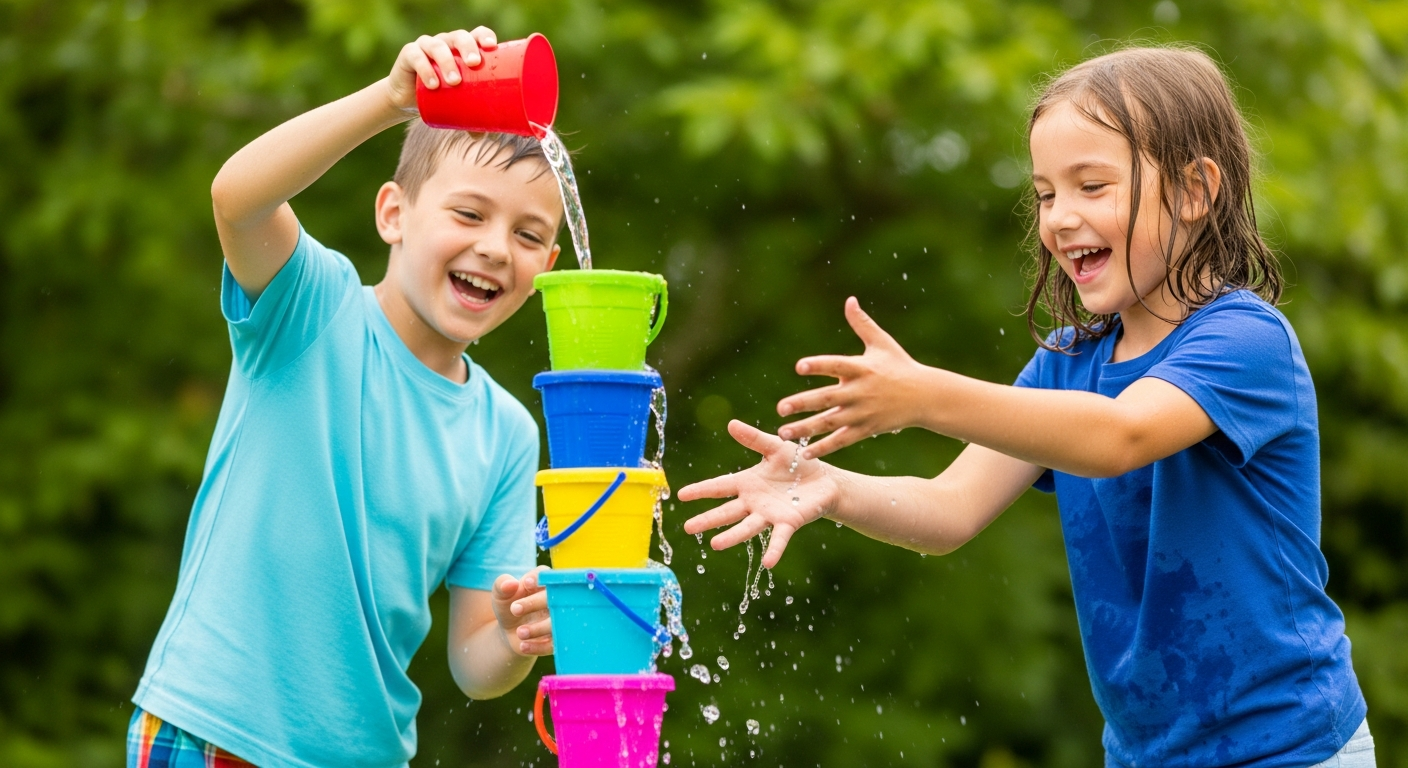
Table of Contents
- The Transformative Power of Water Play for Development
- Our Philosophy at Speech Blubs: Learning Through Interactive Play
- Exciting Water Game Ideas for Kids (and Their Speech Development!)
- Conclusion: Making a Splash for Speech and Development
- Frequently Asked Questions About Water Games and Child Development
Summer days are often synonymous with bright sunshine, laughter, and the inevitable "I'm bored!" chorus. As temperatures rise, finding engaging activities that keep little ones cool and entertained becomes a top priority for parents. But what if these fun-filled moments could also be powerful catalysts for your child's development, especially their communication skills? That's precisely the magic of water play! More than just a way to beat the heat, water games offer a multisensory playground that nurtures everything from fine motor skills to imaginative thinking and, crucially, language development.
In this comprehensive guide, we'll dive deep into a treasury of water game ideas for kids, designed not only to spark joy and keep them cool but also to lay vital foundations for their speech and language journey. We'll explore activities suitable for a wide range of ages and developmental stages, ensuring every splash, pour, and squirt contributes to a rich learning experience. Our mission at Speech Blubs is to empower children to "speak their minds and hearts," and we believe that play, especially interactive and engaging play like water games, is the most natural classroom. So, grab your towels, put on your swimsuits, and get ready to transform your backyard into an exciting hub of learning and laughter.

The Transformative Power of Water Play for Development
Before we plunge into the games themselves, let's appreciate why water play is such a profound tool for child development. It’s not just about keeping cool; it’s a holistic learning experience that touches upon every developmental domain.
Enhancing Sensory Integration and Exploration
Water is a fantastic sensory medium. Its varied textures – from still and calm to bubbly and splashy – provide rich tactile input. The sound of trickling or gushing water, the sight of reflections, and even the temperature changes engage multiple senses simultaneously. This sensory stimulation is vital for young children, helping them to process information about their environment and build stronger neural connections. For children who might be sensitive to certain textures, gentle water play can be a calming and desensitizing experience.
Fostering Fine and Gross Motor Skills
From squeezing a sponge to pouring water from one cup to another, water games are packed with opportunities to refine fine motor skills. These small, precise movements are crucial for tasks like writing, drawing, and self-feeding. Simultaneously, activities like running through sprinklers, splashing, or carrying buckets of water engage gross motor skills, developing strength, balance, and coordination. These physical movements are foundational for overall healthy development and often precede more complex cognitive and linguistic achievements.
Igniting Cognitive Growth and Problem-Solving
Water play naturally encourages children to experiment and observe. They learn about cause and effect ("If I tip the bucket, the water spills!"), volume ("Which container holds more water?"), and basic physics ("Why does this toy float and that one sink?"). These open-ended explorations foster critical thinking, problem-solving abilities, and an early understanding of scientific concepts. When children communicate their observations, they're not just playing; they're actively building their cognitive and linguistic frameworks.

Cultivating Social-Emotional Connections and Communication
Many water games are best enjoyed with others, creating invaluable opportunities for social interaction. Children learn to share toys, take turns, negotiate, and collaborate on a shared goal. These interactions are fertile ground for developing empathy, emotional regulation, and vital social communication skills. Describing actions, making requests, expressing excitement, or even resolving minor conflicts during play all contribute to a child's growing vocabulary and pragmatic language use. At Speech Blubs, we believe in the power of interactive "smart screen time" that sparks these real-world connections, and water play is a perfect extension of this philosophy.
Our Philosophy at Speech Blubs: Learning Through Interactive Play
At Speech Blubs, our commitment to blending scientific principles with joyful play stems from a very personal place. Our company was born from the experiences of our founders, all of whom grew up with speech problems and wished for a tool that combined effective learning with engaging fun. We understand firsthand the challenges parents face and are dedicated to providing an immediate, effective, and joyful solution for the 1 in 4 children who need speech support.
Our unique approach focuses on "video modeling," where children learn by watching and imitating their peers. This natural, intuitive method taps into a child's innate ability to learn through observation, making complex communication skills accessible and fun. Just as a child might learn to splash by watching a friend, they can learn to articulate words and phrases by watching other children in our app. We offer a screen-free alternative to passive viewing, transforming screen time into a powerful tool for family connection and developmental progress.
Ready to see how our blend of science and play can empower your child? Download Speech Blubs on the App Store or Google Play and start your 7-day free trial today!
Exciting Water Game Ideas for Kids (and Their Speech Development!)
Let's dive into some fantastic water game ideas, complete with developmental insights and suggestions for integrating language practice.
I. Sensory and Exploratory Water Games
These games are perfect for younger children or those who enjoy more self-directed, open-ended play. They focus on experiencing water in different ways.
1. The Ultimate Sensory Bin Splash Lab
Supplies: Large plastic bin or kiddie pool, various containers (cups, bowls, sieves, funnels), sponges, floating toys, water. Optional: food coloring, natural elements like leaves or pebbles. How to Play: Fill the bin with water and add the various tools and toys. Let children freely explore pouring, scooping, squeezing, and mixing. Add food coloring for visual interest, or natural items for textured exploration. Developmental Benefits:
- Sensory: Rich tactile experience, visual tracking, temperature awareness.
- Fine Motor: Grasping, pouring, squeezing, scooping.
- Cognitive: Cause and effect, estimation of volume, early science concepts (sink/float).
- Language Focus: Introduce action words like "pour," "scoop," "squeeze," "splash," "fill," "empty." Describe textures: "wet," "slippery," "smooth." Label colors if using food coloring. Encourage "more water," "big splash." For a child learning early sounds, the sound of "ssss" for pouring or "shhh" for splashing can be motivating.
2. DIY Water Wall Adventure
Supplies: Large flat surface (fence, wall), various plastic bottles/jugs (cut in half lengthwise), plastic tubing, funnels, tape/zip ties, a bucket of water. How to Play: Help children attach the bottles, tubes, and funnels to create a maze for water to flow through. They can then pour water into the top, watching it cascade down. Developmental Benefits:
- Problem-Solving: Planning the path of the water, understanding gravity.
- Fine Motor: Careful pouring, manipulating small objects.
- Cognitive: Observation, prediction, understanding flow.
- Language Focus: Use directional words: "up," "down," "through," "into." Describe the water's movement: "trickle," "rush," "drip." Ask "What happens if...?" questions to encourage thinking and verbal responses.
3. Excavating Frozen Treasures
Supplies: Ice cube trays or plastic containers, small plastic toys/figurines, water, spray bottles, small hammers/tools. How to Play: Freeze small toys inside blocks of ice overnight. The next day, provide children with spray bottles of warm water, small tools, and encourage them to "excavate" the treasures from the ice. Developmental Benefits:
- Patience & Persistence: Requires sustained effort.
- Fine Motor: Squeezing spray bottles, precise chipping with tools.
- Cognitive: Understanding melting, temperature concepts (cold/warm).
- Language Focus: Describe the ice: "cold," "hard," "slippery." Use action verbs: "spray," "chip," "melt," "dig." Label the retrieved "treasures." For a child practicing consonant blends, "sp-ray" and "ch-ip" can be highlighted.
II. Active and Gross Motor Water Games
These games get kids moving, running, and burning off energy, all while staying cool!
4. Sprinkler Red Light, Green Light
Supplies: A sprinkler, open yard space. How to Play: One person is the "caller" and stands with their back to the other players. The sprinkler is on. When the caller says "Green Light!" players run towards them. When the caller turns around and shouts "Red Light!" players must freeze. Those still moving (or those closest to the sprinkler getting soaked!) are sent back to the start. Developmental Benefits:
- Gross Motor: Running, stopping, balance.
- Listening Skills: Following instructions, reacting to auditory cues.
- Self-Regulation: Freezing on command.
- Language Focus: Practice "stop" and "go," "run fast," "freeze!" Describe the sensation: "wet," "cold," "sprinkle." This game naturally encourages excited shouts and laughter, which are great for vocalizations.
5. Sponge Relay Race
Supplies: Two buckets per team (one full of water, one empty), large sponges. How to Play: Divide players into teams. Each team lines up. Place a full bucket of water at one end and an empty bucket at the other end (some distance away). The first player soaks a sponge, runs to the empty bucket, squeezes the water in, runs back, and tags the next player. The first team to fill their empty bucket to a designated line wins. Developmental Benefits:
- Teamwork & Cooperation: Working together for a common goal.
- Gross Motor: Running, carrying.
- Fine Motor: Squeezing the sponge.
- Language Focus: Use words like "go," "run," "squeeze," "fill," "fast," "my turn," "your turn." Encourage cheering for teammates. This is excellent for developing social pragmatics and turn-taking vocabulary.
6. Water Limbo
Supplies: Garden hose or sprinkler. How to Play: Instead of a traditional limbo stick, use a stream of water from a hose as the bar. Play music and have children limbo under the water stream. Lower the stream after each successful round. If they touch the water, they're out! Developmental Benefits:
- Flexibility & Balance: Bending and maneuvering.
- Coordination: Moving body parts in relation to the water stream.
- Auditory Processing: Following music and instructions.
- Language Focus: Count how low they can go. Use descriptive words: "low," "lower," "splash." Ask "How low can you go?" and encourage verbal responses.
7. Slip 'n Slide Kickball
Supplies: Slip 'n Slide, soft kickball, bases (or cones), hose. How to Play: Set up a slip 'n slide at each base (or just at home plate for a simpler version). Play kickball as usual, but instead of running, players slide to the bases. Ensure the area is safe and supervise closely. Developmental Benefits:
- Gross Motor: Kicking, sliding, full-body coordination.
- Following Rules: Understanding game mechanics.
- Social Play: Team interaction, turn-taking.
- Language Focus: Sports-related vocabulary: "kick," "slide," "base," "safe," "out." Encourage verbal cues for teammates and excited exclamations.
III. Creative and Imaginative Water Games
These activities encourage creativity, role-play, and imaginative storytelling, often supported by rich language.
8. Kid Canvases: Paint & Wash
Supplies: Washable finger paints, water, sponges, spray bottles or a hose. How to Play: Have children wear old swimsuits. Encourage them to paint on each other's bodies (or on a large tarp) with finger paints. Once they're covered, they can use sponges, spray bottles, or a hose to "wash" each other clean. Developmental Benefits:
- Creativity: Artistic expression, imaginative play.
- Sensory: Tactile experience of paint and water.
- Social Interaction: Cooperative cleaning, turn-taking.
- Language Focus: Describe colors, shapes, and what they are painting ("I'm drawing a blue circle!"). Use action words for cleaning: "wash," "scrub," "spray," "clean." For a child learning to combine words, "clean paint" or "my turn wash" are great targets.
9. Water Music Makers ("Spraychestra")
Supplies: Various household items that make distinct sounds when hit (metal cans, plastic bottles, beach balls, xylophone, pots), water guns or a hose. How to Play: Arrange the items and let children use water guns or a hose to create different sounds by squirting them. Experiment with how different items sound. Developmental Benefits:
- Auditory Discrimination: Identifying different sounds.
- Cause and Effect: Understanding how force impacts sound.
- Creativity: Composing "music."
- Language Focus: Describe sounds: "loud," "soft," "clink," "thump." Use onomatopoeia: "squeak," "bang," "whoosh." Encourage them to "play a song" and describe their "instruments."
10. Toy Wishy-Washy Station
Supplies: Two bins (one with soapy water, one with clear water), various water-safe toys, cleaning tools (toothbrushes, sponges, small brushes). How to Play: Fill one bin with warm soapy water and the other with clear rinsing water. Provide a variety of water-safe toys (plastic animals, blocks, doll accessories) and cleaning tools. Children can "wash" their toys, scrubbing them clean, rinsing them, and letting them dry. Developmental Benefits:
- Imaginative Play: Role-playing adult tasks, caring for toys.
- Fine Motor: Scrubbing, wringing, pouring.
- Life Skills: Understanding hygiene and cleaning.
- Language Focus: Use words like "clean," "dirty," "soap," "bubbles," "scrub," "rinse." Describe the toys being cleaned. Practice sequencing: "First, wash; then, rinse." This can also be a wonderful opportunity to practice requesting "more bubbles" or "another toy."
Parents, seeing your child engaged in these activities is truly rewarding. To further support their communication journey, consider integrating a tool designed with their speech development in mind. Speech Blubs is rated among the top speech apps worldwide thanks to our scientific approach and engaging content.
IV. Competitive and Team-Based Water Games
These games are fantastic for older kids or larger groups, promoting friendly competition and social dynamics.
11. Water Balloon Volleyball
Supplies: A rope for a net, bedsheets or towels, water balloons. How to Play: Set up a "net" using a rope between two trees. Divide players into two teams. Each team holds a bedsheet or large towel. Place a water balloon on one sheet, and teams must work together to launch it over the net for the other team to catch in their sheet and launch back. Developmental Benefits:
- Teamwork: Synchronizing movements, communication.
- Gross Motor: Lifting, swinging, catching.
- Problem-Solving: Strategizing how to launch/catch without popping.
- Language Focus: Verbal cues: "ready," "go," "catch," "over the net." Expressing excitement or frustration appropriately. Counting successful catches.
12. Water Balloon Dodgeball
Supplies: Lots of water balloons, designated playing area. How to Play: Play dodgeball as usual, but use water balloons instead of a ball. When a player gets hit, they're "out" – and wet! The last person or team standing wins. Developmental Benefits:
- Agility & Speed: Dodging, throwing.
- Spatial Awareness: Understanding where opponents and balloons are.
- Following Rules: Understanding game mechanics.
- Language Focus: Action words: "throw," "dodge," "run." Use phrases like "watch out!" or "I got you!" Great for practicing short, exclamatory sentences.
13. Cup-by-Cup Water Transfer Race
Supplies: Two buckets per team (one full, one empty), small plastic cups. How to Play: Teams sit in a line. The first person in line fills their cup from the full bucket, then passes it over their head to the person behind them. The last person in line pours the water into the empty bucket at the end. The cup is then passed back to the start. The first team to fill their empty bucket to a designated line wins. Developmental Benefits:
- Cooperation: Working in sync with teammates.
- Fine Motor: Carefully holding and passing cups.
- Patience: Waiting for their turn.
- Language Focus: Directional language: "over your head," "pass it back." Encouraging phrases: "Go, team, go!" "Almost there!" This is also a good opportunity to discuss the concept of "full" and "empty."
V. Learning-Focused Water Games
These games subtly weave in educational elements, making learning fun and refreshing.
14. Spell Your Name or Squirt the Letter
Supplies: Squirt bottles or water guns, paved surface (driveway/sidewalk). How to Play: On a sunny paved surface, challenge kids to "write" letters, numbers, or even their names by squirting water. The water quickly evaporates, providing a fresh canvas. Developmental Benefits:
- Pre-Writing Skills: Forming letters and shapes.
- Letter Recognition: Identifying and recalling letters.
- Fine Motor: Squeezing bottles, precise aim.
- Language Focus: Naming letters, spelling words, calling out "S-P-L-A-S-H!" This is fantastic for children developing phonological awareness and early literacy skills.
15. Sink or Float Science Experiment
Supplies: Large clear bin or kiddie pool, various household items (penny, leaf, plastic toy, rock, sponge, cork), paper, and markers to record predictions. How to Play: Gather a collection of items. Before placing each item in the water, ask children to predict if it will "sink" or "float." Record their predictions, then test each item. Discuss why some items sink and others float. Developmental Benefits:
- Scientific Inquiry: Forming hypotheses, observing, concluding.
- Critical Thinking: Analyzing properties of objects.
- Vocabulary Expansion: Introducing "sink," "float," "heavy," "light," "dense."
- Language Focus: Encourage descriptive language about the objects ("It's a red, shiny penny"). Use comparative language ("The rock is heavier than the leaf"). Ask open-ended questions to stimulate discussion.
16. Water Jump and Count
Supplies: Jump rope, small plastic cups filled with water. How to Play: Two people hold a jump rope. Other players hold a small cup of water while jumping. The goal is to spill as little water as possible. After a set number of jumps (e.g., 5-10), measure or visually estimate how much water is left. Developmental Benefits:
- Gross Motor: Jumping, coordination.
- Counting: Counting jumps, comparing quantities.
- Self-Control: Trying not to spill.
- Language Focus: Counting aloud, using comparative terms ("more," "less," "full," "empty"), cheering on jumpers. "How many jumps?" "Who has more water?"
Integrating Speech Blubs into Your Playful Learning Journey
As you engage in these enriching water games, remember that every interaction is a chance to foster your child's communication skills. At Speech Blubs, we are here to support and enhance these natural learning opportunities. Our app uses scientifically proven methods like video modeling to make speech practice engaging and effective. Imagine your child, after a session of joyful water play where they've practiced "splash!" and "pour!", transitioning to our app to reinforce these sounds and expand their vocabulary with interactive, peer-led activities.
We're committed to offering a "smart screen time" experience that is an active alternative to passive cartoons. It's a powerful tool for family connection, where you can learn and grow alongside your child. Our mission is personal: our founders experienced speech challenges themselves and built the tool they wished they had – a joyful and effective solution for the 1 in 4 children who need speech support.
Discover more about how Speech Blubs makes a difference by visiting our main homepage.
Value and Pricing: Your Investment in Your Child's Voice
We understand that every parent wants the best for their child's development, and we strive to make Speech Blubs accessible and valuable. We offer flexible plans designed to fit your family's needs:
- Monthly Plan: For $14.99 per month, you get access to our core features.
- Yearly Plan: This is by far our most popular and value-packed option at $59.99 per year. This breaks down to an incredible value of just $4.99 per month, allowing you to save 66% compared to the monthly plan!
Why Choose the Yearly Plan? The Yearly plan isn't just about significant savings; it's about unlocking the full Speech Blubs experience and maximizing your child's potential:
- 7-Day Free Trial: Only the Yearly plan includes a comprehensive 7-day free trial, giving you ample time to explore all the features and see the magic unfold.
- Extra Reading Blubs App: Get exclusive access to our Reading Blubs app, a fantastic complement for developing early literacy skills.
- Early Access & Priority Support: Enjoy early access to new updates and a prioritized 24-hour response time for any support needs, ensuring a smooth and uninterrupted learning journey.
The Monthly plan does not include these exclusive benefits, making the Yearly plan the clear choice for dedicated parents seeking the best value and fullest suite of tools for their child.
Ready to provide your child with immediate, effective, and joyful speech support? Start your 7-day free trial today by creating your account and choosing the Yearly plan!
Conclusion: Making a Splash for Speech and Development
Water games are much more than just a fun way to beat the summer heat. They are invaluable tools for stimulating sensory development, honing motor skills, fostering cognitive growth, and crucially, nurturing language and social-emotional connections. Every splash, every pour, every shared laugh contributes to a child's holistic development, building a strong foundation for their communication journey.
By transforming simple backyard activities into rich learning experiences, you're not just creating joyful memories; you're actively empowering your child to explore, discover, and express themselves. At Speech Blubs, we are honored to be a part of this journey, providing a scientifically-backed, playful, and effective solution to help your child "speak their minds and hearts."
Don't let another summer day pass by without harnessing the incredible power of water play for your child's growth. And when you're ready to supplement these real-world experiences with targeted, engaging speech support, we're here for you. Take our quick 3-minute preliminary screener to get a simple assessment and a free 7-day trial.
Empower your child's voice today! Download Speech Blubs on the App Store or Google Play to begin your 7-day free trial. Remember to select the Yearly plan to unlock the free trial, the Reading Blubs app, and exclusive priority support, making it the best value for your child's bright future!
Frequently Asked Questions About Water Games and Child Development
Q1: Are water games safe for all ages, and what safety precautions should I take?
A1: Water games can be adapted for most ages, but adult supervision is paramount for all children, especially toddlers and infants, even in shallow water. Always ensure the play area is clear of hazards, water temperature is comfortable, and children stay hydrated. For activities with water balloons, supervise to prevent choking hazards from popped pieces. Always use child-safe, non-toxic materials.
Q2: How do water games specifically help with speech and language development?
A2: Water games provide a rich sensory environment that stimulates the brain, which is crucial for language acquisition. They offer natural opportunities to introduce and practice new vocabulary (e.g., "splash," "pour," "wet," "float"), action verbs, adjectives, and prepositions (e.g., "in," "out," "under"). Many games involve social interaction, promoting turn-taking, requesting, and expressing emotions – all vital for pragmatic language skills. The excitement of play also motivates vocalizations and verbal participation.
Q3: My child is a "late talker." Can water games really make a difference, and how can Speech Blubs support this?
A3: Absolutely! For late talkers, engaging, multisensory play like water games can reduce pressure and naturally encourage vocalizations and attempts at communication. Focus on simple exclamations ("Whee!"), action words, and encouraging imitation of sounds. Speech Blubs complements this beautifully by using video modeling, where children watch and imitate peers to learn new sounds and words in a fun, pressure-free environment. It provides structured, targeted practice that can reinforce the casual learning happening during water play.
Q4: How can I choose the best water games for my child's specific developmental stage?
A4: Consider your child's age, interests, and current developmental milestones. For younger children (toddlers), focus on sensory bins, simple pouring, and splashing games that encourage exploration and basic vocabulary. For preschoolers, introduce games with more rules and opportunities for imaginative play, promoting social interaction and sentence building. Older children can enjoy more complex team games and activities that involve problem-solving, counting, and creative expression. Always ensure the activity is slightly challenging but achievable to maintain engagement and build confidence.
About the author