
Spooktacular Fun: Easy Halloween Party Games for Kids
 By Speech Blubs Team•Jan 28, 2026•17 min.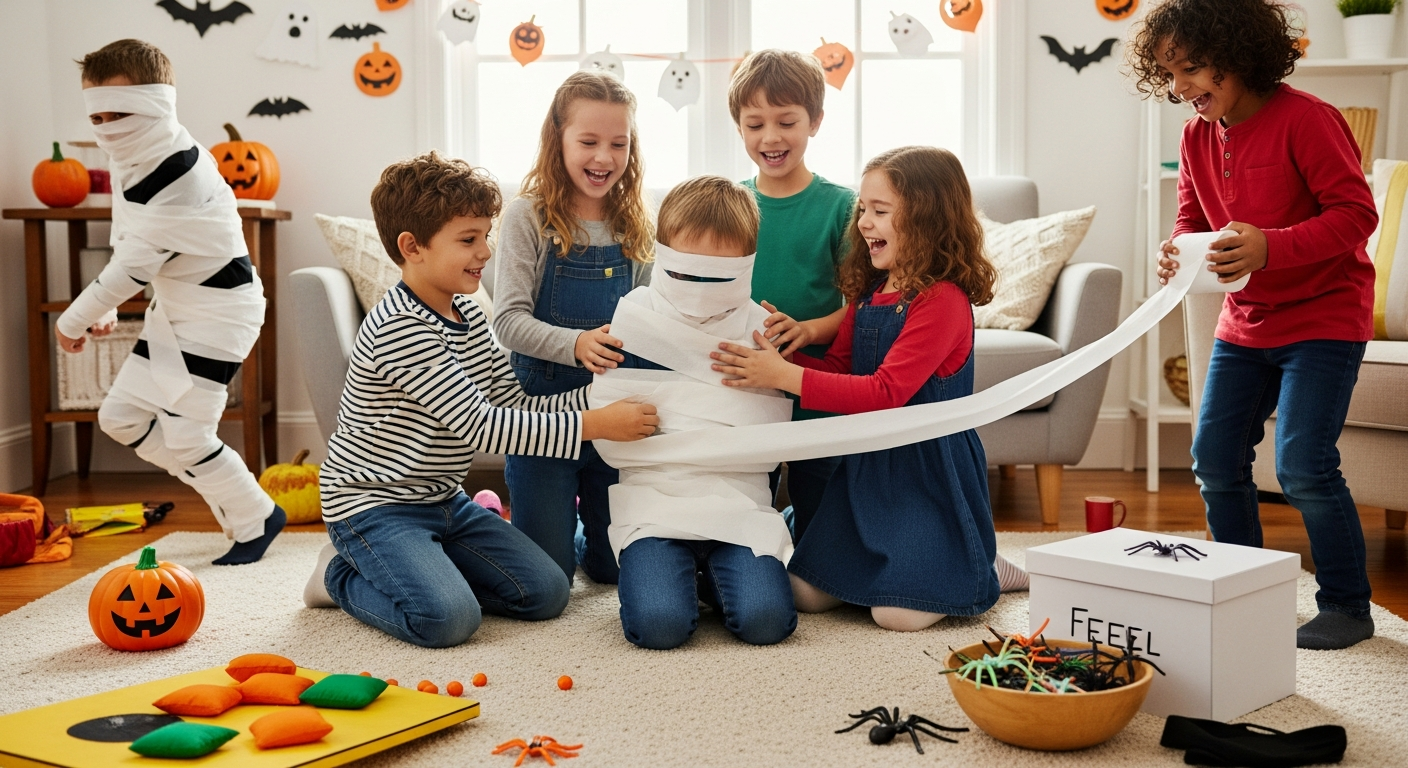
Table of Contents
- Introduction
- The Magic of Play: How Halloween Games Boost Communication
- Classic Halloween Party Games That Never Get Old
- Creative & Quieter Halloween Party Games
- Active & Energetic Halloween Party Games
- Fueling the Fun: Easy Halloween Party Snacks
- Empowering Communication Beyond the Party
- Frequently Asked Questions (FAQ)
Introduction
As the air grows crisp and autumn leaves paint the world in fiery hues, a thrill runs through every child: Halloween is almost here! It's a time for costumes, candy, and, most importantly, unforgettable moments with family and friends. But planning a Halloween party that keeps everyone from toddlers to tweens engaged can feel like a monstrous task. How do you conjure up activities that are not only fun but also easy to set up and play?
At Speech Blubs, we believe that the magic of play is deeply intertwined with the development of communication skills. Every giggle, every shared instruction, and every creative outburst during a game is a building block for confident expression. That’s why we've brewed up the ultimate guide to the best easy Halloween party games for kids – activities designed to spark joy, encourage interaction, and foster crucial developmental skills, all without requiring a cauldron of complicated preparations.

Get ready to transform your home into a hub of haunted delight with games that are simple, engaging, and perfect for children of all ages. This post will walk you through a collection of classic and creative Halloween activities, offering tips for making them inclusive and highlighting the hidden communication benefits in each. By the end, you'll be equipped to host a bewitching bash that your little ghouls and goblins will talk about long after the last candy wrapper is gone!
The Magic of Play: How Halloween Games Boost Communication
Halloween isn't just about costumes and treats; it's a golden opportunity for children to practice essential communication and social skills in a fun, low-pressure environment. When kids engage in group games, they learn to listen, follow directions, take turns, express their ideas, and understand social cues – all foundational elements for confident speech and language development.
Think about it: a game requires understanding rules, verbally negotiating roles, and describing actions. These interactions naturally encourage vocabulary expansion, sentence formation, and the use of expressive language. For children who might be a bit shy or are still developing their verbal fluency, the playful context of a Halloween party can be incredibly motivating. The silly nature of many Halloween activities can lower inhibitions, making it easier for children to experiment with new sounds and words.
At Speech Blubs, our mission is to empower children to "speak their minds and hearts," and we understand that true communication blossoms in environments where children feel safe, engaged, and excited to participate. Many of our innovative activities, like the ones in our app, use a "video modeling" methodology where children learn by watching and imitating their peers. This natural learning style is perfectly complemented by group play, where kids observe and mimic their friends, building a rich tapestry of social and communication experiences.
These games aren't just entertainment; they're valuable learning opportunities disguised as spooky fun. By facilitating these interactions, you're not only creating cherished memories but also actively supporting your child's communication journey. And for parents wondering about their child’s speech development, our quick 3-minute preliminary screener can provide an assessment and next-steps plan to help guide you.

Classic Halloween Party Games That Never Get Old
Some traditions are simply too good to abandon. These classic easy Halloween party games have been delighting children for generations and remain staples for good reason: they're straightforward, highly engaging, and surprisingly beneficial for communication skills.
Mummy Wrap Madness
What You Need: Rolls of toilet paper (the cheaper, the better for easy tearing!), enthusiastic kids.
How to Play: Divide children into teams of two or three. Each team chooses one person to be the "mummy" while the others become the "wrappers." On "go," the wrappers race to cover their mummy from head to toe (leaving a little gap for breathing, of course!). The first team to use up their roll or create the most complete mummy in a set time wins.
Communication Benefits: This game is a fantastic exercise in following multi-step directions ("wrap around," "go under the arm"), teamwork, and verbal negotiation ("you wrap the legs, I'll do the body!"). Children naturally use descriptive language to explain how their mummy looks or what their teammate needs to do. For a parent whose child is working on action verbs, you can explicitly ask, "Are you wrapping? Are you turning? Is the mummy covered?"
Ghoulish Apple Bobbing & Donut Eating Race
What You Need: A large tub or bucket, water, apples for bobbing OR string, donuts, and a place to hang them for the donut race.
How to Play (Apple Bobbing): Fill the tub with water and apples. Children try to grab an apple using only their mouths, no hands allowed! How to Play (Donut Race): Hang donuts from a string at mouth height. Children must eat their donut without using their hands.
Communication Benefits: These sensory-rich activities are wonderful for oral motor practice – the movements of the mouth, jaw, and tongue are crucial for speech sound production. Children also practice patience and turn-taking. Afterwards, encourage them to describe the sensory experience: "Was the water cold?" "Was the donut sticky/sweet?" For a child working on sounds like /w/ or /m/, the "wet" or "mmmm" sounds come naturally. It’s a great, messy way to encourage vocalization and sound play, which complements the engaging video modeling that helps children learn to imitate sounds and words within the Speech Blubs app.
Haunted Scavenger Hunt
What You Need: A list of Halloween-themed items (e.g., "spider," "ghost," "pumpkin," "witch's hat"), small prizes or treats.
How to Play: Hide various Halloween items or pictures around your party space. Give each child or team a list (with words or pictures, depending on age) of what to find. The first to find all the items wins. Add a twist by having a "cauldron" to collect their spooky finds!
Communication Benefits: This game is a treasure trove for vocabulary expansion, especially with Halloween-specific words. It reinforces object recognition and listening comprehension as you read out the list. For older kids, it encourages problem-solving and directional language ("Is it under the table? Behind the curtain?"). For younger children, pointing and naming the objects they find helps build a robust early vocabulary.
Monster Mash Musical Mats
What You Need: Halloween music, enough mats (or pillows, paper plates, hula hoops) for all but one player.
How to Play: Similar to musical chairs, spread the mats on the floor. Play spooky Halloween music and have the children dance around the mats like monsters, witches, or zombies. When the music stops, everyone must quickly find a mat to stand on. Remove one mat each round until only one winner remains.
Communication Benefits: This game hones auditory processing skills (listening for the music to stop), following simple and multi-step directions (dance like a monster, then freeze), and body awareness. It also encourages expressive movements and can prompt sound effects or vocalizations as children move.
Creative & Quieter Halloween Party Games
Sometimes, a party needs a moment of calm, or you might have children who prefer less intense activities. These easy Halloween party games offer creative outlets and encourage different types of communication, perfect for smaller groups or as a cool-down activity.
Pin the Tail on the Monster
What You Need: A large drawing of a monster or pumpkin (missing an eye, nose, or 'tail'), cut-outs of the missing piece for each child, tape or sticky tack, a blindfold.
How to Play: Blindfold each child in turn, spin them around gently a few times, and direct them to pin their piece in the correct spot on the monster. Mark where each child placed their piece. The closest wins!
Communication Benefits: This activity is excellent for spatial awareness, body part vocabulary, and using directional language ("a little to the left," "up higher"). It also encourages descriptive language when talking about the monster or the funny places the pieces ended up. Parents can model phrases like "Is it on his head?" or "Let's try under his chin!"
Halloween Bingo
What You Need: Printable Halloween Bingo cards (easily found online), markers (candy corn, small erasers work well).
How to Play: Each child gets a Bingo card. The caller picks Halloween-themed pictures or words from a hat. If a child has that item on their card, they mark it. The first to get five in a row shouts "Bingo!" (or "Trick-or-Treat!").
Communication Benefits: Halloween Bingo is fantastic for vocabulary acquisition (especially reinforcing Halloween words), matching skills, and turn-taking. It encourages active listening and provides a structured way to practice identifying objects and following simple rules. This is a calmer activity that still offers rich opportunities for language practice.
Spooky Sensory Boxes
What You Need: Several opaque boxes or bowls, various "gross" but safe items (cooked spaghetti for "worms," peeled grapes for "eyeballs," dried beans for "monster teeth," corn kernels for "witch warts"), small hidden treasures (plastic coins, spider rings).
How to Play: Decorate the boxes to look spooky. Children reach into each box without looking and try to identify what they're feeling. You can hide a small prize at the bottom for brave explorers!
Communication Benefits: Sensory play is incredibly powerful for descriptive language. Encourage children to use adjectives like "slimy," "bumpy," "squishy," "hard," "soft," and "cold." It promotes questioning skills ("What is this?"), turn-taking, and expressive language as they describe their discoveries and reactions. This game can also help children articulate their sensory experiences, a crucial step for many speech and language learners. For children who thrive on multi-sensory experiences, integrating activities like this with the visual and auditory learning from Speech Blubs can create a powerful learning synergy.
Halloween Charades
What You Need: Slips of paper with Halloween-themed actions or characters (e.g., "ghost," "witch flying," "carving a pumpkin," "trick-or-treating," "mummy walking"), a timer.
How to Play: Divide into teams. One person acts out a word or phrase without speaking while their team tries to guess. Set a time limit for each turn.
Communication Benefits: Charades is a phenomenal game for developing non-verbal communication skills, understanding actions and verbs, and vocabulary. It encourages inference and deductive reasoning as children try to interpret the actions. When it's their turn to guess, children practice expressive language and turn-taking. Even when not speaking, children are internalizing and associating movements with concepts, which strengthens their language networks.
Cookie Face-Off
What You Need: Flat Halloween cookies (like Oreos or round sugar cookies) for each player.
How to Play: Each player places a cookie on their forehead. Using only facial muscles (no hands!), they must try to maneuver the cookie down their face and into their mouth.
Communication Benefits: This game is pure silliness and laughter, which helps create a positive and relaxed environment for communication. It encourages fine motor control and patience. The shared laughter and attempts can naturally lead to expressive exclamations ("Oh no!", "Almost!") and descriptive comments about the cookie's journey. It's a low-pressure way to encourage children to use their facial muscles in new ways, which can indirectly support articulation.
Active & Energetic Halloween Party Games
When your little monsters have had a sugar rush, these easy Halloween party games are perfect for burning off energy while still reinforcing essential skills.
Pumpkin Patch Stomp (Balloon Pop)
What You Need: Orange and black balloons (stuffed with small, squish-proof candies or slips of paper with simple commands like "say 'boo!'"), a clear space.
How to Play: Inflate balloons and scatter them on the floor. Children race to stomp on and pop as many balloons as they can to collect the treats or complete the commands inside. Alternatively, assign each child a color and they only stomp their own color.
Communication Benefits: This game is fantastic for gross motor skills and auditory processing (the exciting sound of the pop!). If you include commands inside, it's a direct way to practice following instructions and expressive language (saying "boo!"). Counting the popped balloons or collected treats reinforces number concepts. The excitement also naturally encourages exclamations and shared joy, which are important for social communication.
Spider Races
What You Need: Plastic spiders, straws, a smooth table or floor, masking tape for a start and finish line.
How to Play: Each child gets a plastic spider and a straw. Line them up at the start. On "go," they blow through the straw to propel their spider across the finish line. The first spider to cross wins.
Communication Benefits: This game is excellent for developing breath control, which is fundamental for speech production. Children learn to sustain a breath and control its expulsion. It also involves following simple instructions and can spark encouraging phrases among players ("Go, spider, go!"). It’s a fun, active way to work on oral motor skills that are essential for clear articulation.
Broom and Pumpkin Race
What You Need: Small or medium pumpkins (one per child/team), child-sized brooms (one per child/team).
How to Play: Set up a simple race course with a start and finish line, or even a few cones for an obstacle. Children use their brooms to push their pumpkins across the course. If a pumpkin gets too far ahead or goes off course, they must use their broom to bring it back.
Communication Benefits: This game is great for gross motor coordination and following directions. Children listen for "start," "stop," and instructions about the course. It encourages problem-solving when the pumpkin veers off course and can lead to verbal strategy with teammates ("Push it harder!", "Slow down here!"). The physical activity combined with focused task demands supports sustained attention, which is beneficial for overall listening and language comprehension.
Fueling the Fun: Easy Halloween Party Snacks
While the games are the main event, a few spooky snacks can add to the festive atmosphere. Keep it simple and on-theme!
- Satsuma Pumpkins: Draw jack-o'-lantern faces on satsumas or oranges with a black marker. Simple and healthy!
- Oreo Spiders: Twist open Oreos, place four black licorice laces on the cream for legs (eight total), then reattach the top. Add edible googly eyes with a dab of icing.
- Cheesy Broomsticks: Cut cheese sticks into broom shapes, attach to pretzel sticks with chives.
- Strawberry Ghosts: Dip strawberries in melted white chocolate, add two edible googly eyes before the chocolate sets.
These fun snacks can also be opportunities for communication. Ask children to describe the food, request specific items, or talk about how they made them.
Empowering Communication Beyond the Party
These easy Halloween party games for kids are more than just fun; they are powerful opportunities to foster essential communication skills. From expanding vocabulary to mastering turn-taking and following instructions, every game contributes to a child's overall language development.
At Speech Blubs, we deeply understand the journey of helping children find their voice. Our company was born from the personal experiences of our founders, who all grew up with speech problems and created the tool they wished they had. We are committed to providing an immediate, effective, and joyful solution for the 1 in 4 children who need speech support, blending scientific principles with play into one-of-a-kind "smart screen time" experiences.
Our app offers a screen-free alternative to passive viewing, promoting active participation through our unique "video modeling" methodology. Children learn by watching and imitating their peers, making the learning process engaging and natural. It's a powerful tool for family connection, designed to be played together, creating joyful learning moments that build confidence and reduce frustration.
Unlock Your Child's Full Potential with Speech Blubs
Ready to continue the journey of fostering a love for communication and building your child's confidence every day? Speech Blubs is here to support you. We believe in providing access to high-quality, scientifically-backed resources that make a real difference.
We offer two convenient plans:
- Monthly Plan: For just $14.99 per month.
- Yearly Plan: Our best value at $59.99 per year, which breaks down to an incredible $4.99 per month!
Choosing the Yearly Plan not only saves you a significant 66% compared to the monthly subscription but also unlocks exclusive benefits:
- A 7-day free trial to experience the full range of Speech Blubs features.
- Access to the extra Reading Blubs app, further enhancing early literacy skills.
- Early access to new updates and a dedicated 24-hour support response time.
The Monthly Plan does not include these exclusive features or the free trial. We highly recommend starting with the Yearly Plan to get the most comprehensive and valuable experience for your child's communication development.
Join thousands of happy families who have seen incredible progress with Speech Blubs. See what other parents are saying about their child's success with Speech Blubs testimonials and learn more about our science-backed methodology on our research page.
Ready to get started? Download Speech Blubs today and begin your 7-day free trial by selecting the Yearly plan:
Empower your child to communicate confidently, not just for Halloween, but for life. Visit our homepage to learn more about our comprehensive approach to speech and language development.
Frequently Asked Questions (FAQ)
Q1: What age group are these Halloween party games suitable for?
A1: Most of the games mentioned are designed to be adaptable for a wide range of ages, from toddlers to early teens. For younger children, simplify rules and focus on participation rather than competition. For older kids, you can add more complex rules or challenges. Adult supervision and participation are always recommended to ensure everyone has fun and stays safe.
Q2: How can I make these games more inclusive for children with different communication needs?
A2: To make games more inclusive, offer visual aids for instructions, use clear and simple language, and provide opportunities for both verbal and non-verbal participation. For example, in a scavenger hunt, use pictures alongside words. Encourage pointing, gestures, and sounds as forms of communication. Focus on individual effort and enjoyment, rather than just winning. The core of these games is interaction and engagement, which can be tailored to various communication styles.
Q3: What if I don't have all the materials for a specific game?
A3: Most of these easy Halloween party games are highly adaptable! Get creative with what you have around the house. For example, if you don't have mats for "Monster Mash Musical Mats," use pillows, towels, or even marked spots on the floor. Plastic cups can replace tin cans for bowling, and any soft ball can be a "pumpkin" for a broom race. The spirit of Halloween fun often involves a bit of DIY magic!
Q4: How does Speech Blubs complement these in-person party games?
A4: While these party games provide valuable real-world interaction, Speech Blubs offers a structured and engaging way to reinforce foundational communication skills daily. Our video modeling approach helps children practice imitation of sounds and words, expand vocabulary, and build sentences in a "smart screen time" environment. It's a powerful supplement to real-life experiences, allowing children to build confidence and develop specific speech and language skills that they can then bring into social settings like parties. Think of the app as a daily booster for the skills honed during fun activities like your Halloween party!
About the author