
Supporting a 3 Year Old With Speech Delay at Home
 By Speech Blubs Team•Mar 9, 2026•14 min.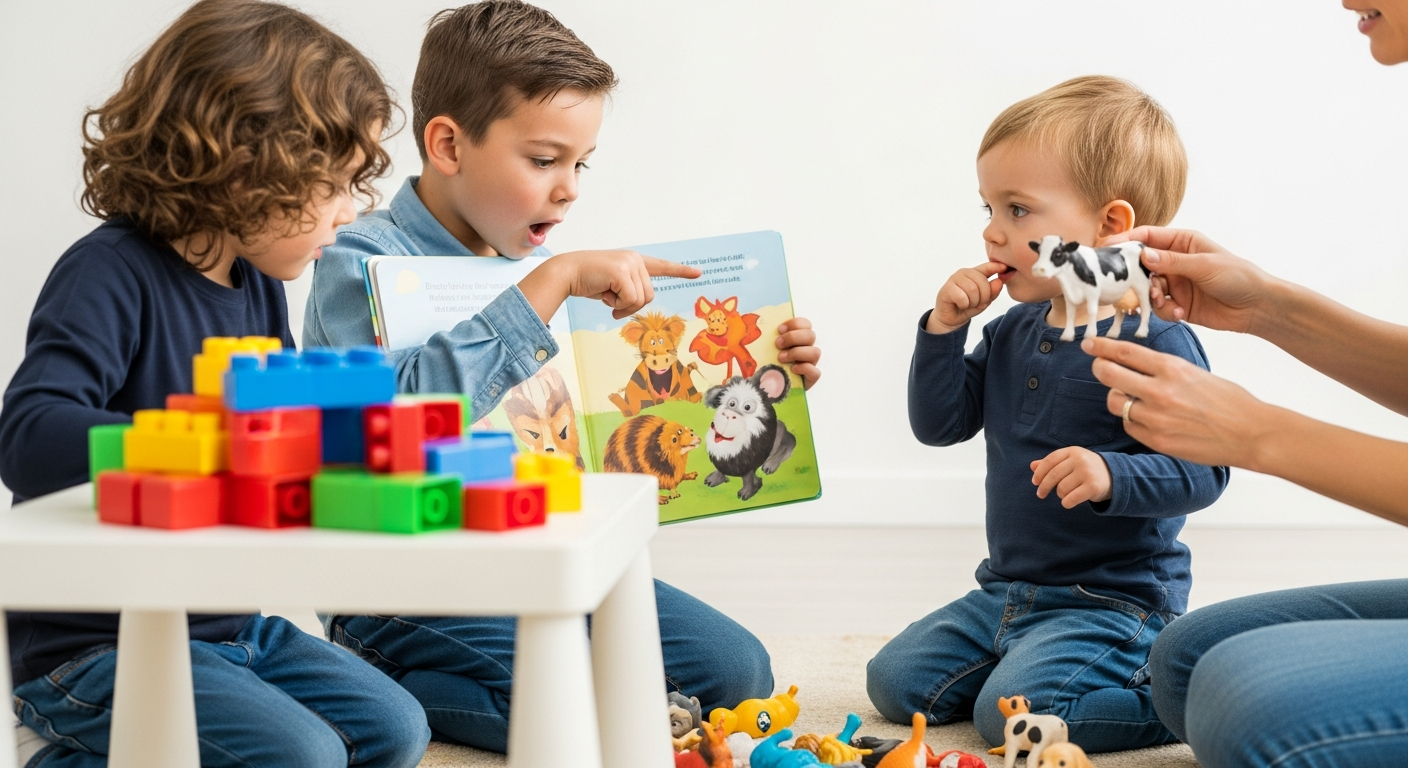
Table of Contents
- Introduction
- Understanding Speech vs. Language
- Milestones for a 3-Year-Old
- Recognizing the Red Flags
- Why Do Speech Delays Happen?
- The Speech Blubs Mission: Empowering Every Child
- Our Unique Methodology: Video Modeling
- Practical Scenarios: Bringing Speech Blubs to Life
- How Parents Can Help at Home
- Setting Realistic Expectations
- Choosing the Right Plan: Monthly vs. Yearly
- Working with Professionals
- Conclusion
- FAQ
Introduction
Imagine you are sitting on the floor with your child, surrounded by colorful blocks. Your toddler points toward a blue square and lets out a frustrated grunt. You offer the red one, then the yellow one, and finally, the blue one. By the time you find the right one, your little one is in tears, unable to tell you that they just wanted the "blue block." For many parents, this scene is a daily reality. Seeing your 3 year old with speech delay struggle to express their thoughts, feelings, and needs is heartbreaking. You might find yourself constantly comparing your child to their peers at the playground or wondering if you should have started reading to them even sooner.
The purpose of this blog post is to provide you with a comprehensive roadmap for navigating speech and language development during these pivotal preschool years. We will explore the critical differences between speech and language, identify the developmental milestones your child should be reaching, and look at the "red flags" that indicate it might be time for extra support. Most importantly, we will share how we at Speech Blubs use science-backed play to help children find their voices.

While every child follows their own unique timeline, a speech delay is not something you have to navigate alone. By understanding the signs early and integrating "smart screen time" into your daily routine, you can transform moments of frustration into joyful opportunities for connection and communication.
Understanding Speech vs. Language
When we talk about a 3 year old with speech delay, it is common to use the terms "speech" and "language" interchangeably. However, in the world of child development, they represent two distinct sets of skills. Understanding the difference helps you identify exactly where your child might need the most encouragement.
What is Speech?
Speech refers to the physical act of producing sounds and forming words. It involves the coordination of the lips, tongue, jaw, and vocal cords. If a child has a speech delay, they might know exactly what they want to say, but the sounds come out garbled or unclear. You might notice they struggle with specific sounds, such as "p," "b," "t," or "d," making it difficult for people outside the family to understand them.
What is Language?
Language is much broader. It is the system of giving and receiving information—the "how" and "why" of communication. It includes:
- Expressive Language: How your child uses words, gestures, and writing to share their thoughts.
- Receptive Language: How well your child understands what is being said to them.
- Social Language (Pragmatics): Knowing how to take turns in a conversation or use eye contact.
A child with a language delay might be able to pronounce words perfectly but only use two-word phrases when their peers are using full sentences. Or, they might struggle to follow a simple direction like, "Go get your shoes and put them by the door."
Milestones for a 3-Year-Old
By the time a child turns three, their world is expanding rapidly. They are moving away from simple labeling and toward storytelling. While there is a wide range of "normal," most children reaching their third birthday will hit several key milestones.

Communication and Vocabulary
At this age, a child's vocabulary typically explodes. We often see children using between 250 and 1,000 words. They should be able to state their first name and use pronouns like "I," "you," and "me" (though they might still mix them up occasionally!). You should also hear them asking plenty of "Why?" and "Where?" questions as they explore their environment.
Sentence Structure and Clarity
A typical 3-year-old should be speaking in three- to five-word sentences. Instead of just saying "juice," they might say, "I want more juice, please." In terms of clarity, parents and regular caregivers should understand about 75% of what the child says. If you find yourself acting as a constant "translator" for your child because others cannot understand them at all, it may be a sign of a delay.
Following Directions and Interaction
Socially, 3-year-olds are beginning to understand the concept of a conversation. They should be able to take a couple of turns in a verbal exchange and follow two-step commands. If your child seems to "ignore" instructions, it might not be defiance; it could be a struggle with receptive language. If you are unsure where your child stands, we invite you to take our quick 3-minute preliminary screener. It consists of 9 simple questions to give you an assessment and a next-steps plan.
Recognizing the Red Flags
As parents, our intuition is a powerful tool. Often, we feel that something is "off" before we can put it into words. If you have a 3 year old with speech delay, look for these specific red flags that suggest it’s time to consult a professional:
- Limited Vocabulary: Using fewer than 200 words or failing to combine words into short phrases.
- Lack of Understanding: Difficulty following simple, familiar instructions without gestures.
- Inconsistent Response: Not responding to their name or appearing to have "selective hearing" (which could actually be a hearing or processing issue).
- Frustration and Behavior: Frequent meltdowns caused by the inability to communicate needs.
- Loss of Skills: If your child was previously using words and suddenly stops, this "regression" is a sign that needs immediate pediatric attention.
- Unusual Tone: A very raspy, nasal, or high-pitched voice that doesn't seem to match the situation.
Early intervention is the "gold standard" for supporting children. Research shows that the brain is most adaptable in these early years, and providing support now can prevent academic and social struggles later in life. You can read more about the scientific research behind early language intervention to see how these foundational years shape future success.
Why Do Speech Delays Happen?
It is important to remember that a speech delay is rarely the "fault" of the parent. Delays can stem from various physical, neurological, or environmental factors.
Oral-Motor and Physical Issues
Sometimes, the issue is structural. A short frenulum (the fold under the tongue) can limit movement, commonly known as being "tongue-tied." In other cases, there is an "oral-motor" problem where the brain has difficulty coordinating the muscles of the lips, tongue, and jaw. This can make it hard to produce the right sounds even if the child knows the word.
Hearing Loss and Ear Infections
Because children learn to speak by listening, even a mild hearing loss can derail speech development. Chronic ear infections can cause fluid buildup, making sounds muffled—much like trying to listen to someone speaking while you are underwater. This is why most specialists recommend a formal hearing test as the first step for any child with a suspected delay.
Developmental Conditions
Speech delays are often one of the first signs of Autism Spectrum Disorder (ASD) or Global Developmental Delay. In these cases, the delay is usually accompanied by other signs, such as a lack of "joint attention" (not looking at the same thing you are pointing at) or a preference for playing alone.
The Speech Blubs Mission: Empowering Every Child
At Speech Blubs, our mission is to empower children to "speak their minds and hearts." Our company was born from the personal experiences of our founders, who all grew up with speech problems themselves. They created the tool they wished they had—one that turns therapy into a joyful, play-based experience.
We understand that for the 1 in 4 children who need speech support, traditional methods can sometimes feel like "work." That is why we have blended scientific principles with play to create "smart screen time." Unlike passive viewing—like letting a child watch cartoons for hours—our approach is active and participatory. We provide a powerful tool for family connection, where the screen becomes a bridge to real-world communication rather than a barrier.
Our Unique Methodology: Video Modeling
The "secret sauce" of our app is a technique called video modeling. This is based on the scientific concept of mirror neurons. When a child watches another child perform an action or say a word, the same parts of their brain light up as if they were doing it themselves.
In our app, children learn by watching and imitating their peers. There is a special magic that happens when a 3-year-old sees another child on the screen making a funny "ooh" sound or popping their lips. It builds confidence and reduces the pressure often felt in adult-led therapy. This peer-to-peer approach is what makes Speech Blubs a one-of-a-kind experience. You can see real success stories from parents who have seen their children’s confidence soar through this method.
Practical Scenarios: Bringing Speech Blubs to Life
We believe that learning happens best when it is tied to a child’s interests. Here are a few ways you can use the Speech Blubs app to support your 3 year old with speech delay in everyday life.
For the Animal Lover: The "Animal Kingdom" Section
Imagine your toddler is obsessed with the neighbor's dog or loves visiting the local farm. You can open the "Animal Kingdom" section of the app. As your child watches a peer mimic a dog's "woof" or a cow's "moo," they are encouraged to do the same. This isn't just about animal sounds; it’s about practicing the lip rounding and breath control needed for more complex words later on. After the session, you can go outside and look for birds or dogs, reinforcing the sounds you just practiced together.
For the Picky Eater: "Yummy Time"
Mealtime can be a source of stress if your child can't tell you what they want. In the "Yummy Time" section, children see their peers eating and naming common foods like "apple," "banana," or "milk." For a parent whose child struggles to name their snacks, this section offers a fun, motivating way to practice. You can download Speech Blubs on the App Store to start exploring these interactive categories today.
For the Child Who Struggles with Routines: "This is My Body"
If your 3-year-old gets frustrated during bath time or when getting dressed, the "This is My Body" section can help. By watching other kids point to their "nose," "eyes," and "hands," your child learns the labels for their own body. This builds receptive language, making it easier for them to follow directions like, "Wash your tummy!" during bath time.
How Parents Can Help at Home
While we are proud of our app, we always emphasize that it is a supplement to the most important "therapy" of all: your interaction. Here are some simple ways to foster a love for communication:
- Narrate Your Day: Talk about everything you are doing. "I am pouring the milk. Now I am putting the milk in the fridge." This provides a constant stream of language for your child to absorb.
- Read Repetitive Books: Books with repeating phrases allow your child to predict what comes next. Pause before the familiar word and see if they fill it in.
- Create a Communication "Need": Instead of giving your child their juice automatically, hold it for a second and wait for them to make a sound or gesture. This encourages them to realize that their voice has power.
- Focus on Confidence, Not Perfection: If your child says "tat" for "cat," don't correct them harshly. Instead, model the correct word: "Yes, that is a big white cat!"
Our goal is to help you build foundational skills while creating joyful family learning moments. If you’re ready to bring these strategies into your home, you can get it on Google Play and begin your journey.
Setting Realistic Expectations
It is vital to frame the use of any tool, including Speech Blubs, with realistic expectations. We are not here to suggest that your child will be giving public speeches in a month. Every child’s brain is wired differently. Instead, we focus on the benefits of the process:
- Fostering a genuine love for communication.
- Building the confidence to try new sounds.
- Reducing the daily frustration for both child and parent.
- Developing key foundational skills like imitation and turn-taking.
Our app is a powerful supplement to your child’s overall development plan and, when applicable, professional therapy. Think of it as a workout for the "communication muscles" that happens through play.
Choosing the Right Plan: Monthly vs. Yearly
We want to be transparent about our pricing to help you make the best decision for your family. We offer two main paths:
- Monthly Plan: $14.99 per month. This is a great "pay-as-you-go" option for those who want to test the waters.
- Yearly Plan: $59.99 per year.
Why the Yearly Plan is the Clear Best Choice: The Yearly plan isn’t just more affordable—it breaks down to just $4.99 per month, saving you 66% compared to the monthly rate. More importantly, the Yearly plan includes exclusive, high-value features that are not available on the Monthly plan:
- 7-Day Free Trial: You can explore everything we offer risk-free for a full week.
- Reading Blubs App: You get full access to our additional app designed to help children transition from speaking to reading.
- Priority Support: Early access to new updates and a 24-hour support response time.
To get the full suite of features and the best value, we recommend choosing the Yearly plan. You can create your account and begin your 7-day free trial today on our website.
Working with Professionals
If you have a 3 year old with speech delay, it is always a good idea to speak with your pediatrician. They may refer you to a Speech-Language Pathologist (SLP). An SLP can provide a formal evaluation, checking both expressive and receptive language, as well as oral-motor function.
Speech Blubs is designed to work hand-in-hand with professional therapy. Many therapists actually use our app during their sessions to engage children who are difficult to motivate. You can visit our Speech Blubs homepage to learn more about how our tools fit into a broader therapeutic context.
Conclusion
Navigating a speech delay can feel like an uphill battle, but every small word and every clear sound is a victory worth celebrating. By focusing on your child’s strengths, using "smart screen time" to encourage imitation, and seeking professional guidance when needed, you are giving your child the greatest gift possible: the ability to "speak their mind and heart."
We invite you to join the Speech Blubs family. Whether your child is just starting to babble or is struggling to put sentences together, we are here to support you with a joyful, effective, and scientifically-backed solution.
Ready to get started? Download Speech Blubs on the App Store or Google Play today. Remember to select the Yearly plan to unlock your 7-day free trial, the Reading Blubs app, and the best long-term value for your child’s development.
FAQ
1. Is a speech delay at age 3 permanent? Not necessarily. Many children with a speech delay make significant progress with early intervention and consistent support at home. While some children may have underlying conditions that require long-term support, many "late talkers" catch up to their peers before they start kindergarten.
2. How much screen time is okay for a 3-year-old with a delay? The quality of screen time matters more than the quantity. The American Academy of Pediatrics suggests limiting screen time to one hour of high-quality programming. Speech Blubs is considered "smart screen time" because it requires the child to be an active participant, making it a productive part of that hour.
3. Does the Speech Blubs app replace traditional speech therapy? No, Speech Blubs is designed to be a powerful supplement to professional therapy, not a replacement. It provides a fun way to practice at home between sessions, helping to reinforce the skills your child is learning with their therapist.
4. Can I use the app if I'm not sure if my child has a delay? Absolutely! Speech Blubs is a great tool for all children to boost their communication skills, vocabulary, and confidence. Even if your child is hitting their milestones, the peer-modeling methodology is a joyful way to encourage early literacy and social skills.
About the author