
Supporting Your Toddler: How to Help 3-Year-Old With Speech Delay
 By Speech Blubs Team•Mar 12, 2026•15 min.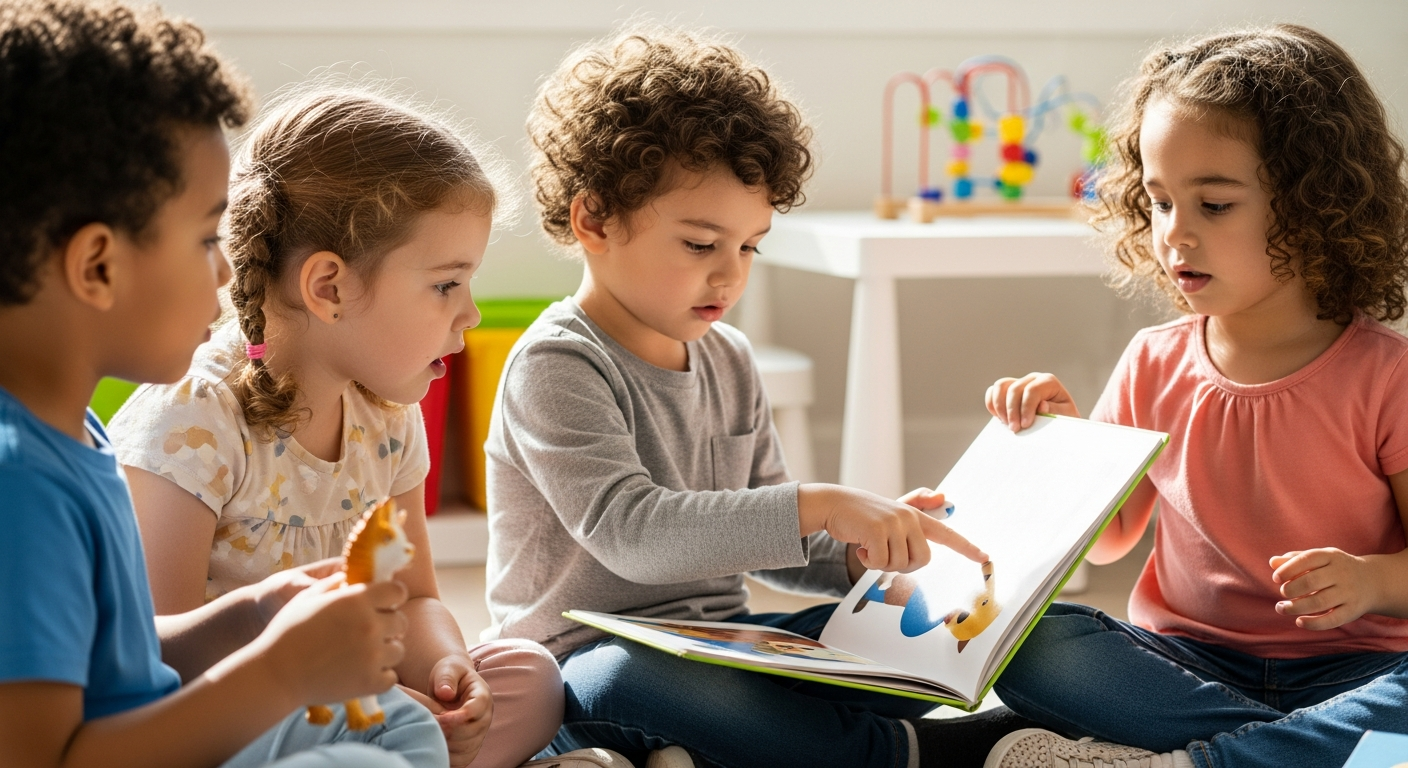
Table of Contents
- Introduction
- Understanding Speech and Language Milestones at Age Three
- Common Causes of Speech Delays
- The Power of Video Modeling: The Speech Blubs Method
- Practical At-Home Exercises to Help Your 3-Year-Old
- Navigating the Professional Path: When to Seek Help
- Why Speech Blubs is the "Smart" Choice for Your Family
- Choosing the Right Plan for Your Child's Success
- Setting Realistic Expectations
- The Role of "Smart Screen Time" in Modern Parenting
- Building a Supportive Environment at Home
- Conclusion
- Frequently Asked Questions
Introduction
Imagine you are at a playdate. Around you, other three-year-olds are chatting about their favorite snacks, asking "why" every ten seconds, and telling short, albeit messy, stories about their morning. Meanwhile, your child stands quietly, perhaps pointing to a juice box or tugging at your sleeve to get your attention, but the words just aren’t there yet. If you have ever felt that heavy knot of worry in your stomach while comparing your child’s silence to the chatter of their peers, please know that you are not alone. It is a common concern that brings thousands of parents to our community every single day.
The purpose of this guide is to provide you with a comprehensive, empathetic, and scientifically-grounded roadmap for navigating speech delays in three-year-olds. We will cover the vital milestones your child should be reaching, the common causes behind these delays, and, most importantly, practical strategies you can start using at home today. At Speech Blubs, our mission is to empower every child to "speak their minds and hearts." We believe that communication is a fundamental right, and our company was born from the personal experiences of our founders who grew up with speech challenges themselves. They created the very tool they wished they had—a way to turn "screen time" into "smart time" that fosters genuine connection.

By the end of this article, you will understand how to help a 3-year-old with speech delay through a combination of professional guidance, at-home exercises, and the joyful application of modern technology. Our thesis is simple: While every child develops on their own timeline, early intervention paired with playful, consistent engagement is the most effective way to build a child’s confidence and help them find their voice.
Understanding Speech and Language Milestones at Age Three
To understand how to help your child, we first need to look at what typical development looks like for a three-year-old. It is important to distinguish between "speech" (how we say sounds and words) and "language" (how we understand and use those words to share ideas).
By the time a child turns three, they are usually in a "language explosion" phase. Typically, a three-year-old can:
- Use between 200 and 1,000 words.
- Speak in three- to four-word sentences (e.g., "I want more juice").
- Be understood by familiar caregivers about 75% of the time.
- Follow two-step instructions (e.g., "Get your shoes and put them by the door").
- Ask simple "who," "what," and "where" questions.
A speech delay occurs when a child isn't making the expected sounds or articulating words clearly, while a language delay might mean they understand what is being said but cannot formulate the words to respond. If your child is struggling in these areas, it isn’t a reflection of your parenting. It is simply a signal that they may need a different type of support to bridge the gap.
If you are unsure where your child stands, we recommend taking our quick 3-minute preliminary screener. It consists of nine simple questions and provides you with an initial assessment and a next-steps plan to help you move forward with clarity.
Common Causes of Speech Delays
When a child isn't talking as much as their peers, parents often wonder "why?" Understanding the "why" is the first step in knowing how to help.
Oral-Motor and Physical Challenges
Sometimes, the delay is physical. This could involve an oral impairment like a short frenulum (tongue-tie) or a cleft palate. In many cases, children experience oral-motor problems where the brain has difficulty coordinating the lips, tongue, and jaw to produce specific sounds. If a child cannot physically form the shapes needed for speech, they will naturally be slower to talk.

Hearing Loss
Speech development is heavily dependent on a child’s ability to hear. Even temporary hearing loss caused by chronic ear infections can disrupt the way a child hears and eventually imitates sounds. If a child hears muffled speech, they will likely produce muffled speech.
Developmental and Neurological Factors
In some instances, speech delay is a symptom of a broader developmental profile, such as Autism Spectrum Disorder (ASD) or Cerebral Palsy. For children with ASD, communication challenges often go hand-in-hand with social and behavioral differences. However, it is vital to remember that a speech delay on its own does not automatically mean a child has autism. Many "late talkers" simply need a bit of extra encouragement to get started.
The Power of Video Modeling: The Speech Blubs Method
At Speech Blubs, we don't believe in passive screen time. We’ve all seen the "zombie effect" that happens when kids stare at mindless cartoons. Instead, we advocate for "smart screen time" that invites participation. Our unique approach is rooted in the scientific methodology of video modeling.
Research suggests that children learn best by watching their peers. When a child sees another child—not an adult or a cartoon—performing a task or making a sound, their "mirror neurons" fire. This creates a natural urge to imitate. Our app features over 1,500 activities where real children model sounds, words, and sentences.
We are proud to say that our method is backed by science, placing us in the top tier of speech applications worldwide. We provide a joyful solution for the 1 in 4 children who need speech support, blending education with play to reduce the frustration that often comes with a language gap.
Practical At-Home Exercises to Help Your 3-Year-Old
While professional therapy is invaluable, the most important "therapy" happens in the small moments of your daily routine. Here are five powerful exercises to help a 3-year-old with speech delay.
1. Self-Talk and Parallel Talk
These are two of the easiest strategies to implement because they require no special toys—just your voice.
- Self-Talk: Narrate your own actions as if you are a sports commentator. "I am washing the red apple. Now I am cutting the apple. Crunch, crunch!"
- Parallel Talk: Narrate your child’s actions. If your child is playing with cars, you might say, "The blue car is going fast! Beep beep! The car stopped."
This constant, low-pressure stream of language helps your child map words to actions without feeling the "pressure" to perform.
2. The Power of Choice
For a child who struggles to speak, it is often easier to just give them what they need before they ask. However, this removes the "need" to communicate. Instead, offer choices. Hold up a banana in one hand and an apple in the other. Ask, "Do you want the apple or the banana?" Even if they just point, you are creating a communicative moment. You can then reinforce the word by saying, "The apple! You chose the red apple."
3. Creating a "Communication Temptation"
If your child’s favorite toys are always within reach, they don't have a reason to talk to you. Try placing a favorite stuffed animal or a beloved toy car on a high shelf where they can see it but can't reach it. When they look at it or point, use that as an opportunity to model the word. For a child who loves animals, this is a perfect time to use the Animal Kingdom section of our app.
Practical Scenario: Imagine a parent, David, whose 3-year-old son, Leo, is a "late talker" who is obsessed with lions. David notices Leo pointing at a toy lion on the shelf. Instead of just handing it over, David opens Speech Blubs to the 'Animal Kingdom' section. They watch a peer model the "Roar!" sound together. Leo sees the child on the screen smiling and roaring, and suddenly, he tries it too. David praises the effort immediately, making the connection between the sound, the toy, and the fun interaction. This turns a moment of potential frustration into a joyful learning experience.
4. Reading with Intent
Don't just read the words on the page. Point to the pictures and ask questions. Use books with repetitive phrases or "lift-the-flap" features that encourage interaction. If your child isn't ready for the story, just talk about the pictures. "Look at the big yellow bus! Vroom vroom!" You can find many parent testimonials on our site that highlight how interactive reading and our app have worked together to spark a love for words.
5. Singing and Nursery Rhymes
Music is processed differently in the brain than speech. Many children who struggle to say a sentence can sing a song. Use nursery rhymes like "The Wheels on the Bus" or "Itsy Bitsy Spider" and pause before the last word of a line to see if your child fills it in. "The wheels on the bus go round and... [pause]."
Navigating the Professional Path: When to Seek Help
While at-home strategies are vital, they are most effective when they supplement professional care. If you are concerned, your first stop should be your pediatrician or a Speech-Language Pathologist (SLP).
An SLP will conduct a formal assessment to look at:
- Receptive Language: What your child understands.
- Expressive Language: What your child says.
- Oral-Motor Status: How their mouth muscles are working.
- Articulation: How clear their speech sounds are.
We always frame the use of Speech Blubs as a powerful supplement to a child's overall development plan. We are here to support the work you do with professionals, providing a way to keep the momentum going between therapy sessions.
To get started on this journey, you can download Speech Blubs on the App Store or Google Play to begin your journey today.
Why Speech Blubs is the "Smart" Choice for Your Family
In a world filled with endless digital distractions, we pride ourselves on being a screen-free alternative to passive viewing. Our goal isn't to keep your child glued to a tablet; it's to use the tablet as a bridge to real-world communication.
Scientific Principles Meets Play
Our founders’ personal history ensures that empathy is at the core of everything we do. We know the frustration of not being understood. That’s why we’ve built an experience that feels like a game but is actually a series of sophisticated speech exercises. We focus on building foundational skills like imitation, facial expressions, and sound recognition, all of which are precursors to complex sentences.
Empowering the Whole Family
We don't expect your child to use the app alone. In fact, we encourage adult co-play. Sit with your child, laugh at the funny filters, and imitate the sounds together. This strengthens your bond and shows your child that communication is fun, not a chore.
Choosing the Right Plan for Your Child's Success
We believe in transparency and providing the best possible value for families who are committed to their child’s progress. To help you choose what works best for your household, here is a breakdown of our current pricing:
- Monthly Plan: $14.99 per month. This is a great way to test the waters and see how your child responds to our peer-led video modeling.
- Yearly Plan: $59.99 per year. This is our most popular option and the clear best choice for long-term development.
When you choose the Yearly Plan, you aren't just saving 66% compared to the monthly rate (bringing the cost down to just $4.99/month); you are also unlocking a suite of exclusive, high-value features designed to accelerate your child's growth:
- 7-Day Free Trial: Experience the full power of the app with zero risk.
- Reading Blubs App: Access our companion app dedicated to early literacy and reading skills.
- Early Access: Be the first to try our new updates and features.
- Priority Support: Enjoy a 24-hour response time from our dedicated support team.
The Monthly plan does not include these additional benefits. We encourage you to create your account and begin your 7-day free trial today to see the difference for yourself.
Setting Realistic Expectations
It is important to have a healthy perspective on progress. You might see some blogs promising that "your child will be giving public speeches in a month," but we prefer to stay grounded in reality. Every child’s journey is unique.
Our focus is on fostering a love for communication, building the confidence to try new sounds, and reducing the daily frustration for both you and your toddler. By celebrating the small wins—a new sound, a pointed finger, a shared laugh—you create a positive environment where language can eventually bloom.
If you are ready to take the next step, you can find us on the Google Play Store and join the millions of families who have made us a part of their daily routine.
The Role of "Smart Screen Time" in Modern Parenting
The debate over screen time is often black and white, but the reality is more nuanced. As a child development expert, I often tell parents that the quality of the content matters far more than the quantity of the minutes.
Passive screen time—where a child sits silently watching bright colors flash by—does very little for language development. In fact, excessive passive viewing can sometimes contribute to delays. "Smart screen time," on the other hand, is active. It requires the child to listen, process, and respond.
When your child uses our video modeling tools, they aren't just watching a video; they are engaging in a social rehearsal. They see a child who looks like them, hear a voice that sounds like theirs, and are prompted to interact. This is why we are more than just an app; we are a specialized tool for family connection.
Building a Supportive Environment at Home
Beyond the exercises and the technology, the emotional climate of your home plays a huge role in how to help a 3-year-old with speech delay.
- Reduce Pressure: Avoid saying things like "Say 'milk'. Say it now." This can cause a child to shut down. Instead, model the word yourself and wait.
- Celebrate All Communication: If your child points to the door to go outside, acknowledge it! "You pointed to the door. You want to go outside! Let's go!" Even non-verbal communication is a win.
- Be Patient: It can be incredibly frustrating when you can't understand what your child wants. Take a deep breath. Your calm presence is the safest place for them to practice their new skills.
We invite you to visit our main homepage to learn more about our philosophy and how we support parents through every stage of this journey.
Conclusion
Helping a 3-year-old with a speech delay is a journey that requires patience, the right tools, and a whole lot of love. We have explored the milestones that define this age, the potential causes of delays, and the practical exercises—like self-talk, singing, and choice-making—that you can use to turn your home into a language-rich environment.
At Speech Blubs, we are honored to be a part of your family’s story. Our peer-led video modeling is designed to spark that "aha!" moment in your child, turning the struggle to speak into a joyful game. Remember, you don't have to do this alone. Whether it's through professional therapy, our "smart screen time" experiences, or the support of our global community, help is available.
We encourage you to start today. Download Speech Blubs on the App Store and begin your 7-day free trial. For the best value and access to Reading Blubs and priority support, be sure to select our Yearly plan. Let's work together to help your little one finally speak their mind and heart.
Frequently Asked Questions
1. Is it normal for a 3-year-old to still have a speech delay?
While every child develops differently, a significant delay at age three is a signal to seek professional advice. By this age, most children should be using 3- to 4-word sentences and be understood by most adults. Early intervention is the most effective way to help them catch up with their peers.
2. Can screen time actually help with speech delay?
Yes, but only if it is "smart screen time." Passive cartoons generally do not help. However, apps like Speech Blubs use video modeling—where children watch and imitate their peers—which is a scientifically proven method to encourage speech and language development.
3. What is the difference between a speech delay and a language delay?
A speech delay refers to difficulty producing the actual sounds of words (articulation), whereas a language delay refers to difficulty understanding what others say or being able to put words together to express ideas. Some children may have both.
4. How long does it take to see progress with speech exercises?
Progress varies for every child. Some may show improvement in a few weeks, while others take longer. The key is consistency and creating a low-pressure, joyful environment. Using tools like Speech Blubs as a supplement to professional therapy can help foster confidence and reduce frustration during the process.
About the author