
Thanksgiving Games for Kids: Fun & Speech-Boosting Ideas
 By Speech Blubs Team•Jan 28, 2026•18 min.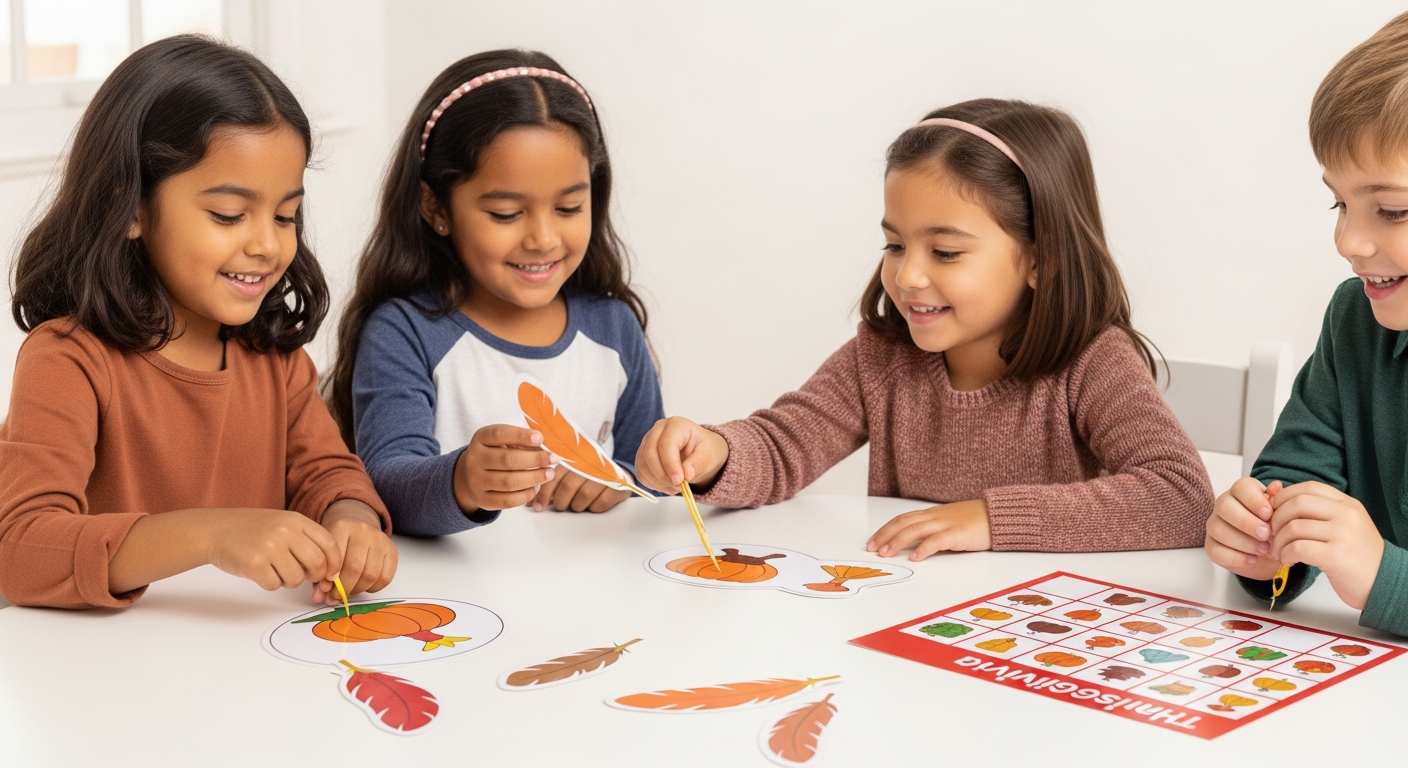
Table of Contents
- Introduction
- The Power of Play: More Than Just Fun
- Thoughtful Thanksgiving Game Ideas for Kids
- The Speech Blubs Difference: Smart Screen Time That Connects
- Choosing Your Speech Blubs Plan: Value for Your Family
- Conclusion
- FAQ
Introduction
The aroma of roasted turkey, the warmth of family laughter, and the bustling energy of children — Thanksgiving is a symphony of heartwarming moments. Yet, amidst the joy and delicious food, many parents find themselves wondering how to keep their little ones engaged, entertained, and connected with relatives they might not see often. More than just a distraction, thoughtful holiday activities offer a unique opportunity to weave learning and development into the festive fabric, especially for a child’s blossoming communication skills.
This Thanksgiving, let's go beyond passive entertainment and embrace games that do more than just pass the time. Our goal is to transform the holiday gathering into a vibrant playground for language, social interaction, and confidence-building. This post will unveil a collection of exciting, easy-to-implement Thanksgiving game ideas for kids that are not only incredibly fun but are also designed to naturally encourage speech development, social skills, and unforgettable family bonding. Get ready to discover how playtime can truly empower your child to speak their mind and heart this holiday season.

The Power of Play: More Than Just Fun
For children, play is the most natural and effective way to learn. It’s their world, their language, and their laboratory for understanding everything around them. During festive occasions like Thanksgiving, the environment is ripe with new sights, sounds, and social dynamics, making it an ideal setting for purposeful play.
Engaging in games provides a relaxed, low-pressure context for children to practice crucial skills. They learn turn-taking, problem-solving, emotional regulation, and, perhaps most importantly for us at Speech Blubs, they develop their communication abilities. When children are having fun, their inhibitions drop, and they become more willing to experiment with new sounds, words, and sentence structures. This natural, organic learning is far more impactful than formal drills, especially when surrounded by loved ones.
How Games Boost Communication Skills
Games, particularly interactive ones, offer a rich tapestry of linguistic opportunities:
- Vocabulary Expansion: Introducing new words related to the game, Thanksgiving, or the actions involved.
- Sentence Structure: Encouraging children to describe actions, explain rules, or articulate their turns.
- Articulation Practice: Many games involve making specific sounds, animal noises, or saying words clearly.
- Social Communication: Learning to ask questions, respond to others, negotiate, share, and express needs or desires.
- Listening Skills: Actively processing instructions, listening to others speak, and understanding social cues.
- Non-Verbal Communication: Using gestures, facial expressions, and body language to convey messages.
At Speech Blubs, we understand that nurturing communication is about more than just sounds and words; it's about empowering children to connect with their world. Our founders, all of whom experienced speech challenges as children, created Speech Blubs to be the immediate, effective, and joyful solution they wished they had. We know firsthand that blending scientific principles with play creates one-of-a-kind "smart screen time" experiences, and the same philosophy applies to screen-free games during holidays.

Thoughtful Thanksgiving Game Ideas for Kids
Let's dive into some fantastic Thanksgiving game ideas that blend festive fun with meaningful developmental benefits. These games are designed to be adaptable for various ages and skill levels, ensuring every child can participate and thrive.
1. Gratitude Alphabet Game
How to Play: Sit in a circle. The first person says something they are grateful for that starts with 'A' (e.g., "I'm grateful for apples."). The next person says something for 'B', and so on. If a child gets stuck, the group can offer gentle suggestions. For younger children, you can just go around the circle, with each person saying any word they're grateful for, while an adult writes it down, later reading the list aloud.
Speech & Language Benefits:
- Vocabulary: Expands a child's understanding of words related to gratitude and Thanksgiving.
- Phonological Awareness: Helps children recognize initial sounds in words.
- Sentence Formation: Encourages the creation of simple gratitude statements.
- Turn-Taking: Practicing conversational flow and waiting for one's turn.
Relatable Scenario: For a parent whose child struggles with expressing emotions or identifying feelings, the Gratitude Alphabet Game offers a gentle, structured way to practice verbalizing positive thoughts. If your child is a "late talker" and finds it hard to initiate conversation, this game provides a scaffolded approach. After the game, you can extend the learning with Speech Blubs' "What Am I Doing?" section, where children watch and imitate peers to understand actions and associated feelings, building a bridge from internal feelings to verbal expression.
2. Thanksgiving Charades
How to Play: Write down various Thanksgiving-related words or phrases on slips of paper (e.g., "eating turkey," "stuffing," "pumpkin pie," "pilgrims," "football," "being grateful"). Children pick a slip and act out the phrase without speaking, while others guess. Divide into teams for added excitement.
Speech & Language Benefits:
- Non-Verbal Communication: Teaches children to convey meaning through gestures and facial expressions.
- Vocabulary Comprehension: Requires understanding the chosen word/phrase to act it out.
- Descriptive Language: Encourages guessers to use descriptive words and questions.
- Social Interaction: Promotes cooperation, active listening, and interpretation of cues.
Relatable Scenario: For a child who might be shy about speaking in front of a group, Thanksgiving Charades can be a fantastic, low-pressure way to participate. They can engage non-verbally first, building confidence. As they see others guess successfully, they might be encouraged to offer verbal clues or guesses. Our Speech Blubs app uses a unique "video modeling" methodology, where children learn by watching and imitating their peers. Charades is a perfect screen-free parallel, as kids naturally imitate and learn from each other's actions and guesses.
3. Turkey Feather Hunt
How to Play: Hide paper turkey feathers (cut from construction paper, perhaps labeled with Thanksgiving words or pictures) around the house or yard. Give each child a list or visual cues of feathers to find. The child who finds the most, or finds a specific "golden feather," wins a small prize.
Speech & Language Benefits:
- Prepositional Phrases: Using words like "under," "behind," "on top of," "next to" when describing where feathers are found or giving clues.
- Object Recognition & Naming: Identifying pictures or reading words on the feathers.
- Following Instructions: Listening to directions about where to look.
- Descriptive Language: Describing the feathers or their hiding spots.
Relatable Scenario: If your child loves exploring and is developing their understanding of spatial concepts, this game is ideal. For example, a child learning prepositions could be asked, "Is the feather under the chair or behind the curtain?" This interactive questioning naturally reinforces location words. Our Speech Blubs app offers various sections, like "Outdoor Scavenger Hunt," that reinforce object identification and prepositions, making the transition from this holiday game to structured learning seamless.
4. Thanksgiving Bingo
How to Play: Create Bingo cards with pictures or words related to Thanksgiving (e.g., pumpkin, turkey, corn, pie, pilgrims, family, gratitude). Call out the words/show the pictures one by one. The first child to get five in a row shouts "Bingo!"
Speech & Language Benefits:
- Vocabulary Recognition: Identifying Thanksgiving-themed items.
- Auditory Discrimination: Differentiating between similar-sounding words.
- Matching Skills: Connecting spoken words to visual representations.
- Focus & Attention: Staying engaged to mark their card.
Relatable Scenario: This is excellent for children who are learning to associate spoken words with written words or pictures. If your child struggles with auditory processing, you can show the picture as you say the word, providing dual input. For a child who might be working on articulation, you can gently encourage them to repeat the word as they mark it on their card. This focused repetition is key to practicing new sounds and words, much like the repetitive, engaging exercises in Speech Blubs' articulation sections.
5. Storytelling Circle: A Gratitude Chain
How to Play: Start a story with a simple Thanksgiving theme (e.g., "Once upon a time, on Thanksgiving Day, a little squirrel found a giant pumpkin…"). Each person adds one sentence to continue the story, building on what the previous person said. Encourage silly ideas and creative twists.
Speech & Language Benefits:
- Narrative Skills: Developing the ability to sequence events and create a coherent story.
- Imaginative Play: Fostering creativity and abstract thinking.
- Sentence Complexity: Encouraging the use of conjunctions and descriptive words.
- Active Listening: Paying attention to previous sentences to build upon the narrative.
Relatable Scenario: This game is wonderful for boosting imaginative play and narrative skills. If your child tends to use very short sentences, the collaborative nature of storytelling encourages them to expand their thoughts into longer, more detailed sentences. For children practicing sequencing, an adult can help by asking, "What happened next?" This kind of guided questioning is integral to how Speech Blubs helps children develop a deeper understanding of language and its structure.
6. "Guess the Thanksgiving Food" Sensory Bin
How to Play: Create a "sensory bin" with various Thanksgiving-related items (e.g., dried corn, cranberries, cinnamon sticks, small toy turkeys, plastic gourds). Blindfold the child and have them reach in and describe what they feel and then guess the item. Or, simply let them explore and describe what they see, feel, and smell.
Speech & Language Benefits:
- Descriptive Vocabulary: Using adjectives to describe textures, shapes, and smells (e.g., "bumpy," "smooth," "prickly," "spicy").
- Sensory Language: Connecting sensory input to verbal expression.
- Inferencing Skills: Drawing conclusions based on tactile information.
- Question Formulation: Encouraging children to ask "What is it?" or "What does it feel like?"
Relatable Scenario: This is perfect for tactile learners or children who need to expand their descriptive vocabulary. For a child struggling with word finding, describing the texture ("It's squishy!") before naming the item ("It's a cranberry!") can build confidence. Our Speech Blubs app emphasizes multi-sensory learning, and activities like this sensory bin complement that approach by engaging multiple senses to reinforce new words and concepts.
7. Turkey Trot Race
How to Play: Designate a start and finish line. Children "trot" like turkeys to the finish line, but with a catch: they can only move while making turkey gobbling sounds. When they stop gobbling, they must freeze. The first one to the finish line wins.
Speech & Language Benefits:
- Voice Production: Practicing vocalizations and sustained sound production.
- Oral Motor Skills: Engaging muscles used for speech through sound imitation.
- Following Instructions: Adhering to the game rules (move only while gobbling).
- Emotional Expression: Expressing excitement and joy through sounds and movement.
Relatable Scenario: This is a fantastic gross motor activity that incorporates vocal play. For children who are still developing oral motor control or who are hesitant to make sounds, the playful context of "gobbling" can be highly motivating. It’s a fun way to practice making sounds loudly and clearly, mimicking the type of playful sound imitation found in the "Animal Kingdom" section of Speech Blubs, where children imitate animal sounds while watching their peers.
8. "I Spy" Thanksgiving Edition
How to Play: Adapt the classic "I Spy" game to your Thanksgiving environment. "I spy with my little eye something that is orange and round!" (Pumpkin) or "I spy something that has many feathers!" (Turkey decoration). Encourage children to take turns being the "spy."
Speech & Language Benefits:
- Descriptive Language: Using adjectives for colors, shapes, and attributes.
- Object Identification: Naming common household or Thanksgiving items.
- Auditory Processing: Listening carefully to clues and identifying the object.
- Question Answering: Responding to "What is it?" or "Where is it?" questions.
Relatable Scenario: This game is incredibly versatile and can be played anywhere. For a child who is learning to use descriptive words, an adult can model rich vocabulary ("I spy something that is shiny, silver, and we use it to eat our dinner!"). This helps expand their descriptive abilities. Our Speech Blubs app helps children build robust vocabulary through engaging visuals and interactive exercises, making "I Spy" a natural extension of their learning.
9. Thanksgiving Meal Story Starters
How to Play: During the meal, periodically offer a story starter related to the food or the gathering. For example: "If this turkey could talk, what would it say?" or "Imagine if a tiny elf hid inside the pumpkin pie, what adventure would it have?" Encourage each person, especially the children, to add a sentence or two.
Speech & Language Benefits:
- Imagination & Creativity: Sparking imaginative thought and narrative generation.
- Opinion & Preference Expression: Allowing children to express their thoughts about the food or experience.
- Conversational Flow: Encouraging participation in a group discussion.
- Sentence Elaboration: Prompting children to expand on simple ideas.
Relatable Scenario: This game transforms the meal into an interactive storytelling opportunity. For a child who struggles with initiating conversation or answering open-ended questions, these lighthearted prompts provide a low-stakes entry point. It’s a wonderful way to practice expressing ideas and joining a group conversation, much like the confidence-building social interaction scenarios we emphasize in Speech Blubs.
10. Memory Matching Game with Thanksgiving Themes
How to Play: Create pairs of Thanksgiving-themed cards (pictures of turkey, pie, cornucopia, autumn leaves, family members). Lay them face down and have children take turns flipping two cards to find a match. When they find a match, they must name the items.
Speech & Language Benefits:
- Vocabulary Reinforcement: Repeatedly naming Thanksgiving items.
- Memory Skills: Enhancing short-term memory and recall.
- Turn-Taking & Waiting: Practicing patience and social rules.
- Sentence Practice: "I found a match! It's a turkey and a turkey!"
Relatable Scenario: This classic game is excellent for reinforcing vocabulary and memory. If your child has difficulty with phonological processing, having them name the matched items helps solidify the connection between the image and the spoken word. This kind of focused repetition is a hallmark of effective language learning, mirroring the structured yet playful repetition that helps children master new sounds and words within the Speech Blubs app.
The Speech Blubs Difference: Smart Screen Time That Connects
While these screen-free games are fantastic for holiday gatherings, we know that modern families often look for engaging, educational screen time solutions. That's where Speech Blubs comes in. Our app is not just another passive viewing experience; it's an active, interactive tool designed to foster real-world communication skills.
At Speech Blubs, our mission is to empower children to "speak their minds and hearts." We believe every child deserves a voice, and our platform provides immediate, effective, and joyful solutions for the 1 in 4 children who need speech support. Our unique approach is rooted in scientific principles, blending play with our innovative "video modeling" methodology. Children learn by watching and imitating their peers, a powerful concept supported by mirror neuron research. This makes learning feel natural and motivating, turning screen time into "smart screen time."
We are committed to providing a screen-free alternative to passive viewing experiences like cartoons. Instead of just watching, children are actively participating, interacting, and practicing. This active engagement makes Speech Blubs a powerful tool for family connection, as parents can co-play and support their child's learning journey.
Why Choose Speech Blubs?
We understand that every child's journey is unique, and we're here to support you every step of the way. If you're wondering if your child could benefit from a little extra support, take our quick 3-minute preliminary screener. It involves just 9 simple questions and provides an assessment and a next-steps plan tailored to your child.
Our app is designed with love and expertise, offering a wealth of activities that support articulation, vocabulary, early literacy, social skills, and more. Don't just take our word for it; see what other parents are saying about their children's incredible progress and success with Speech Blubs. Our method is backed by science, placing us in the top tier of speech apps worldwide, as validated by our high MARS scale rating. You can dive deeper into the research behind our methodology on our website.
Choosing Your Speech Blubs Plan: Value for Your Family
We offer flexible plans to suit your family's needs, but we highly recommend our Yearly plan for the best value and a complete experience.
- Monthly Plan: For $14.99 per month, you get access to our core Speech Blubs app.
- Yearly Plan: For just $59.99 per year, which breaks down to an incredible $4.99 per month, you save a significant 66% compared to the monthly plan! But the value doesn't stop there.
Why the Yearly Plan is the Best Choice:
Our Yearly plan unlocks exclusive, high-value features designed to supercharge your child's development:
- 7-Day Free Trial: The Yearly plan begins with a full 7-day free trial, allowing you and your child to explore all the features and experience the magic of Speech Blubs completely risk-free.
- Reading Blubs App: You also get free access to our supplementary Reading Blubs app, providing even more educational content to support your child's early literacy skills.
- Early Access & Priority Support: Yearly subscribers receive early access to new updates and features, along with a priority 24-hour response time for customer support.
The Monthly plan does not include these incredible benefits, making the Yearly plan the clear superior choice for dedicated parents who want the most for their child's development.
Ready to provide your child with an engaging, effective, and joyful path to communication? Download Speech Blubs on the App Store or get it on Google Play today! Alternatively, you can create your account and begin your 7-day free trial directly on our website. Remember to choose the Yearly plan to get your free trial and access to the full suite of features!
Conclusion
This Thanksgiving, let's make room for more than just feasting; let's create space for meaningful connections and developmental growth through play. The games we've explored offer wonderful opportunities to encourage your children to communicate, interact, and build confidence in a fun, natural setting. From expanding vocabulary with the Gratitude Alphabet Game to boosting social skills with Thanksgiving Charades, these activities are designed to foster a love for communication and create joyful family learning moments.
Remember, every child's journey is unique, and progress often unfolds in small, joyful steps. Our goal isn't to guarantee your child will be giving public speeches by next month, but rather to help them build foundational skills, reduce frustration, and develop a confident voice. These holiday games are fantastic supplements to a child's overall development plan, and when combined with the targeted, engaging activities in Speech Blubs, they create a powerful ecosystem for growth.
We invite you to bring the spirit of playful learning into your Thanksgiving celebrations. Whether it's through a screen-free game with loved ones or a "smart screen time" session with Speech Blubs, every effort to connect and communicate is a step towards empowering your child to speak their minds and hearts.
Ready to embark on a journey of joyful communication? Don't wait! Create your Speech Blubs account today and start your 7-day free trial. Be sure to select the Yearly plan to unlock all premium features, including the Reading Blubs app, and enjoy significant savings. You can also download Speech Blubs directly from the App Store or Google Play to get started on this rewarding adventure. Happy Thanksgiving and happy communicating!
FAQ
Q1: How can I make these Thanksgiving games accessible for children of different ages and abilities?
A1: Adaptability is key! For younger children, simplify rules, focus on sounds or single words, and provide more adult guidance. For older children, introduce more complex vocabulary, encourage longer sentences, or add strategic elements. For children with diverse abilities, consider visual aids, incorporate sensory elements, or modify physical requirements. The goal is participation and enjoyment, so adjust to your child's unique developmental stage.
Q2: What if my child is shy or hesitant to participate in group games during Thanksgiving?
A2: Start with low-pressure activities where participation isn't mandatory, like "I Spy" or the "Sensory Bin," where they can observe first. Offer to be their partner or let them simply watch. Provide positive reinforcement for any small attempt to engage. Remember that the holiday environment can be overwhelming, and allowing them to ease in at their own pace is crucial. Our Speech Blubs app is also a wonderful tool for building confidence in a one-on-one setting, which can then translate to group interactions.
Q3: How do these seemingly simple Thanksgiving games really help with speech and language development?
A3: These games provide natural, context-rich opportunities for communication. They encourage:
- Imitation: Repeating words and sounds (Turkey Trot).
- Vocabulary: Naming objects and actions (Thanksgiving Bingo, Turkey Feather Hunt).
- Sentence Structure: Forming descriptive phrases and sentences ("I Spy," Gratitude Alphabet).
- Social Interaction: Turn-taking, asking questions, and responding (Charades, Storytelling Circle).
- Oral Motor Skills: Making various sounds and movements with the mouth.
- Confidence: Practicing communication in a fun, non-judgmental environment.
This organic learning approach is highly effective because children are motivated by play.
Q4: How can Speech Blubs complement these holiday activities to further support my child's communication?
A4: Speech Blubs perfectly complements these screen-free games by offering targeted, engaging practice that reinforces the same skills. For example, after playing a game with animal sounds, your child can visit the "Animal Kingdom" section in Speech Blubs for more peer video modeling. If a game focuses on emotions, the "People & Emotions" section offers specific exercises. Our app provides consistent, structured learning in a "smart screen time" format that reinforces the vocabulary, articulation, and social skills practiced during family playtime, turning every learning opportunity into a joyful experience.
About the author