
Toddler Cut and Paste Activities for Fine Motor Fun
 By Speech Blubs Team•Feb 23, 2026•16 min.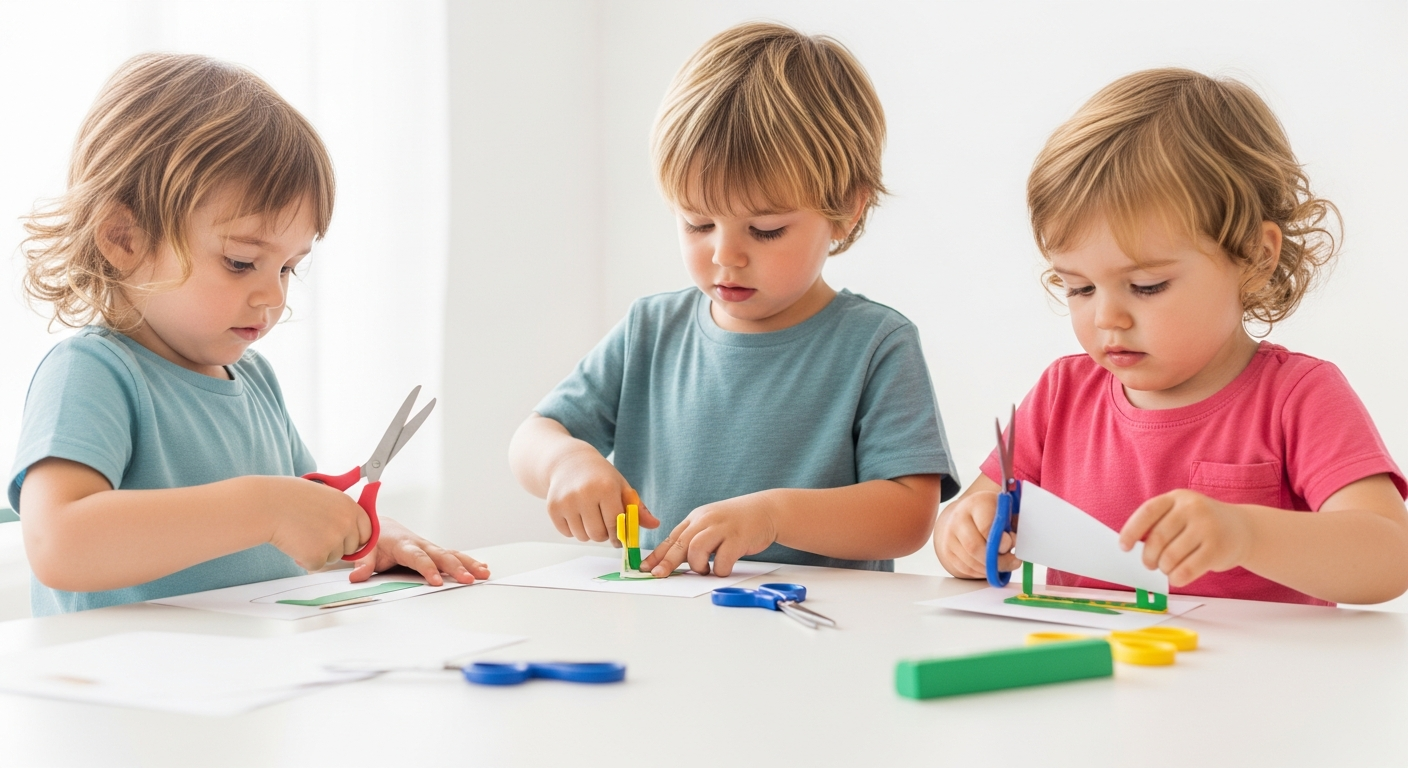
Table of Contents
- Introduction
- The Developmental Magic of Cutting and Pasting
- Preparing for Success: Scissor Safety and Setup
- Level 1: Beginner Activities (Ripping, Fringing, and Glue Sticks)
- Level 2: Mastering Lines and Simple Shapes
- Level 3: Educational Themes (Letters, Numbers, and Sorting)
- How Speech Blubs Complements Fine Motor Play
- Creative "Beyond the Page" Projects
- The Science Behind Video Modeling and Motor Development
- Overcoming Challenges: What if My Toddler Isn't Interested?
- Why "Smart Screen Time" is Part of the Solution
- Conclusion
- FAQs
Introduction
Have you ever walked into a room to find your little one surrounded by a blizzard of tiny paper scraps, a look of pure concentration on their face, and perhaps a rogue smudge of glue on their nose? While the cleanup might feel daunting, that "blizzard" is actually the sound of your child’s brain and body working in perfect harmony. At Speech Blubs, we believe that these messy, joyful moments are where the most profound learning happens. Our mission is to empower children to speak their minds and hearts, and we know that the path to confident communication often starts with the very same fine motor control used in toddler cut and paste activities.
In this guide, we are going to explore why cutting and pasting is a developmental powerhouse for your child. We will cover everything from the first time they hold a pair of safety scissors to advanced sorting games that build logic and literacy. We’ll also share how our unique approach to "smart screen time" can supplement these tactile experiences to help your child reach their full potential. Whether your child is a budding artist or a "late talker" who needs a little extra encouragement, these activities provide a bridge between physical play and cognitive growth.

Our goal is to give you a roadmap for fostering a love for learning through hands-on play. By the end of this article, you will have a toolkit of creative ideas and a deeper understanding of how simple paper and glue can build the foundation for a lifetime of communication and confidence.
The Developmental Magic of Cutting and Pasting
When a toddler picks up a pair of scissors, they aren't just making paper smaller; they are engaging in a complex neurological workout. For many of us at Speech Blubs, this hits close to home. Our founders grew up with speech challenges and created the tools they wished they had—tools that blend science with the joy of play. We see the same scientific principles at work in tactile activities like cutting and pasting.
Bilateral Coordination and Hand Strength
To cut a piece of paper, a child must use one hand to hold and turn the paper while the other hand opens and closes the scissors. This is called bilateral coordination. It requires both sides of the brain to communicate effectively. Simultaneously, the "squeeze and release" motion of cutting builds the small muscles in the hand. These are the same muscles your child will eventually use to hold a pencil, button a shirt, and even manage the complex movements of the tongue and lips required for clear speech.
Visual Perception and Hand-Eye Coordination
Toddler cut and paste activities require a child to see a line or a shape and coordinate their hand movements to follow it. This develops visual perception—the ability to make sense of what they see. When they paste a "monster's eye" onto a specific spot on a drawing, they are practicing spatial awareness. These skills are foundational for reading and writing later on.
Focus and Frustration Tolerance
Have you noticed how quiet a room gets when a toddler is trying to snip a piece of construction paper? This level of focus is a "brain muscle" that needs exercise. Sometimes, the paper doesn't cut the way they want, or the glue gets too sticky. In these moments, with your empathetic support, they learn to manage frustration and try again. Building this confidence is central to our philosophy at Speech Blubs. We want children to feel brave enough to try new sounds and new words, just as they try new crafts.

Preparing for Success: Scissor Safety and Setup
Before you dive into the activities, it’s important to set the stage for a positive experience. We always advocate for "co-play," where you are right there with your child, guiding their journey.
Choosing the Right Tools
For toddlers, the right tools make all the difference. Look for:
- Plastic safety scissors: These usually only cut paper and won't nip skin or hair.
- Spring-loaded scissors: These are fantastic for beginners because they automatically pop open after a squeeze, which helps children who haven't yet mastered the "opening" motion.
- Glue sticks: These are much easier for small hands to control than liquid glue, though liquid glue has its own sensory benefits for older toddlers!
Setting Up a "Yes" Space
Create an environment where you aren't worried about the mess. A low table with a washable plastic tablecloth is ideal. Having a dedicated "scrap bin" can also turn the cleanup process into a game. If you are unsure where your child stands developmentally, you might want to take our quick 3-minute preliminary screener to get a simple assessment and a free 7-day trial of our app, which can help you tailor activities to their specific needs.
Level 1: Beginner Activities (Ripping, Fringing, and Glue Sticks)
Not every toddler is ready for scissors right away, and that is perfectly okay! The journey of toddler cut and paste activities often begins with just the "paste" and "rip" parts.
The "Paper Blizzard" (Ripping)
Ripping paper is the precursor to cutting. Give your toddler strips of colorful construction paper or old magazines and show them how to rip them into small pieces. This uses the tripod grasp (thumb and index finger), which is vital for later development.
- The Activity: Once they have a pile of "snowflakes," let them use a glue stick to cover a piece of blue paper and press the scraps down.
- Speech Blubs Connection: While they rip, you can practice "action words" together. Say "Rip!" or "Pull!" each time. This mimics the peer-based video modeling we use in our app, where children learn by seeing others perform an action.
Fringing the Grass
If your child is just starting with scissors, "fringing" is the best first step. Fringing only requires a single "snip" rather than a continuous cutting motion.
- The Activity: Give them a strip of green paper and let them make small snips along the edge to create "grass."
- Scenario: For a parent whose child loves the "Animal Kingdom" section of Speech Blubs, you can paste small animal cut-outs into the "grass" your child just made. As you play, you can practice the animal sounds like "moo" and "baa" that they’ve seen in the app.
Level 2: Mastering Lines and Simple Shapes
As your child’s hand strength grows, they will move from random snips to purposeful cutting.
The "Road" Cut
Draw thick, straight lines on a piece of cardstock. Tell your child that the scissors are a "car" and they need to stay on the road.
- The Activity: Start with short lines and gradually make them longer. Once they master straight lines, move to "curvy roads" (waves) and "mountain roads" (zig-zags).
- Value of the Process: Don't worry if they veer off the road! The goal isn't a perfect line; it's the effort and the focus they are applying.
Shape Matching Puzzles
Shapes are the building blocks of visual literacy. You can create your own "cut and paste" puzzles at home.
- The Activity: Draw a large circle, square, and triangle on a piece of paper. Cut matching shapes out of a different colored paper. Have your child apply glue to the "shadow" on the page and match the correct shape on top.
- Supportive Learning: This is a great time to use the Speech Blubs homepage to explore how we integrate these same shape and color recognition skills into our "smart screen time" experiences.
Level 3: Educational Themes (Letters, Numbers, and Sorting)
Once the mechanical skill of cutting and pasting is more fluid, you can use these activities to teach academic concepts.
Alphabet Apple Trees
This is a classic for a reason! It combines letter recognition with fine motor practice.
- The Activity: Draw a simple tree trunk and canopy. Provide your child with small red circles (apples) that have letters written on them. You can have them "pick" the letter 'A' and paste it onto the tree.
- Building Literacy: You can even match uppercase and lowercase letters. For example, paste a lowercase 'a' onto an uppercase 'A'.
Sorting by Category
Sorting is a high-level cognitive skill. It requires children to identify characteristics and group objects accordingly.
- The Activity: Print out pictures of different items—some that belong in a "Zoo" and some that belong in a "House." Have your child cut them out (with help) and paste them into the correct box.
- Scientific Backing: Our approach is backed by science, emphasizing that categorization helps children organize their world and their vocabulary. Sorting activities are a physical manifestation of the mental filing system children are building.
How Speech Blubs Complements Fine Motor Play
You might wonder how an app fits into a world of paper, scissors, and glue. At Speech Blubs, we don't believe in passive screen time. We provide a screen-free alternative to cartoons by offering "smart screen time" that encourages children to get off the device and interact with the world.
Our unique "video modeling" methodology is the secret sauce. In the app, children watch their peers perform tasks and speak words. This triggers "mirror neurons" in the brain, making the child more likely to imitate what they see.
Creating a Joyful Learning Loop
Imagine this scenario: Your child watches a video in the "Color Me Happy" section of Speech Blubs, where a peer identifies the color blue. Then, you put the tablet away and start a toddler cut and paste activity using only blue paper. You are reinforcing the digital lesson with a tactile, real-world experience. This loop of "See, Imitate, Do" is incredibly powerful for developing complex communication skills.
Transparency and Value
We want to be a long-term partner in your child's development. That’s why we offer two clear paths for our families:
- Monthly Plan: $14.99 per month. This is great for a quick trial.
- Yearly Plan: $59.99 per year (only $4.99/month).
We highly recommend the Yearly plan because it offers the best value—saving you 66%. More importantly, the Yearly plan includes exclusive features that the monthly plan does not:
- A 7-day free trial to explore everything we offer risk-free.
- The Reading Blubs app, which expands your child's journey into literacy.
- Early access to new updates and a 24-hour support response time.
To start this journey, you can download Speech Blubs on the App Store or get it on Google Play.
Creative "Beyond the Page" Projects
Toddler cut and paste activities don't have to stay flat on a piece of paper. You can take them into the third dimension!
Toilet Paper Roll Robots
Save those cardboard tubes! They are the perfect base for 3D art.
- The Activity: Cut out rectangles, circles, and "antennae" from silver paper or tin foil. Have your child glue these parts onto the tube to create a robot.
- Vocabulary Building: This is an excellent opportunity to talk about body parts. "Where does the robot's eye go?" "Let's give him a square tummy!"
Nature Collages
Take the learning outdoors. Go for a "scavenger hunt" in your backyard or a local park.
- The Activity: Collect leaves, small twigs, and petals. Back at your crafting station, have your child paste these natural elements onto a piece of cardstock. They can use their scissors to trim the leaves or "fringe" them.
- Connection: This activity fosters a love for the environment and provides a variety of textures for sensory play, which is vital for children with sensory processing needs.
The Science Behind Video Modeling and Motor Development
The connection between seeing and doing is at the heart of everything we do. When a child watches a peer in Speech Blubs, they aren't just watching a character; they are watching a "model" of success. This methodology is particularly effective for children with speech delays, Down syndrome, or autism, but it benefits all children.
Mirror Neurons at Work
Neuroscience tells us that mirror neurons fire both when we perform an action and when we observe someone else performing it. When your toddler watches a peer on Speech Blubs making a "fish face" or saying "Pop!", their brain is practicing the movement. This makes it much easier for them to execute that movement when you ask them to.
The same applies to motor skills. If you sit across from your child and show them how to hold scissors, you are acting as their "live" video model. Combining these live interactions with the peer-led models in our app creates a robust learning environment. You can see the impact of this approach by reading our parent testimonials, where thousands of families share their stories of breakthrough and joy.
Overcoming Challenges: What if My Toddler Isn't Interested?
Every child develops at their own pace. If your little one throws the scissors or has no interest in the glue, don't panic. Here are a few ways to gently encourage participation:
- Follow Their Lead: If they love cars, do car-themed activities. If they love dinosaurs, cut out "dino spikes." For a child obsessed with "things that go," the "Wheels on the Bus" section of Speech Blubs can be a great motivator.
- Make it a Social Event: Sit down and do your own "adult" version of the craft. When they see you having fun, they will naturally want to join in. This is the power of family connection that we strive to facilitate.
- Keep it Short: A toddler’s attention span is short. Five minutes of focused play is a huge win!
- Check for Readiness: Sometimes, a child just isn't physically ready. Focus on playdough or finger painting to build hand strength first, then try the scissors again in a month.
If you’re concerned about your child’s overall developmental milestones, remember that our web account creation page is the gateway to a wealth of resources designed to support you every step of the way.
Why "Smart Screen Time" is Part of the Solution
In a world full of passive entertainment, Speech Blubs stands out as a "smart" alternative. We didn't just build an app; we built a tool that encourages active participation. We know that as a parent, you are constantly balancing the need for a break with the desire to provide high-quality education.
Our app is designed to be used with you. It’s a tool for family connection. While the app provides the scientific framework and the engaging peer models, you provide the love, the encouragement, and the real-world application—like the toddler cut and paste activities we’ve discussed.
By choosing the Yearly plan, you ensure that your child has a consistent, structured path to growth. You get the Reading Blubs app to transition from speaking to reading, and you get our 7-day free trial to make sure it’s the right fit for your family. We are committed to providing a joyful, effective solution for the 1 in 4 children who need speech support.
Conclusion
Toddler cut and paste activities are so much more than a way to pass the time on a rainy afternoon. They are a fundamental part of your child’s journey toward independence and communication. From the first snip of green "grass" to the complex sorting of zoo animals, each activity builds the hand strength, coordination, and confidence your child needs to "speak their minds and hearts."
We are honored to be a part of your parenting toolkit. Whether you are using our app to practice new sounds or using this guide to plan your next craft session, remember that progress is a process. Focus on the joy, embrace the mess, and celebrate every small victory.
Ready to take the next step in your child's communication journey? Sign up and begin your 7-day free trial today. For the most comprehensive experience and the best value, be sure to select our Yearly plan. This gives you full access to Speech Blubs, the Reading Blubs app, and early updates—all for just $4.99 a month. Let’s work together to help your child find their voice through the power of play!
FAQs
1. At what age should I start toddler cut and paste activities?
Most children are ready to begin supervised cutting and pasting between the ages of 2 and 3. Start with ripping paper and using glue sticks first. Introduce plastic safety scissors when you notice your child has the hand strength to squeeze a toy or use tongs. Always provide close supervision to ensure safety and to encourage proper technique.
2. My child is frustrated because they can't cut straight. What should I do?
Frustration is a natural part of learning! Emphasize that the goal is to have fun, not to be perfect. You can start with "fringing" (one-step snips) to build confidence before moving to long lines. Using thicker paper like cardstock can also make it easier for them to control the scissors. Remember, even "crooked" cutting is building those vital hand muscles.
3. How does cutting paper help with my child's speech development?
It might seem unrelated, but the fine motor skills used for cutting are closely linked to the motor skills used for speech. Both require the brain to send precise signals to small muscles. Cutting also builds bilateral coordination (using both sides of the brain), which is essential for the complex task of processing and producing language.
4. Is the Yearly plan really worth it compared to the Monthly plan?
Absolutely! The Yearly plan is our most popular choice because it offers a 66% discount, making it only $4.99/month compared to $14.99. Plus, it’s the only plan that includes the 7-day free trial, the Reading Blubs app for literacy, and 24-hour support response. It provides a long-term, comprehensive support system for your child’s development.
About the author