
Top Fun Basketball Games Kids Will Love
 By Speech Blubs Team•Jan 19, 2026•21 min.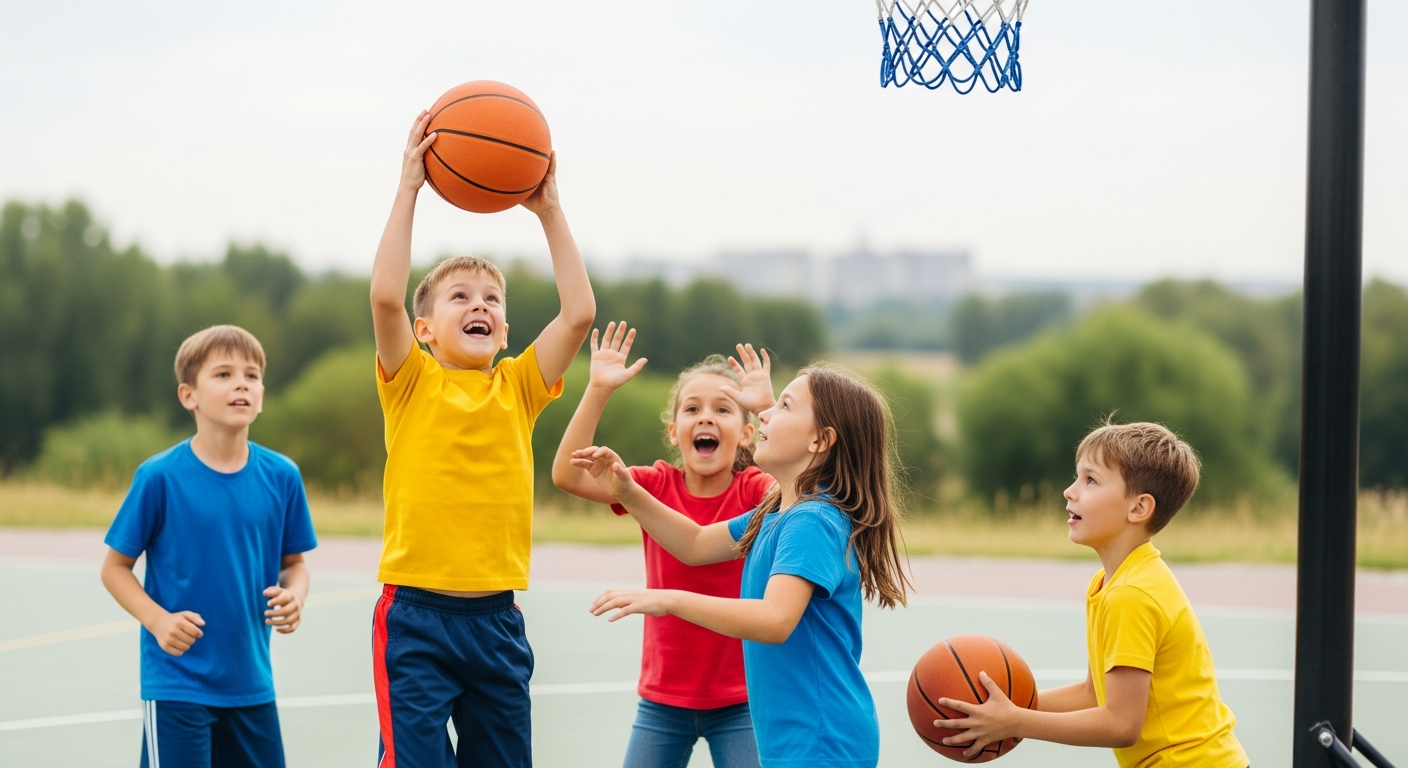
Table of Contents
- Why Fun Basketball Games Score Big for Kids' Development
- Top Fun Basketball Games for Kids
- Enhancing Communication Through Play: A Speech Blubs Perspective
- Safety First: Ensuring Fun and Well-being
- Ready to Empower Your Child's Voice? Discover Speech Blubs!
- Conclusion
- FAQs For Fun Basketball Games for Kids
Ever watched a child light up with pure joy as they chase a bouncing ball, giggling with every dribble and cheer with every shot? It's a truly magical sight. For many children, the rigid structure of traditional sports drills can feel less like play and more like a chore. But what if we told you that some of the most profound learning experiences – from physical coordination to vital communication skills – happen when kids are simply having a blast? Imagine a world where every jump, every pass, and every basket also builds confidence, fosters teamwork, and sparks a love for expressing themselves.
That's precisely what we aim to explore today. In this comprehensive guide, we're diving deep into the exciting world of fun basketball games for kids. We believe that by transforming practice into play, we can unlock incredible developmental potential in every child. You'll discover a treasure trove of engaging games that go beyond just teaching basketball skills, fostering crucial cognitive, social, and, yes, communication abilities. We'll show you how these dynamic activities naturally encourage children to interact, problem-solve, and articulate their thoughts, all while having an absolute blast on the court. Ready to trade mundane drills for unforgettable moments of play and progress? Let’s jump in!

Why Fun Basketball Games Score Big for Kids' Development
Basketball is often celebrated for its physical benefits, and rightly so. It's a fantastic way to boost cardiovascular health, improve agility, enhance hand-eye coordination, and build strong muscles. But the impact of playing basketball, especially through engaging games, stretches far beyond the physical. For children, these playful encounters on the court become powerful classrooms for life skills, particularly in the realm of communication.
Think about the sheer amount of interaction involved in a simple game: children call out to teammates, express frustration (and learn to manage it), celebrate successes, negotiate rules, and ask questions. These aren't just isolated incidents; they're continuous loops of communication that hone listening skills, expand vocabulary, and build confidence in self-expression.
Moreover, embracing fun basketball games over rigid drills keeps children engaged and enthusiastic about the sport. When learning feels like play, they're more likely to stick with it, developing a long-term love for physical activity and teamwork. This sustained engagement creates more opportunities for them to practice the foundational skills that underpin not only basketball mastery but also effective communication. It's about fostering an environment where making mistakes is part of the fun, reducing pressure, and encouraging a natural desire to participate and connect.
The Speech Blubs Difference: More Than Just Games
At Speech Blubs, we understand deeply the challenges and triumphs of a child's communication journey. Our company was born from a very personal place: our founders all grew up with speech problems and were driven to create the very tool they wished they had during their own formative years. We know firsthand the frustration that can come with communication difficulties, and the immense joy when a child finally finds their voice.
Our mission is clear: to empower children to "speak their minds and hearts." We are committed to providing an immediate, effective, and joyful solution for the 1 in 4 children who need speech support. We achieve this by blending scientific principles with play, creating one-of-a-kind "smart screen time" experiences. We offer a screen-free alternative to passive viewing, replacing endless cartoons with active, engaging content that truly makes a difference. This isn't just an app; it's a powerful tool for family connection, turning screen time into quality learning time.

Central to our approach is our unique "video modeling" methodology. We believe that children learn best by watching and imitating their peers. This technique leverages mirror neurons, a fascinating part of the brain that activates both when we perform an action and when we observe someone else performing it. By seeing real children their age articulate words and sounds, our users gain a powerful and relatable model for speech. It’s a natural, intuitive way for kids to develop complex communication skills, fostering not just speech, but also confidence and social engagement. Our method is backed by extensive research, consistently placing us in the top tier of speech apps worldwide.
Top Fun Basketball Games for Kids
Now, let's dive into the court and explore a collection of games that promise laughter, learning, and plenty of basketball action. Remember, the best games are those that can be adapted to suit different ages and skill levels, always prioritizing fun and participation.
H-O-R-S-E
This timeless classic is a fantastic way to practice shooting and unleash creativity. Players take turns shooting from any spot on the court, making up unique shots (e.g., "behind the back," "with your eyes closed"). If a player makes a shot, the next player must make the exact same shot. If they miss, they get a letter from "H-O-R-S-E." The game continues until only one player remains who hasn’t spelled out the entire word. This game encourages players to describe their shots, expanding their vocabulary (e.g., "I'm going to shoot it from here, under my leg!"), and it builds sportsmanship as they cheer on creative attempts.
Knockout
Get ready for some fast-paced action! All players line up at the free-throw line, with the first two holding basketballs. The first player shoots, and as soon as the ball leaves their hands, the second player can shoot. The goal is to make your basket before the person in front of you does. If you do, the player in front is "knocked out" and goes to the end of the line. This game is excellent for practicing quick shots under friendly pressure and improving rebounding skills. It also reinforces counting and sequence as children keep track of who is "in" and "out."
Dribble Limbo
How low can you go? Set up a limbo bar (a broomstick works perfectly) and challenge players to dribble under it without touching the bar or losing control of the ball. After everyone takes a turn, lower the bar slightly. This game is brilliant for developing dribbling control, body awareness, and understanding spatial concepts like "under" and "over," while also refining fine motor skills needed for precise ball handling.
Basketball Relay Races
Divide players into teams and set up a course with cones. Players must dribble around the course as fast as possible, passing the ball to the next teammate once they return. To add a challenge, introduce specific dribbling tasks like alternating hands or dribbling only with their non-dominant hand. These races build endurance, improve dribbling skills, and, crucially, teach teamwork and following multi-step instructions ("Dribble to the cone, switch hands, dribble back, then pass!").
Around the World
This popular shooting game involves marking several spots in a semi-circle around the hoop (e.g., baseline corner, wing, free-throw line, opposite wing, opposite corner). Players must make a shot from each spot to advance. If they make it, they move to the next spot; if they miss, the next player takes a turn. The first player to successfully shoot from all positions wins. "Around the World" is fantastic for practicing shots from different angles and encourages spatial language as children describe their positions ("I'm shooting from the wing now!").
Freeze Tag Basketball
Combine the classic game of freeze tag with dribbling. One or two players are "it" and must tag other players who are dribbling within a defined area. When tagged, a player must freeze, holding their basketball above their head with legs wide apart. Other players can "unfreeze" them by passing the basketball through their legs. This game fosters teamwork, court awareness, and encourages action words like "freeze," "tag," and "pass."
21
This is a dynamic game where players shoot from anywhere on the court. The first player to score exactly 21 points wins. Typically, a regular basket is worth two points, and a three-pointer is worth three. A common rule is that if a player scores over 21, their score is reduced to 11, adding a strategic element. "21" emphasizes shooting accuracy, strategic thinking, and basic math skills like counting and addition.
Sharks and Minnows
In "Sharks and Minnows," one or two players are designated as the "Sharks" and start at half-court without a ball. The remaining players, the "Minnows," each have a basketball and start at one baseline. The Minnows' goal is to dribble to the opposite baseline without having their basketball stolen or knocked away by a Shark. If a Minnow's ball is stolen, they become a Shark in the next round. The last Minnow remaining becomes the first Shark. This game is excellent for developing dribbling skills, defensive techniques, and descriptive language like "steal," "chase," and "evade."
Bump Out
Similar to Knockout, players line up at the free-throw line with two basketballs. When the first player shoots, the second player can shoot immediately. If the second player scores before the first player, the first player is "bumped out" and goes to the end of the line. This game practices quick, pressured shots and reinforces concepts of "in" and "out."
Musical Basketballs
A delightful twist on musical chairs! Place multiple basketballs in a circle on the court (one less than the number of players). Players dribble around the circle while music plays. When the music stops, each player must quickly grab a basketball and make a shot from wherever they are. Those who don't get a ball are out for the round. "Musical Basketballs" is a fun way to improve dribbling, quick decision-making, and listening skills.
Simon Says Basketball
This classic listening game can be perfectly adapted for the basketball court. One player is "Simon" and calls out basketball-related actions (e.g., "Simon says, dribble with your left hand!" or "Simon says, make a lay-up!"). Players must only follow instructions that begin with "Simon says." If they act without the "Simon says" prompt or perform the wrong action, they're out. This game is highly effective for practicing listening comprehension, following multi-step commands, and identifying body parts and actions.
Basketball Tag
In "Basketball Tag," all players dribble within a defined area. One player is "it" and must tag others by touching them or their basketball. Once tagged, a player must perform a specific task, like five jumping jacks or ten quick dribbles, before rejoining the game. This variant helps improve dribbling in tight spaces, evasive maneuvers, and reinforces counting and sequencing.
Home Run
This fast-paced game involves two teams: dribblers and shooters. Dribblers line up with their balls at one baseline, while shooters line up at a designated spot. When the game starts, a dribbler attempts to dribble a full lap around the court (or a defined path). Simultaneously, a shooter attempts to make a basket. If the shooter makes the basket before the dribbler completes their lap, the dribbler is "out." If the dribbler makes it back "home" before a shot is made, their team scores a point. Teams switch roles after a set number of "outs" or rounds. This game emphasizes both dribbling and shooting, alongside important teamwork and turn-taking skills.
40 and a Half
"40 and a Half" is a scoring game focused on accuracy. Players take turns shooting from various marked positions on the court. Closer shots might be worth one point, while farther shots could be worth a half-point. The goal is to be the first player to reach exactly 40.5 points. Distances and point values can be adjusted based on skill level. This adaptive game is excellent for developing shooting accuracy, strategic planning, and introduces basic fraction concepts in a fun way.
Pressure Free Throws
This game brings a friendly sense of competition to free-throw practice. Players take turns shooting free throws. If a player makes a shot, they earn one point. If they miss, the "pressure" passes to the next player. The game can be played where players are eliminated after a miss under pressure, or given a certain number of "lives." This activity helps young players strengthen their focus, build self-confidence in making shots under mild pressure, and learn about cause-and-effect ("If I miss, the pressure is on you!").
All-Star Shootout
Set up several shooting spots around the court, each representing a different "station." Players take turns attempting baskets from each location. Each made basket earns a point, and players move to the next station. The player with the most points at the end wins. This game can be adapted for individual practice or team challenges, helping kids improve their shooting technique from various angles and developing spatial vocabulary ("Shoot from the corner," "move to the top of the key").
Red Light, Green Light
The classic "Red Light, Green Light" gets a basketball twist! Children dribble their basketballs on "Green Light" and must immediately stop and maintain control of their ball when the coach or leader calls out "Red Light." If a player continues to move or loses control of their ball after "Red Light" is called, they must return to the starting position. This straightforward game is excellent for developing ball control, active listening skills, and impulse control, all while using simple commands.
Basketball Drag Race
This game focuses on developing dribbling control, speed, and coordination. Players stand at the baseline, each with a basketball. On "Go!", they must dribble down the court and back as quickly as possible, staying in their designated lane and maintaining control. Variations can include dribbling only with the non-dominant hand or alternating between fast and slow speeds, adding layers of challenge and fun.
Cone Tip Over Drill
For this drill, cones are scattered around the court. Players must dribble around and "tip over" as many cones as possible using only their basketball, without picking up the ball or touching the cones with their hands. This game enhances dribbling precision, control, and agility. It's a great way to practice changing direction while keeping the ball close.
War
"War" is a simple shooting game where two players stand at the free-throw line. Each player shoots one free throw. The player with the highest number of successful shots (or closest to the hoop if both miss) wins that "round." The game can be extended to various shooting spots, making it a fun way to practice shooting accuracy and competitive spirit.
Circle Tag
Players form a large circle, all dribbling a basketball. One player is "it" and stands in the center. The player in the center tries to tag someone in the circle (who is still dribbling). If tagged, they switch places. This game is excellent for maintaining dribbling control, quick reactions, and spatial awareness within a group.
Shot Contest
This is a less structured but equally fun game. Two or more players simply challenge each other to make baskets from various self-selected spots. It encourages friendly competition, creativity in shot selection, and the joy of making a basket without strict rules or scoring.
Enhancing Communication Through Play: A Speech Blubs Perspective
While these basketball games are fantastic for physical development, their power to foster communication should not be underestimated. Every interaction, every rule explained, every cheer, and every collaborative moment is a building block for stronger communication skills.
- For the "Late Talker": Imagine a 3-year-old who loves animals but is a late talker. In a game like "Sharks and Minnows," they might instinctively shout "Shark!" or "Run!" as they dribble. In "Simon Says Basketball," they are practicing listening and following commands like "dribble fast" or "pass the ball." These are prime opportunities for parents to model and reinforce language. At Speech Blubs, we build on this with our "Animal Kingdom" section, where children watch peers make animal sounds and actions, providing a motivating way to practice these very sounds and expand their vocabulary with playful peer video modeling. Download Speech Blubs on the App Store to explore this and many other engaging activities.
- For the "Shy Communicator": A child who is naturally shy might struggle with social interactions. Participating in team games like "Basketball Relay Races" or "Freeze Tag Basketball" naturally encourages them to communicate with teammates ("Pass it here!" or "I'll unfreeze you!"). The low-pressure, fun environment can be a great starting point. Speech Blubs supports this by creating a safe space for children to practice imitation and expression, building their confidence in a familiar setting before they engage in larger social groups. Our app's interactive nature means children are actively responding and participating, which is a powerful step towards more confident real-world conversations.
- For Difficulties with Sequencing and Instructions: Some children struggle with understanding multi-step directions or sequencing events. Games like "Around the World," with its clear progression of shooting spots, or "Red Light, Green Light," which demands immediate action based on a command, naturally train these skills. A parent can reinforce this by clearly narrating the steps. Speech Blubs complements this by offering structured activities that guide children through sequences of sounds, words, and sentences, breaking down complex communication into manageable, joyful steps. Our interactive stories and themed sections, for example, require children to follow a logical progression, enhancing their comprehension and expressive language skills. Ready to get started? Create your account and begin your 7-day free trial today!
Unsure if your child could benefit from a little extra support? Take our quick 3-minute preliminary screener to get a simple assessment and a personalized next-steps plan. It’s a great way to gain insight into your child’s communication development.
Safety First: Ensuring Fun and Well-being
While the focus is on fun, safety should always be a top priority. Here are some essential tips to ensure a safe and enjoyable experience for everyone:
- Age-Appropriate Equipment: Use smaller, lighter basketballs and adjustable hoops for younger children. This makes the game more accessible and reduces the risk of injury.
- Warm-ups and Cool-downs: Always start with a light warm-up (like jogging and stretching) and end with a cool-down to prevent muscle soreness and injuries.
- Supervision: Adult supervision is crucial to ensure rules are followed, fair play is maintained, and potential hazards are addressed immediately.
- Hydration: Keep water readily available, especially during active play. Encourage frequent water breaks.
- Modifying Rules: Be flexible with rules to accommodate different skill levels and ensure inclusivity. The goal is participation and fun, not professional competition.
- Safe Playing Area: Ensure the playing surface is clear of obstacles and safe for running and jumping.
By keeping these safety tips in mind, you can create a dynamic and secure environment where children can thrive both physically and communicatively.
Ready to Empower Your Child's Voice? Discover Speech Blubs!
We hope this exploration of fun basketball games has inspired you to get out and play with your child, recognizing that every bounce and every cheer is an opportunity for growth. Just as these games build physical confidence and social skills, we at Speech Blubs are dedicated to building communication confidence, empowering children to "speak their minds and hearts."
Our unique "smart screen time" approach transforms passive viewing into an active, engaging, and scientifically-backed learning experience. Through our video modeling methodology, children learn by imitating their peers, fostering speech development in a joyful and effective way. It's screen time you can feel good about, designed to complement your child's overall development journey and strengthen family bonds. We believe in providing real solutions, blending play with purpose. Don't just take our word for it; see what other parents are saying about their children's progress.
Ready to begin? Join thousands of families who are already experiencing the Speech Blubs difference.
Our Subscription Plans:
- Monthly: Get started for $14.99 per month.
- Yearly: Unlock the best value at just $59.99 per year, which breaks down to an incredible $4.99/month!
Why choose the Yearly plan? It's not just about saving 66%. The Yearly plan offers exceptional value with exclusive features:
- A 7-day free trial, so you can experience everything Speech Blubs has to offer before committing.
- Access to our extra Reading Blubs app, expanding your child's learning journey beyond speech.
- Early access to new updates and a lightning-fast 24-hour support response time, ensuring you always have the best experience.
The Monthly plan does not include these fantastic benefits, making the Yearly plan the clear choice for comprehensive support.
Experience the magic of learning with Speech Blubs. Download now on Google Play or on the App Store and choose the Yearly plan to unlock everything!
Conclusion
The power of play, especially through engaging activities like basketball games, is immeasurable for a child's holistic development. From strengthening physical coordination and fostering teamwork to building confidence and enhancing communication, these games offer a fun and low-pressure environment for learning. We've explored a variety of games that can transform any court or driveway into a vibrant classroom, where every dribble, pass, and shot contributes to a child's growth.
Remember, the goal isn't just about making baskets; it's about fostering a love for activity, encouraging interaction, and building the foundational skills that empower children in all aspects of life. At Speech Blubs, we are passionate about complementing this journey by providing a joyful and effective pathway for children to find their voice. Our unique blend of scientific principles and playful peer interaction in a "smart screen time" format creates an unparalleled resource for communication development.
Ready to take the next step in empowering your child's voice and connecting through play? Start your 7-day free trial today! We encourage you to select the Yearly plan to unlock exclusive features like the Reading Blubs app and priority support, ensuring your child receives the most comprehensive support at the best value. Let's make every moment count, both on and off the court!
FAQs For Fun Basketball Games for Kids
What age are these basketball games suitable for?
Most of the basketball games listed can be adapted for children as young as 3 or 4 years old up to pre-teens and even teenagers. The key is to modify the rules, equipment (like using smaller balls or adjustable hoops), and court size to match the children's physical and developmental abilities. For younger children, focus on simpler rules and lots of movement, while older kids can handle more complex strategies and competitive elements.
How do fun basketball games help with a child's communication skills?
Fun basketball games naturally foster communication in several ways. Children learn to follow multi-step instructions (e.g., "Simon Says Basketball," "Red Light, Green Light"), use descriptive language ("I'm shooting from behind the line!"), engage in turn-taking (H-O-R-S-E, Knockout), and use social language for teamwork ("Pass it!", "Good shot!"). The low-pressure environment of play encourages children to express themselves, building confidence in articulating thoughts, asking questions, and understanding others, which are all crucial aspects of communication development.
Do kids need a full-size court or special equipment to play these games?
Not at all! Many of these games can be played in a driveway, a backyard with a portable hoop, or even a small park. While some games benefit from more space, most can be modified for smaller areas. Essential equipment typically includes just a basketball and a hoop. Cones, jump ropes, or even chalk can be used to mark boundaries or spots. The emphasis is on creativity and adaptability to ensure fun is accessible regardless of the playing environment.
How can Speech Blubs complement the learning from these physical games?
Speech Blubs provides a targeted, structured, and joyful approach to communication development that perfectly complements the incidental learning from physical games. While basketball games offer general communication practice, Speech Blubs specifically addresses speech and language skills using our unique video modeling method. For example, if a child struggles with action words used on the court, Speech Blubs offers engaging activities where they can practice imitating peers saying "run," "jump," "throw," and "catch." It builds confidence in a safe, interactive setting, reinforcing the vocabulary and expressive skills children use during their active play. It's a "smart screen time" solution that makes communication practice fun and effective.
About the author