
Top Fun Card Games for All Ages
 By Speech Blubs Team•Jan 19, 2026•20 min.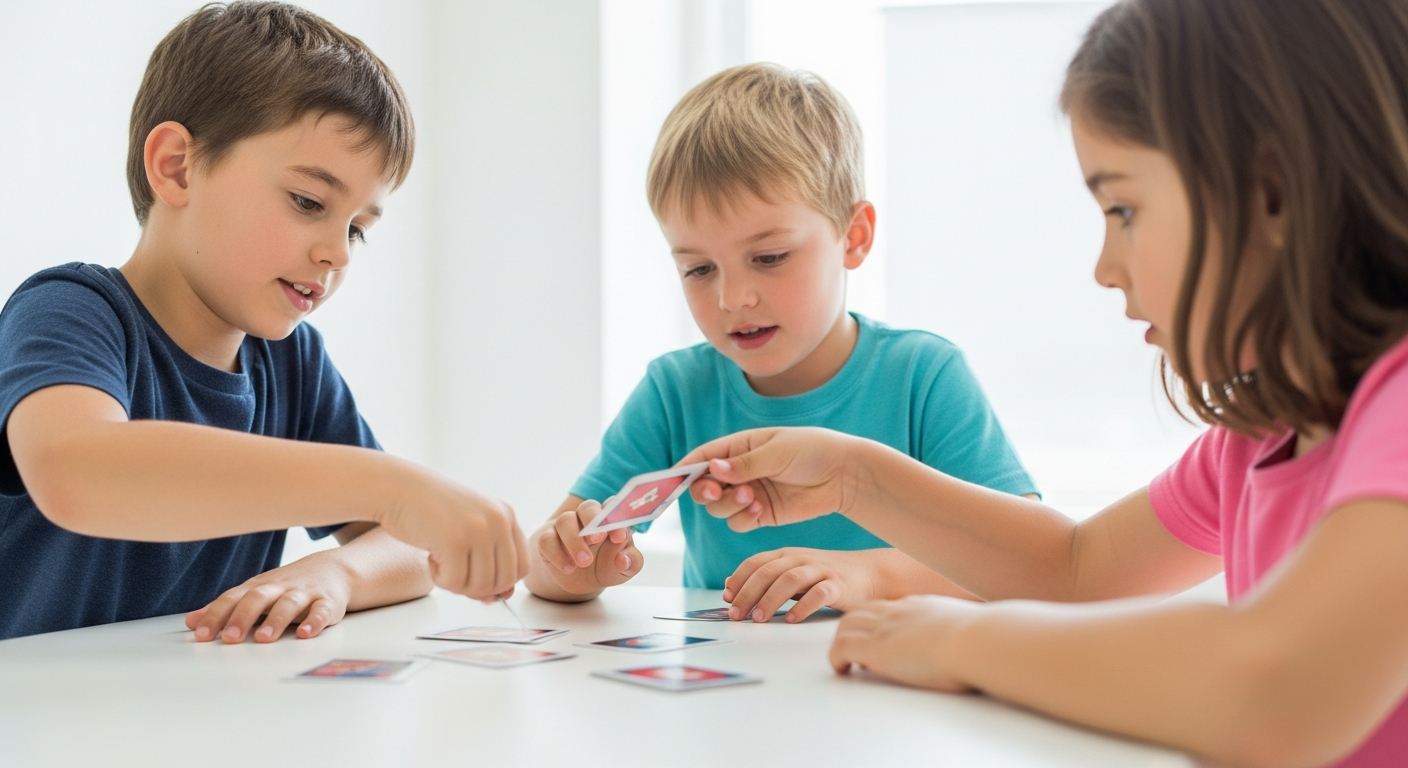
Table of Contents
- Introduction
- The Unsung Hero: Why Card Games Matter for Development
- Classic Card Games for Kids
- How Card Games Boost Communication Skills
- Pairing Card Games with Smart Screen Time: The Speech Blubs Approach
- Choosing the Right Card Game for Your Child
- Making Card Game Play a Regular Family Ritual
- Why Speech Blubs is Your Partner in Communication Development
- Conclusion
- FAQ
Introduction
Imagine a rainy afternoon, a long car ride, or a quiet evening at home. What's one simple, inexpensive item that can instantly transform these moments into laughter, learning, and connection? Often overlooked in our digital age, the humble deck of cards holds immense power. Beyond mere entertainment, fun kids card games are a secret weapon in a child's developmental arsenal, fostering crucial skills from math and strategy to patience and social interaction.
At Speech Blubs, we believe in empowering children to "speak their minds and hearts," and we recognize that communication extends far beyond spoken words. It's about confidence, understanding, and engaging with the world around them. That's why we’re passionate about activities that naturally cultivate these abilities. This post isn't just a list of games; it's an exploration of how a simple deck of cards can become a cornerstone of joyful family learning and a powerful supplement to your child's overall development plan. We’ll delve into classic favorites and exciting new finds, highlighting how these screen-free interactions build foundational skills and create cherished memories, all while keeping communication at the forefront.

The Unsung Hero: Why Card Games Matter for Development
In a world increasingly dominated by screens, finding engaging, interactive, and educational activities can feel like a quest. Yet, sometimes the best solutions are the simplest. A standard deck of cards offers an incredible array of possibilities, providing hours of entertainment while subtly nurturing a child’s cognitive, social, and linguistic growth.
Beyond Basic Entertainment
Card games aren't just about passing the time; they are miniature classrooms disguised as play. When children engage with card games, they are actively processing information, making decisions, and interacting with others. This active participation is profoundly different from passive viewing, like watching cartoons, and it's essential for holistic development.
For instance, consider a child who struggles with social cues. Playing a game like "Go Fish" requires them to ask direct questions, listen to answers, and understand turn-taking. This immediate feedback loop in a low-stakes, fun environment is invaluable. Similarly, a child who is a "late talker" might find the repetitive phrases and simple vocabulary in card games less intimidating and more motivating to participate verbally. This is where the magic happens: communication isn't forced; it's a natural part of the game.
Cultivating Essential Skills Through Play
The benefits of engaging with fun kids card games are wide-ranging and impactful:
- Cognitive Development: Card games enhance memory (think Concentration!), number recognition, pattern identification, strategic thinking, and problem-solving skills. Children learn to anticipate moves, calculate probabilities (even if subconsciously), and adapt to changing game dynamics.
- Language and Communication: From asking "Do you have a..." to declaring "Snap!" or "War!", card games provide natural opportunities for verbal interaction. They encourage children to articulate their thoughts, follow instructions, and use descriptive language. For a child who might be hesitant to speak, the structure of a game can provide a safe framework for practicing new words and phrases.
- Social-Emotional Growth: Sharing, turn-taking, winning gracefully, losing with resilience, and dealing with frustration are all critical life lessons learned around a card table. These games foster patience, empathy, and the ability to cooperate or compete in a healthy manner.
- Fine Motor Skills: Shuffling, dealing, holding, and playing cards all contribute to the development of fine motor coordination and dexterity, which are crucial for tasks like writing and self-care.
- Family Bonding: Perhaps one of the most significant benefits is the opportunity for quality family time. Card games bring everyone together, fostering connection, creating shared laughter, and building lasting memories away from individual screens. This shared experience reinforces the idea that communication is a two-way street, a valuable interaction with loved ones.
Integrating Play and Purpose
At Speech Blubs, we understand the power of play-based learning. Our mission, born from the personal experiences of our founders who all grew up with speech problems, is to provide an immediate, effective, and joyful solution for the 1 in 4 children who need speech support. We achieve this by blending scientific principles with play, creating one-of-a-kind "smart screen time" experiences. Just as card games offer a screen-free alternative to passive viewing, Speech Blubs offers an active, engaging alternative to other forms of digital entertainment.

Our unique "video modeling" methodology, where children learn by watching and imitating their peers, directly mirrors the natural imitation and observation that occurs during card games. A child watching an older sibling ask for a card in "Go Fish" is engaging in a form of video modeling, learning not just the words but the social context. Speech Blubs extends this natural learning process into a structured, fun environment.
Curious if your child could benefit from more communication support? Take our quick 3-minute preliminary screener to get a simple assessment and a free 7-day trial.
Classic Card Games for Kids
Let’s dive into some timeless card games that have been entertaining and educating children for generations. These games are easy to learn, adaptable to various age groups, and packed with developmental benefits.
Crazy Eights
- Age: 5+
- Players: 2-4
- Cards: Standard 52-card deck
- How to Play: Each player is dealt a hand (seven cards for two players, five for more). The remaining deck forms a draw pile, and the top card is flipped to start the discard pile. Players take turns discarding a card that matches either the rank or suit of the top card on the discard pile. If no match is available, they draw cards until a playable one appears. Eights are wild cards – they can be played on any card, and the player declares the new suit. The first player to empty their hand wins.
- Developmental Benefits: This game is fantastic for pattern recognition, matching skills, strategic thinking (when to save an eight!), and number/suit identification. For a child learning early math concepts, recognizing "fives" or "hearts" repeatedly reinforces these ideas. The need to verbally declare a suit when playing an eight encourages verbalization and decision-making.
Go Fish!
- Age: 7+ (can be simplified for younger kids)
- Players: 2+
- Cards: Standard 52-card deck or a Go Fish! specific deck
- How to Play: The dealer gives out cards (seven for 2-3 players, five for more). The rest form the "fish pond." Players sort their cards by rank. The first player asks another player for cards of a specific rank (e.g., "Do you have any Kings?"). If the asked player has them, they must hand them over. The asking player continues until the other player says, "Go fish!" At that point, the asking player draws from the pond, and if they get the card they asked for, they get another turn. Otherwise, the turn passes. Collecting all four cards of a rank creates a "set," which is laid down. The goal is to collect the most sets.
- Developmental Benefits: Go Fish! is a powerhouse for developing auditory memory, question-asking skills, and using specific vocabulary. For children working on articulation, practicing phrases like "Do you have any [letter sounds]?" or "Go Fish!" provides excellent repetitive practice. It also teaches turn-taking and patience. For a shy child, the structured nature of asking a direct question can be a gentle way to encourage verbal interaction.
War
- Age: 6+
- Players: 2
- Cards: Standard 52-card deck
- How to Play: All cards are dealt face down, evenly, between two players. Players simultaneously turn over their top card. The player with the higher card takes both. If the cards are of the same rank, it’s "War!" Each player then places two cards face down, followed by one face-up card. The higher face-up card wins all six cards. The game continues until one player collects all the cards.
- Developmental Benefits: War is excellent for number comparison (higher/lower), quick decision-making, and understanding sequences. It also builds anticipation and can teach children about probability in a fun, intuitive way. The "War!" declaration provides a fun, emphatic verbalization opportunity.
Old Maid
- Age: 5+
- Players: 3+
- Cards: Standard 52-card deck with one Queen removed (leaving one unmatched Queen, the "Old Maid").
- How to Play: Cards are dealt face down. Players make pairs from their hand and lay them down. The player to the left of the dealer then offers their cards face down to the player on their left, who draws one card. If it makes a pair, they lay it down. If not, they keep it. This continues around the table. The goal is to avoid being the player left holding the "Old Maid" card.
- Developmental Benefits: This game sharpens matching skills, visual discrimination, and social interaction. Children learn to strategize about which card to offer or draw. It also introduces the concept of elimination in a light-hearted way.
Concentration / Memory
- Age: 3+ (with fewer cards)
- Players: 2+
- Cards: Standard 52-card deck (or any matching memory deck, ensuring pairs).
- How to Play: Shuffle cards and spread them face down on a table, either randomly or in a grid. Players take turns flipping over two cards. If they match, the player keeps the pair and gets another turn. If they don't match, they flip them back over, trying to remember their location. The game ends when all pairs are found. The player with the most pairs wins.
- Developmental Benefits: This is a fantastic game for memory recall, visual recognition, and focus. For younger children, it's a superb way to learn numbers, colors, and suits. Verbally identifying the cards as they are flipped ("It's a red seven! And a black queen!") adds a strong linguistic component. For children who need to work on sustained attention, the quiet focus required for Memory can be very beneficial.
Snap
- Age: 6+
- Players: 2+
- Cards: Standard 52-card deck (two decks for more than three players).
- How to Play: Cards are dealt face down into individual piles. Players take turns flipping their top card into a central face-up pile. When two consecutive cards in the central pile match (e.g., two Queens), the first player to shout "Snap!" wins both piles and adds them to the bottom of their face-down stack. If two players shout "Snap!" simultaneously, those cards form a "Snap Pool" in the center. The game continues until a card matching the top of the Snap Pool appears, and the first to shout "Snap Pool!" wins it all. The winner is the player who collects all the cards.
- Developmental Benefits: Snap is all about quick reflexes, visual discrimination, and auditory processing. It encourages alertness and fast verbal responses. For children developing expressive language, the opportunity to shout "Snap!" or "Snap Pool!" in an exciting context can be highly motivating.
Rummy
- Age: 7+
- Players: 2-6
- Cards: Standard 52-card deck
- How to Play: The dealer deals cards (10 for two players, 7 for 3-4, 6 for 5-6). The rest form a "stockpile," and one card is turned up to start the "discard pile." The goal is to form "melds" (sets of 3-4 of the same rank or "runs" of 3+ consecutive cards of the same suit) and lay them down. Players take turns drawing from either the stock or discard pile, making melds if possible, and then discarding one card. The first player to get rid of all their cards by melding wins the round.
- Developmental Benefits: Rummy is a more complex game that significantly boosts strategic thinking, logical reasoning, and pattern recognition. It involves planning several moves ahead and adapting to what others play. Managing hands of cards also helps with organization and visual scanning.
I Doubt It (or Baloney/BS)
- Age: 6+
- Players: 6-12 (best with more)
- Cards: Standard 52-card deck
- How to Play: All cards are dealt. The first player starts by placing cards face down in the center, announcing a number of aces (e.g., "Two Aces"). The next player does the same with twos, and so on up to Kings, then back to Aces. Players don't have to play the cards they announce; they can bluff. Any player can challenge an announcement by saying "I Doubt It!" If the player was bluffing, they pick up the entire discard pile. If they were telling the truth, the challenger picks up the pile. The first player to get rid of all their cards wins.
- Developmental Benefits: This game is fantastic for social deduction, understanding non-verbal cues, and strategic bluffing. It encourages critical thinking about what others might be doing and helps children develop a "poker face." It also requires them to listen carefully to what others are announcing.
How Card Games Boost Communication Skills
The benefits of card games directly align with many principles we champion at Speech Blubs. We know that effective communication isn't just about uttering words; it's about context, confidence, and connection.
Encouraging Verbalization and Expression
Every card game offers opportunities for specific verbal prompts. In "Go Fish," a child explicitly asks, "Do you have any sevens?" This simple phrase is repeated, reinforced, and associated with a desired outcome. For a child who might be a "late talker" or has a limited vocabulary, these structured prompts are less overwhelming than open-ended conversations.
- Relatable Scenario: For a parent whose 4-year-old is shy about speaking up, playing "Go Fish" provides a safe script. The repeated pattern of asking "Do you have a...?" and responding with "Yes, I do!" or "Go fish!" builds confidence. When they succeed in getting a card, the positive reinforcement encourages more verbal attempts.
Similarly, in "Crazy Eights," a child might announce "I'm changing the suit to hearts!" This not only practices specific vocabulary but also demonstrates their understanding of the game's rules and their ability to assert a choice.
Fostering Turn-Taking and Social Reciprocity
Communication is a dance, a back-and-forth exchange. Card games inherently teach turn-taking, a foundational skill for any conversation. Children learn to wait for their turn, observe others, and then act. This patience and understanding of social rhythm are invaluable.
- Relatable Scenario: A child who often interrupts might benefit greatly from games like "War" or "Snap," where strict turn-taking (or lightning-fast observation) is key. The game's rules provide a clear, external structure that helps them internalize the concept of waiting for their moment to speak or act.
Developing Comprehension and Following Instructions
Before a child can speak, they must understand. Card games require children to listen carefully to rules, understand new vocabulary (e.g., "meld," "stockpile," "wild card"), and follow multi-step instructions. This strengthens their receptive language skills.
Building Confidence and Reducing Frustration
Success in a game, even a small one like finding a pair in Concentration, builds self-esteem. When children feel capable and successful in playful settings, they are more likely to take risks in other areas, including trying new words or engaging in more complex conversations. The low-pressure environment of a game allows for mistakes, which are often met with encouragement rather than correction, further reducing communication frustration.
- Relatable Scenario: If a child is easily frustrated when they can't express themselves, a game like "Memory" can be a great starting point. The clear rules and achievable goal of finding a match allow for quick wins, boosting their confidence and making the learning process enjoyable.
Pairing Card Games with Smart Screen Time: The Speech Blubs Approach
While card games offer incredible screen-free benefits, we also recognize that technology, when used purposefully, can be a powerful ally in a child's developmental journey. At Speech Blubs, we've carefully crafted our app to be a "smart screen time" solution that complements and enhances these real-world interactions.
Video Modeling: Learning from Peers
Our core methodology, "video modeling," is rooted in scientific principles. Children learn by watching and imitating their peers, much like they learn social cues and game mechanics by watching family members play card games. This natural, intuitive way of learning makes complex communication skills accessible and engaging. Our app replaces passive viewing with active participation, transforming screen time into a dynamic learning experience.
From Card Table to App: Reinforcing Concepts
Imagine your child has just mastered identifying numbers in a game of Concentration. They can then transition to Speech Blubs, where they might encounter activities that reinforce number recognition, counting, or even describing objects using those numbers. The skills are transferable and reinforced across different learning environments.
For a parent whose 3-year-old "late talker" loves animals, the "Animal Kingdom" section within Speech Blubs offers a fun, motivating way to practice "moo" and "baa" sounds through video modeling, mirroring the animal sounds they might make while playing "Old Maid" with animal-themed cards. This blended approach ensures consistent exposure and practice.
Our commitment to providing a powerful tool for family connection extends from the card table to our app. Speech Blubs is designed to be used with your child, fostering interaction and shared learning, rather than isolating them with a screen.
Want to learn more about the science behind our effective method? Explore the research that places us in the top tier of speech apps worldwide.
Choosing the Right Card Game for Your Child
Selecting the perfect card game involves considering your child's age, developmental stage, and interests.
Age-Specific Considerations
- Toddlers (1-3 years): Focus on simple matching, color, and number recognition. Games like a simplified Concentration (using only a few pairs) are ideal. Emphasize verbalizing colors and numbers as you play.
- Preschoolers (3-5 years): Introduce basic turn-taking and more complex matching. Go Fish (simplified), Old Maid, and simple versions of Snap work well. These games build confidence in asking questions and following basic rules.
- Early Elementary (6-8 years): Children can grasp more intricate rules and strategy. Crazy Eights, War, and full Concentration are excellent choices. They start to understand cause and effect and planning.
- Late Elementary & Pre-Teens (9+ years): Introduce games with deeper strategy and social interaction. Rummy, I Doubt It, and more complex variations of classic games are perfect for developing advanced reasoning and social skills.
Tailoring to Interests and Personality
- For the visual learner: Games with clear imagery like Concentration are great.
- For the auditory learner: Games requiring specific verbal prompts like Go Fish are ideal.
- For the energetic child: Fast-paced games like Snap or War can channel their energy productively.
- For the strategic thinker: Rummy or I Doubt It will challenge and engage them.
Remember, the goal is to foster a love for communication and interaction, build confidence, and create joyful family learning moments, not to achieve guaranteed outcomes or produce public speakers overnight. Card games are a powerful supplement, not a magic bullet.
Making Card Game Play a Regular Family Ritual
Integrating card games into your family routine doesn't require a lot of effort, but it yields significant rewards.
- Designate "Game Night": Even once a week can make a huge difference.
- Keep Cards Accessible: Have a deck ready in a common area for spontaneous play.
- Be Patient: Learning new games takes time. Focus on fun over perfection.
- Model Good Sportsmanship: Celebrate wins, learn from losses, and always encourage.
- Vary the Games: Introduce new games regularly to keep things fresh and challenge different skills.
Why Speech Blubs is Your Partner in Communication Development
While card games are wonderful for fostering natural communication, sometimes a child needs a little extra support. That's where Speech Blubs comes in, designed by experts and born from the real-life experiences of our founders. Our app is a powerful, science-backed tool that integrates seamlessly into your child's developmental journey.
We are committed to providing an immediate, effective, and joyful solution for the 1 in 4 children who need speech support. Through our innovative video modeling approach, we turn screen time into "smart screen time," enabling children to learn critical communication skills by imitating their peers. This is not passive entertainment; it's active learning that empowers children to truly speak their minds and hearts.
We believe in transparency and providing exceptional value for families. Our pricing is straightforward:
- Monthly Plan: $14.99 per month
- Yearly Plan: $59.99 per year (which breaks down to just $4.99/month)
The Yearly Plan offers superior value, allowing you to save 66% compared to the monthly subscription. But the savings are just the beginning. The Yearly plan also includes exclusive, high-value features designed to maximize your child's progress and your family's experience:
- A 7-day free trial to explore everything Speech Blubs has to offer without commitment.
- Access to the extra Reading Blubs app, enhancing literacy alongside speech development.
- Early access to new updates and features, ensuring your child always has the latest tools.
- 24-hour support response time, so help is always there when you need it.
The Monthly plan does not include these invaluable benefits. We highly recommend the Yearly plan to unlock the full suite of features and ensure your child gets the most comprehensive support possible.
Download Speech Blubs on the App Store or get Speech Blubs on Google Play to start your free trial and discover how we can help your child thrive. You can also create your account and begin your 7-day free trial today directly on our website.
Conclusion
From fostering cognitive abilities to nurturing social-emotional growth and enhancing communication skills, fun kids card games are a truly invaluable resource for families. They offer a simple, accessible way to create meaningful connections, build confidence, and develop crucial foundational skills, all away from screens. Whether you're revisiting a beloved classic like Go Fish or discovering a new family favorite, the benefits of gathering around a card table are immense.
Remember, every "Do you have any Kings?" or "Snap!" is a step forward in your child's communication journey. These joyful moments of interaction, problem-solving, and shared laughter are what truly empower children to express themselves fully. And for those times when a little extra support is needed, Speech Blubs is here to complement these screen-free efforts with our "smart screen time" approach, reinforcing learning and boosting confidence.
Ready to deal a hand of fun and foster your child's communication potential? Start your free 7-day trial by downloading Speech Blubs today! Choose our Yearly plan to unlock the best value, including the Reading Blubs app and priority support, and watch your child flourish.
FAQ
Q1: What are the best card games for a 3-year-old?
For a 3-year-old, focus on simple matching games like Concentration (using fewer cards for shorter playtimes) or a very simplified version of Go Fish where you focus on colors or specific numbers. The key is to keep it short, fun, and focused on basic recognition and turn-taking.
Q2: How can card games help a child with speech delay?
Card games provide structured opportunities for verbalization, such as asking questions ("Do you have a...?"), making declarations ("Snap!", "War!"), or identifying cards by name. The repetitive nature of phrases and the clear visual cues can make it less intimidating for children with speech delays to practice new words and sounds in a fun, low-pressure environment. It also builds confidence and strengthens receptive language skills.
Q3: What if my child gets frustrated when playing card games?
Frustration is a normal part of learning. To help, choose simpler games, focus on participation and fun rather than winning, and offer plenty of encouragement. Break the game into shorter sessions if needed. Model good sportsmanship and emphasize that mistakes are part of learning. You can also try cooperative card games where everyone works together towards a common goal.
Q4: Are there any card games that teach specific academic skills like math or reading?
Absolutely! Many card games naturally integrate academic skills. Concentration helps with number and letter recognition. War reinforces "greater than/less than" concepts. Rummy requires strategic thinking that involves number sequences and set formation, akin to early algebra concepts. You can also adapt games, for instance, by asking your child to read the names of the suits or numbers aloud as they play, directly boosting literacy skills.
About the author