
Unlock Imagination: Easy Cardboard Crafts for Kids
 By Speech Blubs Team•Jan 13, 2026•20 min.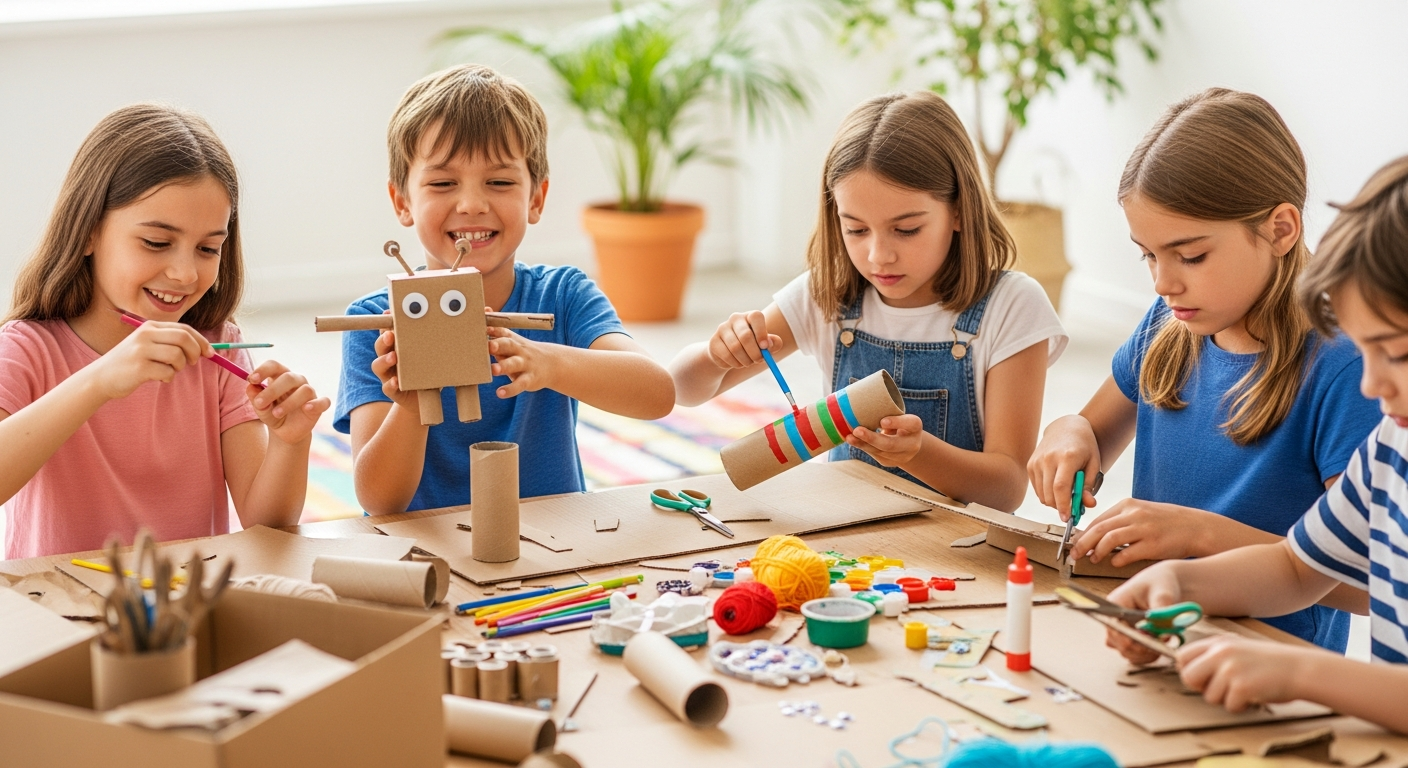
Table of Contents
- Introduction
- The Magic of Cardboard: Why It's a Parent's Best Friend
- Essential Tools for Cardboard Crafting Adventures
- Easy Cardboard Crafts for Little Explorers (Ages 2-5)
- Engaging Cardboard Projects for Growing Minds (Ages 6-9)
- Advanced Cardboard Challenges for Young Innovators (Ages 10+)
- Enhancing Communication Through Play: How Cardboard Crafts & Speech Blubs Go Hand-in-Hand
- Why Choose Speech Blubs for Your Child's Communication Journey
- Frequently Asked Questions (FAQ)
- Conclusion: Crafting a Brighter Future, One Word at a Time
Do you ever look at that pile of cardboard boxes destined for recycling and see not waste, but possibility? As parents, we’re constantly seeking engaging, educational activities that spark creativity without relying on screens. The good news is that the solution to hours of imaginative play, cognitive development, and even speech stimulation might just be hiding in your recycling bin!
Cardboard, the unsung hero of the crafting world, offers an incredible, free, and versatile medium for children of all ages to explore, build, and express themselves. Far from just being "boxes," these humble materials can transform into anything a child can dream up, fostering essential skills and creating cherished family memories. This post will delve into the wonderful world of easy cardboard crafts for kids, providing you with a treasure trove of ideas, tips, and insights into how these simple projects can significantly contribute to your child's holistic development, including their communication skills. We'll explore why cardboard is a parent's best friend, essential tools, and a range of projects tailored for different age groups, all while highlighting how engaging in such hands-on, interactive play can beautifully complement the communication support we offer at Speech Blubs.

Introduction
In a world increasingly dominated by digital distractions, the simple, tactile joy of hands-on creation can feel like a breath of fresh air. How often do we find ourselves searching for ways to keep our children entertained and engaged, only to stumble upon complex crafts requiring expensive, specialized materials? The answer to this common dilemma is often right under our noses, in the form of everyday cardboard. This seemingly ordinary material is, in fact, an extraordinary canvas for limitless imagination and learning.
This blog post is your comprehensive guide to unlocking the creative potential of cardboard, transforming mundane boxes into magnificent masterpieces with your children. We’ll explore a variety of easy cardboard crafts that are not only fun and inexpensive but also incredibly beneficial for developing fine motor skills, problem-solving abilities, and crucial communication pathways. Our aim is to empower you with practical ideas that encourage "smart screen time" alternatives and create rich opportunities for family connection and joyful learning. Through these projects, you'll discover how to turn discarded packaging into springboards for storytelling, descriptive language, and playful interaction, setting the stage for strong communication skills.
The Magic of Cardboard: Why It's a Parent's Best Friend
Cardboard isn't just a packaging material; it's a launchpad for learning and an essential tool for sustainable play. For parents, it ticks so many boxes, making it an ideal crafting medium.
Accessibility & Sustainability
One of the greatest appeals of cardboard is its ubiquitous nature. From cereal boxes to shipping containers, it's readily available, often free, and infinitely recyclable. This makes it an incredibly sustainable choice for crafting. You're not just creating; you're teaching your child about upcycling and reducing waste, instilling valuable environmental awareness from a young age. There’s no need for expensive trips to the craft store when a world of potential is waiting in your recycling bin.

Boosting Creativity & Imagination
Give a child a toy, and they play with the toy. Give a child a box, and they can imagine it’s a car, a house, a rocket, or a secret hideout. Cardboard crafts inherently encourage open-ended play, where the child dictates the narrative and direction. There’s no right or wrong way to build a cardboard castle, allowing their imagination to run wild. This freedom cultivates innovative thinking and problem-solving as they figure out how to transform a flat piece of material into a three-dimensional object of their dreams.
Developing Essential Skills
Beyond the imaginative leap, cardboard crafting is a powerhouse for skill development:
- Fine Motor Skills: Cutting, folding, taping, gluing, and painting cardboard all refine hand-eye coordination and strengthen small muscles in the hands and fingers, which are vital for writing and self-care tasks.
- Problem-Solving & Critical Thinking: Children learn to conceptualize a design, plan their steps, and adapt when things don't go exactly as planned. How do I make this door open? How can I make this wall stand up? These challenges are mini-engineering lessons.
- Cognitive Development: Following instructions (or creating their own!), understanding spatial relationships, and identifying shapes and forms are all cognitive exercises embedded within cardboard play.
- Communication & Language: This is where cardboard truly shines as a partner in your child's development. As children design and build, they naturally engage in conversation. They describe their vision, ask for materials, narrate their actions, and role-play with their finished creations. These interactions are invaluable for expanding vocabulary, practicing descriptive language, expressing ideas, and even learning to negotiate and collaborate. For a parent whose child is just beginning to explore these verbal interactions, Speech Blubs provides a nurturing environment where children can practice new words and sounds by imitating their peers. Our unique video modeling methodology means children learn by watching and imitating other children, making the learning process natural and fun, much like sharing a crafting experience.
Essential Tools for Cardboard Crafting Adventures
While cardboard is the star, a few basic tools will make your crafting sessions smoother, safer, and even more enjoyable.
Basic Supplies
- Cardboard: Collect various sizes and thicknesses – small cereal boxes, paper towel rolls, large appliance boxes, shoe boxes. Variety is key!
- Child-Safe Scissors: Essential for little hands to cut paper and thin cardboard. For thicker cardboard, adult-only utility scissors or a craft knife will be needed for pre-cutting.
- Tape: Masking tape, painter's tape, or even duct tape work wonders for quickly joining pieces. They are often easier for children to manage than glue for initial assembly.
- Glue: Craft glue, hot glue (adult supervised!), or a glue stick for paper details.
- Decorating Materials: Markers, crayons, paint (tempera or acrylic), glitter, construction paper, fabric scraps, pipe cleaners, googly eyes, yarn, buttons – anything that adds color and texture!
- Ruler & Pencil: For measuring and marking cuts.
Safety First!
Always supervise children, especially when using sharp tools. Pre-cut challenging shapes or thick cardboard pieces for younger children. Emphasize that crafting tools are not toys and should be used responsibly. Creating a designated "crafting zone" can also help manage mess and ensure tools are kept safely.
Easy Cardboard Crafts for Little Explorers (Ages 2-5)
At this age, the focus is on sensory exploration, simple construction, and imaginative play. Keep projects straightforward and allow plenty of room for creative input.
Cardboard Box Vehicles (Cars, Rockets, Boats)
Transform a medium to large cardboard box into a vehicle your child can sit inside or push around.
- Materials: Large cardboard box, paper plates (for wheels), paint or markers, tape/glue.
- How-To:
- Choose a Box: A washing machine box for a car, a tall box for a rocket, a flatter box for a boat.
- Cut Openings: An adult can cut armholes, a windshield, or a door.
- Decorate: Let your child paint or draw details like windows, steering wheels, buttons, or flames for a rocket. Attach paper plate wheels with glue or tape.
- Play! Encourage your child to "drive," "fly," or "sail" their creation.
- Developmental Boost: This craft encourages gross motor skills as they move their vehicle, and imaginative play. For a child fascinated by vehicles, parents can use this play opportunity to practice vehicle names and sounds. Our Speech Blubs app has an exciting "Things That Go" category where children watch other kids make vehicle sounds and names, reinforcing the vocabulary they're using in their play. It's a wonderful way to extend the learning from a hands-on project to targeted speech practice.
Simple Animal Masks or Puppets
Cardboard makes fantastic animal masks or stick puppets for pretend play.
- Materials: Cereal box cardboard, elastic string or craft sticks, paint/markers, googly eyes, yarn.
- How-To:
- Draw & Cut: An adult helps draw and cut out simple animal faces (cat, dog, bear) or body shapes for puppets. Remember eye holes for masks!
- Decorate: Let your child paint, color, or glue on features like whiskers (yarn), ears, noses, and googly eyes.
- Assemble: For masks, attach elastic string. For puppets, glue a craft stick to the back.
- Developmental Boost: Great for fine motor skills and creative expression. As your child pretends to be an animal, they'll make animal sounds and simple words. Our "Animal Kingdom" section in Speech Blubs is perfect for reinforcing these early sounds and names, with children imitating their peers saying "moo," "baa," or "roar!"
Cardboard Block City or Dollhouse
Recycle small boxes into building blocks or rooms for a miniature world.
- Materials: Various small cardboard boxes (cereal, tissue, milk cartons), craft glue, markers/paint.
- How-To:
- Prepare Boxes: Seal open ends of boxes.
- Decorate: Let your child draw windows, doors, bricks, or furniture onto the boxes.
- Build: Stack and arrange the "blocks" to create a city skyline, a house, or even an imaginative abstract sculpture.
- Developmental Boost: Encourages stacking, balancing, and spatial reasoning. As they build, prompt them to describe what they are making: "What color is this house?" "Who lives here?" This kind of descriptive language practice is crucial for expanding early vocabulary, a cornerstone of our Speech Blubs program, which aims to empower children to speak their minds and hearts.
Engaging Cardboard Projects for Growing Minds (Ages 6-9)
At this age, children can handle more complex steps and enjoy crafts with a clearer goal or function, often leading to interactive play.
DIY Cardboard Arcade Games
Turn old boxes into fun, playable games like "plinko" or a target toss.
- Materials: Large cardboard box, smaller cardboard pieces, toilet paper rolls, plastic cups, markers, small balls (ping pong, whiffle).
- How-To:
- Game Board: Use the large box as the base.
- Obstacles/Targets: Cut and glue smaller cardboard pieces or toilet paper rolls inside the box to create a maze or targets. Label sections with points.
- Decorate: Decorate the game with bright colors and fun themes.
- Play! Drop balls in and see who scores the most points.
- Developmental Boost: This project introduces elements of design and engineering, along with counting and basic math. As they play, children will naturally describe the game rules, explain their turns, and cheer for their scores. For a child who needs support in developing more complex sentences or sequencing, our app provides modules that encourage storytelling and explaining, building confidence in their ability to articulate thoughts clearly.
Cardboard Castles & Forts
A classic for a reason, building a fort or castle from large boxes offers endless imaginative play.
- Materials: Large appliance boxes, smaller boxes for turrets, toilet paper rolls, paint/markers, tape/glue.
- How-To:
- Base Structure: Use large boxes for walls and rooms. Cut out windows, doors, and crenellations.
- Turrets/Towers: Attach smaller boxes or toilet paper rolls for added architectural details.
- Decorate: Paint stones, flags, or banners.
- Role-Play: Once built, it becomes the stage for epic knight battles or royal tea parties!
- Developmental Boost: This fosters collaboration (if building with others), spatial reasoning, and sustained imaginative play. Imagine your child building a majestic cardboard castle, complete with turrets and a drawbridge. As they play, you can encourage them to describe the knights guarding the castle, the dragon in the moat, or the royal feast happening inside. This imaginative play is a powerful catalyst for expressive language. For a parent whose child is a "late talker" and loves these kinds of imaginative scenarios, Speech Blubs offers engaging activities like our "When I Grow Up" section, where children watch peers act out different roles and describe their actions, providing real-life language models that complement their play.
Wearable Costumes & Props
From robot suits to superhero capes or even simple crowns, cardboard can bring dress-up to life.
- Materials: Various cardboard boxes, elastic, paint, glitter, fabric scraps, glue.
- How-To:
- Choose a Character: Decide what your child wants to be.
- Cut & Shape: For a robot, use a large box for the body and smaller ones for arms/legs. For a sword, cut out a cardboard shape.
- Decorate: Paint, glue on reflective foil, or add gems.
- Wear & Play: Encourage them to act out their chosen character.
- Developmental Boost: Promotes creative thinking, self-expression, and storytelling. Children will describe their character, what they do, and create dialogues. This is excellent practice for narrative skills, something our app specifically supports through various interactive story-based activities, where children learn to sequence events and express emotions.
Advanced Cardboard Challenges for Young Innovators (Ages 10+)
Older children can tackle more intricate designs, multi-step projects, and integrate more complex mechanical elements.
Marble Runs & Rube Goldberg Machines
Design an elaborate system for a marble to travel through, using ramps, tubes, and pivots made from cardboard.
- Materials: Cardboard sheets, toilet paper/paper towel tubes, small boxes, tape, glue, marbles.
- How-To:
- Plan: Sketch out the path of the marble.
- Build Ramps & Tunnels: Cut cardboard into strips for ramps, and use tubes for tunnels.
- Connect: Securely tape or glue components to a large cardboard base or wall.
- Test & Refine: Experiment with angles and connections until the marble flows smoothly.
- Developmental Boost: This is a fantastic STEAM activity, integrating science, technology, engineering, art, and math. It requires significant problem-solving, critical thinking, and iterative design. As children explain the mechanics of their marble run or the chain reaction of their Rube Goldberg machine, they practice sequential language and precise vocabulary. For these explanations, the communication strategies learned in Speech Blubs can be incredibly valuable, helping children articulate complex ideas and processes with clarity and confidence.
Cardboard Sculptures & Art Installations
Move beyond functional objects to creating pure art. This could be an abstract sculpture, a replica of a famous landmark, or an entire miniature world.
- Materials: Various cardboard types, craft knife (adult use only!), strong glue, paint, texture materials.
- How-To:
- Vision: Decide on the concept.
- Cut & Join: Use adult-supervised precise cutting and strong adhesives to assemble complex forms.
- Surface Treatment: Paint, add textures, or incorporate other materials.
- Developmental Boost: Fosters advanced spatial reasoning, artistic expression, and attention to detail. Children can describe their artistic choices, the emotions their art evokes, or the story behind their creation. This expressive language is at the heart of our mission at Speech Blubs: to empower children to "speak their minds and hearts."
Enhancing Communication Through Play: How Cardboard Crafts & Speech Blubs Go Hand-in-Hand
The beauty of easy cardboard crafts for kids is how naturally they encourage communication. When children are deeply engaged in an activity, their desire to share, ask, explain, and narrate becomes incredibly strong.
The Power of Shared Experiences
Crafting together creates powerful shared experiences, fostering stronger family connections. As you sit side-by-side, cutting, gluing, and problem-solving, you're not just making a craft; you're building a bond. These moments are rich with opportunities for conversation – discussing choices, describing actions, and celebrating successes. This interactive play is a vital screen-free alternative to passive viewing experiences like cartoons, promoting genuine connection and dialogue.
From Imagination to Articulation
Every step of a cardboard craft from ideation to completion offers a chance to build language:
- Planning: "What should we build first?" "What do you need for the roof?" (Question-asking, vocabulary)
- Doing: "Pass me the red marker." "I'm cutting the door." (Following instructions, action verbs, descriptive language)
- Playing: "My robot is going to space!" "The princess lives in the tallest tower." (Storytelling, imaginative language, character voices)
These natural language exchanges are precisely what helps a child develop their communication skills. When a child needs a little extra boost in their articulation, vocabulary, or sentence structure, Speech Blubs steps in to provide targeted support in a playful, engaging way.
Our Video Modeling Approach: Learning from Peers
At Speech Blubs, we believe in the power of peer learning. Our app utilizes a unique video modeling methodology, where children learn by watching and imitating their peers. This approach is rooted in scientific principles, leveraging the power of "mirror neurons" that activate when we observe others. Just as your child might watch you cut cardboard and then imitate your action, they watch other children speak in the app and are motivated to imitate sounds, words, and sentences. This creates a powerful, positive learning loop. We are proud to be consistently ranked in the top tier of speech apps worldwide on the MARS scale for scientific effectiveness.
Beyond the Crafts: How Speech Blubs Supports Ongoing Development
Our company was born from the personal experiences of our founders, who all grew up with speech problems and created the tool they wished they had. We are committed to providing an immediate, effective, and joyful solution for the 1 in 4 children who need speech support, blending scientific principles with play into one-of-a-kind "smart screen time" experiences. While cardboard crafts foster general communication, Speech Blubs provides a structured yet fun environment for developing specific speech and language skills. For example, if your child is working on specific sounds, our "Sounds and Mouth Gym" activities provide fun exercises. If they need to build their vocabulary, our themed sections like "Outer Space" or "Food" expand their word bank in an engaging way.
Why Choose Speech Blubs for Your Child's Communication Journey
Finding the right support for your child's speech and language development can feel overwhelming. At Speech Blubs, we strive to make that journey joyful, effective, and accessible.
Our Scientific Approach and Success Stories
Our app isn't just fun; it's built on a foundation of scientific research into child language acquisition and the effectiveness of video modeling. We are dedicated to providing a powerful supplement to a child's overall development plan, and when applicable, professional therapy. Don't just take our word for it; hundreds of parents have shared their incredible experiences. See what other parents are saying about their child's success with Speech Blubs.
Smart Screen Time vs. Passive Viewing
We understand the concerns parents have about screen time. That's why Speech Blubs is designed to be "smart screen time" – interactive, engaging, and purposeful. Unlike passive viewing of cartoons, our app demands active participation, encouraging children to imitate, listen, and respond. It transforms a potential distraction into a powerful learning tool, and importantly, it's designed to be played with a parent, making it a tool for family connection, not isolation.
Flexible Plans to Fit Your Family
We believe every child deserves the opportunity to speak their minds and hearts, and we want to make our tools accessible to every family.
- Monthly Plan: For $14.99 per month, you get access to our core features.
- Yearly Plan: Our most popular and highly recommended option, priced at just $59.99 per year, which breaks down to an incredible value of only $4.99 per month! By choosing the Yearly plan, you save 66% compared to the monthly subscription.
The Yearly plan is truly the best value, offering a full suite of benefits to support your child's communication journey:
- 7-day free trial: Experience the full potential of Speech Blubs before committing.
- The extra Reading Blubs app: An additional app to boost early literacy skills.
- Early access to new updates: Be the first to try our latest features and content.
- 24-hour support response time: Get prompt assistance whenever you need it.
The Monthly plan does not include these invaluable extra features or the free trial, making the Yearly plan the clear choice for families looking for comprehensive support and incredible savings.
Unsure if your child could benefit from a little extra support? Take our quick 3-minute preliminary screener to get a simple assessment and a free 7-day trial of our app. It involves just 9 simple questions and provides an assessment along with a personalized next-steps plan.
Frequently Asked Questions (FAQ)
Q1: What age is best for starting cardboard crafts?
A: Cardboard crafts are fantastic for all ages! Toddlers (2-3) can enjoy simple tasks like coloring or sticking pre-cut shapes. Preschoolers (4-5) can start cutting with child-safe scissors and assembling basic structures. Older children (6+) can design and execute more complex projects, incorporating their own ideas and problem-solving skills. Adult supervision and assistance with sharp tools are always recommended, especially for younger children or intricate cuts.
Q2: What kind of cardboard should I collect?
A: Collect a variety! Cereal boxes, tissue boxes, and paper towel/toilet paper rolls are great for smaller details and thinner cuts. Shoe boxes are perfect for building blocks or small structures. Larger shipping boxes from appliances or online orders are ideal for forts, cars, or elaborate playhouses. The more variety you have in thickness and size, the more versatile your crafting supplies will be.
Q3: How can I make cardboard crafts educational, especially for speech?
A: Integrate language throughout the crafting process!
- Describe: Encourage your child to describe what they are making ("This is a tall, green robot").
- Narrate: Have them narrate their actions ("I am cutting the round wheel").
- Ask Questions: "What color should we paint the door?" "Where should the window go?"
- Storytelling: Once the craft is done, use it as a prop for imaginative storytelling. These interactions build vocabulary, sentence structure, and conversational skills. For more targeted speech practice, parallel these activities with Speech Blubs' themed sections that reinforce relevant vocabulary and sounds.
Q4: My child gets frustrated easily with crafts. How can I keep them engaged?
A: The key is to keep it fun and low-pressure.
- Start Simple: Choose very easy projects initially.
- Focus on the Process: Emphasize the joy of creating, not just the perfect end product. "Look at all the beautiful colors you used!"
- Offer Choices: Let them decide what to make or how to decorate.
- Provide Assistance: Help with tricky parts to prevent frustration.
- Break It Down: Tackle big projects in smaller steps. And remember, sometimes the most fun is just playing with the box itself, even before it's transformed! The goal is always joyful learning, which is a core value we share at Speech Blubs.
Conclusion: Crafting a Brighter Future, One Word at a Time
Easy cardboard crafts for kids are a gateway to boundless imagination, critical skill development, and invaluable family bonding. They offer a sustainable, accessible, and incredibly effective way to engage children, fostering their creativity, problem-solving abilities, and crucially, their communication skills. By turning everyday cardboard into extraordinary creations, you're not just making a craft; you're building confidence, nurturing expression, and creating lasting memories.
As you embark on these crafting adventures, remember that every snip, every stroke of paint, and every imaginative play scenario is an opportunity for your child to grow and communicate. And when you're ready to provide even more dedicated support for their speech and language development, we at Speech Blubs are here to help. Our app complements these hands-on activities by providing engaging, scientifically-backed "smart screen time" that empowers children to speak their minds and hearts.
Ready to unlock your child's full communication potential? Begin your journey today! We invite you to experience the full benefits of our app. Create your account and begin your 7-day free trial today! Remember to choose the Yearly plan to unlock your free trial, access the bonus Reading Blubs app, and enjoy exclusive features and savings. You can also download Speech Blubs on the App Store or Google Play to get started immediately!
About the author