
Unplugged Fun: Engaging Games to Play with Kids No Equipment Needed
 By Speech Blubs Team•Jan 19, 2026•19 min.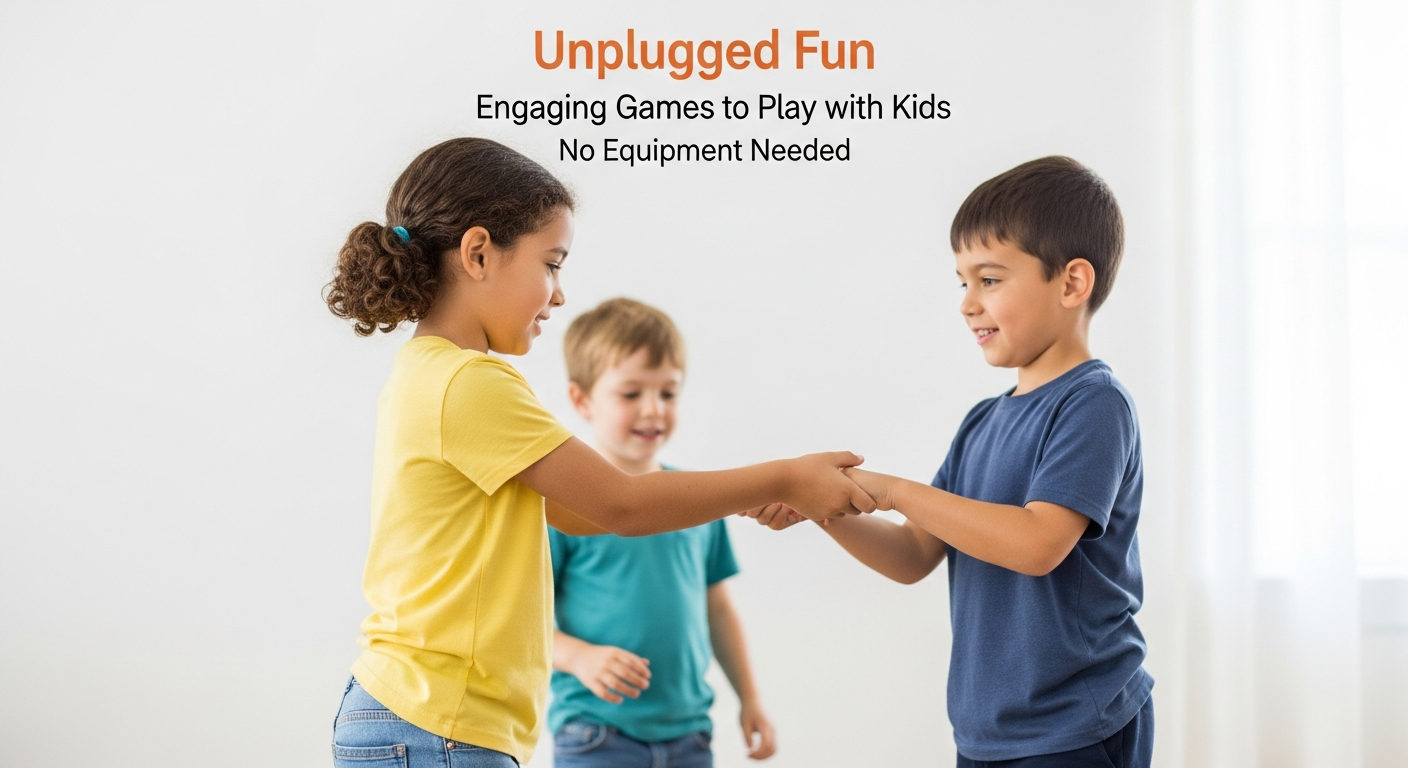
Table of Contents
- Introduction
- The Undeniable Benefits of Unplugged Play for Child Development
- Unleashing Imagination: Games to Play with Kids No Equipment
- Empowering Communication with Speech Blubs: A Complement to Play
- Conclusion
- FAQ
Imagine a world where the most captivating entertainment doesn't require batteries, Wi-Fi, or even a trip to the toy store. A world where laughter echoes, imaginations soar, and connections deepen, all fueled by the simple magic of human interaction. For many parents, this sounds like a dream, especially in an age saturated with digital distractions. But what if we told you this world is not only real but also incredibly accessible, often right within the four walls of your home or the leafy expanse of your backyard?
At Speech Blubs, we passionately believe in the power of play – both on and off the screen – to unlock a child's full communication potential. We understand the daily juggle parents face, and while we offer a scientifically-backed, engaging app for "smart screen time," we also champion the immense value of screen-free play. These moments, free from gadgets, are golden opportunities to foster crucial speech, language, and social skills in the most organic and joyful ways.
This post is your ultimate guide to unlocking that world of spontaneous fun. We'll dive into a treasure trove of games that require absolutely no equipment, perfect for sparking creativity, encouraging communication, and creating unforgettable family memories. From wordplay that sharpens minds to action games that burn energy, we'll show you how to transform ordinary moments into extraordinary adventures, all while nurturing your child's ability to speak their minds and hearts.

Introduction
In a society increasingly reliant on digital devices, it’s easy for the art of simple, imaginative play to fade into the background. Yet, some of the most profound learning and bonding experiences happen when we strip away the gadgets and embrace the power of presence. Have you ever noticed how quickly children can transform a cardboard box into a spaceship or a pile of cushions into a fortress? Their innate ability to create worlds from nothing is a superpower, and these no-equipment games are designed to tap directly into that.
The purpose of this blog post is to rekindle that spark, offering parents and caregivers a comprehensive collection of fun, engaging, and developmentally beneficial games that require nothing more than imagination and a few eager participants. We'll explore how these seemingly simple activities contribute significantly to a child's cognitive, social, and, most importantly, communication skills. By the end, you’ll be equipped with a repertoire of go-to games that promise laughter, learning, and stronger family bonds, reminding us that the best resources often come free.
The Undeniable Benefits of Unplugged Play for Child Development
Before we dive into the games, let's understand why unplugged play isn't just "nice to have," but crucial for holistic child development. When children engage in play without external stimuli from screens, their brains are free to create, adapt, and problem-solve in real-time. This environment is ripe for fostering vital communication skills.
Fostering Communication, Social-Emotional Growth, and Cognitive Skills
Unplugged games naturally encourage:
- Verbal Expression: Children must use words to explain rules, describe actions, negotiate roles, and articulate their thoughts, significantly boosting vocabulary and sentence structure.
- Active Listening: Many games require careful attention to instructions and the words of others, honing a fundamental skill for effective communication.
- Turn-Taking: This is a cornerstone of conversation and social interaction. Games inherently build the understanding of when to speak and when to listen.
- Emotional Regulation: Dealing with winning, losing, frustration, and collaboration provides real-world practice in managing emotions and understanding social cues.
- Imaginative Play: Inventing scenarios and characters strengthens narrative skills, creativity, and the ability to think abstractly – all precursors to complex language use.
- Problem-Solving: Figuring out strategies, adapting to unexpected twists, and collaborating with peers or siblings enhances critical thinking.
These foundational skills are not only essential for effective communication but also lay the groundwork for academic success and healthy social relationships. At Speech Blubs, our mission is to empower children to "speak their minds and hearts," and we see these screen-free interactions as a beautiful complement to the structured learning our app provides.

Bridging the Gap: How Screen-Free Play Prepares for "Smart Screen Time"
You might be wondering how an app-based solution like ours fits into a discussion about "no equipment" games. The truth is, the two approaches are deeply complementary. While these unplugged games foster spontaneous, real-world communication, Speech Blubs offers a unique "smart screen time" experience. It’s designed to be an active, not passive, engagement that builds upon the very skills honed during screen-free play.
Our founders, all of whom experienced speech challenges as children, created Speech Blubs because they wished for a tool that blended scientific principles with joyful play. Our unique "video modeling" methodology, where children learn by watching and imitating their peers, capitalizes on the brain's natural mirror neuron system. This is a scientific approach to learning through imitation – much like how children learn from watching and imitating you during an unplugged game! This makes Speech Blubs a powerful tool for developing imitation skills, expanding vocabulary, and practicing speech sounds in a fun, engaging way, reinforcing the progress made through real-world interactions. To learn more about the science behind our method and why it places us in the top tier of speech apps worldwide, we invite you to explore our research page.
Unleashing Imagination: Games to Play with Kids No Equipment
Now, let's dive into the games! We’ve categorized them to help you pick the perfect activity for any mood or moment.
1. Imaginative & Storytelling Games
These games are fantastic for building narrative skills, vocabulary, and creative thinking.
Stinky Pinkies (Rhyming Riddles)
This clever rhyming riddle game is perfect for developing phonological awareness and expanding vocabulary. One person thinks of two words that rhyme and have the same number of syllables, then provides a hint. Others guess. The fun part is the naming convention: a one-syllable pair is a "stink pink," two syllables is a "stinky pinky," three is a "stinkity pinkity," and so on.
- Example: A "stink pink" that's a container for an orange animal with a big tail. (Answer: Fox box)
- Developmental Benefits: Enhances phonological awareness (the ability to recognize and manipulate the sound structure of spoken language), boosts vocabulary, and promotes creative thinking.
Excuses, Excuses
This game is a hilarious blend of charades and storytelling. Designate one person as the "boss," another as the "employee" (who's late), and a third as the "co-worker." The boss asks the employee why they're late. The employee must narrate an excuse based on what the co-worker (standing behind the boss, visible only to the employee) is miming. At any point, the boss can spin around and ask the co-worker, "What are you doing?" The co-worker must then come up with a plausible, office-appropriate excuse for their bizarre actions.
- Relatable Scenario: Your child is a "late talker" and struggles with spontaneous speech. Playing "Excuses, Excuses" encourages them to quickly string words together, even if silly, to describe actions, building confidence in verbal reasoning.
- Developmental Benefits: Encourages spontaneous verbal expression, develops descriptive language, promotes quick thinking, and fosters social understanding through role-play.
Jebrahamadiah and Balthazar (Master and Servant)
In this narrative game, one person (the "Master") gives an order, and the other (the "Servant") must explain why they cannot carry it out. The catch? Each excuse must build upon the previous one, forming a consistent, absurd narrative. The goal is to draw it out as long as possible.
- Example: "Master: Jebrahamadiah! Go get me a glass of water." "Servant: I would, but I just broke the last glass!" "Master: Then get me a cup of water." "Servant: I would, but when I broke the glass, I cut my finger, and I can't use my hand!" (and so on).
- Developmental Benefits: Excellent for developing sustained narrative skills, imaginative problem-solving, cause-and-effect reasoning, and expanding vocabulary related to actions and explanations. It’s also a powerful tool for family connection, as the shared silliness creates lasting memories.
Categories
Pick a theme – animals, foods, things that are red. Players take turns naming items within that category. If someone can't think of an item or repeats one, they're out.
- Developmental Benefits: Sharpens vocabulary, improves categorization skills (a fundamental cognitive process), and enhances rapid recall.
Storytelling (Collaborative Creativity)
Start a story with a few sentences, then each person adds one sentence to continue the narrative. Watch as a wild and wonderful story unfolds collectively.
- Developmental Benefits: Develops narrative structure, encourages active listening, builds vocabulary, and sparks imagination. Great for fostering sequential thinking and creativity.
I Spy
"I spy with my little eye, something that is..." followed by a descriptive clue (e.g., "something green," "something that starts with 'B'"). Others guess.
- Relatable Scenario: For a child who is learning to use descriptive words, "I Spy" offers a low-pressure way to practice adjectives and initial sounds. If they struggle with differentiating sounds, this game encourages focused listening. If you're unsure if your child could benefit from targeted communication support, take our quick 3-minute preliminary screener to get a simple assessment and a free 7-day trial.
- Developmental Benefits: Enhances descriptive language skills, observation, vocabulary, and phonetic awareness.
2. Action & Imitation Games
These games are perfect for getting bodies moving, practicing listening skills, and exploring non-verbal communication.
Simon Says
A classic for a reason! One person is "Simon" and gives commands, but only commands prefaced with "Simon says" should be followed. If a command is given without "Simon says," and someone follows it, they're out.
- Developmental Benefits: Boosts listening skills, ability to follow instructions, impulse control, and body awareness.
Charades
Write down simple actions, animals, or emotions on scraps of paper (if you have them, otherwise just think of them!). One person acts out a word or phrase silently, and the others guess.
- Relatable Scenario: A child who is shy about speaking aloud might thrive with charades, using gestures and facial expressions to communicate, building confidence in non-verbal expression. This can be a stepping stone to more verbal communication.
- Developmental Benefits: Enhances non-verbal communication, encourages creative expression, expands vocabulary, and improves understanding of emotional cues.
In the Manner of the Adverb
One person secretly thinks of an adverb (e.g., bitterly, gracefully, enthusiastically). Others ask them to perform actions "in the manner of the adverb." The person acts out the adverb, and others guess.
- Example: "Make some biscuits in the manner of the adverb!" (If the adverb is "bitterly," the person might grumble, complain, and sigh while miming the action).
- Developmental Benefits: Teaches an understanding of adverbs and how they modify actions, enhances expressive communication through body language, and builds vocabulary.
Get Down, Mr. President!
This stealthy game is best played subtly. One person starts holding two fingers to their ear, as if listening to an earpiece. When others notice, they silently mimic the action. The last person to notice becomes the "President," and everyone else shouts "GET DOWN, MR. PRESIDENT!" and (gently!) tackles them.
- Developmental Benefits: Fosters observational skills, non-verbal communication cues, and social awareness.
Red Light, Green Light
One player stands with their back to the others and calls "Green Light!" The other players run towards them. When the "traffic cop" calls "Red Light!" and turns around, everyone must freeze. Anyone caught moving is out.
- Developmental Benefits: Develops listening skills, impulse control, and gross motor coordination.
Follow the Leader
One person is the leader and performs various actions (jumping, spinning, crawling). Everyone else must accurately mimic the leader.
- Developmental Benefits: Encourages imitation (a key skill in speech development), develops motor planning, and promotes social interaction.
3. Logic & Wordplay Games
These games are perfect for sharpening cognitive skills, vocabulary, and problem-solving.
Ghost
Players spell a word out loud, one letter at a time, without actually finishing a word. The goal is to avoid being the one who completes a valid word. Each player must have a real word in mind when adding a letter. If challenged, they must reveal their intended word. If they can't, or it's not a real word, they're out.
- Example: Player 1: "R." Player 2: "E." Player 3: "S." (Thinking of "restaurant"). Player 4: "A." (Thinking of "resale"). Player 1 might challenge Player 4, not seeing "resa" as a word start.
- Developmental Benefits: Improves spelling, phonics, strategic thinking, and vocabulary, while also teaching logical reasoning.
20 Questions
One person thinks of an object, animal, or person. Others ask up to 20 yes-or-no questions to figure out what it is.
- Developmental Benefits: Encourages question formulation, develops deductive reasoning, expands vocabulary, and promotes critical thinking.
Hangman
(While traditionally needing paper, this can be played verbally, with players keeping track of guessed letters in their heads). Choose a word. Players guess letters. If correct, the letter is revealed. If incorrect, a part of the "hangman" figure is drawn (or mentally accounted for). The goal is to guess the word before the "hangman" is complete.
- Developmental Benefits: Reinforces spelling skills, letter recognition, and vocabulary.
Fictionary (No-Equipment Adaptation)
Instead of a dictionary, one person thinks of a genuinely obscure word (or even invents one that sounds plausible). They then make up a fake definition. Everyone else makes up their own fake definitions. The "it" person reads all definitions aloud, and everyone votes for the one they believe is real.
- Developmental Benefits: Boosts vocabulary, encourages creative writing, develops critical thinking and persuasive language skills.
4. Movement & Coordination Games
These games get children active, improve gross motor skills, and still offer opportunities for communication.
Duck, Duck, Goose
Children sit in a circle. One person walks around tapping heads, saying "duck, duck, duck..." until they tap someone and say "goose!" That person then chases the "it" player around the circle to try and tag them before they sit in the empty spot.
- Developmental Benefits: Encourages social interaction, turn-taking, and develops gross motor skills.
Musical Statues
Play some music and have everyone dance. When the music stops, everyone must freeze in place like a statue. Anyone who moves is out.
- Developmental Benefits: Develops listening skills, impulse control, and body awareness.
Riverbank
Mark a line on the ground (real or imaginary). This is the "riverbank." Players stand on one side. When you call "In the river!", they jump over the line. When you call "On the bank!", they jump back. The trick is if you call the same command twice, they should stay put. If they jump, they're out.
- Developmental Benefits: Enhances listening skills, quick reactions, and gross motor coordination.
The Floor is Lava
Declare "The floor is lava!" Everyone must immediately get off the floor by climbing onto furniture, cushions, or anything else available.
- Developmental Benefits: Sparks imagination, develops physical agility, and encourages quick problem-solving in a playful context.
Hopscotch (Imaginary or Natural Markers)
If you don't have chalk, use imaginary lines or natural markers like leaves or small stones to create the hopscotch grid. Players then hop through the squares on one foot, following the pattern.
- Developmental Benefits: Improves balance, coordination, and can be adapted to practice number recognition or sequencing.
Captain on Deck
One person is the "Captain" and calls out commands like:
- "Captain's coming!": Everyone salutes and says "Aye, aye, Captain!"
- "Scrub the deck!": Players kneel and mime scrubbing.
- "Man overboard!": Players lie down flat.
- "Climb the rigging!": Players mime climbing a ladder. Anyone who does the wrong action or is too slow is out.
- Developmental Benefits: Develops listening skills, ability to follow multi-step instructions, and gross motor skills.
Sardines (Reverse Hide-and-Seek)
Instead of everyone hiding from one seeker, one person hides, and everyone else counts. When a seeker finds the hider, they silently join them in their hiding spot. The game continues until the last seeker finds the whole group packed like sardines.
- Developmental Benefits: Fosters social interaction, problem-solving, and spatial awareness.
Ring Around the Rosie
A classic for younger children. Hold hands in a circle, sing the nursery rhyme, and all fall down together at the end.
- Developmental Benefits: Encourages rhythm, coordination, and simple social play.
Leapfrog
Players crouch down in a line. The last person in line "leaps" over each crouching player, placing their hands on the back of the person they're leaping over. They then crouch down at the front of the line.
- Developmental Benefits: Builds physical fitness, coordination, and teamwork.
Empowering Communication with Speech Blubs: A Complement to Play
While these no-equipment games are fantastic for fostering communication in spontaneous ways, we understand that some children may need a little extra support on their speech and language journey. That's where Speech Blubs comes in. Our app is designed to be a powerful supplement, built from the personal experiences of our founders who grew up with speech problems and created the tool they wished they had.
At Speech Blubs, our commitment is to provide an immediate, effective, and joyful solution for the 1 in 4 children who need speech support. We blend scientific principles with play, transforming screen time into a one-of-a-kind "smart screen time" experience. Our unique video modeling method, where children learn by watching and imitating their peers, is more than just engaging – it's scientifically validated. Parents frequently share how our app has helped their children make incredible strides. Don't just take our word for it; see what other parents are saying about their child's success with Speech Blubs.
We offer a screen-free alternative to passive viewing (like cartoons) because our activities are highly interactive and require active participation. This isn't just an app; it's a powerful tool for family connection, encouraging parents to play and learn alongside their children, strengthening bonds while building essential skills. We focus on fostering a love for communication, building confidence, reducing frustration, and developing key foundational skills that complement the benefits of unplugged play. We empower children to truly speak their minds and hearts, helping them communicate clearly and joyfully.
Unlocking the Full Potential: Our Pricing & What You Get
To support your child's communication journey comprehensively, we offer flexible plans, but we highly recommend our Yearly plan for the best value and full access to features.
Our plans are:
- Monthly: $14.99 per month.
- Yearly: $59.99 per year, which breaks down to an incredible $4.99/month.
The Yearly plan is by far the superior choice, allowing you to save 66% compared to the monthly option! But the savings are just the beginning. The Yearly plan also includes exclusive, high-value features designed to give your child the most robust support:
- A 7-day free trial to experience everything Speech Blubs has to offer before committing.
- The extra Reading Blubs app, providing additional literacy support.
- Early access to new updates and a 24-hour support response time for priority assistance.
The Monthly plan, unfortunately, does not include these valuable benefits. We believe in transparency and want you to have the best tools at your fingertips.
Conclusion
The joy and developmental richness found in simple, no-equipment games are truly unparalleled. They remind us that the most valuable resources for a child's growth often lie within their own imagination and the connections they share with loved ones. By embracing these games, you're not just filling time; you're actively nurturing your child's communication skills, fostering creativity, and building a foundation for confident self-expression.
Whether you're engaging in a lively game of "Stinky Pinkies" or building an imaginary world with "Jebrahamadiah and Balthazar," these moments are invaluable. And when it comes to supporting your child's speech and language development further, Speech Blubs is here as your trusted partner, offering "smart screen time" that complements these real-world interactions.
Ready to embark on a journey of playful learning and empower your child's voice? Start your child's 7-day free trial today and discover the Speech Blubs difference. We encourage you to choose our Yearly plan to unlock the full suite of features, including the Reading Blubs app and priority support, all while enjoying incredible savings.
Download Speech Blubs from the App Store or Google Play to get started immediately, or create your account and begin your free trial on our website. Let's work together to help your child speak their minds and hearts!
FAQ
Q1: Why are no-equipment games so important for a child's development?
A1: No-equipment games are crucial because they rely solely on imagination, interaction, and physical movement. They encourage children to develop crucial skills like problem-solving, creativity, social interaction (turn-taking, negotiation), and expressive and receptive language without the distractions of screens or toys. These games foster stronger bonds between players and enhance the ability to self-entertain and adapt.
Q2: How can I encourage my child to play no-equipment games if they are usually glued to screens?
A2: Start by modeling enthusiasm and joining in wholeheartedly. Introduce games as fun, new "adventures" rather than "screen-free time." Begin with short bursts of play and gradually extend the time. Offer choices from a list of exciting games. Create a designated "play without gadgets" time each day. Over time, as they experience the joy and engagement, children often naturally gravitate towards these activities.
Q3: How do Speech Blubs' "smart screen time" activities complement these no-equipment games?
A3: Speech Blubs' "smart screen time" complements no-equipment games by providing structured, active learning that reinforces skills developed during free play. Our app uses video modeling to help children practice imitation, expand vocabulary, and develop clearer speech, mirroring the real-world interactions in games like "Simon Says" or "Charades." It’s designed to be an engaging, interactive experience that builds on foundational communication skills in a targeted way, making both types of play highly beneficial for a child's overall development.
Q4: My child struggles with communication. Can these games really help, and when should I seek professional support?
A4: Yes, these games can significantly help by providing natural, low-pressure environments for practicing communication skills like turn-taking, listening, and expressing ideas. They build confidence and reduce frustration by focusing on joyful interaction. However, if you have ongoing concerns about your child's speech and language development, it's always best to consult with a professional. Speech Blubs can serve as a powerful supplementary tool, and our preliminary screener can offer an initial assessment and guide your next steps towards a free 7-day trial.
About the author