
15 Fun and Easy Toddler Sensory Activities for Home
 By Speech Blubs Team•Mar 18, 2026•14 min.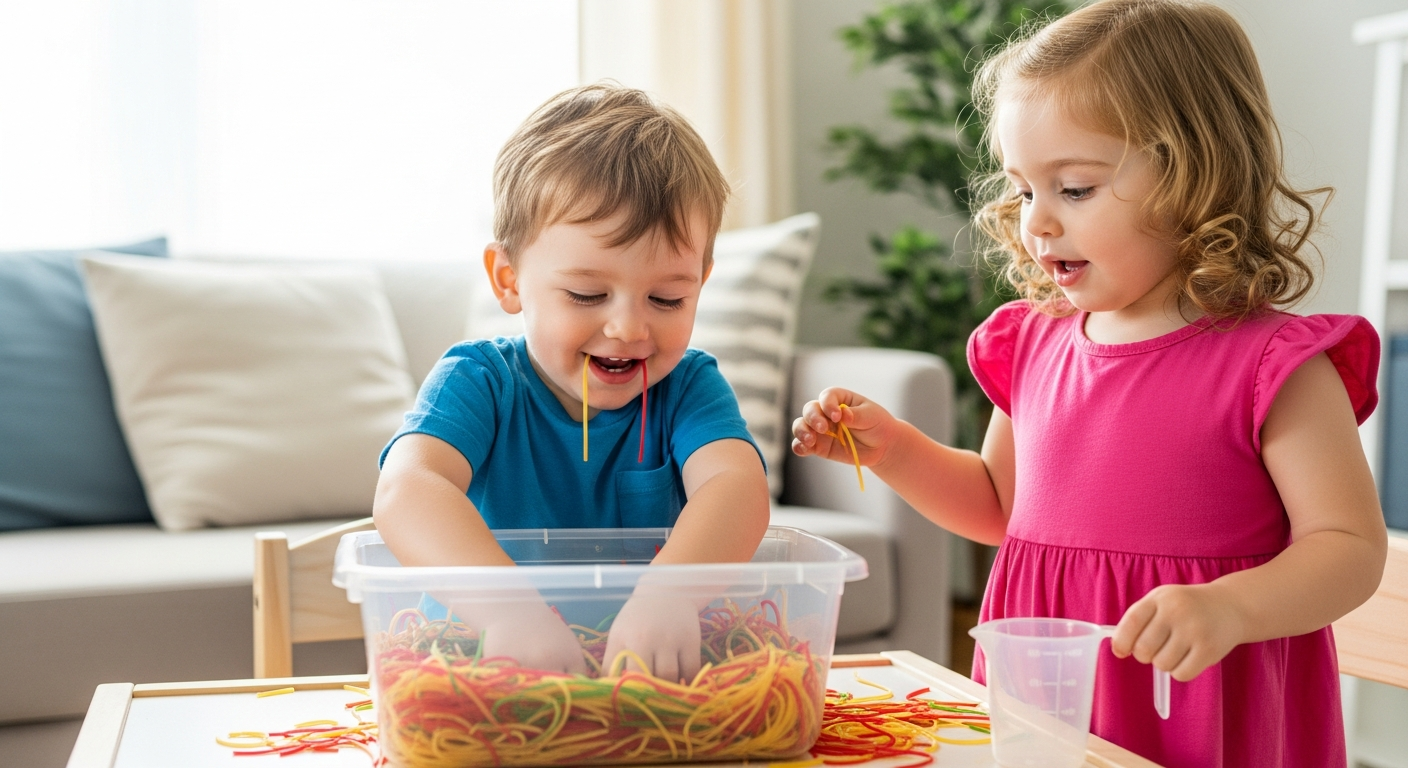
Table of Contents
- Introduction
- The Power of Sensory Play in Toddler Development
- Overcoming the "Mess" Factor
- 15 Easy Toddler Sensory Activities
- Integrating Smart Screen Time with Physical Play
- Choosing the Right Plan for Your Family
- Real-World Scenario: The Busy Tuesday
- Conclusion
- Frequently Asked Questions
Introduction
Have you ever watched your toddler spend forty-five minutes meticulously pouring water from one plastic cup into another, completely lost in the moment? Or perhaps you’ve noticed how they gravitate toward the crinkliest wrapping paper instead of the actual gift inside? These aren't just random quirks of childhood; they are signs of a brain hard at work. At Speech Blubs, we believe that every "messy" moment is a massive learning opportunity.
The purpose of this blog post is to provide you with a comprehensive list of easy toddler sensory activities that you can set up in minutes using common household items. We will cover why sensory play is the cornerstone of early development, how to manage the dreaded cleanup, and most importantly, how to use these activities to boost your child’s communication skills.
Our mission is to empower children to speak their minds and hearts, and we know that a child who is engaged through their senses is a child who is ready to learn. By the end of this guide, you will have a toolkit of activities designed to foster a love for discovery, build confidence, and create those joyful family learning moments that stay with you forever.

The Power of Sensory Play in Toddler Development
Sensory play includes any activity that stimulates your child’s senses: touch, smell, taste, sight, and hearing. But it also involves the less-talked-about senses, like balance and body awareness. When a toddler squishes a handful of "goop" or listens to the different sounds of rice hitting a metal tin, they are building neural pathways in their brain.
At Speech Blubs, our approach is rooted in the scientific principles of video modeling and mirror neurons. Just as children learn to speak by watching and imitating their peers in our app, they learn about the physical world by "imitating" the properties of the materials they touch. If a material is "runny," they learn the concept of flow; if it’s "sticky," they learn about resistance. This hands-on experience is the foundation for vocabulary and cognitive growth.
Why Sensory Activities Support Speech
Many parents are surprised to learn that tactile play directly supports language development. When a child is elbow-deep in a bin of dried beans, they aren't just playing; they are experiencing adjectives. This is the perfect time to narrate their actions. Words like "crunchy," "cold," "smooth," and "hidden" take on real meaning because the child is feeling them in real-time.
For a parent whose 3-year-old "late talker" loves animals, the "Animal Kingdom" section in the Speech Blubs app offers a fun, motivating way to practice "moo" and "baa" sounds. You can bring this to life by hiding toy farm animals in a sensory bin of dried corn or grass. As your child finds each animal, you can practice the sounds together, bridging the gap between digital learning and physical play.
Overcoming the "Mess" Factor
We hear it all the time: "I’d love to do sensory play, but I don’t want my living room covered in flour!" We get it. As a company founded by people who grew up with speech challenges, we value effective, joyful solutions—not added stress for parents.
Sensory play doesn’t have to result in a disaster zone. Here are our top tips for keeping things manageable:

- The "Containment" Rule: Use a dedicated bin or tray. Tell your child, "The rice stays in the box." If it consistently moves out of the box, the activity is over for now.
- The "Sheet" Strategy: Lay down an old bedsheet or a shower curtain liner before you start. When play is over, you can simply gather the corners and shake the debris outside or into the trash.
- Outdoor Transitions: Save the high-mess activities, like "cloud dough" or heavy water play, for the backyard or the park.
- High Chair Control: For younger toddlers, the high chair tray is a perfect, contained environment for sensory exploration.
If you are curious about where your child stands in their development, you can take our quick 3-minute preliminary screener to get a simple assessment and see if more targeted support might be beneficial.
15 Easy Toddler Sensory Activities
1. Yogurt Finger Painting (Taste-Safe!)
This is the ultimate activity for the "everything goes in the mouth" stage.
- What you need: Plain yogurt and food coloring.
- What to do: Divide the yogurt into small bowls and add a drop of food coloring to each. Let your toddler paint directly on their high chair tray or a piece of paper.
- The Speech Connection: Use this time to name colors. If you are using the "Yummy Time" section of our app, you can practice words like "eat," "cold," and "spoon" while they play.
2. The Baking Soda Volcano Tray
A classic science experiment that doubles as a sensory delight.
- What you need: A baking tray, baking soda, vinegar, and a spray bottle or dropper.
- What to do: Spread a layer of baking soda on the tray. Fill a spray bottle with vinegar (add food coloring for extra flair). Let your child spray the soda and watch it fizz.
- Why it works: The "fizzing" sound and the bubbles provide immediate sensory feedback. It’s a great way to practice "Wow!" and "Look!"
3. DIY Cloud Dough
This material feels like soft, moldable sand and stays fresh for months in a sealed container.
- What you need: 8 parts flour to 1 part oil (vegetable or baby oil).
- What to do: Mix the flour and oil until it holds a shape when squeezed. Add some scoops and small toy cars.
- Pro Tip: If you want to keep your child engaged longer, download Speech Blubs on the App Store and explore the "Building Blocks" section to find new words to model during play.
4. Scented Playdough
Adding scents engages the olfactory system, making the experience more "three-dimensional."
- What you need: Homemade or store-bought playdough and extracts (vanilla, peppermint, or cinnamon).
- What to do: Knead a few drops of extract into the dough.
- The Speech Connection: Talk about smells! "Does it smell sweet?" "Does it smell like a cookie?"
5. The Rice Treasure Hunt
Simple, inexpensive, and highly absorbing.
- What you need: A large bin, uncooked rice, and small "treasures" (blocks, toy animals, or coins).
- What to do: Bury the items in the rice and ask your child to find them using their hands or a scoop.
- Growth Mindset: This builds fine motor skills and persistence. See how other parents have used similar play-based strategies to boost their child's confidence on our testimonials page.
6. Shaving Cream Highways
If you aren't afraid of a little foam, this is a toddler favorite.
- What you need: A tray and unscented shaving cream.
- What to do: Squirt a mountain of shaving cream onto the tray. Let your child drive toy cars through it to make "tracks."
- Cleanup Hack: Do this right before bath time!
7. Magic Oobleck
Oobleck is a "non-Newtonian" fluid—it acts like a solid when you squeeze it but flows like a liquid when you let go.
- What you need: 2 parts cornstarch to 1 part water.
- What to do: Mix them together in a bowl. Add toys and watch them "sink" and then get "stuck."
- Vocabulary: This is perfect for words like "hard," "soft," "fast," and "slow."
8. Contact Paper "Stained Glass"
A mess-free visual sensory activity.
- What you need: Clear contact paper and bits of colored tissue paper.
- What to do: Tape the contact paper (sticky side out) to a window. Let your child press the tissue paper onto it.
- Visual Development: The light coming through the window makes the colors pop, capturing their attention.
9. The Texture Basket
Great for younger toddlers who are still exploring the basics of touch.
- What you need: A basket filled with items of different textures (a silk scarf, a pinecone, a smooth stone, a scrubby sponge).
- What to do: Let them explore one at a time. Describe the feeling: "This is prickly," or "This is soft."
10. Bubble Wrap Stomp
- What you need: Leftover bubble wrap and tape.
- What to do: Tape the bubble wrap to the floor and let your toddler walk, jump, or crawl over it.
- Gross Motor Skills: This encourages body awareness and provides a satisfying auditory "pop" with every movement.
11. Edible "Mud" Construction Site
- What you need: Crushed chocolate cookies or cocoa-mixed cloud dough and toy trucks.
- What to do: Create a "construction site" where the trucks have to move the mud.
- Communication: Use the "Move Your Body" section in the Speech Blubs app on Google Play to learn action words like "push" and "pull" to use while playing.
12. Floating/Sinking Water Bin
- What you need: A bin of water and various household objects (a cork, a spoon, a plastic toy).
- What to do: Ask "Will it float?" before dropping each item in.
- Scientific Discovery: This teaches cause and effect and basic physics in a fun, wet way!
13. Sensory Bottles (The "Calm Down" Jar)
- What you need: An empty plastic bottle, water, glitter, and a little dish soap or glue.
- What to do: Fill the bottle, glue the cap shut, and let your child shake it up.
- Self-Regulation: These are wonderful for helping a child regulate their emotions by watching the glitter slowly settle.
14. Kitchen Percussion
- What you need: Pots, pans, and wooden spoons.
- What to do: Let them make some noise!
- Auditory Processing: Vary the rhythm and see if they can imitate you. This imitation is a precursor to mimicking speech sounds.
15. The "Mystery" Box
- What you need: A cardboard box with a hole cut in the side.
- What to do: Place a familiar object inside. Have your child reach in (without looking) and guess what it is.
- Cognitive Challenge: This builds mental imaging and vocabulary as they try to describe what they feel.
Integrating Smart Screen Time with Physical Play
While we love these hands-on activities, we also know that parents need a break and children benefit from structured learning. That’s where Speech Blubs comes in as your partner in "smart screen time." Unlike passive cartoons that can lead to "zoning out," our app is designed to be a "screen-free alternative" in spirit—it’s an active, participatory experience.
Our methodology uses video modeling, where children see other children performing actions or saying words. This triggers their mirror neurons, making them much more likely to try the sounds themselves. It’s the perfect supplement to a day filled with sensory exploration.
If you are ready to see the difference that joyful, scientifically-backed learning can make, you can create your account and begin your 7-day free trial today.
Choosing the Right Plan for Your Family
We want to make sure every family has access to the tools they need to help their child thrive. We offer two simple plans to choose from:
- Monthly Plan: $14.99 per month. This is a great way to test the waters and see how your child responds to the app.
- Yearly Plan (Best Value!): $59.99 per year. This breaks down to just $4.99 per month, saving you 66% over the monthly price.
Why the Yearly Plan is the clear winner: Beyond the significant cost savings, the Yearly plan includes exclusive features designed to give your child the best possible start:
- 7-Day Free Trial: You get a full week to explore everything we offer before being charged.
- Reading Blubs App: Access to our companion app that focuses on early literacy and reading skills.
- Priority Support: You’ll receive 24-hour response times from our support team.
- Early Access: You’ll be the first to receive new updates and content releases.
The Monthly plan does not include the free trial, the Reading Blubs app, or early access updates. We highly recommend the Yearly plan to ensure your child has the most comprehensive set of tools available to "speak their minds and hearts."
Real-World Scenario: The Busy Tuesday
Imagine it’s a rainy Tuesday. Your toddler is restless, and you have a pile of laundry to fold. You set up a quick Rice Treasure Hunt on the kitchen floor (on an old sheet, of course!). While they are busy scooping and pouring, you engage with them by asking "Where is the blue block?"
After 20 minutes of tactile play, they are calm and focused. You then spend 10 minutes together on the Speech Blubs app, exploring the "Animal Kingdom" section. You watch as they try to imitate a peer saying "Dog." This combination of tactile sensory play and smart screen time creates a powerful learning loop that builds both confidence and skill. This is how we support the 1 in 4 children who need a little extra boost in their communication journey.
Conclusion
Easy toddler sensory activities are more than just a way to pass the time; they are an essential part of how your child learns to communicate, solve problems, and understand the world. From the squishy joy of yogurt paint to the scientific wonder of oobleck, these moments of play are building the foundation for a lifetime of learning.
At Speech Blubs, we are here to support you every step of the way. Whether you are dealing with a "late talker," looking for ways to reduce frustration, or simply want to foster a love for communication, our app is a powerful supplement to your child’s development. We invite you to join our community of parents who are choosing "smart screen time" to empower their children.
Ready to get started? Download Speech Blubs on the App Store or Google Play to begin. Remember to choose the Yearly plan to unlock your 7-day free trial, the Reading Blubs app, and all of our premium features. Let’s start this journey of joyful learning together!
Frequently Asked Questions
1. What age is best to start sensory play?
You can start sensory play as early as infancy! For babies, it might be as simple as feeling different fabric textures or watching bubbles. For toddlers (ages 1-3), the activities can become more complex, involving scooping, pouring, and basic "science" reactions like baking soda and vinegar. Always ensure that the materials used are age-appropriate and that children are supervised to prevent choking hazards.
2. My child hates getting their hands dirty. Can they still do sensory play?
Absolutely! Not every child enjoys the "messy" side of sensory play. For children who are sensory-sensitive, you can start with "no-mess" activities like sensory bottles, paint in a sealed zip-lock bag, or using tools (like spoons or tongs) to move items in a dry bin. Over time, as their confidence grows, they may become more comfortable touching different textures.
3. How long should a sensory activity last?
Toddlers have short attention spans, so don't be discouraged if they only play for 5 to 10 minutes at first. The goal is engagement, not duration. Some activities, like a rice bin or water play, might keep them occupied for 30 minutes, while others might be a quick 5-minute "spark." Follow your child's lead!
4. Does sensory play really help with speech delays?
Yes! Sensory play provides a rich environment for "language modeling." When a child is physically engaged, they are more likely to be vocal. It allows you to introduce and repeat functional vocabulary (words like "more," "stop," "go," "in," "out") in a context that makes sense to them. While it isn't a replacement for professional therapy if needed, it is a powerful tool to use alongside apps like Speech Blubs to encourage communication.
About the author