
15 Fun Toddler Problem Solving Activities for Home
 By Speech Blubs Team•Feb 23, 2026•15 min.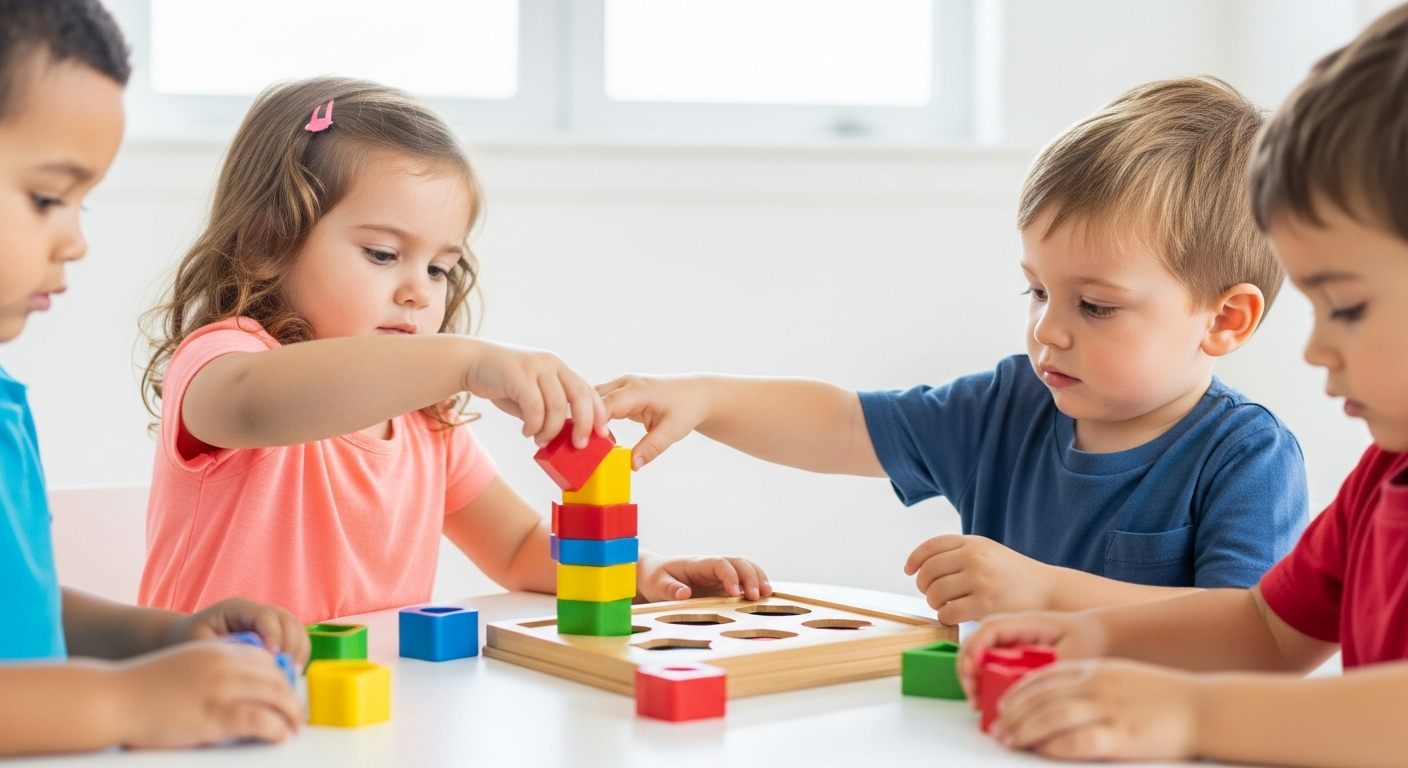
Table of Contents
- Introduction
- Why Problem Solving Activities Matter for Toddlers
- Classic Problem Solving Activities
- Montessori-Inspired DIY Problem Solving Activities
- Sorting and Grouping Activities
- The Science of "Smart Screen Time"
- Active and Outdoor Problem Solving
- Empowering Learning Through Scaffolding
- Choosing the Right Tools for Development
- Practical Scenarios: Real-World Problem Solving
- Conclusion
- Frequently Asked Questions
Introduction
Did you know that a three-year-old’s brain is actually twice as active as an adult’s brain? It is a staggering thought, but those tiny toddlers running around our living rooms are essentially little sponges, soaking up every interaction and environment to build complex neural pathways. Every time a toddler tries to fit a square peg into a round hole or figures out how to reach a toy on a high shelf, they aren't just playing; they are engaging in critical cognitive work.
At Speech Blubs, our mission is to empower children to "speak their minds and hearts." We believe that communication and cognitive development go hand-in-hand. Our company was born from the personal experiences of our founders, who all grew up with speech problems and created the tool they wished they had during their own childhoods. We understand that solving a puzzle or figuring out a pattern is often the first step toward a child finding the words to describe their world.

The purpose of this post is to provide you with a comprehensive list of toddler problem solving activities that you can easily implement at home. We will cover everything from classic toys and Montessori-inspired DIYs to "smart screen time" solutions that foster critical thinking. Our goal is to help you create a home environment where your child feels confident to experiment, fail, and try again. By the end of this article, you will have a full toolkit of strategies to boost your child’s resilience, logic, and creativity. We believe that by fostering these foundational skills early on, we are setting the stage for a lifetime of confident communication and joyful learning.
Why Problem Solving Activities Matter for Toddlers
Problem solving is more than just finding an answer; it is a process that involves observation, trial and error, and emotional regulation. When a child encounters a challenge—like a block tower that keeps falling—they are forced to slow down and analyze the situation. This builds "executive function," a set of mental skills that include working memory, flexible thinking, and self-control.
Building Cognitive Milestones
By age two, children usually begin to find objects even when they are hidden under two or three layers. By age three, they can often complete simple puzzles and understand the concept of "same" and "different." Engaging in specific toddler problem solving activities helps ensure they hit these milestones and, more importantly, enjoy the process of discovery.
Reducing Frustration through Confidence
A common challenge for parents of "late talkers" is the frustration that comes when a child cannot express their needs. For example, if a 3-year-old loves animals but struggles to name them, they might become upset when they can't ask for their favorite toy. In the Speech Blubs app, the Animal Kingdom section offers a fun, motivating way to practice "moo" and "baa" sounds. By solving the "problem" of how to make the sound, the child gains a sense of mastery that reduces overall communication frustration.

Fostering Resilience
When we encourage children to troubleshoot their own problems, we teach them that mistakes are not failures but data points. If a toddler is trying to put on their own socks and keeps getting stuck, a parent who asks, "What do you think would happen if we stretched the opening wider?" is teaching the child how to think through a hurdle rather than giving up.
Classic Problem Solving Activities
You don't always need high-tech gadgets to challenge a toddler's brain. Some of the most effective tools have been around for generations.
1. Shape Sorters
Shape sorters are the quintessential problem-solving toy. They require a child to recognize a shape, find the corresponding hole, and—this is the tricky part—rotate the object until it fits. This involves spatial awareness and fine motor coordination. If your child is struggling, resist the urge to do it for them. Instead, point to the corners of the shape and the corners of the hole to help them make the connection.
2. Puzzles
Puzzles teach children how to visualize a whole picture while focusing on individual pieces. For younger toddlers, start with "knob puzzles" where each piece has a small handle and fits into a specific indentation. As they grow, move to two-piece or four-piece jigsaw puzzles.
Pro Tip: If your child gets bored with their current puzzles, put them away for two weeks and then bring them back out. The "novelty effect" makes the old puzzle feel like a brand-new challenge!
3. Block Building and Constructive Play
Building a tower of four blocks is a major milestone for a two-year-old. By age three, they should be aiming for six or more. Constructive play requires a child to understand balance and gravity. When the tower falls, it presents a natural problem: "Why did it fall, and how can I make it sturdier next time?" This is the beginning of engineering logic.
Montessori-Inspired DIY Problem Solving Activities
The Montessori philosophy emphasizes self-correction and independence. You can create amazing toddler problem solving activities using simple items you likely already have in your recycling bin.
4. Paper Plate Puzzles
Take a clean paper plate and draw a large, simple image on it, like a pepperoni pizza or a smiling sun. Cut the plate in half (or into quadrants for older toddlers). Now, your child has a DIY puzzle. Because the plate is round, they have to figure out how the edges align to complete the circle.
5. Flash Card Puzzles
Do you have a stack of flashcards that your child has outgrown? Don't toss them! Cut them in half using different types of cuts (one zig-zag, one wavy, one straight). Mixing them up creates a matching game where the child has to solve which "halves" belong together based on both the image and the physical shape of the cut.
6. Animal Silhouette Matching
This is a fantastic activity for boosting visual discrimination. Print out black-and-white silhouettes of common animals and provide the child with small plastic animal figurines. The challenge is to match the 3D toy to the 2D shadow.
For a child who is particularly fond of dinosaurs or jungle creatures, this activity pairs perfectly with Speech Blubs. You can watch a peer model the "Roar" of a lion in the app, and then the child can find the lion figurine and match it to its silhouette on the table. This multi-sensory approach reinforces learning and keeps them engaged.
Sorting and Grouping Activities
Sorting is a foundational math skill. It requires children to identify attributes like color, size, shape, or function and categorize items accordingly.
7. Laundry Sorting
This is a "real-world" problem-solving task. Ask your toddler to help you sort the laundry. "Can you find all the blue socks?" or "Can you put all of Daddy's big shirts in one pile and your small shirts in another?" This teaches them to observe differences in scale and color while making them feel like a helpful member of the household.
8. Popsicle Stick Color Sorting
Take a few cardboard boxes or plastic cups and mark each with a different color. Provide your child with a handful of colored popsicle sticks. The "problem" is to ensure every stick finds its "home" in the matching cup. This simple task builds concentration and helps children learn to categorize information—a skill they will use for the rest of their lives.
9. Household Item Scavenger Hunt
Create a "mission" for your child. Tell them, "We need to find three things that are round" or "Find something that makes a noise." This encourages them to scan their environment with a specific goal in mind, which is a high-level cognitive task for a toddler.
The Science of "Smart Screen Time"
In our digital age, many parents feel guilty about screen time. However, at Speech Blubs, we advocate for "smart screen time"—an experience that is active rather than passive. Unlike cartoons, which children often watch in a trance-like state, our app is designed to be a "screen-free alternative" in spirit. It is a tool for family connection that requires the child to interact, imitate, and solve communication challenges.
Video Modeling and Mirror Neurons
Our unique approach is based on the scientific principle of video modeling. When children watch their peers (other children) perform an action or say a word on screen, their "mirror neurons" fire. These are the same neurons that fire when the child performs the action themselves.
This peer-to-peer learning is incredibly effective for teaching complex communication skills. Instead of an adult telling a child to "Say apple," a child sees another kid happily saying "Apple!" while wearing a fun digital hat. This turns the "problem" of speech into a joyful game of imitation. If you're curious about where your child stands, you can take our quick 3-minute preliminary screener to get a simple assessment and a custom next-steps plan.
Encouraging Joint Attention
The best way to use Speech Blubs is together. When you sit with your child and laugh at the funny filters or repeat the sounds together, you are practicing "joint attention." This is the ability to focus on the same object or task with another person, and it is a vital building block for all social problem-solving.
Active and Outdoor Problem Solving
Sometimes, the best way to solve a problem is to move your body. Physical challenges require "motor planning"—the ability to think of an action, plan how to do it, and then execute it.
10. The "Human Knot" or "Minefield" (Simplified)
For older toddlers, you can set up a "minefield" in the living room using pillows and stuffed animals. The child has to navigate from one side of the room to the other without touching any of the "mines." This requires them to plan their path and adjust their balance. If they get stuck, you can provide verbal clues: "Do you think you should go over the pillow or around it?"
11. Obstacle Courses
An outdoor obstacle course is a fantastic way to burn energy while building brain power. Use a hula hoop to crawl through, a plank of wood to balance on, and a ball to throw into a basket. Each station is a mini-problem that the child must solve physically.
12. Hide the Teddy Bear
Hide a favorite toy in a semi-obvious place. As your child searches, give them clues. "You're getting warmer!" or "The teddy bear is under something soft." This teaches them to follow directions and use deductive reasoning to locate the hidden object.
Empowering Learning Through Scaffolding
As parents, our role is to be "scaffolders." Think of a scaffold on a building; it provides support while the structure is being built, and then it is slowly removed.
Ask Open-Ended Questions
When your child encounters a hurdle during their toddler problem solving activities, try not to give the answer immediately. Instead, ask:
- "What do you think will happen if we move this block?"
- "How can we make this fit?"
- "Where do you think the other piece went?"
- "Why is the water spilling out of the cup?"
By asking "What," "How," and "Why," you encourage the child to brainstorm their own solutions. This builds the "analytical thinking" mentioned in developmental research.
Acknowledge Effort Over Results
Instead of saying "Good job!" when they finish a puzzle, try saying, "I saw how hard you worked to find that corner piece. You didn't give up!" This shifts the focus from the final product to the process of problem-solving itself. It builds the "growth mindset" that will help them tackle much bigger problems in school and beyond.
Choosing the Right Tools for Development
We know that every child’s journey is unique. Some children are natural-born problem solvers, while others need a bit more encouragement and specialized tools. That is why we offer different ways to access Speech Blubs.
We are committed to providing an immediate, effective, and joyful solution for the 1 in 4 children who need speech and cognitive support. To ensure we can continue developing these high-quality resources, we offer two transparent pricing plans:
- Monthly Plan: For $14.99 per month, you get full access to our library of 1,500+ activities and video modeling sessions.
- Yearly Plan: This is our best value at $59.99 per year, which breaks down to just $4.99 per month.
When you choose the Yearly plan, you aren't just saving 66%. You also get a 7-day free trial to explore everything we have to offer. The Yearly plan also includes the Reading Blubs app, which helps toddlers transition from sounds to words and early reading. Plus, Yearly members receive early access to new updates and a 24-hour support response time. We recommend the Yearly plan for families who want a comprehensive, long-term tool to support their child's growth.
You can create your account and begin your 7-day free trial today to see the difference for yourself.
Practical Scenarios: Real-World Problem Solving
Let’s look at how these activities and tools work in real life.
Scenario A: The Frustrated Builder Imagine little Leo, a 28-month-old who loves building but gets very upset when his towers fall. His mom notices he hasn't started using many words yet. Instead of just rebuilding the tower for him, she opens the "Building Blocks" section in Speech Blubs. Leo watches another child say "Up, up, up!" as they stack. He starts to imitate the sound. Later, when his real-life tower falls, his mom says, "Oh no! It fell down. Let's go up again!" By linking the physical activity to the peer-led video modeling, Leo learns both a new word and a way to handle the "problem" of his fallen tower without a meltdown.
Scenario B: The Sorting Specialist Sarah is a 3-year-old who loves order. Her dad sets up the "Socks and Shoes" matching activity. Sarah is great at it, but she struggles with the names of the colors. Her dad uses the Speech Blubs app to show her the "Colors" section. Seeing other kids excitedly identifying "Red!" and "Blue!" gives Sarah the confidence to start naming the socks as she sorts them. This is the power of blending physical play with "smart screen time."
Conclusion
Fostering problem-solving skills in your toddler is one of the greatest gifts you can give them. It is about more than just toys; it is about building a foundation of confidence, curiosity, and communication. Whether you are creating DIY puzzles out of paper plates, navigating an outdoor obstacle course, or using Speech Blubs to practice peer-led imitation, you are helping your child learn to "speak their minds and hearts."
Remember that you don't have to do this alone. Our community of parents and experts is here to support you. You can read testimonials from other parents who have seen their children flourish through these methods. Our app is a powerful supplement to your child's overall development plan and can be a wonderful companion to professional therapy.
Ready to take the next step? We invite you to join the Speech Blubs family. Choose our Yearly plan to get the best value, including a 7-day free trial, the Reading Blubs app, and exclusive features. It’s just $59.99 for the entire year, providing your child with a joyful, scientific way to learn and grow every single day.
Download Speech Blubs on the App Store or Google Play today and start your journey toward confident communication!
Frequently Asked Questions
What are the best problem solving activities for a 2-year-old?
For two-year-olds, the best activities focus on cause and effect and basic categorization. Shape sorters, simple wooden puzzles, and "hide and seek" with toys are excellent choices. At this age, activities that encourage fine motor skills—like putting popsicle sticks into a jar—also help build the cognitive focus needed for more complex problem-solving later on.
How can I help my toddler solve problems without doing it for them?
The key is "scaffolding." Instead of fixing the problem, provide a hint. If they can't fit a puzzle piece, try rotating it slightly and asking, "Does it fit now?" Use open-ended questions like "What else could we try?" This gives them the "aha!" moment of success, which is crucial for building their confidence.
Is screen time bad for my toddler's problem-solving skills?
Passive screen time (like watching cartoons) doesn't typically challenge a child's brain. However, "smart screen time" that involves interaction, imitation, and active participation can actually enhance these skills. Speech Blubs uses video modeling to encourage kids to solve the "problem" of communication by imitating their peers in a fun, game-like environment.
Why is my toddler getting so frustrated with simple puzzles?
Frustration is a normal part of the learning process! It often happens when a child's physical abilities haven't quite caught up to their mental plan. If your child gets upset, validate their feelings: "I see you're frustrated because that piece is tricky." Take a break and come back to it later. Over time, completing these "tricky" tasks will help them build resilience.
About the author