
Creative Toddler Activities with Pipe Cleaners
 By Speech Blubs Team•Mar 25, 2026•15 min.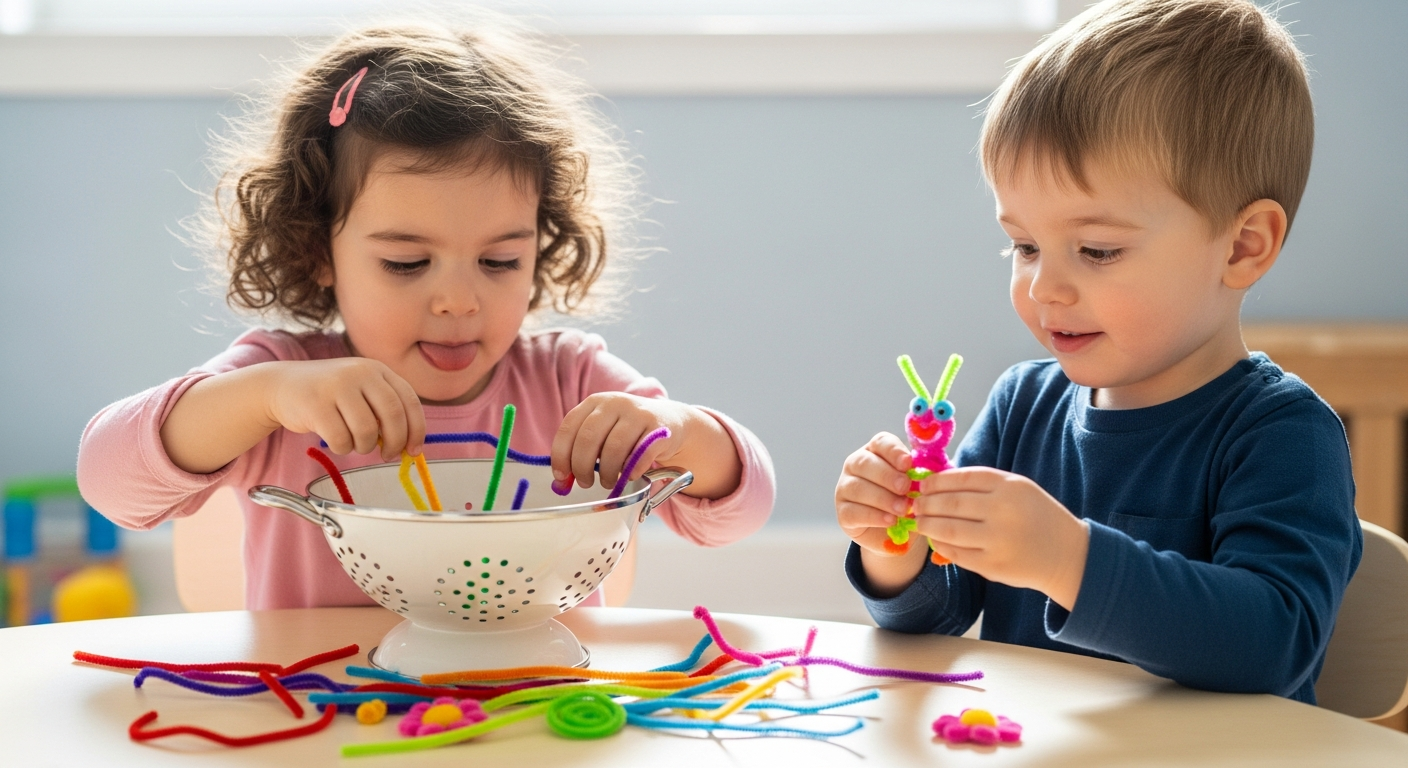
Table of Contents
- Introduction
- Why Pipe Cleaners are a Developmental Powerhouse
- Fine Motor Focused Toddler Activities with Pipe Cleaners
- Boosting Language Skills with Pipe Cleaners
- STEM and Sensory Exploration for Toddlers
- The Science of Play: Why Our Method Works
- Practical Scenarios: Real-World Wins
- Setting Realistic Expectations
- Understanding the Value: Choosing the Right Plan
- Tips for Success with Pipe Cleaner Play
- Frequently Asked Questions
- Conclusion
Introduction
Have you ever noticed how the simplest household items often become the most captivating toys for a toddler? While high-tech gadgets have their place, there is something almost magical about a pack of fuzzy, bendable pipe cleaners. These inexpensive craft staples are more than just wire and chenille; they are foundational tools for building fine motor precision, sparking creative problem-solving, and, most importantly, encouraging the breakthrough of new words. At Speech Blubs, our mission is to empower children to speak their minds and hearts. We know that the journey to clear communication often begins with the hands.
Research shows that fine motor skills and language development are deeply intertwined in a child's brain. When your toddler focuses on threading a pipe cleaner through a tiny hole, they aren’t just "playing"—they are building the neural pathways required for complex tasks, including the articulatory movements needed for speech. This blog post will dive deep into a variety of engaging toddler activities with pipe cleaners that you can do at home today. We will explore how these activities foster a love for learning, reduce the frustration of "late talking," and create joyful moments of connection between you and your child.

Whether you are looking for a quiet-time "busy bag" idea or a structured way to practice new vocabulary, we have curated the best strategies to help your little one thrive. We’ll also show you how to pair these physical activities with our unique "smart screen time" approach, creating a holistic environment for your child’s development.
Why Pipe Cleaners are a Developmental Powerhouse
Before we jump into the specific activities, it is worth understanding why these fuzzy wires are so highly recommended by occupational and speech-language therapists. For a toddler, a pipe cleaner offers a unique sensory experience. They are flexible yet hold their shape, they have a distinct texture that provides tactile feedback, and they come in a vibrant array of colors that stimulate visual interest.
The Fine Motor Connection
Fine motor skills involve the coordination of small muscles in the hands and fingers. These skills are essential for future tasks like writing, buttoning a coat, and using a fork. However, the benefits go even deeper. The same area of the brain that controls fine motor movements is closely situated next to the areas responsible for language processing. By challenging your child to manipulate pipe cleaners, you are giving their brain a "full-body workout" that supports cognitive growth.
Building Confidence through Play
At Speech Blubs, we focus on providing an immediate, effective, and joyful solution for the 1 in 4 children who need speech support. Our company was born from the personal experiences of our founders, who all grew up with speech problems. They created the tool they wished they had—one that blends scientific principles with the pure joy of play. Pipe cleaner activities mirror this philosophy. They are low-stakes, high-reward, and allow children to see immediate results from their efforts, which builds the confidence they need to try new, more difficult sounds and words.
Fine Motor Focused Toddler Activities with Pipe Cleaners
Let’s get started with some of the most effective ways to use pipe cleaners for physical development. These activities are perfect for toddlers who are just starting to refine their "pincer grasp" (the ability to pick up small objects with the thumb and forefinger).

1. The Classic Colander "Sculpture"
This is perhaps the most famous of all toddler activities with pipe cleaners, and for good reason. It is incredibly simple to set up and provides a high level of engagement.
- What you need: A kitchen colander (the kind with many small holes) and a pack of colorful pipe cleaners.
- The activity: Simply turn the colander upside down and show your child how to poke the pipe cleaners through the holes.
- Why it works: It requires precise hand-eye coordination. Your child has to aim the tip of the pipe cleaner into a very small target.
- The Speech Connection: Use this time to narrate their actions. "In! You put the blue one in." "Look, it’s stuck!" This helps them associate specific words with physical sensations.
2. Straw and Pipe Cleaner Threading
If the colander is too easy for your little one, try adding "beads" made of straws.
- What you need: Pipe cleaners and plastic or paper straws cut into one-inch pieces.
- The activity: Show your child how to slide the straw pieces onto the pipe cleaner.
- Why it works: This is a precursor to actual beading. Because the pipe cleaner is stiff, it is much easier for a toddler to handle than a piece of floppy string. It builds finger strength as they hold the pipe cleaner steady with one hand and navigate the straw with the other.
3. The Snack Can "Button" Drop
Reusing household items is a great way to keep activities fresh without spending a fortune.
- What you need: An old snack can (like a Pringles or coffee can) with a plastic lid.
- The activity: Use a hole punch or a small nail to poke several holes in the lid. Give your child pipe cleaners to "drop" into the holes. They will love the sound it makes when the pipe cleaner hits the bottom of the tin!
- Speech Blubs Tip: If your child gets frustrated because they can't quite get the wire in the hole, this is a great time to model "Help please." Encouraging functional communication reduces the meltdowns that often come with developmental hurdles.
Boosting Language Skills with Pipe Cleaners
Once your child has mastered the basic manipulation of the materials, you can start using these activities to target specific language goals. This is where the magic of "smart screen time" and physical play really comes together.
4. Creating Pipe Cleaner Animals
Toddlers are naturally drawn to animals. We see this every day in the popularity of our "Animal Kingdom" section within the Speech Blubs app. You can bring those digital interactions to life with pipe cleaners.
- The activity: Help your child twist a green pipe cleaner into a "snake" or a pink one into a "pig's tail."
- Practical Scenario: For a parent whose 3-year-old "late talker" loves animals, the "Animal Kingdom" section in Speech Blubs offers a fun, motivating way to practice "moo" and "baa" sounds. After watching a peer make the "Sss" sound for a snake in the app, you can sit down together and bend a pipe cleaner into a wiggly snake shape, repeating that "Sss" sound as you move the pipe cleaner across the table.
- Download the App: To see our video modeling in action, you can download Speech Blubs on the App Store or get it on Google Play.
5. Pipe Cleaner Letters and Shapes
If your toddler is starting to show interest in letters, pipe cleaners are the perfect tactile tool for literacy.
- The activity: Bend pipe cleaners into the shapes of letters, especially the first letter of your child's name. Let them trace the fuzzy letter with their finger.
- Why it works: Learning is more "sticky" when it involves multiple senses. By seeing the letter, feeling its texture, and hearing you say its sound, they are much more likely to retain the information.
6. Color Sorting and Labeling
- The activity: Use colored cups or pieces of construction paper that match your pipe cleaners. Ask your child to put the "red pipe cleaner in the red cup."
- The Goal: This builds vocabulary (colors) and helps with following simple, one-step directions. If they struggle, don't worry! Every attempt is a learning moment.
STEM and Sensory Exploration for Toddlers
It is never too early to introduce basic STEM (Science, Technology, Engineering, and Math) concepts. Pipe cleaners are excellent for "engineering" small structures.
7. DIY Bubble Wands
Blowing bubbles is a fantastic way to strengthen the muscles in the mouth (oral motor skills), which are used for speech.
- The activity: Twist the end of a pipe cleaner into a circle (or a heart, or a square!) and leave the rest as a handle. Dip it into bubble solution and blow!
- The Lesson: This teaches toddlers about shapes and cause-and-effect. "I blow, and the bubble grows!"
8. Magnetic "Fishing" Game
- What you need: A small plastic bin, water, small pieces of cut-up pipe cleaners, and a strong magnet (like a magnetic wand).
- The activity: The metal wire inside the pipe cleaner makes it magnetic! Your child can "fish" for the pieces using the magnet.
- Safety Note: Always supervise your child closely during water play and when using magnets, especially if the pipe cleaners have been cut into small pieces.
9. Building "Constellations"
- The activity: Use star-shaped beads and pipe cleaners to build your own stars. This is a wonderful activity for quiet time before bed, helping your child wind down while still working their little fingers.
The Science of Play: Why Our Method Works
At Speech Blubs, we don’t just create games; we create "smart screen time" experiences based on proven scientific principles. One of our core methodologies is video modeling.
What is Video Modeling?
Video modeling is a teaching method where children learn by watching and imitating their peers. When a child sees another child (not an adult or a cartoon) performing a task or making a sound, it triggers "mirror neurons" in their brain. These neurons fire both when a person acts and when they observe the same action performed by another.
Our method is backed by science, placing us in the top tier of speech apps worldwide. You can read more about the research behind our approach here. By watching other kids in our app make sounds and then following it up with a physical activity like our pipe cleaner animals, you are providing a powerful, multi-sensory learning environment.
We provide a screen-free alternative to passive viewing (like cartoons) and a powerful tool for family connection. The app is designed for adult co-play. We want you to be right there with your child, celebrating every "Pop!" and "Moo!"
Practical Scenarios: Real-World Wins
We often hear from parents who feel overwhelmed by the "wait and see" approach. If you are feeling uncertain, we recommend starting with our quick 3-minute preliminary screener. It involves 9 simple questions and provides an assessment and a next-steps plan.
Consider the story of a parent whose toddler was frustrated because they couldn't express their needs. They began using Speech Blubs for 10 minutes a day and paired it with "busy play" activities like the pipe cleaner colander.
"It wasn't just about the words," the parent shared. "It was about the confidence. Suddenly, he wasn't crying because he couldn't do something; he was coming to me with his pipe cleaner 'sculpture' and trying to tell me about it."
You can read more success stories and testimonials here to see how other families have navigated their speech journeys.
Setting Realistic Expectations
While we are passionate about the benefits of our app and these activities, we want to set realistic expectations. Every child develops at their own pace. We do not suggest guaranteed outcomes like "your child will be giving public speeches in a month." Instead, we focus on the benefits of the process:
- Fostering a love for communication.
- Building foundational fine motor skills.
- Developing confidence in social interactions.
- Creating joyful family learning moments.
Frame the use of pipe cleaner activities and the Speech Blubs app as a powerful supplement to your child's overall development plan. If your child is already in professional therapy, our tool is a fantastic way to reinforce what they are learning during their sessions.
Understanding the Value: Choosing the Right Plan
We believe in being transparent about our pricing to build trust with our community of parents. We offer two main plans to fit your family's needs:
- Monthly Plan: $14.99 per month. This is a great way to try out the app and see if it’s a fit for your child’s learning style.
- Yearly Plan: $59.99 per year. This is the clear best choice for most families. It breaks down to just $4.99 per month—a 66% savings compared to the monthly plan.
Why Choose the Yearly Plan?
The Yearly plan is not just about the cost savings; it includes exclusive, high-value features that are not available in the monthly plan:
- 7-Day Free Trial: You can explore everything the app has to offer for a full week before being charged.
- The Reading Blubs App: This is an incredible bonus app focused specifically on early literacy and reading skills.
- Early Access: You get first dibs on all new updates and content.
- Priority Support: We offer a 24-hour support response time for our yearly subscribers.
If you are ready to give your child the tools they need to "speak their minds and hearts," we encourage you to create your account and start your 7-day free trial today. Remember to select the Yearly plan to get the best value and the full suite of developmental features.
Tips for Success with Pipe Cleaner Play
To get the most out of these activities, keep these simple tips in mind:
- Follow Their Lead: If your child wants to twist the pipe cleaners around their fingers instead of putting them in the colander, that’s okay! Exploration is the first step toward learning.
- Narrate Everything: Use simple language to describe what they are doing. "Pull!" "Twist!" "Fuzzy!"
- Keep it Short: Toddlers have short attention spans. 5-10 minutes of focused play is a huge win.
- Safety First: Pipe cleaners have wire centers. Occasionally, the ends can be a bit sharp. You can fold the ends over with a pair of pliers to make them safer for tiny hands.
- Make it a Family Affair: Get older siblings involved! They can be great "models" for the toddler to imitate.
Frequently Asked Questions
1. Are pipe cleaners safe for toddlers?
Generally, yes, but they require adult supervision. The main concerns are the wire ends, which can be sharp, and the risk of a child putting them in their mouth. Always check the ends and ensure your child is playing while you are present. For very young toddlers who still "mouth" everything, you might wait a few months or choose extra-thick, jumbo pipe cleaners.
2. How do pipe cleaners help with speech?
They help indirectly by strengthening fine motor skills, which share neural pathways with speech. Directly, they provide a visual and tactile "prop" for language learning. When you create a pipe cleaner object, you are providing a concrete item for your child to label, describe, and interact with, which encourages vocalization.
3. My child is frustrated by these activities. What should I do?
Frustration is a natural part of learning! If an activity is too hard, simplify it. For example, if the colander holes are too small, try a wire cooling rack with larger gaps. Use the moment to model "calm down" strategies and provide lots of encouragement. "You are trying so hard! Let's do it together."
4. Can I use pipe cleaner activities if my child is in professional speech therapy?
Absolutely! In fact, most speech therapists love when parents do "homework" that involves sensory play. These activities are a wonderful supplement to professional therapy and can help your child generalize the skills they are learning in their sessions to a home environment.
Conclusion
Toddler activities with pipe cleaners are a simple, joyful, and incredibly effective way to support your child's development. From the fine motor challenge of threading a colander to the imaginative fun of creating fuzzy animals, these activities provide endless opportunities for growth. At Speech Blubs, we are honored to be a part of your parenting journey, providing the "smart screen time" tools that complement these hands-on moments.
Our goal is to help every child find their voice, reducing frustration and building the confidence they need to succeed. Whether you are dealing with a speech delay or simply want to give your child a head start, our science-backed methodology is here to support you.
Ready to see your child blossom? Take the first step toward clearer communication. Download Speech Blubs on the App Store or Google Play to begin. For the best experience, we recommend signing up for our Yearly plan. You'll get a 7-day free trial, the bonus Reading Blubs app, and full access to our entire library of expert-designed content for just $4.99 a month. Let’s start this journey together and help your little one speak their mind and heart!
About the author