
Engaging Main Idea Games for Kids
 By Speech Blubs Team•Jan 28, 2026•19 min.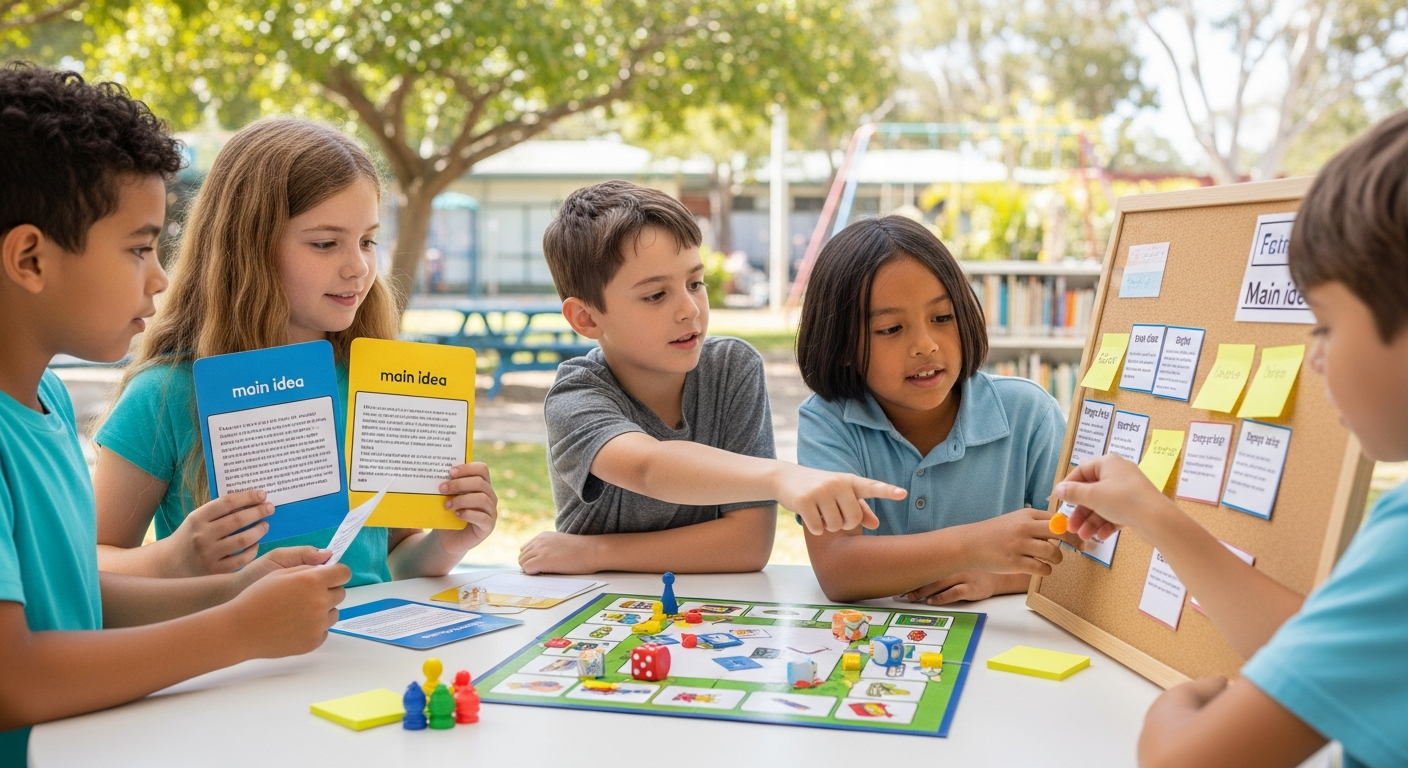
Table of Contents
- Introduction
- What Exactly Is the Main Idea?
- Why Is Understanding the Main Idea So Important for Kids?
- Developmental Stages: How Children Learn the Main Idea
- How to Teach Main Idea Skills: Strategies and Approaches
- Engaging Main Idea Games for Kids: Fun at Every Age
- How Speech Blubs Supports Main Idea Development (Indirectly & Directly)
- The Power of Parental Involvement
- When to Consider Professional Support
- Conclusion
- Frequently Asked Questions (FAQ)
Introduction
Have you ever tried to explain a movie plot to a friend, only to get lost in all the tiny details? Or perhaps your child recounted their day at school, sharing every single event from recess to snack time, but left you wondering what the main point of their story was? Understanding the "main idea" isn't just a skill for literary critics; it's a fundamental building block for effective communication, critical thinking, and academic success. It’s the ability to grasp the core message, whether from a story, a conversation, or a real-life situation, and it’s crucial for children as they navigate an increasingly complex world. At Speech Blubs, we believe in empowering children to "speak their minds and hearts," and a huge part of that empowerment comes from truly understanding and expressing core concepts. This post will dive deep into what the main idea is, why it's so vital for your child's development, and—most importantly—how you can turn this essential skill into a fun, engaging learning experience through a variety of main idea games for kids, both on and off-screen. We’ll explore playful strategies and even show you how our innovative app can support these foundational language and comprehension skills.

What Exactly Is the Main Idea?
Before we dive into games, let’s clarify what we mean by "main idea." In simple terms, the main idea is the most important point or central message of a text, conversation, picture, or event. It's what the author, speaker, or situation is primarily about. Think of it as the "big picture" or the "gist." All the other details are supporting details that help explain or prove this main idea.
For example, if you read a paragraph about a lion, and it describes its mane, its roar, and how it hunts, the main idea might be: "Lions are powerful predators of the savanna." The mane, roar, and hunting are all details that support this central point.
It’s important to distinguish the main idea from the topic. The topic is usually one or two words, like "lions," "summer vacation," or "baking cookies." The main idea is a complete sentence that tells you something specific about that topic. For instance, the topic is "lions," but the main idea is "Lions are apex predators that live in African savannas and hunt in groups."
Why Is Understanding the Main Idea So Important for Kids?
Developing the ability to identify the main idea is far more than just a reading comprehension skill. It’s a cornerstone for various aspects of a child's cognitive and communicative development:
Enhanced Listening and Communication Skills
When children listen for the main idea, they become more active listeners. They learn to filter out irrelevant information and focus on the core message, which is vital for following instructions, participating in conversations, and understanding social cues. This also helps them articulate their own thoughts more clearly and concisely.
Improved Reading Comprehension
This is perhaps the most obvious benefit. Understanding the main idea allows children to grasp the core message of stories, textbooks, and articles. It helps them move beyond simply decoding words to truly understanding what they are reading, which is essential for all academic subjects.
Stronger Critical Thinking and Problem-Solving
Identifying the main idea requires children to analyze information, distinguish between important and unimportant details, and synthesize facts into a coherent summary. These are critical thinking skills that extend far beyond the classroom, helping them solve problems in everyday life. For example, if a child is trying to figure out why their toy car isn't working, they need to identify the main problem (e.g., the battery is dead) rather than getting sidetracked by minor cosmetic issues.

Better Writing and Organization
When children understand how to identify a main idea in what they read, they can apply this structure to their own writing. They learn to organize their thoughts around a central point, making their stories, reports, and essays clearer and more logical.
Academic Success Across the Board
From understanding science concepts to analyzing historical events, identifying the main idea is a fundamental skill that underpins learning in every subject. Children who master this skill are better equipped to learn new information, prepare for tests, and engage with complex topics.
Reduced Frustration and Increased Confidence
When a child struggles to grasp the main idea, learning can become incredibly frustrating. They might feel overwhelmed by information, miss key points, and fall behind. By developing this skill, children gain confidence in their ability to understand and communicate, fostering a love for learning rather than dread.
Developmental Stages: How Children Learn the Main Idea
The ability to grasp the main idea doesn't appear overnight. It develops gradually, much like other language and cognitive skills.
Early Childhood (Ages 2-5): The Foundations
At this stage, children are learning to connect language with concepts and experiences. While they won't explicitly identify "main ideas," they are building foundational skills:
- Vocabulary Development: The more words they know, the better they can understand simple concepts.
- Sequencing Events: Understanding "what happened first, next, last" is a precursor to understanding a story's flow.
- Answering "What?" and "Who?" Questions: These simple questions help them identify key elements of a situation.
- Making Connections: Recognizing patterns and relationships between objects or events.
For a parent whose 3-year-old is a "late talker" and might struggle with understanding basic commands, strengthening vocabulary and attention is crucial. Our app, Speech Blubs, uses unique video modeling to engage children. By watching peer models, children learn to imitate sounds and words, building the vocabulary and attention span needed to eventually grasp main ideas. Sections like "Animal Kingdom" or "Yummy Time" can introduce basic concepts and related words in a fun, interactive way. You can experience this firsthand by creating your account and beginning your 7-day free trial today.
Preschool and Early Elementary (Ages 5-7): Concrete Understanding
Children begin to understand main ideas in a very concrete way, often with strong visual support.
- Picture Comprehension: They can describe what's happening in a single picture.
- Retelling Simple Stories: They can retell a story using their own words, focusing on the most important events.
- Identifying Key Details: They can pick out specific pieces of information from a short, simple text.
Mid-Elementary (Ages 7-9): Identifying Explicit Main Ideas
At this stage, children can often identify the main idea when it's explicitly stated in a topic sentence, usually at the beginning or end of a paragraph.
- Summarizing Paragraphs: They can identify the central theme of a paragraph.
- Differentiating Main Idea from Details: They start to understand that some information is more important than other information.
Upper Elementary and Beyond (Ages 9+): Inferring Main Ideas
This is the most advanced stage, where children can infer the main idea even when it's not directly stated.
- Analyzing Implicit Information: They can read between the lines and synthesize information to determine the core message.
- Summarizing Longer Texts: They can summarize multi-paragraph articles or chapters.
- Critical Evaluation: They can evaluate whether the supporting details truly back up the main idea.
How to Teach Main Idea Skills: Strategies and Approaches
Teaching the main idea isn't about memorizing definitions; it's about developing a way of thinking. Here are some effective strategies:
Start with Visuals
Begin with pictures, comics, or short videos before moving to text. Ask, "What's the most important thing happening here?" or "What is this picture mostly about?"
Use "Who, What, Where, When, Why, How?" Questions
These questions help children extract key information, which can then be synthesized into a main idea.
- Who is the story about?
- What happened?
- Where did it happen?
- When did it happen?
- Why did it happen?
- How did it happen? The answers to these questions often form the backbone of the main idea.
Look for Keywords and Repetitions
Often, authors will repeat certain words or phrases, or use strong topic sentences. Teach children to identify these clues.
Distinguish Between Main Idea and Details
A great exercise is to give children a list of sentences and ask them to pick out the one that is the main idea, and then identify the sentences that are supporting details.
Summarize in One Sentence
Challenge children to summarize a story, paragraph, or conversation in a single sentence. This forces them to distill the information down to its essence.
Think "Newspaper Headline"
Ask your child to imagine they are writing a newspaper headline for a story. Headlines need to be short, catchy, and capture the main point.
Engaging Main Idea Games for Kids: Fun at Every Age
Learning should be fun! These games can be adapted for various ages and skill levels, turning main idea practice into an exciting adventure.
Early Childhood Games (Ages 2-5): Building Foundations
These games focus on foundational skills like vocabulary, observation, and simple comprehension.
1. Picture Power Play
- How to Play: Gather a collection of interesting pictures (from magazines, online, or photo albums). Show your child one picture and ask, "What's happening in this picture?" or "What is this picture mostly about?"
- Skills Developed: Observation, vocabulary, simple description.
- Speech Blubs Connection: Our app's themed sections are full of vibrant images and videos. As your child explores "Vehicles" or "Food," ask them about what they see. "What's the car doing?" "What kind of food is this?" This builds their descriptive vocabulary and ability to identify key elements.
2. Mystery Bag Guess
- How to Play: Place several related objects into a bag (e.g., a small toy car, a plastic block, a doll, a ball). Give clues about the objects one by one without showing them. "It has wheels." "It's red." "It makes noise." After a few clues, ask, "What do you think is in the bag?"
- Skills Developed: Listening for details, making inferences, categorization.
- Relatable Scenario: For a child who enjoys guessing games and needs to work on inferencing, the "Mystery Bag" can be tailored to their interests. If they love animals, put animal toys in. If they love cooking, use kitchen items. This activity, combined with the structured vocabulary lessons in Speech Blubs' "Things That Go" or "Wild Animals" sections, reinforces the connection between details and a larger category, a stepping stone to understanding main ideas.
3. Story Sequencing Fun
- How to Play: Read a very simple story. Then, provide 2-3 picture cards that represent key events from the story. Ask your child to put the pictures in the correct order.
- Skills Developed: Sequencing, retelling, understanding story flow.
Elementary School Games (Ages 6-9): Explicit Main Idea
These games focus on identifying the main idea when it's present, often with some support.
1. Headline Hunt
- How to Play: Take short, simple newspaper articles or online kid-friendly news stories. Read a story together. Then, challenge your child to come up with a headline that summarizes the most important part of the story in 3-5 words.
- Skills Developed: Summarizing, identifying key information, conciseness.
- Speech Blubs Connection: Our activities often involve following instructions and completing tasks. While not direct headline creation, the focus on understanding core instructions translates into grasping main points. Additionally, the clear, concise language used in the app’s prompts helps children understand how to convey information effectively.
2. Main Idea Match-Up
- How to Play: Write several short paragraphs (3-4 sentences each) on separate index cards. On other index cards, write the main idea for each paragraph. Your child's task is to match each paragraph with its correct main idea.
- Skills Developed: Reading comprehension, main idea identification.
3. "What's the Point?" Board Game
- How to Play: Create a simple board game with spaces like "Read a Sentence," "Read a Paragraph," "Look at a Picture." When a player lands on a space, they perform the action (e.g., read a paragraph) and then state the main idea. If correct, they move forward. Add "Wild Card" spaces for extra challenges or turns.
- Skills Developed: Applying main idea skills in a gamified context.
Upper Elementary Games (Ages 10+): Inferring and Complex Main Ideas
These games challenge children to infer the main idea from more complex texts and situations.
1. Infer the Theme Storytelling
- How to Play: Read a longer story or fable that has a clear moral or theme but doesn't explicitly state it. After reading, discuss with your child: "What was the most important lesson in this story?" or "What do you think the author wanted us to learn?"
- Skills Developed: Inferencing, abstract thinking, identifying themes.
- Relatable Scenario: If your 10-year-old struggles to understand the underlying message in social interactions or stories, this game can be invaluable. The ability to infer is crucial for navigating social dynamics. Speech Blubs, through its focus on verbal and non-verbal communication in various contexts, helps children build the social awareness needed to understand implicit meanings. While not directly focused on story themes, the app fosters the communication skills that are precursors to deeper comprehension. Unsure if your child could benefit? Take our quick 3-minute preliminary screener to get a simple assessment and a free 7-day trial.
2. News Reporter Interview
- How to Play: Watch a short news clip or read a news article together. Then, one person plays the "news reporter" and interviews the other (the "witness" or "expert") about the event. The "reporter" must ask questions that help them figure out the main idea to create their news report.
- Skills Developed: Active listening, questioning, synthesizing information.
3. "Argument Analysis" Debate
- How to Play: Present your child with two short, opposing viewpoints on a topic (e.g., "Should kids have smartphones?" or "Is screen time good or bad?"). After reading both, ask them to identify the main argument (main idea) of each side.
- Skills Developed: Critical thinking, analyzing arguments, identifying bias.
How Speech Blubs Supports Main Idea Development (Indirectly & Directly)
At Speech Blubs, our mission is to empower children to "speak their minds and hearts." We know that effective communication is about more than just speaking words; it’s about understanding, interpreting, and expressing meaning. While we don't have a "main idea" game specifically, our app's comprehensive approach to language development lays a robust foundation for this critical skill. Our company was born from the personal experiences of our founders, who all grew up with speech problems and created the tool they wished they had. We are committed to providing an immediate, effective, and joyful solution for the 1 in 4 children who need speech support, blending scientific principles with play into one-of-a-kind "smart screen time" experiences.
Here's how Speech Blubs helps foster the precursors and components of main idea comprehension:
1. Vocabulary and Concept Building
Understanding the main idea starts with understanding the words that make it up. Speech Blubs offers thousands of words and concepts across various categories. As children learn new vocabulary in engaging contexts (like "Yummy Time" or "Animal Kingdom"), they expand their knowledge base, making it easier to grasp the core meaning of sentences and paragraphs.
2. Attention and Focus
Identifying the main idea requires sustained attention. Our unique "video modeling" methodology, where children learn by watching and imitating their peers, is incredibly engaging. It draws children into the activity, encouraging active participation rather than passive viewing. This focus on joint attention and imitation helps build the sustained attention span necessary for complex cognitive tasks like main idea comprehension.
3. Sentence Structure and Syntax
The app naturally exposes children to correct sentence structures and how words fit together to form meaningful phrases. This foundational understanding of grammar and syntax helps them decode the meaning of more complex sentences, which is crucial for identifying topic sentences and main ideas.
4. Answering "Wh-" Questions
Many activities within Speech Blubs encourage children to answer "who," "what," "where," and "when" questions. These are the building blocks for extracting key information from a text or conversation, which can then be synthesized into a main idea.
5. Storytelling and Retelling Skills
While not direct "main idea" exercises, many of our activities involve sequential understanding and describing actions. These skills are critical for children to eventually retell stories in their own words, focusing on the most important events—a direct precursor to summarizing and identifying the main idea.
6. Engaging and Interactive Learning
We provide a screen-free alternative to passive viewing (like cartoons) and a powerful tool for family connection. This means that while your child is engaged with the app, you can be right there with them, asking questions, expanding on vocabulary, and guiding their understanding. This active co-play reinforces learning and makes the "smart screen time" even more effective.
Our method is backed by science, placing us in the top tier of speech apps worldwide. You can read more about our approach and the research behind it on our research page. See what other parents are saying about their child's success with Speech Blubs by visiting our testimonials page.
The Power of Parental Involvement
No app or game can replace the invaluable role of a parent or caregiver. When playing main idea games, remember to:
- Be Patient and Encouraging: Learning this skill takes time. Celebrate small victories and avoid frustration.
- Model the Skill: Think aloud as you identify the main idea in everyday situations. "The main idea of this shopping trip is to get ingredients for dinner."
- Connect to Real Life: Point out main ideas in conversations, TV shows, and daily activities.
- Make it Playful: The more fun it is, the more engaged your child will be.
- Ask Open-Ended Questions: Instead of "Did you get the main idea?", ask "What was the most important part?" or "What's the big picture here?"
When to Consider Professional Support
While main idea games and consistent practice can significantly boost a child's comprehension, it's also important to recognize when professional help might be beneficial. If your child consistently struggles with:
- Understanding directions or simple stories.
- Retelling events in a coherent order.
- Distinguishing important from unimportant information.
- Making inferences or understanding abstract concepts.
- Experiencing significant frustration with reading comprehension.
These could be signs of underlying language processing difficulties. A speech-language pathologist can assess your child's specific needs and provide targeted strategies. Remember, Speech Blubs is a powerful supplement to a child's overall development plan and, when applicable, professional therapy. It’s designed to provide supportive and joyful learning.
Conclusion
The ability to identify the main idea is a truly transformative skill, impacting everything from a child's communication and academic performance to their confidence and critical thinking. By transforming this essential learning into engaging main idea games for kids, you’re not just teaching a skill; you’re fostering a love for communication, building resilience, and equipping your child with the tools they need to navigate their world with clarity and understanding. From picture-based activities for toddlers to complex analysis for older children, there's a game for every stage of development.
At Speech Blubs, we are committed to providing innovative tools that make learning joyful and effective. Our "smart screen time" app strengthens the foundational language skills that underpin main idea comprehension, turning everyday moments into powerful learning opportunities.
Ready to give your child the tools to speak their minds and hearts, and build essential comprehension skills for a lifetime of confident communication? We invite you to experience the Speech Blubs difference yourself.
To get the full suite of features and the best value, choose our Yearly plan:
- Yearly Plan: Just $59.99 per year, breaking down to an incredible $4.99 per month. That's a massive 66% savings compared to the monthly plan! The Yearly plan also includes a 7-day free trial, the extra Reading Blubs app, early access to new updates, and 24-hour support response time.
- Monthly Plan: $14.99 per month (does not include the free trial, Reading Blubs, early access, or 24-hour support).
Don't miss out on the incredible value and comprehensive learning experience of our Yearly plan. Download Speech Blubs on the App Store or Google Play to begin your 7-day free trial today! For desktop users, you can also create your account and start your trial on our website.
Frequently Asked Questions (FAQ)
Q1: What's the difference between a topic and a main idea?
A1: The topic is the general subject of a text, usually expressed in a few words (e.g., "dogs," "summer"). The main idea is a complete sentence that states the most important point about that topic (e.g., "Dogs make wonderful pets because they are loyal and playful.").
Q2: At what age should my child start learning about the main idea?
A2: While explicit teaching of "main idea" usually begins in early elementary school (ages 5-7), foundational skills like vocabulary, sequencing, and answering "Wh-" questions start much earlier, even in preschool. You can incorporate playful activities to build these skills from a young age.
Q3: How can Speech Blubs help my child with main idea skills?
A3: Speech Blubs indirectly supports main idea development by significantly boosting foundational language skills. It enhances vocabulary, improves attention and focus through engaging video modeling, strengthens understanding of sentence structure, and encourages answering key "Wh-" questions, all of which are precursors to effectively identifying the main idea.
Q4: My child struggles with reading; will these games still help?
A4: Absolutely! Many main idea games can be adapted to use visuals, oral stories, or simplified texts. The focus is on comprehension and critical thinking, not just reading proficiency. Working on these skills in a non-textual way can actually improve overall comprehension, which will then support their reading development.
About the author