
Engaging Toddler Circle Time Activities for Language Growth
 By Speech Blubs Team•Mar 18, 2026•14 min.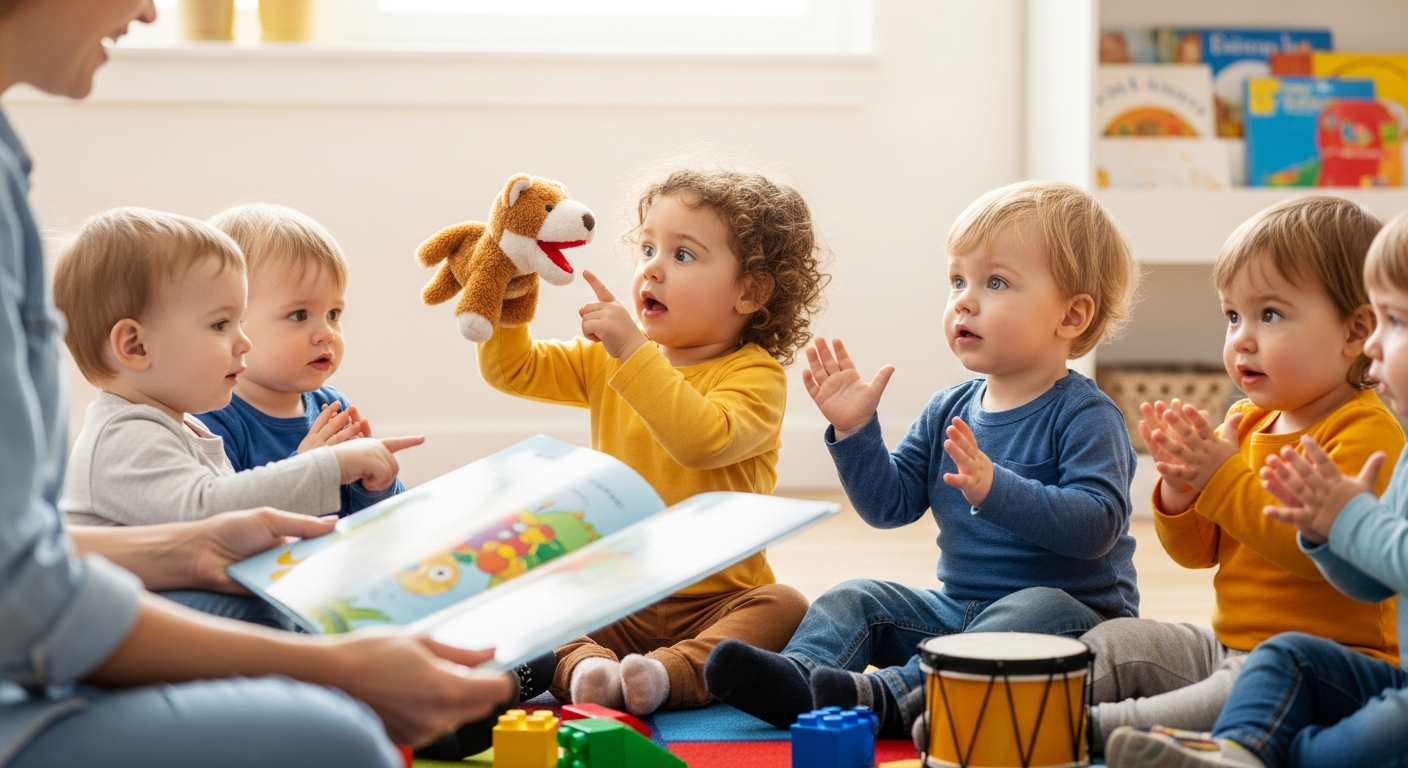
Table of Contents
- Introduction
- Why Circle Time Matters for Toddlers
- Setting the Stage: Preparing for Success
- Essential Music and Movement Activities
- Literacy and Language Circle Time Games
- Social-Emotional Development Activities
- Addressing Challenges: What if They Won't Sit?
- Speech Blubs: The Ultimate Circle Time Supplement
- Pricing and Value: Choosing the Best Path for Your Child
- Tips for Parents at Home
- FAQ
- Conclusion
Introduction
Picture this: You have gathered a small group of energetic two-year-olds on a colorful rug. You are ready to lead a beautiful session of songs and stories, but within thirty seconds, one child is investigating a dust mote, another is trying to do a somersault, and a third is wandering toward the block corner. If this sounds familiar, you aren’t alone. Engaging toddlers in a group setting is a unique challenge that requires a blend of patience, rhythm, and a deep understanding of child development. At Speech Blubs, we understand that the early years are a whirlwind of growth, and our mission is to empower every child to "speak their minds and hearts" by providing the tools they need to communicate effectively.
This blog post is designed to be your go-to resource for toddler circle time activities that actually work. We will cover why circle time is essential for language development, how to structure your sessions for maximum engagement, and provide a massive list of activities—from music and movement to literacy and social-emotional games. We will also explore how to integrate "smart screen time" through our unique video modeling methodology to support children who may need an extra boost. By the end of this article, you will have a toolkit of strategies to transform circle time from a chaotic struggle into a joyful highlight of your child’s day. Our goal is to help you build a foundation for lifelong communication, confidence, and connection.

Why Circle Time Matters for Toddlers
Circle time is much more than just a break in the day; it is a fundamental pillar of early childhood education. For a toddler, the world is often a series of individual explorations. Circle time provides one of their first experiences with communal learning. It creates a predictable routine, which is vital for a child’s sense of security. When children know that "The Hello Song" follows "The Clean-Up Song," they feel more in control of their environment, which reduces anxiety and frustration.
From a speech and language perspective, circle time is a goldmine. It exposes children to a rich variety of vocabulary, sentence structures, and phonological patterns through songs and rhymes. At Speech Blubs, our founders—who all grew up with speech challenges—created our platform specifically because they knew that the traditional ways of teaching communication often lacked the "joy" factor. Circle time brings that joy back. It encourages peer imitation, turn-taking, and active listening. When a child sees their friend clapping along to a beat, their "mirror neurons" fire, helping them learn through observation and participation. This is the same scientific principle behind our video modeling methodology, where children learn to speak by watching and imitating their peers.
Setting the Stage: Preparing for Success
Before you even start singing, the environment plays a massive role in how successful your toddler circle time activities will be. Toddlers are easily overstimulated, so a dedicated, clutter-free space is essential.
Choosing the Right Seating
Individual carpet squares or small mats are a game-changer for this age group. They provide a physical boundary that says, "This is your spot." For a fidgety toddler, having a soft tuft of carpet to touch can actually help them stay grounded and focused. Unlike older preschoolers, we don't necessarily need to put them in a perfect circle; a loose semi-circle where everyone can see you and each other works best.

Managing Attention Spans
The golden rule for toddler circle time is "short and sweet." A successful session for two-year-olds might only last five to seven minutes. As they grow and their skills develop, you can gradually extend this to ten or twelve minutes. If you notice the group losing interest, don't be afraid to pivot. It is better to end on a high note than to struggle through a book that no one is listening to.
The Power of Props
A "Circle Time Basket" or a dedicated shelf can house all your props. Items like scarves, egg shakers, bean bags, and puppets make activities tangible. For a parent whose 3-year-old "late talker" loves animals, having a small toy cow to hold while watching the 'Animal Kingdom' section on the Speech Blubs app offers a fun, motivating way to practice "moo" and "baa" sounds.
Essential Music and Movement Activities
Toddlers learn with their whole bodies. Incorporating movement into circle time isn't just about "getting the wiggles out"—though that is a nice side effect—it's about cognitive and gross motor development.
1. The Animal Walk
This is a classic for a reason. Ask the children to move like different animals. "Can you slither like a snake? Can you hop like a frog?" This improves body awareness and encourages children to use descriptive language. You can pair this with the "Living Things" section of our app, where children see other kids making these animal movements and sounds. If you are ever concerned about whether your child is meeting their speech milestones during these games, you can take our quick 3-minute preliminary screener to get an assessment and a next-steps plan.
2. Freeze Dance
Play some upbeat music and encourage everyone to dance. When the music stops, everyone must "freeze." This activity is fantastic for developing self-regulation and inhibitory control. It teaches toddlers how to stop their bodies on command, which is a foundational skill for safety and social interaction.
3. The Hokey Pokey
This song is a powerhouse for teaching body parts and spatial awareness (left, right, in, out). It also promotes gross motor coordination. The repetitive nature of the lyrics makes it easy for toddlers to eventually join in with the words, boosting their expressive language.
4. We’re Going on a Bear Hunt
This interactive story involves rhythmic chanting and physical movements (swish-swash through the grass, splash-splosh through the river). It’s an excellent way to teach prepositions and sequencing. Children love the dramatic buildup and the "scary" (but fun) ending.
Literacy and Language Circle Time Games
Language development is at the heart of our mission. We provide a screen-free alternative to passive viewing, like cartoons, by making screen time an active, "smart" experience. You can bring these same principles to your circle time.
5. The Name Game
Building community starts with names. Go around the circle and have each child say their name followed by an action (e.g., "I'm Maya, and I clap!"). The group repeats the name and the action. This fosters eye contact and social recognition. For children who are still shy or non-verbal, you can use the Speech Blubs video modeling to show them other children proudly saying their names, which builds their confidence to try it themselves.
6. Sound I Spy
Instead of spying colors, try spying sounds. "I spy with my little eye something that starts with the /b/ sound." This introduces the concept of phonics in a playful way. Use simple objects like a ball, a book, or a bear. This helps children begin to understand that spoken words are made up of individual sounds.
7. Rhyming Train
Start with a simple word like "cat." Ask the children if they can think of words that sound the same. "Bat! Hat! Mat!" Even if they give you nonsense words that rhyme, celebrate it! They are learning to hear the patterns in language, which is a key precursor to reading.
8. Story Builders
Read a familiar book but stop before the end of a sentence to let the toddlers fill in the blank. For example, "The little brown bear went into the..." and wait for them to shout "Cave!" This encourages active listening and predictive thinking.
"Our approach is about fostering a love for communication, not just hitting milestones. We want every child to feel the joy of being understood." — The Speech Blubs Team
Social-Emotional Development Activities
Toddlers are in a stage where they are learning to navigate big emotions and social boundaries. Circle time is a safe space to practice these skills.
9. Emotion Charades
Use simple cards with faces showing different emotions (happy, sad, angry, surprised). Ask a child to pick a card and act it out for the group to guess. This builds empathy and helps toddlers put names to the feelings they experience every day.
10. The Mystery Missing Object
Place three to five items in the center of the circle (e.g., a spoon, a block, a toy car). Ask the children to close their eyes while you hide one item. When they open their eyes, they have to guess what is missing. This game builds memory and turn-taking skills.
11. Cookie Jar Song
The "Who Stole the Cookie from the Cookie Jar?" song is a favorite for teaching names and the rhythm of conversation. It follows a call-and-response pattern that mimics the natural flow of a dialogue, which is essential for developing communication skills.
Addressing Challenges: What if They Won't Sit?
It is perfectly normal for a toddler to refuse to join the circle. In fact, forcing a child to sit usually results in a negative association with group activities.
- Offer Choices: If a child doesn't want to join, allow them to sit nearby with a quiet activity, like a book or a puzzle. They are still listening and observing, even if they aren't in the center of the action.
- Make it Irresistible: Often, when a child sees their peers laughing and playing with scarves or bubbles, they will naturally gravitate toward the group.
- Check the Timing: If circle time always ends in meltdowns, it might be scheduled too close to naptime or mealtime. A hungry or tired toddler cannot be expected to focus.
- Use Visual Aids: For children with speech delays or autism, using a visual schedule can help them understand that circle time has a beginning and an end.
If you find yourself constantly worried about your child's engagement or speech progress, remember that you are not alone. Our testimonials page is filled with stories from parents who felt the same way before finding a solution that worked for their family.
Speech Blubs: The Ultimate Circle Time Supplement
While physical circle time is irreplaceable for social interaction, Speech Blubs acts as a powerful supplement to your child’s overall development plan. Our app is built on the scientific principle of video modeling. When a toddler sees a peer on the screen performing a task—like making a "pop" sound with their lips—the mirror neurons in their brain fire as if they were doing it themselves. This reduces the pressure on the child and turns learning into a game.
Our "smart screen time" is the opposite of passive cartoon watching. It requires the child to be an active participant. We recommend using the app together with your child, mirroring the activities they see on the screen in your own mini-circle time at home. This creates joyful family learning moments and bridges the gap between digital learning and real-world application.
Pricing and Value: Choosing the Best Path for Your Child
We believe that every child deserves access to high-quality speech support. We offer two main plans to fit your family's needs, but there is a clear winner when it comes to value.
- Monthly Plan: For $14.99 per month, you get full access to the Speech Blubs app and its vast library of activities.
- Yearly Plan: For $59.99 per year, which breaks down to just $4.99 per month. This is our most popular option because it saves you 66% compared to the monthly rate.
The Yearly Plan also includes exclusive features that the Monthly plan does not:
- A 7-day free trial: You can explore the entire app with your child risk-free.
- Reading Blubs: Access to our additional app designed to build early literacy and reading skills.
- Priority Support: You get a 24-hour response time from our support team and early access to all new updates and features.
To give your child the full suite of tools they need to thrive, we encourage you to create your account and select the Yearly plan to start your 7-day free trial today.
Tips for Parents at Home
You don't need a classroom to have a circle time. You can incorporate these elements into your daily routine at home:
- The Morning Ritual: Start the day with a "Good Morning" song and a quick check-in on how everyone is feeling.
- The Transition Song: Use a specific song for transitions, like cleaning up toys or getting ready for bed. This helps toddlers switch gears without resistance.
- Mirror Play: Sit in front of a mirror with your child. Practice making silly faces and sounds together. This mimics the video modeling technique and helps children see how their mouths move to create sounds.
- Consistency is Key: Even five minutes a day of focused, face-to-face interaction can make a massive difference in a child's confidence and vocabulary.
FAQ
1. My toddler won't sit still for even two minutes. Is circle time a waste of time? Not at all! For very active toddlers, focus on movement-based activities like "Freeze Dance" or "Animal Walks." The goal isn't to make them sit still; it's to engage them in a shared activity. Even if they are moving, they are still absorbing the language and rhythm of the session.
2. How do I know if my child's speech is on track during these activities? While every child develops at their own pace, circle time is a great place to observe their imitation skills and social responses. If you have concerns, we recommend taking our 3-minute preliminary screener to get professional insight and a personalized plan.
3. Can I use Speech Blubs if my child is already in professional speech therapy? Yes! Speech Blubs is designed to be a powerful supplement to professional therapy. Many speech-language pathologists recommend our app to parents as a way to keep children engaged and practicing their skills between sessions. It turns "homework" into a fun, joyful experience.
4. What is the best age to start circle time activities? You can start simple versions of circle time as early as 18 months. At this age, focus heavily on sensory play, simple songs with hand motions (like "Itsy Bitsy Spider"), and short, colorful board books. As they approach two and three, you can introduce more complex games and turn-taking.
Conclusion
Toddler circle time activities are a gateway to a world of communication, social connection, and cognitive growth. By keeping sessions short, interactive, and filled with movement, you create an environment where toddlers feel safe to explore their voices. Whether you are a teacher in a classroom or a parent in a living room, the principles remain the same: follow the child's lead, embrace the wiggles, and focus on the joy of the process.
At Speech Blubs, we are honored to be part of your child's journey. Our founders started this company because they knew the frustration of struggling to speak, and they wanted to ensure that no child has to feel that way. We have blended scientific principles like video modeling with the pure fun of play to create a "smart screen time" experience that truly makes a difference.
Are you ready to see your child's confidence soar? Start your journey today by downloading Speech Blubs on the App Store or Google Play. For the best value, choose our Yearly plan to receive a 7-day free trial, access to the Reading Blubs app, and early updates. Let's work together to help your child speak their mind and heart!
About the author