
Fun and Easy Toddler Science Activities for Early Learning
 By Speech Blubs Team•Mar 25, 2026•12 min.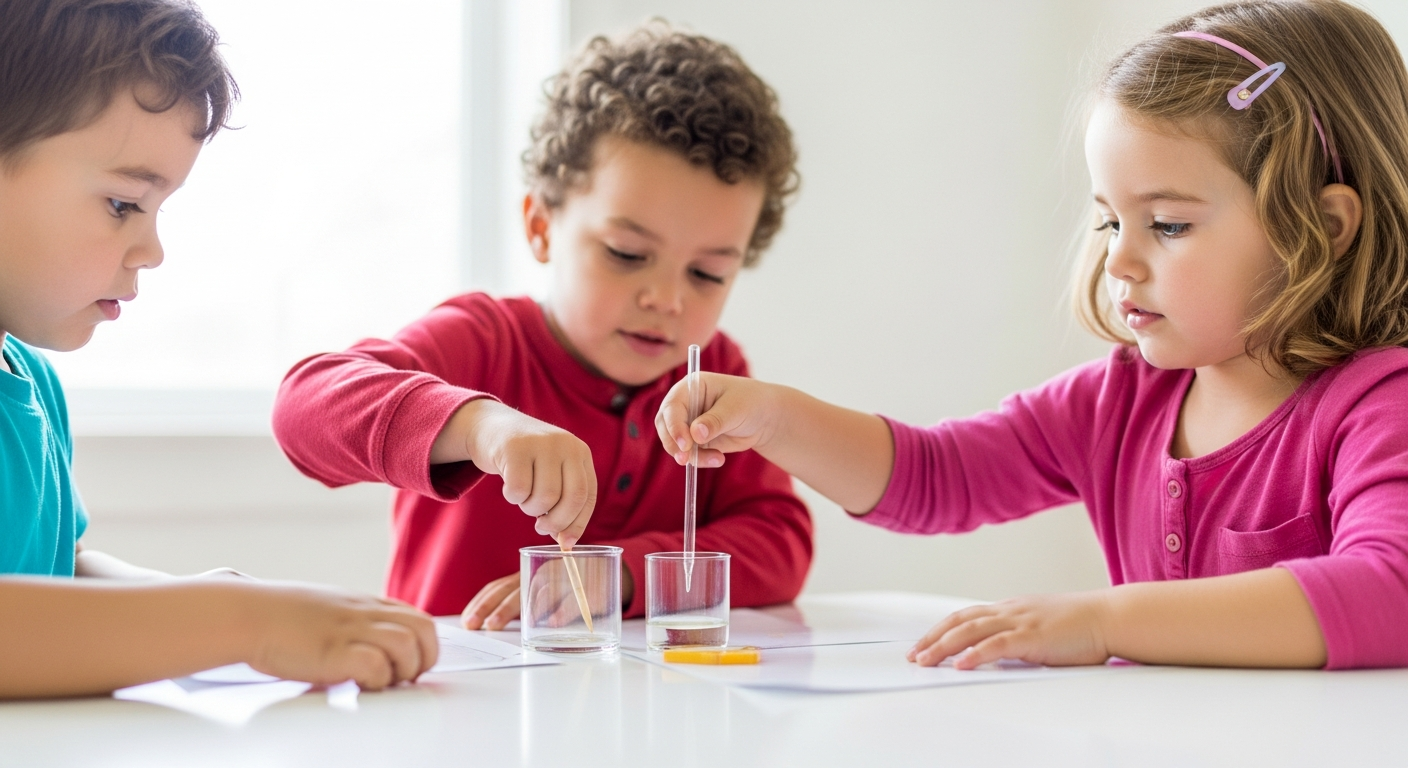
Table of Contents
- Introduction
- The Power of Early STEM Exposure
- Speech and Science: A Perfect Match
- 10 Quick and Messy Science Experiments
- Sensory Science for Language Development
- Observation Activities: Teaching Patience and Patterns
- Creating a Science-Friendly Environment
- Using Speech Blubs to Support Scientific Curiosity
- Choosing the Right Plan for Your Family
- Why Consistency and Play Matter Most
- Frequently Asked Questions
- Conclusion
Introduction
Have you ever watched a two-year-old’s face when they realize that mixing yellow and blue paint creates green? That wide-eyed "wow" moment is more than just play—it is the spark of scientific discovery. A toddler’s brain is a powerhouse of activity, forming millions of neural connections every single second. At this age, children aren't just passive observers; they are tiny scientists constantly testing hypotheses about how the world works. They drop a spoon to see if it falls, they splash in a puddle to see how far the water goes, and they push buttons just to see what happens.
The purpose of this blog post is to provide you with a comprehensive set of toddler science activities that are easy to set up, safe for little hands, and deeply impactful for development. We will explore how hands-on experiments foster critical thinking, sensory processing, and most importantly, language skills. At Speech Blubs, our mission is to empower children to speak their minds and hearts. We believe that when a child is engaged in a joyful, "smart screen time" experience or a messy kitchen experiment, they are building the confidence they need to communicate.

By the end of this article, you will have a toolkit of activities that bridge the gap between scientific wonder and verbal expression. Our main message is simple: science for toddlers isn't about complex formulas; it’s about nurturing a love for discovery that sets the stage for a lifetime of learning and communication.
The Power of Early STEM Exposure
When we talk about STEM (Science, Technology, Engineering, and Math) for toddlers, it can sound intimidating. However, for a three-year-old, STEM is simply "finding out." Engaging in toddler science activities helps develop several key foundational skills:
- Cause and Effect: Understanding that "if I do this, then that happens."
- Critical Thinking: Learning to predict what might occur next.
- Language Development: Building a vocabulary of descriptive words like sticky, cold, fizzy, sink, and float.
- Fine Motor Skills: Using droppers, spoons, and tweezers to manipulate materials.
Our company was born from the personal experiences of our founders, who all grew up with speech problems and created the tool they wished they had. We know that for the 1 in 4 children who need speech support, these tactile, real-world experiences are vital. Science provides the "what" to talk about, while tools like Speech Blubs provide the "how" to say it.
Speech and Science: A Perfect Match
Why do we emphasize science in a blog about speech? It’s because science is inherently social and communicative. When a child sees a baking soda volcano erupt, their natural instinct is to vocalize their excitement. This is a prime opportunity for "video modeling," a core part of our methodology. In our app, children watch and imitate their peers. In a science experiment, they observe a reaction and imitate the language you use to describe it.
Our unique approach is backed by science, focusing on mirror neurons that fire when a child watches another child perform an action or make a sound. By combining physical toddler science activities with our digital tools, you are creating a multi-sensory learning environment that reduces frustration and builds joyful family moments.

10 Quick and Messy Science Experiments
Here are ten tried-and-true experiments that require minimal prep but offer maximum engagement.
1. The Classic Sink or Float
Gather a variety of household objects: a plastic block, a metal spoon, a leaf, a crayon, and a rubber ball. Fill a clear tub with water. Before dropping each item, ask your toddler, "Will it sink or float?" This introduces basic physics and buoyancy while encouraging them to make predictions.
2. Magic Milk Swirls
Pour a thin layer of milk into a shallow dish. Add a few drops of food coloring. Dip a cotton swab in dish soap and touch the center of the milk. Watch as the colors "dance" away from the soap. This experiment demonstrates surface tension in a visually stunning way.
3. Baking Soda Eruptions
This is a favorite for a reason! Place baking soda in a tray and give your toddler a small cup of vinegar (add food coloring for extra fun). Let them use a dropper to add the vinegar to the soda. The "fizz" sound is a great prompt for practicing the "f" and "z" sounds!
4. Shaving Cream Rain Clouds
Fill a clear jar with water and top it with a thick layer of shaving cream (the cloud). Use a dropper to add blue-tinted water onto the "cloud." Eventually, the cloud gets too heavy, and the "rain" falls through into the water below. It’s a perfect way to explain weather patterns.
5. Dancing Raisins
Drop a few raisins into a glass of clear carbonated soda. The bubbles attach to the rough surface of the raisins, lifting them to the top before they pop and the raisins sink again. This simple activity introduces the concept of gases and buoyancy.
6. Magnetic Discovery Jar
Fill a plastic jar with non-magnetic items (rice, beads) and a few magnetic items (paperclips, small metal washers). Give your toddler a strong magnet wand and let them "find" the hidden treasures through the plastic.
7. Celery Color Transport
Place a stalk of celery (with leaves) into a glass of water heavily dyed with food coloring. Over the next 24 hours, watch as the colored water travels up the "tubes" of the plant, turning the leaves a new color.
8. Shadow Puppets
On a sunny day or using a flashlight in a dark room, use your hands or toys to create shadows on the wall. Move the light closer and further away to show how the size of the shadow changes. This introduces the basics of light and optics.
9. Sticky Note Adhesion
Give your toddler a stack of sticky notes and let them see which surfaces they stick to best (the wall, the carpet, their own shirt). Talk about why some things are "sticky" and others are "smooth."
10. DIY Ice Excavation
Freeze small plastic dinosaurs or toys inside a large block of ice. Give your toddler "tools" like warm water, salt, and a small hammer (under supervision) to rescue the toys. This is an excellent lesson in states of matter (solid to liquid).
Sensory Science for Language Development
Sensory play is the foundation of all learning for toddlers. When a child feels the squish of "oobleck" (cornstarch and water), they are processing complex tactile information.
Practical Scenario: For a parent whose 3-year-old "late talker" loves sensory experiences, the "Sensory Box" section of Speech Blubs can be paired with a real-life cornstarch experiment. As the child feels the mixture turn from solid to liquid, you can use the app to practice words like "wet," "hard," and "gooey." This reinforces the connection between the physical sensation and the spoken word.
If you are unsure where your child stands in their development, we recommend taking our quick 3-minute preliminary screener. It involves 9 simple questions and provides an assessment and a next-steps plan to help you tailor these activities to your child's needs.
Observation Activities: Teaching Patience and Patterns
Science isn't always about immediate "explosions." Sometimes, it’s about watching things change over time. These activities help toddlers develop observational skills and the ability to notice patterns.
- Regrowing Kitchen Scraps: Place the base of a head of lettuce in a shallow dish of water. Within days, new leaves will sprout from the center.
- The Bean in a Jar: Place a damp paper towel and a dried bean in a clear glass jar. Keep it in a sunny spot and watch the roots and sprouts emerge.
- A Nature Walk Journal: Even if they can’t write, toddlers can "collect" data. Bring a bag on a walk and collect three different types of leaves or five different stones. Back home, sort them by size or color.
These long-term activities are wonderful for building vocabulary related to time—words like "yesterday," "today," "grow," and "change."
Creating a Science-Friendly Environment
You don't need a laboratory to perform toddler science activities. You just need a space where it is okay to be a little messy. Here are some tips for setting the stage:
- Accessibility: Keep "science tools" like magnifying glasses, plastic tweezers, and droppers in a low bin that your child can reach.
- Safety First: Always supervise experiments, especially those involving small parts or liquids.
- Ask Open-Ended Questions: Instead of asking, "Is the water blue?" ask, "What happened when we added the blue drops?"
- Follow Their Lead: If your toddler is more interested in pouring the water back and forth than in the "sink or float" aspect, let them! Pouring is a scientific exploration of volume and gravity.
Using Speech Blubs to Support Scientific Curiosity
While we advocate for hands-on play, we also recognize the power of "smart screen time." Speech Blubs is designed to be a powerful supplement to your child's overall development plan.
For example, if you are doing an experiment about animals—perhaps building a simple bird feeder—you can use the "Animal Kingdom" section of our app to learn the sounds and names of the birds you might see. This creates a bridge between the digital learning and the physical world, making the experience more meaningful.
Our users often share how this combination has transformed their daily routines. You can read some of these parent success stories to see how other families have used Speech Blubs to foster a love for communication and discovery.
Choosing the Right Plan for Your Family
We want to be transparent about our pricing so you can make the best choice for your child’s learning journey. We offer two main paths:
- Monthly Plan: At $14.99 per month, this is a great way to test the waters and see how your child responds to our video modeling methodology.
- Yearly Plan (The Best Value): At $59.99 per year, this breaks down to just $4.99/month. This plan is the clear favorite for families committed to long-term progress.
The Yearly plan is not just more affordable; it includes exclusive features that the monthly plan does not:
- A 7-day free trial so you can explore everything risk-free.
- The Reading Blubs app, which helps transition speech skills into early literacy.
- Early access to all new updates and features.
- Priority Support: A 24-hour response time from our dedicated team.
We encourage you to create your account and start your 7-day free trial today. Selecting the Yearly plan ensures you get the full suite of features designed to help your child "speak their mind and heart."
Why Consistency and Play Matter Most
It is important to set realistic expectations. Science experiments and speech exercises won't result in your child giving public speeches in a month. Development is a journey, not a race. The goal of these toddler science activities is to foster a love for learning, reduce the frustration of not being able to communicate, and create joyful family moments.
When you mix science with play, you are telling your child that their curiosity is valuable. When you use Speech Blubs alongside these activities, you are giving them the tools to share that curiosity with the world. Whether it's through the "smart screen time" of our app or the "messy time" of a kitchen experiment, the focus should always be on the bond you are building.
Frequently Asked Questions
1. Are these science activities safe for 2-year-olds?
Yes, as long as they are done under adult supervision. We recommend using food-grade materials (like vinegar, baking soda, and food coloring) whenever possible. Always be mindful of small objects that could be choking hazards and ensure that all "tools" like tweezers or droppers are child-safe plastic.
2. My toddler doesn't talk much yet. How can I do science with them?
Science is a great way to encourage non-verbal children to communicate. Focus on "shared attention"—looking at the same thing together. Use simple signs or single words like "Look!", "Pop!", or "More!" You can also use Speech Blubs to see how other children vocalize during similar activities, which can motivate your toddler to try making those sounds themselves.
3. What if the experiment doesn't work?
In science, a "failed" experiment is just more data! If the raisins don't dance or the volcano doesn't erupt, talk about it. "Hmm, it didn't fizz. Do we need more vinegar?" This teaches resilience and problem-solving, which are just as important as the scientific concepts themselves.
4. How often should we do these activities?
There is no set rule, but incorporating a "science moment" into your daily routine is very effective. It could be as simple as talking about why the steam rises from their bathwater or why the leaves are crunchy in the fall. Consistency helps reinforce new vocabulary and concepts.
Conclusion
Science is a gateway to a world of wonder, and for a toddler, every day is an opportunity for discovery. By engaging in toddler science activities, you are doing much more than teaching them about gravity or chemical reactions; you are building the cognitive and linguistic foundations they need for the rest of their lives.
At Speech Blubs, we are honored to be a part of that journey. We believe in the power of play, the importance of peer-led learning, and the magic of a child finding their voice. Our app is designed to be a joyful, effective tool that fits seamlessly into your busy life, providing "smart screen time" that actually helps your child connect with the real world.
Ready to spark some curiosity? Download Speech Blubs on the App Store or Google Play to begin. For the best experience and the greatest value, we recommend signing up for our Yearly plan. This gives you a full week to explore the app for free, plus access to the Reading Blubs app and our full library of peer-led video modeling content.
Let’s help your little scientist find the words to tell you all about their amazing discoveries. Create your account and start your 7-day free trial today!
About the author