
Navigating Speech Language Delay Therapy for Your Child
 By Speech Blubs Team•Mar 12, 2026•14 min.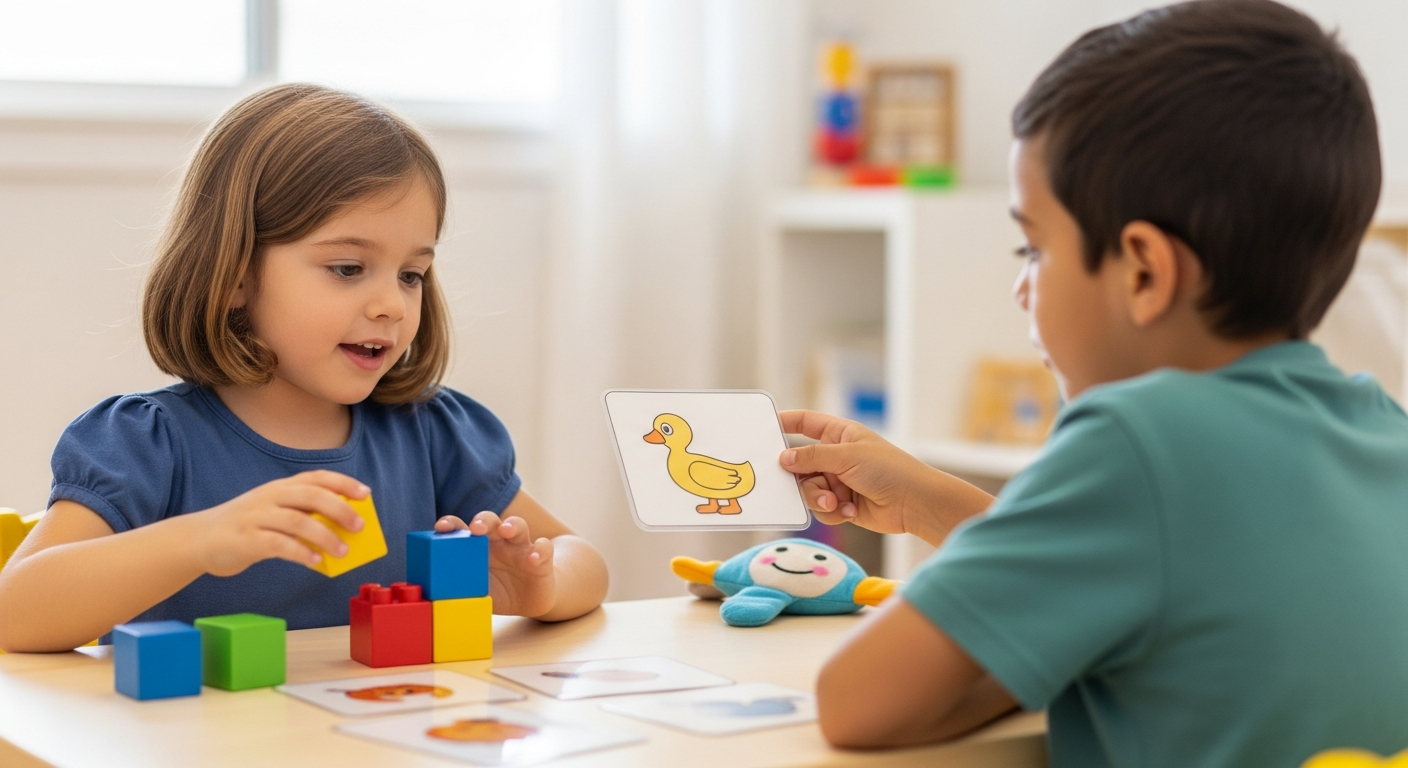
Table of Contents
- Introduction
- Understanding the Basics: Speech vs. Language
- Identifying the Signs: Milestones and Red Flags
- Potential Causes of Speech and Language Delays
- The Role of Professional Speech Language Delay Therapy
- The Speech Blubs Approach: "Smart Screen Time"
- Practical Strategies for Home Support
- Why the Right Tools Matter
- Realistic Expectations: What Success Looks Like
- Overcoming Common Hurdles
- Conclusion
- FAQs
Introduction
Imagine the moment you’ve been waiting for: your child looks you in the eye, opens their mouth, and... nothing happens. Or perhaps they point and grunt, their frustration mounting as you struggle to guess whether they want their favorite blue truck or a glass of water. For many parents, this silence or struggle isn't just a phase; it is a daily reality. In fact, approximately 1 in 4 children will face challenges with speech or language development at some point in their early years. This statistic can feel overwhelming, but it also means you are far from alone in this journey.
The purpose of this post is to provide a comprehensive look at speech language delay therapy, helping you distinguish between different types of delays, recognize the early red flags, and understand the various paths toward effective intervention. We will explore the science behind communication, the role of professional speech-language pathologists (SLPs), and how modern tools like Speech Blubs can transform a stressful situation into a joyful, bonding experience for the whole family. At Speech Blubs, our mission is to empower children to "speak their minds and hearts," a goal born from the personal experiences of our founders, who all grew up with speech problems and created the tool they wished they had.

Ultimately, while every child develops at their own pace, early identification and proactive support are the most powerful tools a parent has. By the end of this article, you will have a clear roadmap for supporting your child’s communication journey, building their confidence, and fostering a lifelong love for learning and expression.
Understanding the Basics: Speech vs. Language
Before diving into therapy options, it is essential to understand that "speech" and "language" are not the same thing, though they are often used interchangeably.
What is Speech?
Speech refers to the actual physical act of producing sounds. It involves coordination between the breath, the vocal cords, the tongue, the lips, and the jaw. When we talk about speech, we are looking at:
- Articulation: How we make individual sounds (e.g., saying "rabbit" instead of "wabbit").
- Voice: How we use our vocal folds and breath to make sounds (looking at pitch, volume, and quality).
- Fluency: The rhythm of our speech (addressing issues like stuttering).
What is Language?
Language is much broader. It is the entire system we use to share and receive information. It includes:
- Receptive Language: This is about understanding. Does your child understand what you say? Can they follow a direction like "Put your shoes in the basket"?
- Expressive Language: This is about output. How does your child share their thoughts? This can be through words, gestures, signs, or writing.
- Pragmatics: The social rules of communication, such as taking turns in a conversation or staying on topic.
A child might have a speech delay (they understand everything but find it hard to form sounds) or a language delay (they can make sounds perfectly but don't know how to put them into meaningful sentences). Understanding this distinction is the first step in effective speech language delay therapy.
Identifying the Signs: Milestones and Red Flags
As a parent, you are the world’s leading expert on your child. While "late blooming" does happen, it is crucial to be aware of the standard milestones. If you find yourself wondering if your child's development is on track, you can take our quick 3-minute preliminary screener. It consists of 9 simple questions and provides an immediate assessment and a next-steps plan.

12 to 18 Months
By their first birthday, most babies are using gestures like waving "bye-bye" and pointing to things they want. They should be babbling with different sounds and perhaps saying "mama" or "dada" specifically to you.
- Red Flag: By 12 months, the child is not using any gestures or responding to their name.
- Red Flag: By 18 months, the child prefers gestures over sounds or has significant trouble imitating sounds.
24 Months (2 Years)
This is a major milestone year. By age two, a child should typically have a vocabulary of at least 50 words and be starting to put two-word phrases together (e.g., "more milk" or "doggy bark").
- Red Flag: Speaking fewer than 50 words.
- Red Flag: Cannot follow simple, one-step directions without a gesture.
- Red Flag: Can only imitate speech but doesn't produce words or phrases spontaneously.
3 Years and Beyond
By age three, about 75% of what your child says should be understood by strangers. They should be using three-word sentences and asking "why" and "what" questions.
- Red Flag: Speech is predominantly unintelligible to people outside the immediate family.
- Red Flag: Difficulty interacting with peers or showing little interest in communication.
Potential Causes of Speech and Language Delays
When a delay is identified, the first question parents ask is "Why?" It’s important to remember that delays are rarely caused by anything a parent did or didn't do. Most factors are biological or developmental.
1. Oral-Motor Issues
Some children have a physical difficulty coordinating the muscles of the mouth. If the brain has trouble communicating with the tongue, lips, and jaw, the child may struggle to form sounds. This is sometimes seen in conditions like childhood apraxia of speech.
2. Hearing Loss
This is a very common and often overlooked cause. Even minor, temporary hearing loss due to chronic ear infections (fluid behind the eardrum) can make sounds muffled. If a child cannot hear clearly, they cannot learn to imitate sounds correctly. An audiologist should always be consulted if a speech delay is suspected.
3. Developmental and Neurological Conditions
Conditions such as Autism Spectrum Disorder (ASD) often present with language delays as a primary symptom. In these cases, the delay is usually part of a broader pattern involving social communication and behavior. Global developmental delays can also impact the rate at which a child acquires language.
4. Environmental Factors
While less common as a primary cause, a lack of stimulation or "passive screen time" (like leaving a child alone with cartoons for hours) can limit a child's opportunities to practice back-and-forth communication.
The Role of Professional Speech Language Delay Therapy
If your child shows signs of a delay, the gold standard for support is working with a Speech-Language Pathologist (SLP).
The Evaluation Process
An SLP will conduct a thorough evaluation, which includes:
- Standardized Testing: Comparing your child's skills to age-matched peers.
- Oral-Motor Exam: Checking the physical structure and movement of the mouth.
- Observations: Watching how the child plays and interacts.
- Parent Interview: Gathering a history of the child's development.
How Therapy Works
Therapy is not just "teaching words." For young children, therapy is play-based. The SLP uses toys, games, and songs to encourage the child to use their voice. They focus on building the "foundational skills" of communication, such as joint attention (looking at the same thing together) and turn-taking.
Professional therapy is a partnership. The SLP works with the child, but they also train the parents. Our research shows that children make the most progress when therapy is reinforced with consistent, joyful practice at home.
The Speech Blubs Approach: "Smart Screen Time"
We understand that accessing professional therapy can sometimes involve long waiting lists or high costs. While we always recommend professional guidance, we created Speech Blubs to be a powerful, effective, and joyful supplement to a child’s overall development plan.
Born from Experience
We are not just a tech company; we are a team of people who understand the frustration of speech struggles firsthand. Our founders grew up with speech problems and felt the sting of not being understood. We built the tool we wished we had—a solution that blends scientific principles with the pure joy of play.
The Science of Video Modeling
Our app is built on the proven methodology of video modeling. In our "smart screen time" experiences, children watch videos of other children (their peers) making sounds and saying words.
- Why Peers? Children are more likely to imitate other children than they are to imitate adults.
- Mirror Neurons: When a child watches a peer perform an action or make a sound, the "mirror neurons" in their brain fire as if they were doing it themselves. This creates a powerful bridge for learning.
Moving Beyond Passive Viewing
Unlike cartoons, which are passive, Speech Blubs is interactive. We use fun face filters to turn your child into a lion, a firewarden, or a monkey, encouraging them to use the front-facing camera to see themselves as they practice. This transforms a screen into a digital mirror, making the process of speech language delay therapy feel like a game rather than a chore.
Practical Strategies for Home Support
Whether you are waiting for an appointment or are already in therapy, there are many ways you can encourage your child’s speech development every single day.
1. Narrate Your Life
Talk through everything you are doing. "I am putting on my red socks. Now I am tieing my shoes. One, two, pull!" This exposes your child to a rich stream of vocabulary without the pressure of a "test" environment.
2. The Power of Choice
Instead of asking yes/no questions, offer choices. Instead of saying "Do you want juice?", try saying "Do you want apple juice or orange juice?" and hold up both options. This encourages the child to attempt a specific word or gesture to get what they want.
3. Use Motivating Interests
If your child is a "late talker" who happens to be obsessed with animals, leverage that! In the Speech Blubs app, the 'Animal Kingdom' section offers a fun, motivating way to practice 'moo' and 'baa' sounds. Using what they already love reduces the frustration often associated with learning new skills.
4. Wait for the Response
One of the hardest things for parents to do is stay silent. When you ask a question or prompt a sound, wait at least 5–10 seconds. Give your child’s brain the time it needs to process the request and formulate a response.
Why the Right Tools Matter
In the world of speech support, consistency is everything. However, keeping a toddler engaged in repetitive practice can be exhausting for parents. This is where a structured, fun program comes in.
We offer two main ways to access our full suite of tools:
- Monthly Plan: For $14.99 per month, you get access to our core Speech Blubs library.
- Yearly Plan: This is our best value option at $59.99 per year (breaking down to just $4.99/month).
Why choose the Yearly Plan? Beyond the 66% savings, the Yearly plan is designed to provide a comprehensive learning ecosystem. It includes:
- A 7-day free trial: Test the app with your child risk-free.
- Reading Blubs: Our additional app specifically designed to bridge the gap between speech and literacy.
- Priority Support: 24-hour response times to any questions you have.
- Early Access: Be the first to try new updates and activities.
By signing up for the Yearly plan on our website, you ensure that your child has the long-term support needed to build lasting confidence.
Realistic Expectations: What Success Looks Like
It is important to set realistic goals. Speech language delay therapy is a journey, not a sprint. You won't see your child giving public speeches in a month, and that's okay. Success in speech therapy looks like:
- Reduced Frustration: When a child can communicate even one or two more needs, tantrums often decrease.
- Increased Confidence: Watching a child realize they can make a sound is a beautiful moment of empowerment.
- Joyful Connection: Therapy should be a time of bonding between you and your child.
- Foundational Skills: Building the blocks—eye contact, imitation, and sound play—that eventually lead to fluent sentences.
Our parent testimonials highlight these small but mighty victories. From the first time a child says "mama" to the moment they can finally ask for a snack without crying, these are the milestones that matter most.
Overcoming Common Hurdles
"Is it too much screen time?"
Many parents worry about the impact of digital devices. We agree that passive screen time (like watching endless loops of nursery rhyme videos) can be detrimental. However, "smart screen time"—screen time that requires active participation, vocalization, and physical movement—is a different story. Speech Blubs is designed to be a co-play tool, meant to be used with an adult to spark real-world conversation.
"What if they don't like it?"
Every child is different. Some might jump right in, while others might just want to watch for a few days. That’s why we offer a variety of themes, from 'Dinosaur World' to 'Yummy Time.' You can download Speech Blubs on the App Store or Google Play and explore different categories to see what captures your child’s imagination.
Conclusion
Navigating a speech or language delay can feel like a lonely path, but it is one filled with hope and potential. By understanding the difference between speech and language, recognizing the early signs, and seeking the right blend of professional and at-home support, you are giving your child the greatest gift possible: the ability to be heard.
At Speech Blubs, we believe that every child deserves the chance to speak their mind and heart. Whether your child is just starting to babble or is struggling to form sentences, we are here to support that journey with tools backed by science and infused with joy.
Don't wait to see if they "grow out of it"—early action is the best strategy. Ready to take the first step? Start your journey today by creating your account and beginning your 7-day free trial. We highly recommend selecting our Yearly plan to unlock the best value, including our Reading Blubs app and priority support. Together, we can turn frustration into communication and silence into song.
FAQs
1. How do I know if my child needs speech language delay therapy or if they are just a "late talker"?
While some children do catch up on their own, it is impossible to know for sure without a professional evaluation. A "late talker" typically has good receptive language (understands what you say) and uses gestures to communicate, but is slow to use spoken words. However, because early intervention is so much more effective than "waiting and seeing," we recommend consulting an SLP or taking our preliminary screener if you have any concerns.
2. Can using a speech app like Speech Blubs replace a traditional speech therapist?
No. Speech Blubs is designed to be a powerful supplement to professional therapy, not a replacement for it. A speech-language pathologist provides personalized, diagnostic care that an app cannot. However, Speech Blubs provides a fun, scientifically-backed way to practice the skills your child learns in therapy sessions, making the "homework" part of therapy feel like play.
3. What exactly is "video modeling," and why is it effective?
Video modeling is a teaching method where a child learns a behavior or skill by watching a video of someone else performing it. In our case, we use "peer modeling," where children watch other kids their age. This works because children are naturally inclined to imitate their peers, and it activates mirror neurons in the brain, which help the child "rehearse" the sound mentally before they try it physically.
4. How much does speech language delay therapy cost with Speech Blubs?
We believe in transparent pricing to help families plan. You can choose our Monthly plan for $14.99 per month. However, the best value is our Yearly plan at $59.99 per year (which is only $4.99 per month). The Yearly plan also includes a 7-day free trial, access to the Reading Blubs app, and 24-hour support response times, making it the most comprehensive choice for your child's development.
About the author