
Supporting Your Child With Down Syndrome Speech Delay
 By Speech Blubs Team•Mar 12, 2026•14 min.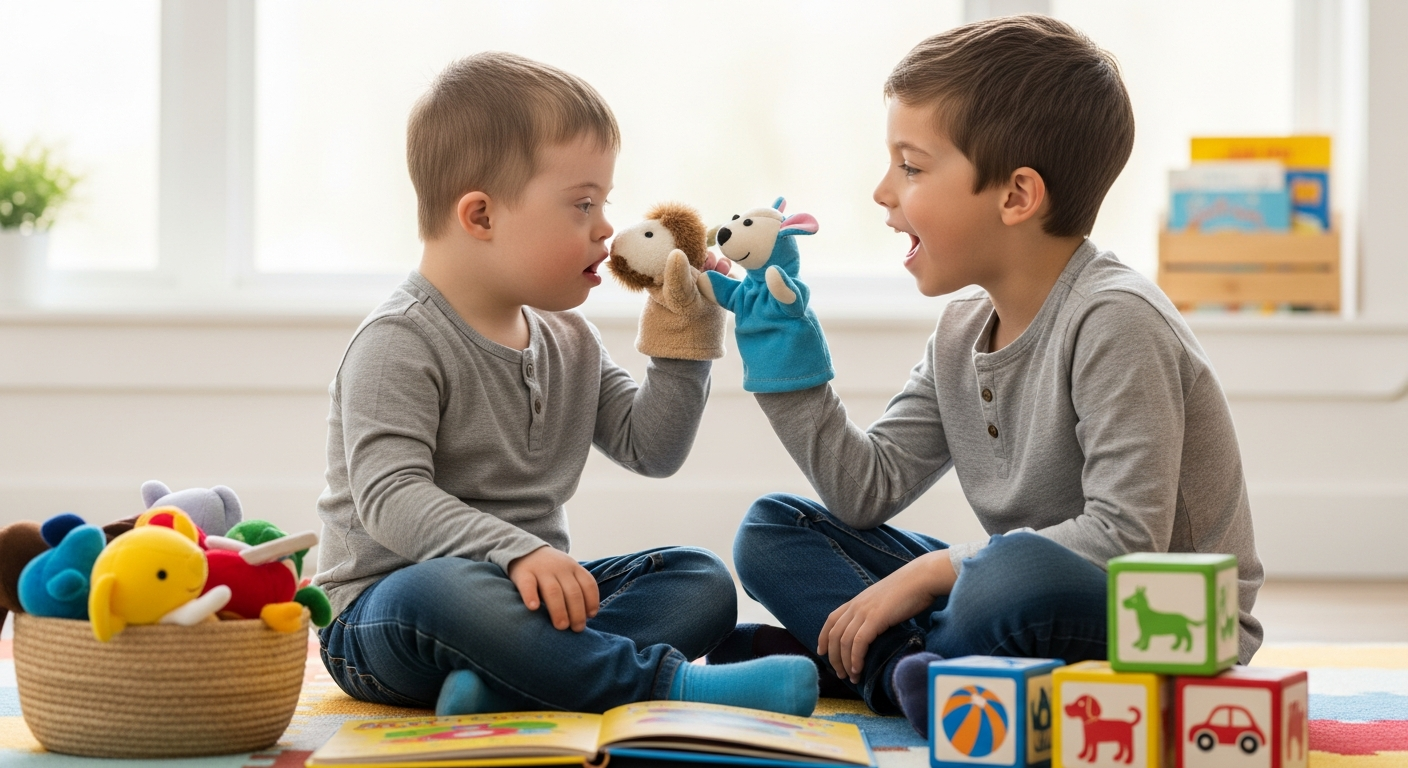
Table of Contents
- Introduction
- Understanding the Roots of Down Syndrome Speech Delay
- The Receptive vs. Expressive Gap
- Milestones: What to Expect in the Early Years
- The Science of Video Modeling: Why It Works
- Real-World Practice: Making Speech Part of Play
- Integrating Speech Blubs into Your Routine
- Addressing Common Challenges: Clarity and Fluency
- The Importance of Family Connection
- Why Early Intervention Matters
- Beyond the App: A Holistic Approach
- Summary of Key Takeaways
- FAQ
- Conclusion
Introduction
Imagine the moment your child finally looks you in the eyes, smiles, and attempts that very first "ma-ma" or "da-da." For parents of children with Down syndrome, these milestones are not just points on a growth chart; they are hard-won victories celebrated with tears of joy. While every child’s developmental path is unique, a Down syndrome speech delay is a common reality that many families navigate. It can be frustrating when you know your little one has so much to say, yet the words seem stuck behind physical and cognitive hurdles.
At Speech Blubs, we believe every child deserves the chance to speak their minds and hearts. Our company was born from the personal experiences of our founders, who all grew up with speech problems themselves. They created the tool they wished they had—a way to turn the challenge of speech therapy into a joyful, play-based experience. We understand that for the 1 in 4 children who need speech support, including those with Trisomy 21, the journey requires patience, the right tools, and a lot of heart.

In this post, we will explore why speech delays occur in children with Down syndrome, what the typical developmental timeline looks like, and how you can use "smart screen time" and proven scientific methods like video modeling to bridge the gap. We will also provide practical strategies for home use and explain how our Speech Blubs app can serve as a powerful supplement to professional therapy. Our goal is to empower you with the knowledge to foster a love for communication and build your child's confidence.
Understanding the Roots of Down Syndrome Speech Delay
To effectively support a child, we must first understand the "why" behind the delay. Down syndrome, or Trisomy 21, brings about specific physical and neurological differences that directly impact the complex process of producing speech. It isn’t just about "learning words"; it’s about the coordination of dozens of muscles, the clarity of hearing, and the way the brain processes sounds.
The Physical Impact of Hypotonia
One of the primary factors in a Down syndrome speech delay is hypotonia, or low muscle tone. Speech is a motor task. It requires the precise coordination of the lips, tongue, jaw, and breath. For a child with lower muscle tone, these movements are physically more demanding.
Think of it like trying to run a marathon in sand; the effort required to make a "k" or "t" sound is significantly higher for a child with Down syndrome. This often leads to speech that is "telegraphic"—where the child uses only the most essential keywords—or speech that is difficult for those outside the immediate family to understand.
Hearing and Auditory Processing
Research shows that a vast majority of children with Down syndrome experience some form of hearing loss, often due to narrower ear canals that are prone to fluid buildup (glue ear). Even a mild, fluctuating hearing loss can make speech sounds seem muffled, like listening to someone talk underwater. If a child cannot hear the subtle differences between sounds like "p" and "b," they will struggle to replicate them.

Cognitive and Memory Challenges
The way the brain stores and recalls information also plays a role. Short-term memory—the "workbench" of the brain—is often a challenge for children with Down syndrome. Following a long sentence or remembering a multi-step instruction can be difficult. This is why we focus so heavily on visual learning and repetition. When a child can see the word being formed while hearing it, they have a much better chance of "cracking the code" of language.
The Receptive vs. Expressive Gap
One of the most important things for parents to recognize is the gap between receptive language (what a child understands) and expressive language (what a child says). Children with Down syndrome almost always have much stronger receptive skills. They often understand complex social cues, instructions, and stories long before they can vocalize their thoughts.
This gap can lead to significant frustration. Imagine being a five-year-old who understands exactly what is happening at a birthday party but can only point and grunt to ask for a piece of cake. This frustration often manifests as behavioral issues. By using tools like sign language or the Speech Blubs app, we provide an "alternative" voice that reduces this frustration while the physical ability to speak catches up.
Milestones: What to Expect in the Early Years
While it is helpful to know average milestones, remember that "average" is a wide range. For children with Down syndrome, the timeline is typically shifted.
- The First Year: Communication begins with eye contact and smiles. While babies with Down syndrome may be slightly later to start these "social games," they are often highly motivated by social interaction. They are "people people."
- The First Words: On average, children with Down syndrome may say their first words around 16 months, compared to 10-12 months for typically developing peers. However, it is not uncommon for first words to appear much later.
- Vocabulary Growth: Once the first few words appear, vocabulary tends to grow more slowly. You might notice your child stays in the "single word" phase for a longer period before moving to two-word phrases like "more juice" or "go out."
If you are concerned about your child's specific progress, we recommend taking our quick 3-minute preliminary screener. It involves 9 simple questions and provides a personalized assessment and next-steps plan to help you understand where your child stands.
The Science of Video Modeling: Why It Works
At the heart of the Speech Blubs experience is a scientific principle called video modeling. This is a method where children learn new behaviors or skills by watching videos of others performing them. But we don't just use any actors; we use "peers"—other children.
Mirror Neurons and Peer Imitation
Humans have "mirror neurons" in the brain that fire both when we perform an action and when we see someone else perform that same action. For a child with a Down syndrome speech delay, watching a peer on a screen make a "B" sound triggers these neurons. It makes the child feel like they are doing it themselves.
Research into our methodology shows that children are far more likely to imitate another child than an adult. Adults can be intimidating or too "perfect." Seeing a child who looks like them, making funny faces and sounds, turns a "therapy session" into a playdate. This is what we call "smart screen time." Instead of the passive viewing of a cartoon, Speech Blubs requires active participation and imitation.
"Our method is backed by science, placing us in the top tier of speech apps worldwide. By leveraging the power of peer-to-peer imitation, we help children build the neural pathways necessary for speech in a way that feels like a game, not a chore." — Learn more about our scientific research.
Real-World Practice: Making Speech Part of Play
For a parent whose 3-year-old with Down syndrome is fascinated by animals, the "Animal Kingdom" section of our app offers a motivating way to practice sounds. Instead of just saying "cow," the child sees a peer making the "Moo" sound. The child can then use our digital "hats" and filters to turn themselves into a cow on the screen, creating a joyful moment of connection.
Here are some practical ways to support speech at home:
- Face-to-Face Interaction: Always try to get down to your child's eye level. Let them see how your mouth moves when you speak.
- Narrate Your Day: Talk about everything you are doing. "Now we are putting on your blue shoes. One shoe, two shoes!"
- Use Visuals and Signs: Don't be afraid that sign language will stop them from talking. Evidence suggests that sign language actually helps speech development by giving the child a way to communicate while they work on their vocal sounds.
- Mirror Play: Sit in front of a mirror with your child and make silly faces. Stick out your tongues, blow bubbles, and make "fish faces." This builds the oral-motor strength needed for speech.
Integrating Speech Blubs into Your Routine
We designed Speech Blubs to be a powerful supplement to professional therapy. We know that many families face long waitlists for Speech-Language Pathologists (SLPs) or can only afford one session a week. Our app provides a way to maintain momentum between those sessions.
Choosing the Right Plan for Your Family
We want to be transparent about how you can access these tools to ensure you get the best value for your child's development.
- Monthly Plan: For $14.99 per month, you get full access to our library of 1,500+ activities, face filters, and educational videos.
- Yearly Plan (Best Value): Our Yearly plan is $59.99 per year, which breaks down to just $4.99 per month. This is a 66% saving compared to the monthly option.
Why choose the Yearly plan? Beyond the cost savings, the Yearly plan is designed for families who are committed to long-term growth. It includes:
- A 7-day free trial to see if the app is a fit for your child.
- The extra Reading Blubs app, which focuses on the next step of the journey: literacy and phonics.
- Early access to new updates and a 24-hour support response time from our team.
Ready to give your child the tools to thrive? Download Speech Blubs on the App Store or Google Play to begin your journey.
Addressing Common Challenges: Clarity and Fluency
As children with Down syndrome grow, new challenges often emerge, such as stuttering or difficulties with specific consonant sounds.
Improving Speech Clarity
Because of the physical differences in the mouth and tongue, certain sounds like "s," "z," "sh," and "ch" are often the most difficult. We recommend focusing on "intelligibility"—making sure the child can be understood by others.
In the Speech Blubs app, we have sections dedicated to specific sounds. For example, if a child struggles with the "L" sound, they can practice with the "Lion" activity. The peer model shows exactly where the tongue goes, and the child is encouraged to repeat the sound to "unlock" a fun reward. This immediate feedback loop is crucial for building confidence.
Dealing with Stuttering
Stuttering or "cluttering" (rapid, jumbled speech) is much more common in the Down syndrome population, with rates between 10% and 45%. This is often a result of the brain's "processing speed" being faster than the mouth's "output speed."
When your child stutters, the best thing you can do is wait. Don't finish their sentences. Give them the "time and space" to get the words out. Maintaining a calm, encouraging environment reduces the anxiety that often makes stuttering worse. You can see how other parents have navigated these challenges by reading our parent testimonials.
The Importance of Family Connection
At its core, communication is about connection. It’s about a child being able to tell their parents "I love you," or "I’m hungry," or "Look at that bird!" Our mission is to empower children to "speak their minds and hearts," and that happens most effectively through play.
We advocate for "co-play." While the app is an amazing tool, it works best when you are right there with your child. Cheer when they make a sound, laugh at the funny filters together, and repeat the words they learn in the app during your dinner conversation. This creates "joyful family learning moments" that turn a developmental delay into an opportunity for bonding.
Why Early Intervention Matters
The earlier a child receives support for a Down syndrome speech delay, the better the long-term outcomes for their independence and quality of life. Language is the tool we use for thinking, reasoning, and remembering. By boosting a child's communication skills, we are also boosting their cognitive development.
Don't wait for a "perfect" time to start. Whether your child is just starting to babble or is a teenager struggling with clarity, there are tools available to help. We are proud to provide a screen-free alternative to passive viewing (like cartoons) and a bridge to a more communicative future.
Beyond the App: A Holistic Approach
While we believe Speech Blubs is a vital tool, it should be part of a broader plan that includes:
- Regular Hearing Checks: Ensure that fluid or hearing loss isn't acting as a barrier.
- Professional SLP Support: A therapist can provide targeted exercises for your child's specific anatomical needs.
- Healthy Nutrition and Sleep: Physical health plays a massive role in a child's ability to focus and learn.
By combining professional expertise with the daily, playful practice provided by Speech Blubs, you are creating a "communication-rich" environment that gives your child the best possible start.
Summary of Key Takeaways
- Hypotonia and Hearing are the primary physical causes of speech delay in Down syndrome.
- Receptive language is usually much stronger than expressive language, which can lead to frustration.
- Video modeling—watching peers perform sounds—is a scientifically proven way to encourage imitation and speech.
- Smart Screen Time should be active, engaging, and used as a tool for connection, not just a distraction.
- Consistency is key. Short, daily practice sessions are often more effective than one long session per week.
FAQ
1. Will using sign language or an app stop my child from learning to talk? Absolutely not. In fact, research shows the opposite is true. Using augmentative and alternative communication (AAC) like sign language or Speech Blubs reduces frustration and actually provides a bridge to vocal speech. As your child’s physical ability to speak improves, they will naturally transition from signs to words because speech is the more efficient way to communicate.
2. How much time should my child spend on Speech Blubs each day? We recommend short, frequent sessions—about 5 to 15 minutes a day. The goal is to keep it fun and engaging. If your child is tired or frustrated, it’s okay to stop and try again tomorrow. The Yearly plan includes early access to new content to keep the experience fresh and exciting for your little learner.
3. My child is a teenager; is it too late to start using Speech Blubs? It is never too late to work on communication. While the app is designed with a playful aesthetic that appeals to younger children, the core principles of video modeling and articulation practice are effective for individuals of all ages. Many parents of older children use the app to focus specifically on speech clarity and intelligibility.
4. What is the difference between the Monthly and Yearly plans? The Monthly plan ($14.99/mo) offers basic access to the app's activities. However, the Yearly plan ($59.99/year) is the best choice for families. It saves you 66%, includes a 7-day free trial, gives you the bonus Reading Blubs app for literacy, and ensures you get 24-hour support and early access to all our latest updates.
Conclusion
Navigating a Down syndrome speech delay can feel like a long journey, but you don't have to walk it alone. By understanding the physical and cognitive roots of the delay and using evidence-based tools like video modeling, you can help your child find their voice. Remember, the goal isn't perfection—it’s about fostering a love for communication, building confidence, and creating those joyful moments where your child can finally "speak their mind and heart."
We invite you to join our community of thousands of families who have seen the benefits of our "smart screen time" approach. Whether it's practicing animal sounds or learning the names of family members, every step forward is a victory.
Ready to start? Create your account and begin your 7-day free trial today. We highly recommend choosing the Yearly plan to unlock the full suite of features, including Reading Blubs and priority support, for the best possible value in your child’s development.
Sign up on our website or Download Speech Blubs from the App Store to begin your journey toward better communication today. Let's start talking!
About the author