
15 Engaging Pipe Cleaner Toddler Activity Ideas for Fun
 Por Speech Blubs Team•18 mar 2026•16 min.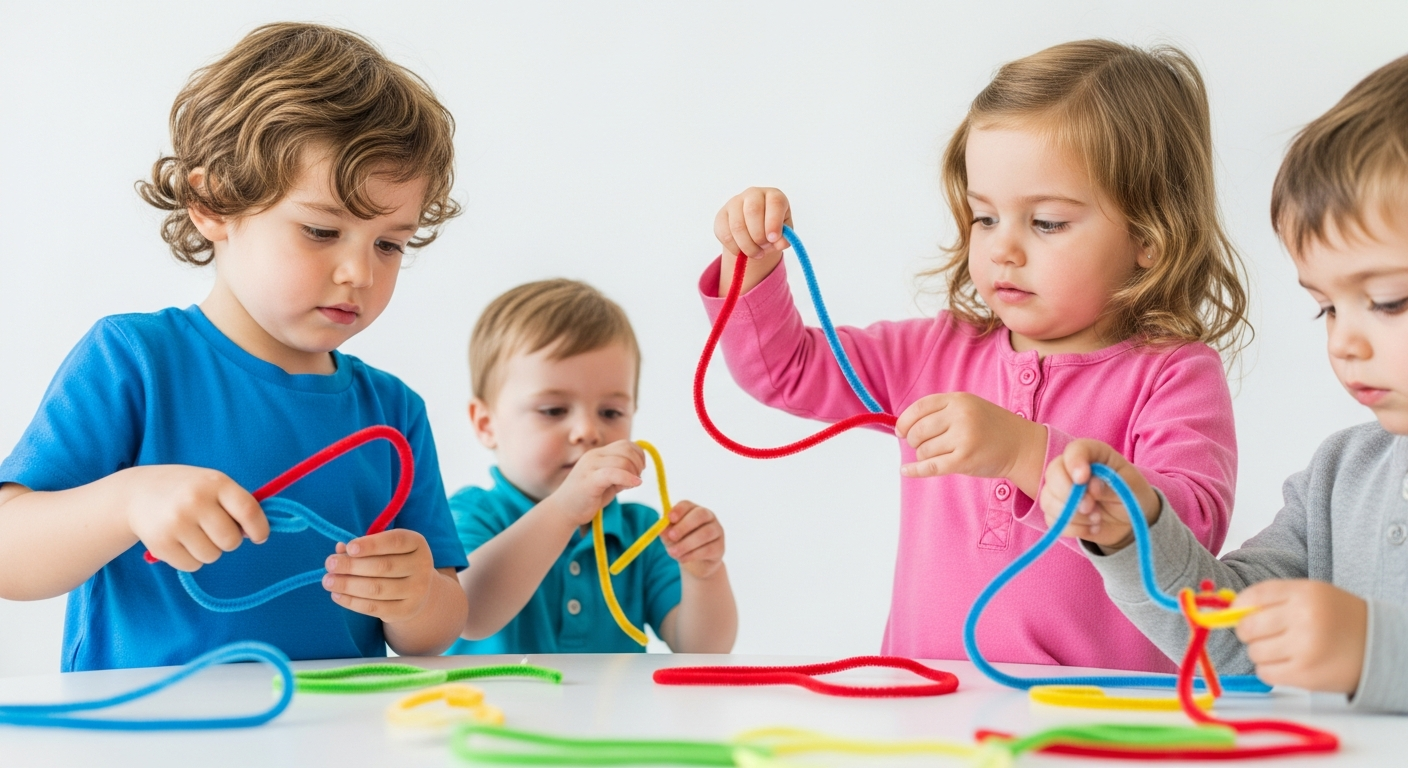
Table of Contents
- Introduction
- Why Pipe Cleaners are Developmental Powerhouses
- Activity 1: The Classic Colander Threading
- Activity 2: Magnetic Sensory Bin Grab
- Activity 3: The Pipe Cleaner "Hairdresser"
- Activity 4: Color Sorting and Counting
- Activity 5: Creating Pipe Cleaner Letters and Shapes
- Activity 6: Bead Threading Snakes
- Activity 7: DIY Bubble Wands
- Activity 8: The "Mystery Bag" Tactile Game
- Activity 9: Pipe Cleaner Finger Puppets
- Activity 10: Nature's Crowns and Bracelets
- Integrating Speech Blubs into Your Play Routine
- Practical Scenarios: Real-World Wins
- Creating a "Quiet Time" Kit
- Safety First: A Note for Parents
- Summary of Benefits
- FAQ
- Conclusion
Introduction
Have you ever noticed how the most expensive, battery-operated toys often end up gathering dust while your toddler spent forty-five minutes fascinated by a cardboard box or a stray piece of ribbon? There is a profound simplicity in how children learn, and as parents, we are often searching for that "holy grail" of activities: something that is low-cost, requires zero prep, keeps them occupied, and actually helps them grow. Enter the humble pipe cleaner. This fuzzy, flexible crafting staple is secretly one of the most powerful tools in your developmental toolbox.
At Speech Blubs, our mission is to empower children to "speak their minds and hearts." We know that language development doesn't happen in a vacuum; it is deeply connected to sensory exploration and fine motor mastery. Our founders, who navigated their own speech challenges as children, designed our tools to be the joyful support system they wished they had. We believe in "smart screen time" that encourages active participation rather than passive scrolling. In this post, we are going to explore how a simple pipe cleaner toddler activity can bridge the gap between physical play and communication skills, providing you with a wealth of ideas to foster your child's confidence and curiosity.

By the end of this article, you will have a comprehensive list of activities that target fine motor skills, color recognition, and early literacy, all while creating those precious moments of family connection. Whether you are looking to supplement professional therapy or just want a way to make it to nap time with your sanity intact, these activities are designed to be immediate, effective, and, above all, joyful.
Why Pipe Cleaners are Developmental Powerhouses
It might seem like just a bit of wire and fuzz, but the tactile nature of a pipe cleaner offers unique sensory feedback that children crave. When a toddler grips, bends, and twists a pipe cleaner, they aren't just playing; they are strengthening the tiny muscles in their hands and wrists. These are the same muscles they will eventually use to hold a pencil, button a shirt, and even coordinate the complex movements required for clear speech.
The Connection Between Hands and Speech
Research has long suggested a strong link between fine motor skills and language acquisition. The parts of the brain responsible for hand movements and speech production are located closely together. When we engage a child in a "pipe cleaner toddler activity," we are stimulating neural pathways that support overall cognitive development.
At Speech Blubs, we lean heavily into the science of video modeling, where children learn by watching their peers. Just as they watch a peer on a screen to learn how to make a "B" sound, they watch your hands to learn how to loop a pipe cleaner. This imitation is the foundation of all learning.
Sensory Exploration and Focus
Pipe cleaners provide a "resistive" sensory experience. Unlike a piece of string, a pipe cleaner holds its shape. This allows a toddler to see the immediate result of their physical effort. For a child who might struggle with focus, the "crunchy" feel and vibrant colors of these stems can be incredibly grounding. It turns a simple afternoon into a session of "smart play" that builds the foundational skills necessary for future academic success.

Activity 1: The Classic Colander Threading
If you only try one pipe cleaner toddler activity this week, make it this one. It is the ultimate "busy play" setup that parents swear by because it is virtually impossible to do "wrong."
What You Need:
- A kitchen colander (the kind with plenty of holes).
- A pack of colorful pipe cleaners.
How to Play: Simply place the colander upside down on the floor or a table and show your child how to poke the pipe cleaners into the holes. Some toddlers will want to push them all the way through, while others will enjoy creating a "spiky" sculpture.
Why it Works: This activity is a powerhouse for hand-eye coordination. It requires a high level of concentration and precision to align the thin tip of the pipe cleaner with the small hole of the colander.
Expert Tip: If your child is a "late talker" and loves animals, try narrating the activity using sounds from the "Animal Kingdom" section of the Speech Blubs app. As they poke a yellow pipe cleaner in, you can say, "Look, it’s a tall giraffe! Can you say 'Moo' like the cow nearby?" Using these simple prompts helps link the physical action to vocalization.
Activity 2: Magnetic Sensory Bin Grab
Did you know that most pipe cleaners have a metal core that is magnetic? This opens up a whole new world of scientific exploration for your little one.
What You Need:
- A plastic bin or large bowl.
- Pipe cleaners cut into small pieces (about 1–2 inches).
- A magnetic wand or a large refrigerator magnet.
- Optional: Rice, dried beans, or water as a filler.
How to Play: Fill the bin with your chosen "filler" and hide the pipe cleaner pieces inside. Give your child the magnet and let them "fish" for the pieces. The "click" of the metal connecting to the magnet is incredibly satisfying for toddlers.
The Developmental Benefit: This is a fantastic way to introduce basic STEM concepts like magnetism while working on "pincer grasp" (using the thumb and forefinger). If you find yourself wondering if these types of activities are hitting the right milestones for your child's age, you can take our quick 3-minute preliminary screener. It involves 9 simple questions and provides an assessment and next-steps plan to help you feel confident in your child's progress.
Activity 3: The Pipe Cleaner "Hairdresser"
This activity adds a layer of imaginative play to the fine motor work. It’s perfect for toddlers who are starting to engage in pretend play.
What You Need:
- A piece of cardboard or a paper plate.
- Markers.
- A hole puncher.
- Pipe cleaners.
How to Play: Draw a simple face on the cardboard or paper plate. Use the hole puncher to make several holes along the "top" of the head. Let your child thread the pipe cleaners through the holes to create "hair." They can then twist, curl, or "cut" the hair (using child-safe scissors) to give the character a makeover.
Speech Connection: While your child is "styling," talk about emotions. "Is our friend happy with their new blue hair?" This builds vocabulary related to feelings and social-emotional learning. We love seeing how activities like this create joyful family learning moments, similar to the ones shared by parents in our community testimonials.
Activity 4: Color Sorting and Counting
Pipe cleaners usually come in bright, distinct colors, making them the perfect tool for early math and categorization skills.
What You Need:
- Several colored cups or pieces of construction paper that match your pipe cleaners.
- A bundle of pipe cleaners.
How to Play: Ask your child to place the red pipe cleaners in the red cup, the blue ones in the blue cup, and so on. As they get older, you can ask them to "Give me three green pipe cleaners," introducing basic counting.
Why This Matters: Categorization is a key cognitive skill. It helps children organize information in their brains, which is essential for language structure later on. If you want to dive deeper into how digital tools can support these concepts, you can download Speech Blubs on the App Store to see how we use visual cues to teach these same categories.
Activity 5: Creating Pipe Cleaner Letters and Shapes
For preschoolers or toddlers showing an interest in letters, pipe cleaners are much more engaging than a pencil and paper.
What You Need:
- Pipe cleaners.
- Printouts of large letters or shapes (optional).
How to Play: Help your child bend the pipe cleaners to mirror the shapes of letters. Start with the first letter of their name. Because pipe cleaners are tactile, the child can "feel" the shape of the letter "S" or "A," which helps with letter recognition through muscle memory.
The Speech Blubs Edge: If you choose our Yearly plan, you also get access to the Reading Blubs app. This is the perfect companion for this activity. While you build the letter "B" out of a pipe cleaner, you can use Reading Blubs to see how that letter sounds and functions in a word. Our Yearly plan is $59.99 per year (only $4.99/month), which is a 66% savings compared to the $14.99 monthly plan. Plus, the Yearly plan includes a 7-day free trial so you can see the benefits for yourself!
Activity 6: Bead Threading Snakes
Threading beads onto a pipe cleaner is significantly easier for a toddler than threading them onto a floppy piece of string.
What You Need:
- Large plastic beads (ensure they are age-appropriate to avoid choking hazards).
- Pipe cleaners.
How to Play: Tie a small loop at one end of the pipe cleaner to act as a "stop." Let your child slide beads onto the stem. When they are finished, bend the end to keep the beads on and draw a little face on the first bead to make a "snake."
Building Confidence: Completing a "snake" gives a child a huge sense of accomplishment. Reducing frustration is a key part of our philosophy. When a task is achievable, a child’s confidence grows, making them more willing to try new speech sounds or complex words.
Activity 7: DIY Bubble Wands
Who knew you could make your own bubbles with just a few craft supplies? This is a great outdoor pipe cleaner toddler activity.
What You Need:
- Pipe cleaners.
- A jar of bubble solution.
- Optional: Cookie cutters.
How to Play: Bend the pipe cleaner into a circle (or use a cookie cutter as a guide for stars or hearts) and twist the end around a straight pipe cleaner to make a handle. Dip it in the solution and blow!
Speech Development Tip: Blowing bubbles is a classic speech therapy technique. It helps children develop "oral motor" strength—the ability to control the muscles of the mouth and breath. Practice saying "Pop!" every time a bubble bursts to encourage bilateral labial sounds.
Activity 8: The "Mystery Bag" Tactile Game
This activity focuses entirely on the sense of touch, which is vital for sensory processing.
What You Need:
- An opaque fabric bag or a pillowcase.
- Various pipe cleaner shapes (a circle, a triangle, a "wiggly" line).
How to Play: Place the shapes in the bag. Ask your child to reach in (without looking!) and find the "wiggly" one or the "round" one.
Why it Works: This encourages "stereognosis," the ability to perceive the form of an object using tactile cues. It’s a sophisticated brain exercise wrapped in a fun game. For more "smart screen time" ideas that challenge the brain, check out our homepage to learn about our unique methodology.
Activity 9: Pipe Cleaner Finger Puppets
Bring stories to life with characters your child helps create.
What You Need:
- Pipe cleaners.
- Pom-poms, googly eyes, or scraps of felt.
- Glue (adult assistance needed).
How to Play: Coil a pipe cleaner around your finger to create a spiral shape. Slide it off, and glue a pom-pom "head" onto the top. Add eyes and maybe some pipe cleaner "arms."
Communication in Action: Use these puppets to act out daily routines. If your child is nervous about trying new foods, the finger puppet can "taste" the broccoli first. This type of role-play is incredibly effective for language modeling.
Activity 10: Nature's Crowns and Bracelets
Combine a walk outside with a creative craft session.
What You Need:
- Pipe cleaners.
- Leaves, flowers, or small twigs found on a nature walk.
How to Play: Twist two pipe cleaners together to form a circle that fits your child’s head or wrist. As you walk, help your child "weave" their nature finds into the pipe cleaner.
Connection: This activity encourages observational skills. "Look at this yellow leaf! It’s crunchy." At Speech Blubs, we want to provide a screen-free alternative to passive viewing, and nature play is the perfect partner to our app.
Integrating Speech Blubs into Your Play Routine
While tactile play with pipe cleaners is essential, we also recognize the reality of modern parenting. There are times when you need a moment to prep dinner or take a breath. This is where Speech Blubs becomes your partner. Instead of turning on a cartoon that encourages passive "zoning out," our app provides an interactive experience.
Why Choose the Yearly Plan?
When you sign up for a web account, you’ll see that we offer two main paths. While our Monthly plan is $14.99, the Yearly plan is the gold standard for families committed to their child's growth.
At just $59.99 per year, you are only paying $4.99 per month. But it’s not just about the price; it’s about the exclusive features:
- A 7-Day Free Trial: Test the waters and see how your child responds to our peer-led videos.
- Reading Blubs App: A full secondary app included at no extra cost to help with early literacy.
- Early Access: Be the first to try new updates and themes.
- Priority Support: 24-hour response time from our dedicated team.
The Monthly plan does not include the free trial, Reading Blubs, or priority support. To get the full suite of features and the best value, we always recommend the Yearly plan.
Practical Scenarios: Real-World Wins
Let’s look at how this all comes together. Imagine a parent, Sarah, whose 2-year-old son, Leo, isn't yet using many words. Sarah uses the "Animal Kingdom" section of Speech Blubs for 10 minutes in the morning. Leo watches a video of a child his age making a "fish face" and saying "Blub, blub."
Later that afternoon, Sarah sets up a pipe cleaner toddler activity. They make "fish" out of blue pipe cleaners and "swim" them through a colander. Sarah mimics the "fish face" Leo saw earlier. Because of the video modeling he watched, Leo has a clear mental image of how to move his mouth. He attempts the sound while playing with the physical toy. This is the "joyful solution" we strive for—blending scientific principles with the power of play.
Creating a "Quiet Time" Kit
One of the best ways to use pipe cleaners is in a "Quiet Time" or "Busy Bag" kit. This is a collection of activities your child can do independently (with your supervision nearby).
What to Include:
- A small bundle of pipe cleaners.
- An empty spice jar with holes in the lid (perfect for threading!).
- A few large wooden beads.
- A small magnet.
Having this kit ready to go can turn a stressful car ride or a long wait at the doctor's office into a productive learning session. If you are ever unsure which activities are best for your child's current level, remember you can always download Speech Blubs on Google Play to explore different categories and see what sparks your child's interest.
Safety First: A Note for Parents
While pipe cleaners are wonderful, they do have thin wire centers. Always supervise your toddler during these activities.
- Check the Ends: Sometimes the wire can be sharp. You can fold the tips over with a pair of pliers to make them blunt.
- Size Matters: If you cut pipe cleaners into small pieces, ensure they aren't small enough to be a choking hazard.
- Supervised Play: These activities are intended for "adult co-play." Not only does this keep things safe, but your involvement is what turns a simple activity into a rich language-learning opportunity.
Summary of Benefits
By incorporating a pipe cleaner toddler activity into your weekly routine, you are supporting:
- Fine Motor Strength: Building the muscles for writing and self-care.
- Hand-Eye Coordination: Essential for physical development and reading.
- Cognitive Skills: Sorting, counting, and letter recognition.
- Speech and Language: Linking physical actions to sounds and vocabulary.
- Confidence: Providing "small wins" that encourage a love for learning.
FAQ
1. At what age can my child start doing pipe cleaner activities? Most toddlers can begin exploring pipe cleaners around 18 months to 2 years old, once they have moved past the "everything goes in the mouth" phase. Always provide close supervision to ensure safety.
2. How do pipe cleaner activities help with speech delay? They help by strengthening fine motor skills, which share neural pathways with speech. Additionally, using these activities as a prompt for narration and "smart play" encourages children to vocalize and interact with their caregivers in a low-pressure environment.
3. Can I use pipe cleaners as a screen-free alternative to Speech Blubs? We actually recommend using them together! Pipe cleaners provide the tactile, physical experience, while Speech Blubs provides the expert-led "video modeling" that shows your child how to produce specific sounds. They are complementary tools in a child's development plan.
4. What if my child gets frustrated because they can't thread the pipe cleaner? Start with larger holes, like a plastic laundry basket or a chunky bead. Focus on the joy of the process rather than the perfection of the result. Building confidence is more important than the activity itself.
Conclusion
The journey of child development is paved with small, joyful moments. A pipe cleaner toddler activity might seem like a small thing, but it represents the heart of what we believe at Speech Blubs: that play is the most powerful way for a child to learn how to "speak their minds and hearts." Whether you are threading a colander or creating a pipe cleaner crown, you are building the foundational skills your child needs to communicate with confidence.
We invite you to join our community of over 5 million parents who are using "smart screen time" to supplement their children's growth. Our app isn't just a tool; it's a bridge to deeper family connection and effective communication.
Ready to see the difference for yourself? Begin your 7-day free trial by signing up today. Remember to select the Yearly plan at checkout to unlock the full suite of features, including the Reading Blubs app and early updates, all for just $59.99 per year. Let’s make learning a joyful, shared adventure!
Sobre el autor