
25 Fun Pom Pom Toddler Activities for Home Learning
 Por Speech Blubs Team•25 mar 2026•16 min.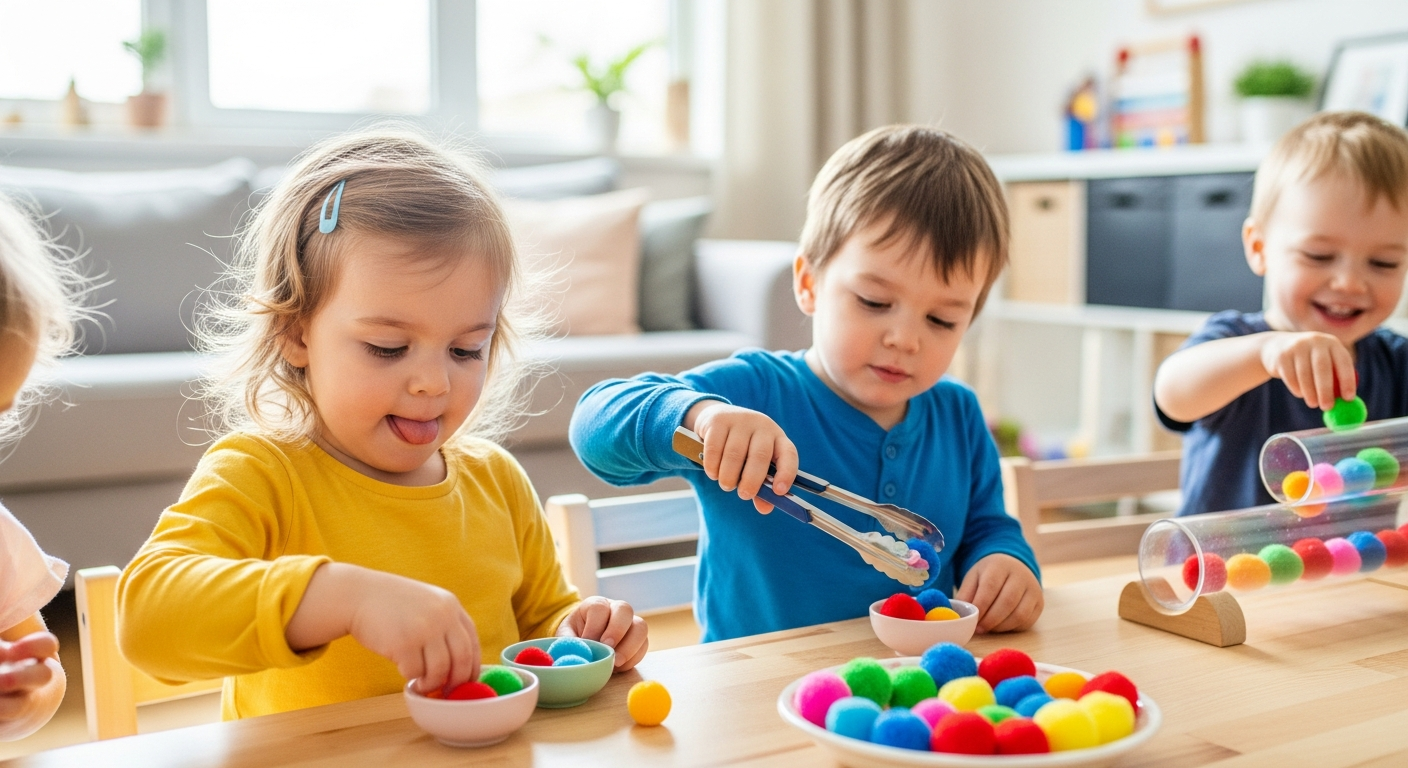
Table of Contents
- Introduction
- The Developmental Power of Pom Poms
- Fine Motor and Coordination Activities
- Sensory Play with Pom Poms
- Language and Communication Through Play
- Early Math and Logic Concepts
- Creative Arts and Crafts
- Making the Most of Playtime
- Why Choose Speech Blubs for Your Child?
- Creating Lasting Memories
- Frequently Asked Questions
- Conclusion
Introduction
Have you ever noticed how the simplest objects often spark the most intense curiosity in a child? You spend a fortune on a flashing, buzzing electronic toy, only to find your toddler spent forty-five minutes intently pushing a single soft, fuzzy pom pom through the opening of an empty water bottle. At Speech Blubs, we see this magic every day. We know that the most profound learning often happens through simple, joyful play.
The purpose of this blog post is to provide you with a comprehensive resource of pom pom toddler activities that are not only easy to set up but are also powerhouses for developmental growth. We will cover everything from sensory exploration and fine motor coordination to advanced language building and creative expression. Our goal is to show you how these colorful little craft supplies can become a cornerstone of your child’s learning journey.
At Speech Blubs, our mission is to empower children to "speak their minds and hearts." We believe that by combining tactile, physical play—like these pom pom activities—with our scientifically-backed "smart screen time," we can help every child reach their full potential. Whether your child is a "late talker" or simply a curious explorer, these activities provide the foundational skills needed for confident communication.

The Developmental Power of Pom Poms
Before we dive into the activities, it is helpful to understand why pom poms are such a hit with the toddler crowd. From a developmental perspective, these fuzzy balls offer a unique sensory experience. They are soft, lightweight, and come in a dazzling array of colors and sizes. For a child learning about the world, a pom pom represents a riddle to be solved: "What happens if I squeeze it? What happens if I drop it? Can I make it go into this small hole?"
At Speech Blubs, we often talk about the importance of "smart screen time." Our app was born from the personal experiences of our founders, who all grew up with speech challenges. They wanted to create the tool they wished they had—a tool that bridges the gap between digital learning and real-world interaction. While our app uses video modeling to teach communication, we always encourage parents to pair that digital learning with physical, hands-on activities. Pom poms are the perfect physical companion to our digital tools.
Using pom poms helps develop:
- Fine Motor Skills: The small movements of the fingers and hands required to pick up a pom pom are crucial for later skills like writing and buttoning clothes.
- Hand-Eye Coordination: Aiming a pom pom into a container or sticking it onto a specific spot on paper builds the connection between what the eye sees and what the hand does.
- Language Skills: Play provides the perfect context for learning new words, following directions, and practicing social turn-taking.
- Cognitive Development: Sorting, counting, and pattern-making with pom poms introduce basic mathematical and logic concepts.
Fine Motor and Coordination Activities
Fine motor skills are the foundation of independence. For a toddler, mastering the "pincer grasp"—using the thumb and index finger to pick up small objects—is a major milestone. These activities are designed to strengthen those tiny hand muscles while keeping your child completely engaged.
1. The Classic Pom Pom Drop
This is perhaps the simplest activity on our list, yet it never fails to entertain. All you need is a cardboard tube (from paper towels or toilet paper) and some painter's tape. Tape the tube vertically to a wall or a door at your child’s eye level. Place a bowl of pom poms at their feet.

- How it works: Your child picks up a pom pom and drops it through the top of the tube, watching it disappear and then reappear at the bottom.
- Speech Tip: Every time the pom pom falls, say "Drop!" or "Pop!" or "Down!" This pairs a physical action with a functional word, a core principle we use in our Speech Blubs app.
2. The Whisk Rescue
Take a standard kitchen whisk and stuff it full of medium-sized pom poms. Hand it to your toddler and watch them work.
- The Challenge: They have to figure out how to pull the fuzzy balls out through the wires. This requires focus, finger strength, and problem-solving.
- Why it works: It mimics the natural curiosity children have with household objects. It’s also a great way to occupy a toddler while you are busy in the kitchen.
3. Pom Pom Pushing
Find a plastic container with a soft lid (like an old yogurt or coffee container). Cut a small hole in the lid, just slightly smaller than your pom poms.
- The Goal: Encourage your child to "push" the pom poms through the hole. The resistance provided by the lid helps build hand strength.
- Connection: For a child who loves vehicles, you can pretend the container is a "garage" and the pom poms are "cars" that need to be parked. You can find many more vehicle-related sounds and words in the "Toy Box" section of Speech Blubs.
4. Tongs and Tweezers Transfer
Once your child has mastered the pincer grasp, it’s time to introduce tools. Provide two bowls—one full of pom poms and one empty—along with a pair of kid-friendly tongs or large plastic tweezers.
- The Activity: Ask your child to move the "fuzzy friends" from one "house" (bowl) to the other using only the tool.
- Value: This is excellent preparation for using pencils and scissors later in life.
Sensory Play with Pom Poms
Sensory play is any activity that stimulates a child’s senses: touch, sight, hearing, smell, and taste. Pom poms primarily target touch and sight, offering a soothing yet stimulating experience.
5. Pom Pom Water Soup
Many parents are surprised to learn that pom poms can go in the water! Fill a large plastic bin with a few inches of water and toss in a handful of colorful pom poms.
- The Fun: Provide ladles, spoons, and bowls. Your toddler can "cook" pom pom soup, scooping them up and pouring them out.
- Cleaning Tip: When play is over, simply squeeze the water out and lay them on a towel to dry, or put them in a mesh laundry bag and toss them in the dryer on a low setting.
6. The Sensory Bin Scavenger Hunt
Fill a large bin with a base material like dried rice, beans, or even shredded paper. Hide 10–15 pom poms throughout the bin.
- The Task: Ask your child to "find the hidden treasures." As they dig through the rice, they experience different textures—the hardness of the rice versus the softness of the pom poms.
- Speech Connection: If you are unsure where your child stands in their sensory and language development, you can take our quick 3-minute preliminary screener to get a simple assessment and a plan for next steps.
7. Sticky Wall Art
Use clear contact paper (shelf liner) and tape it to a wall or window with the sticky side facing out.
- The Creation: Give your child a basket of pom poms and let them press them onto the sticky surface. They can create patterns, shapes, or just a beautiful fuzzy collage.
- Benefit: Working on a vertical surface is great for shoulder stability and gross motor development.
Language and Communication Through Play
At Speech Blubs, we are experts in how play drives communication. When a child is engaged in an activity they enjoy, they are much more likely to attempt new sounds and words. Our "video modeling" methodology—where children watch their peers perform actions and make sounds—works so well because it taps into this natural desire to imitate and play.
8. The "Blow" Game
Place a few pom poms on a flat surface like a table or the floor. Get down on your child’s level and show them how to blow the pom pom across the "finish line."
- Oral Motor Skills: Blowing is a fantastic way to develop the muscles in the mouth and cheeks, which are necessary for speech.
- Language: Use words like "Ready... Set... Go!" and "Blow!" to build anticipation and vocabulary.
9. Pretend Play: The Ice Cream Shop
Construction paper can easily be rolled into "cones." Use different colored pom poms as the "scoops" of ice cream.
- Scenario: "Would you like strawberry or vanilla?" "Two scoops, please!"
- Social Skills: This encourages turn-taking and conversational exchange. If your 3-year-old "late talker" loves treats, this is a motivating way to practice "m" for "more" or "y" for "yummy."
10. Animal "Feeding" Time
Gather your child’s favorite stuffed animals. Use the pom poms as "food" for the animals.
- Interactive Play: "The lion is hungry! Can you give him a green snack?"
- App Integration: After feeding the stuffed lion, you can head over to the "Animal Kingdom" section of the Speech Blubs app on Google Play to see real children making the "Roar!" sound. This reinforces the concept and encourages imitation.
11. Pom Pom Parachute
Use a small blanket or a silk scarf. Place a bunch of pom poms in the middle. You and your child each hold an end of the blanket and shake it to make the pom poms "pop" like popcorn.
- Rhythm and Rhyme: Sing a simple song while you shake. When the song ends, everyone shouts "Pop!" and the pom poms fly. This helps children understand the rhythm of language.
Early Math and Logic Concepts
You don’t need flashcards to teach math to a toddler. All you need is a bag of pom poms and a little bit of structure.
12. Color Sorting
Use an empty egg carton or a muffin tin. Place one colored pom pom in each "cup" as a guide.
- The Task: Ask your child to match the rest of the pom poms to the correct color cup.
- Why it matters: Sorting is a foundational logic skill. It requires the child to identify attributes (color) and categorize objects accordingly.
13. Big vs. Small
If you have a variety of pom pom sizes, you can practice the concept of "size."
- The Activity: Create two piles—one for "big" and one for "small." Use your hands to emphasize the size as you say the words.
- Research Connection: Our approach at Speech Blubs is backed by scientific research on mirror neurons and imitation. When children see and hear these concepts paired together in play, their brains are better able to map the meaning to the word.
14. Simple Counting
As your child moves pom poms from one place to another, count them out loud: "One, two, three..."
- Tip: Don't worry if they don't repeat the numbers yet. Just hearing the sequence in a meaningful context is the first step toward numeracy.
Creative Arts and Crafts
Sometimes, the best activity is one with no rules. Process art—where the focus is on the making, not the end result—is wonderful for fostering a child’s confidence and creativity.
15. Pom Pom Painting
Instead of a paintbrush, give your child a pom pom held by a clothespin.
- The Experience: They can dip the pom pom in paint and "dab" it onto paper. It creates a unique texture and is much easier for small hands to control than a thin brush.
16. Threading and Jewelry
For older toddlers (with close supervision), you can use a large plastic needle and some yarn to thread pom poms together.
- The Result: A "fuzzy necklace" or a "caterpillar."
- Skill Building: This requires significant bilateral coordination—using both hands together to achieve a goal.
Making the Most of Playtime
We know that as a parent, your time is valuable. It can be tempting to set up an activity and then step away to finish the laundry or check your email. While independent play is an important skill to foster, the real magic of these pom pom toddler activities happens when you are involved.
At Speech Blubs, we design our "smart screen time" experiences to be a powerful tool for family connection. We don't want children to just passively watch a screen; we want them to interact, move, and then bring what they've learned into their physical play with you.
Tips for Co-Play:
- Follow Their Lead: If your child wants to use the pom poms to "wash" their toy cars instead of sorting them by color, go with it! Play is most effective when it is child-led.
- Narrate Everything: Act like a sports commentator. "Oh, you picked up the blue one! Now you're pushing it... push, push, push! It went in!" This provides a rich "language bath" for your child.
- Set Realistic Expectations: Remember that every child develops at their own pace. Some days your toddler might engage for twenty minutes; other days, they might throw the pom poms and walk away after thirty seconds. Both are perfectly normal. Our goal isn't to create public speakers overnight, but to foster a lifelong love for communication and learning.
Why Choose Speech Blubs for Your Child?
We understand that 1 in 4 children will need some form of speech support during their development. We also know that professional therapy can be expensive and sometimes has long waiting lists. That is why we created Speech Blubs—to provide an immediate, effective, and joyful solution for families.
Our app is a supplement to your child's overall development plan. It’s designed to reduce frustration and build confidence by making the learning process feel like a game. We are proud of the countless testimonials we receive from parents who have seen their children's personalities blossom as they begin to "speak their minds and hearts."
Choosing the Best Plan for Your Family
We believe in transparency and providing the best value for our community. We offer two main subscription options:
- Monthly Plan: For $14.99 per month, you get full access to the Speech Blubs app and its vast library of activities.
- Yearly Plan: This is our most popular and high-value option. At $59.99 per year, it breaks down to just $4.99 per month—a 66% savings compared to the monthly plan!
The Yearly Plan includes exclusive features not available on the monthly plan:
- A 7-day free trial so you can explore everything we have to offer before committing.
- Access to our Reading Blubs app, which focuses on early literacy and phonics.
- Early access to all new updates and content releases.
- Priority support with a 24-hour response time guarantee.
We strongly encourage families to create an account on our website and select the Yearly plan to unlock the full suite of developmental tools.
Creating Lasting Memories
Beyond the developmental milestones and the speech goals, these pom pom toddler activities are about creating joyful moments of connection. In a world that often feels rushed and digital-heavy, sitting on the floor with your child and a pile of fuzzy colorful balls is a way to slow down and truly see each other.
Whether you are using pom poms to "feed" a stuffed animal or following along with a peer on the Speech Blubs app, you are building a foundation of trust and love. You are showing your child that their efforts to communicate matter, and that learning is a fun adventure you are taking together.
To learn more about who we are and our commitment to children's growth, visit the Speech Blubs homepage. We are here to support you every step of the way.
Frequently Asked Questions
1. Are pom poms safe for all toddlers? Safety is our top priority. Pom poms can be a choking hazard for children who are still frequently putting objects in their mouths. Always supervise pom pom play closely and choose larger sizes for younger toddlers. If your child is a "mouther," consider using larger items like soft fabric scraps or bean bags until they are ready for small craft supplies.
2. How do I clean pom poms after water play or painting? Most craft pom poms are surprisingly durable. For water play, simply squeeze out the excess water and lay them flat on a dry towel. For paint, it's often best to treat them as disposable, but if you want to save them, you can try rinsing them immediately under cold water. If they become flattened, a quick tumble in the dryer (inside a mesh bag) usually puffs them back up.
3. What if my child isn't interested in these activities? That's okay! Every child has different interests. If they aren't into sorting, try the "Blow" game or the "Pom Pom Drop." Sometimes, simply changing the environment—moving the activity to the bathtub or the backyard—can spark a new interest. You can also look for themes they already love within the Speech Blubs app to find inspiration for your physical play.
4. Can Speech Blubs replace professional speech therapy? While Speech Blubs is a powerful tool based on clinical principles, it is intended to be a supplement to, not a replacement for, professional speech-language therapy. If you have significant concerns about your child's development, we always recommend consulting with a licensed professional. Our app is a wonderful way to practice and reinforce skills at home between therapy sessions.
Conclusion
From the simple joy of a "Pom Pom Drop" to the creative complexity of "Process Art," these fuzzy little spheres offer endless opportunities for your toddler to grow. By integrating these pom pom toddler activities into your daily routine, you are supporting your child's fine motor skills, cognitive development, and most importantly, their ability to communicate.
We at Speech Blubs are honored to be a part of your parenting journey. We invite you to experience the difference our peer-led video modeling can make in your child's life. Don't wait to start building those joyful learning moments.
Ready to get started? Download Speech Blubs on the App Store or get it on Google Play today. Remember to select the Yearly plan during sign-up to enjoy your 7-day free trial and the complete suite of features, including Reading Blubs!
Sobre el autor