
7 Creative Contact Paper Toddler Activity Ideas for Speech and Play
 Por Speech Blubs Team•18 mar 2026•15 min.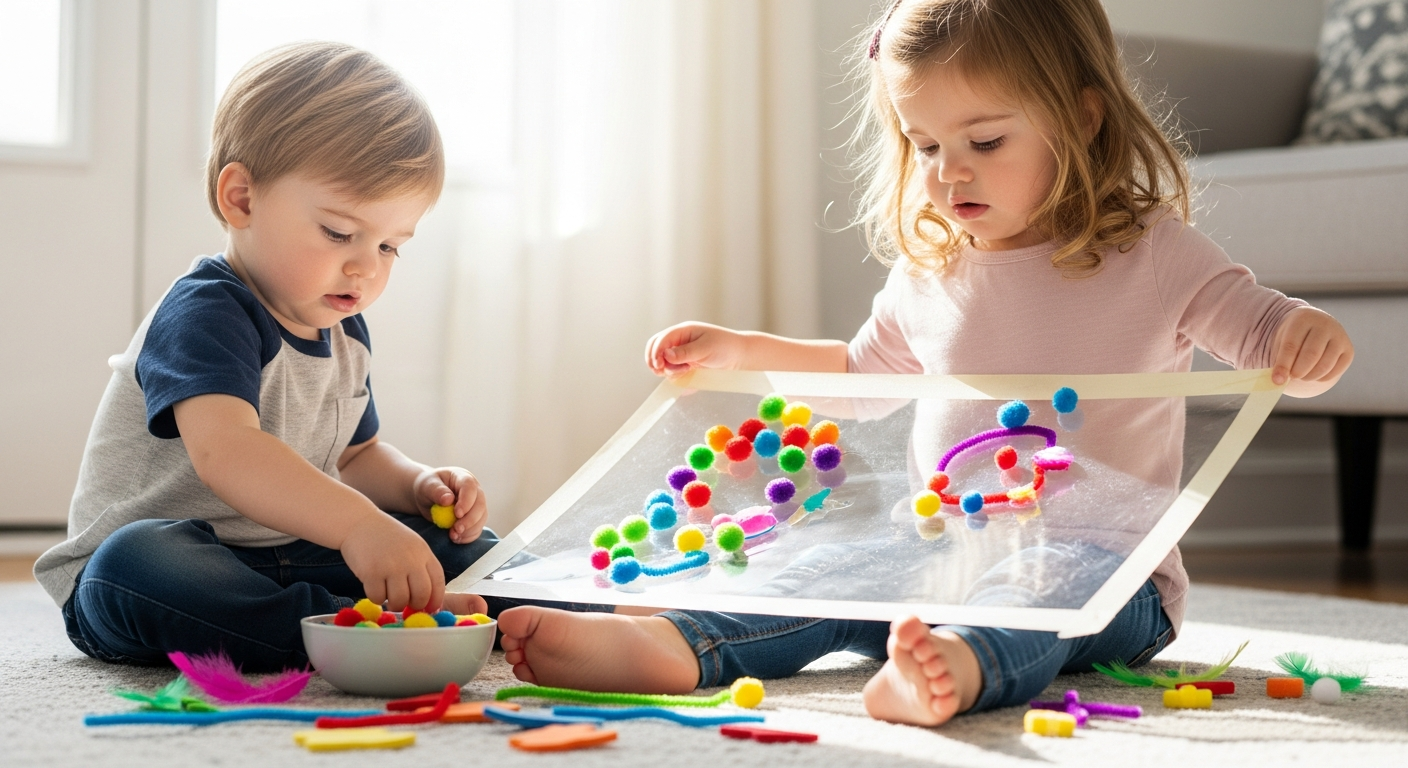
Table of Contents
- Introduction
- Why Contact Paper is the "Magic Tool" for Toddler Development
- Setting Up Your Sticky Workspace: Tips and Tricks
- 7 Fun Contact Paper Toddler Activity Ideas to Try Today
- Beyond the Wall: Bridging Physical Play and Smart Screen Time
- The Value of Investing in Your Child’s Journey
- The Science Behind Play: Why Video Modeling and Tactile Exploration Work Together
- Choosing the Right Path: Our Commitment to Your Child’s Journey
- Frequently Asked Questions
- Conclusion
Introduction
Have you ever noticed how a simple piece of tape can keep a toddler occupied for twenty minutes? There is something inherently fascinating to a child about the "sticky" sensation. As parents, we often find ourselves caught between wanting to encourage messy, creative play and the reality of cleaning up glitter, glue, and paint from the living room rug. What if there was a tool that offered all the sensory benefits of a collage without the sticky residue on your furniture? Enter contact paper: the unsung hero of the toddler activity world.
At Speech Blubs, we believe that every moment is an opportunity for a child to find their voice. Our mission is to empower children to speak their minds and hearts, a goal born from our founders’ own childhood experiences with speech challenges. We know that language development doesn't just happen in a vacuum; it happens when children are engaged, curious, and having fun. By combining tactile experiences like a contact paper toddler activity with our unique "smart screen time" approach, you can create a powerful environment for growth.

In this post, we will explore why contact paper is a must-have in your parenting toolkit, provide seven detailed activity ideas that support fine and gross motor skills, and explain how these physical games perfectly complement the video modeling methodology we use in the Speech Blubs app. Our goal is to provide you with realistic, joyful ways to foster communication and confidence in your little one.
Why Contact Paper is the "Magic Tool" for Toddler Development
Before we dive into the activities, it’s important to understand why contact paper—traditionally used as a shelf liner—is such a powerhouse for child development. For a toddler, the world is a giant laboratory. Contact paper provides a unique "low-stakes" adhesive surface. Unlike glue, which is permanent once it dries and can be frustratingly messy, contact paper allows for trial and error. A child can stick a pom-pom down, peel it off, and move it elsewhere. This freedom to experiment is key to building creative confidence.
From a speech and language perspective, these activities are "language-rich" environments. When your child interacts with a sticky surface, they are naturally exposed to a variety of descriptive words: sticky, smooth, bumpy, clear, pull, push, stuck, and oops! These are foundational vocabulary words that help children describe their physical sensations.
Furthermore, many contact paper activities are "vertical" in nature when taped to a wall or window. Working on a vertical surface is excellent for developing core strength and shoulder stability, which are surprisingly linked to the fine motor control needed for writing and even the complex muscle movements involved in speech. By pairing these physical movements with the peer-led video modeling found in our app, you are supporting your child’s development from multiple angles.
Setting Up Your Sticky Workspace: Tips and Tricks
The beauty of contact paper is its simplicity, but a few "pro tips" can make the experience much smoother for you and more engaging for your child.

- Secure the Perimeter: When you peel the backing off contact paper, it has a natural tendency to curl. Always use painter’s tape or duct tape to secure the corners and edges to your surface—whether that’s the floor, a table, or a window.
- Sticky Side Out: This sounds obvious, but in the heat of a toddler-induced whirlwind, it’s easy to get backwards! Ensure the adhesive side is facing your child.
- The "Invitation to Play": Instead of just handing your child a roll of paper, set up an "invitation." Tape the paper to the wall and place a small basket of colorful items (scraps of paper, ribbons, or foam shapes) nearby. This encourages independent exploration.
- Manage Expectations: Remember, the goal isn't a museum-quality piece of art. The goal is the process. If your child just wants to stick their hand on the paper and pull it off repeatedly, they are still learning about cause and effect and sensory input!
If you're ever unsure where your child stands in their developmental journey, we recommend taking a moment to check their progress. You can take our quick 3-minute preliminary screener to get a simple assessment and a personalized next-steps plan. It consists of 9 simple questions and is a great way to see how activities like these can support your child's specific needs.
7 Fun Contact Paper Toddler Activity Ideas to Try Today
1. The Sticky Sidewalk: Gross Motor Magic
This is perhaps the simplest way to introduce your child to the world of contact paper. It’s perfect for younger toddlers who are still mastering the art of walking and balance.
- How to do it: Tape a long strip of clear contact paper (sticky side up) to a hard floor. Make sure the ends are securely taped down so the paper doesn't lift with your child's feet.
- The Activity: Invite your toddler to walk across the "sidewalk." They will love the shhhkk sound their feet or socks make as they lift them off the adhesive.
- Language Boost: Use this time to practice action verbs. "Lift your foot!" "Stuck!" "Walk, walk, walk." If your child is using the Speech Blubs app, this is a great time to transition to the "Early Sounds" section, where they can practice the repetitive sounds associated with movement.
2. Nature’s Suncatcher: Connecting with the Outdoors
Combining a nature walk with a contact paper toddler activity is a fantastic way to build vocabulary related to the environment.
- How to do it: Go for a short walk and collect flat items—leaves, petals, small blades of grass, or even thin flat stones.
- The Activity: Tape a square of contact paper to a sunny window. Let your child press their "treasures" onto the sticky surface. Once they are finished, you can place another sheet of contact paper over the top to "laminate" it, creating a permanent suncatcher.
- Speech Connection: As you walk and stick, name the items. "Green leaf," "Yellow flower," "Soft petal." This mirrors the vocabulary building we emphasize in our app's "Living Things" section.
3. The "Animal Kingdom" Collage: Building Vocabulary
For a child who is a "late talker" but loves animals, this activity is a game-changer. It turns a standard vocabulary lesson into a tactile, interactive experience.
- How to do it: Print out or cut out pictures of different animals from old magazines.
- The Activity: Tape a large sheet of contact paper to a wall at your child’s eye level. As your child sticks the "cow" to the wall, encourage them to make the "moo" sound.
- Speech Blubs Integration: This activity works perfectly alongside our "Animal Kingdom" section. In the app, your child will see a peer—not an adult—making animal sounds. This "video modeling" is at the heart of our scientific research and methodology. When they see a child like them saying "baa," they are much more likely to imitate it. After playing with the app, let them "stick" the animals they just saw onto their wall collage.
4. Color Sorting Station: Cognition and Labeling
Sorting is a key cognitive milestone. Using contact paper adds a layer of fine motor challenge to the task.
- How to do it: Use a permanent marker to draw three or four large colored circles (red, blue, green, yellow) on the non-sticky side of the contact paper before you peel the backing. Tape it to a table.
- The Activity: Provide a bowl of mixed colored items—pom-poms, scraps of construction paper, or buttons. Ask your child to stick the red items in the red circle.
- Language Boost: Focus on color labels and the concept of "same" and "different." "Is this the same as the red circle? Yes! Stick it on!" To see how other parents have used these types of interactive learning moments, you can read our testimonials and success stories.
5. "Build a Face" Mirror Play: Emotional Intelligence
Understanding facial expressions and parts of the face is vital for social-emotional development and speech.
- How to do it: Cut out various shapes for eyes, noses, and mouths from felt or foam.
- The Activity: Tape the contact paper over a child-safe mirror. Your child can see their own face while "building" a new one on the sticky paper.
- Speech Connection: Practice labeling body parts. "Where is the nose? Put the nose on the paper!" You can also talk about emotions: "Let's make a happy face!" This complements our "Face Elements" and "Emotions" sections in the app, where children learn the names of features and how to express feelings.
6. The Vertical Sticky Wall: Strengthening Little Shoulders
Sometimes the best activity is one that is completely open-ended. A giant "sticky wall" can stay up for a week, with new items added daily.
- How to do it: Use a large piece of contact paper to cover a significant portion of a hallway wall.
- The Activity: Provide a "junk tray" of household items: bits of yarn, cupcake liners, feathers, and ribbons. Let your child add to the wall whenever they feel inspired.
- Developmental Tip: Working on a vertical surface forces the child to use their shoulder and elbow muscles, which provides the stability needed for the refined movements of the fingers and the mouth.
7. Texture Exploration Station: Sensory Input
Sensory processing is closely linked to a child’s ability to focus and communicate. This activity focuses purely on the "feel" of things.
- How to do it: Collect items with distinct textures—rough sandpaper, soft cotton balls, crinkly cellophane, and smooth ribbons.
- The Activity: Let your child explore how different textures feel on the sticky surface and on their fingertips.
- Language Boost: This is the perfect time for complex adjectives. "This is scratchy," "This is fluffy." Using these words during play helps solidify their meaning.
Beyond the Wall: Bridging Physical Play and Smart Screen Time
At Speech Blubs, we are often asked: "Isn't screen time bad for toddlers?" The answer depends entirely on the quality of that time. Most kids' content is passive—children sit and stare at cartoons that move too fast for their brains to process. We offer a "screen-free alternative" in the sense that our app is not a passive viewing experience; it is a tool for active participation and family connection.
We call it "smart screen time." Our app is designed to be used with a parent. While your child watches their peers on the screen, you are right there to mimic the sounds, cheer them on, and then transition that learning into the real world with a contact paper toddler activity. It’s about creating a joyful cycle of learning.
Our founders created the tool they wished they had when they were struggling with speech problems. They knew that traditional therapy can sometimes feel like work, but play always feels like... well, play! By blending scientific principles like mirror neurons and video modeling with the joy of discovery, we’ve created a space where the 1 in 4 children who need speech support can thrive.
The Value of Investing in Your Child’s Journey
We want to be transparent about how you can access the full suite of Speech Blubs tools. We believe in providing an immediate, effective solution that fits into your family's life.
To get started, we offer two main plans:
- Monthly Plan: For $14.99 per month, you get full access to our speech-boosting activities.
- Yearly Plan: This is our best value option at $59.99 per year. When you break it down, that is only $4.99 per month—a savings of 66% compared to the monthly rate.
The Yearly Plan is more than just a lower price; it’s a comprehensive package designed for long-term success. When you choose the Yearly Plan, you also receive:
- A 7-day free trial to explore everything we have to offer.
- Access to the Reading Blubs app, which helps transition speech skills into early literacy.
- Early access to all our new updates and features.
- 24-hour support response time from our dedicated team.
Ready to get started? Create your account and begin your 7-day free trial today. Choosing the yearly path ensures your child has the consistent support they need to build confidence and communication skills at their own pace.
The Science Behind Play: Why Video Modeling and Tactile Exploration Work Together
You might wonder why we are so focused on both digital video modeling and physical activities like contact paper play. The secret lies in how a toddler's brain learns. Children are hardwired to imitate their peers. This is due to "mirror neurons"—cells in the brain that fire both when an individual acts and when the individual observes the same action performed by another.
When your child watches a peer in the Speech Blubs app make a "pop" sound with their lips, their brain is literally practicing that movement. When you then take that "pop" sound and apply it to popping a bubble on a contact paper "sticky wall," you are reinforcing that neural pathway through tactile, multi-sensory feedback.
This combination reduces frustration. A child who struggles to find the right mouth shape for a word might feel pressured in a formal setting. But when they are playing with a sticky sidewalk or a suncatcher, the pressure is off. They are in a state of "flow," which is the optimal state for learning new, complex communication skills.
Choosing the Right Path: Our Commitment to Your Child’s Journey
Every child’s path to communication is unique. Some children start talking early, while others need a little extra nudge. We are here to provide that nudge in the most joyful way possible. Whether your child is working on their first sounds, expanding their vocabulary, or building the confidence to speak in front of others, the combination of interactive play and evidence-based tools can make all the difference.
We don't promise that your child will be giving public speeches in a month. Development is a journey, not a race. What we do promise is a way to foster a love for communication, a method to reduce the frustration that often comes with speech delays, and a wealth of joyful family learning moments that you will treasure.
Frequently Asked Questions
1. Is contact paper safe for my toddler to play with? Yes, contact paper is generally safe for supervised play. However, because it is an adhesive, you should always supervise your child to ensure they don’t try to eat the paper or any of the small items (like sequins or pom-poms) you might be using with it. If your child is still in the "everything goes in the mouth" phase, stick to larger items like big fabric scraps or large construction paper shapes.
2. How long can I leave a contact paper activity on my wall? Painter's tape is usually safe for walls for several days, but if left for weeks, it might leave a residue or pull some paint. We recommend checking the tape every few days. The contact paper itself isn't usually the issue—it's the tape holding it up!
3. What if my child isn't interested in the sticky surface? Every child has different sensory preferences. Some children find the sticky sensation "too much" at first. If your child seems hesitant, try "detackifying" the paper slightly by tapping it with a clean cloth, or start by having them use a tool (like a popsicle stick) to move items onto the paper rather than using their bare hands.
4. Can Speech Blubs replace professional speech therapy? Speech Blubs is a powerful supplement to a child’s overall development plan and can be a wonderful tool to use alongside professional therapy. It provides a way to practice skills at home in a fun, low-pressure environment. However, it is not a replacement for a clinical diagnosis or treatment from a certified Speech-Language Pathologist (SLP) if your child has a specific medical need.
Conclusion
The journey of a thousand words begins with a single, sticky step. A simple contact paper toddler activity might seem like just a way to pass a rainy afternoon, but it is actually a foundational building block for fine motor skills, cognitive development, and language expansion. By embracing these moments of messy, joyful play, you are telling your child that their exploration of the world is valuable.
At Speech Blubs, we are honored to be a part of your family's story. We invite you to join our community of parents who are trading passive screen time for "smart screen time" that actually gets kids talking. Remember, our Yearly Plan offers the best value, including the 7-day free trial, the Reading Blubs app, and the consistent support your child deserves.
Take the first step today. Download Speech Blubs on the App Store or Google Play to begin your journey. Let’s work together to help your child speak their mind and heart, one sticky pom-pom and one "smart" video at a time.
Sobre el autor