
Autism Speech Delay 4-Year-Old: Signs & Support
 Por Speech Blubs Team•23 mar 2026•15 min.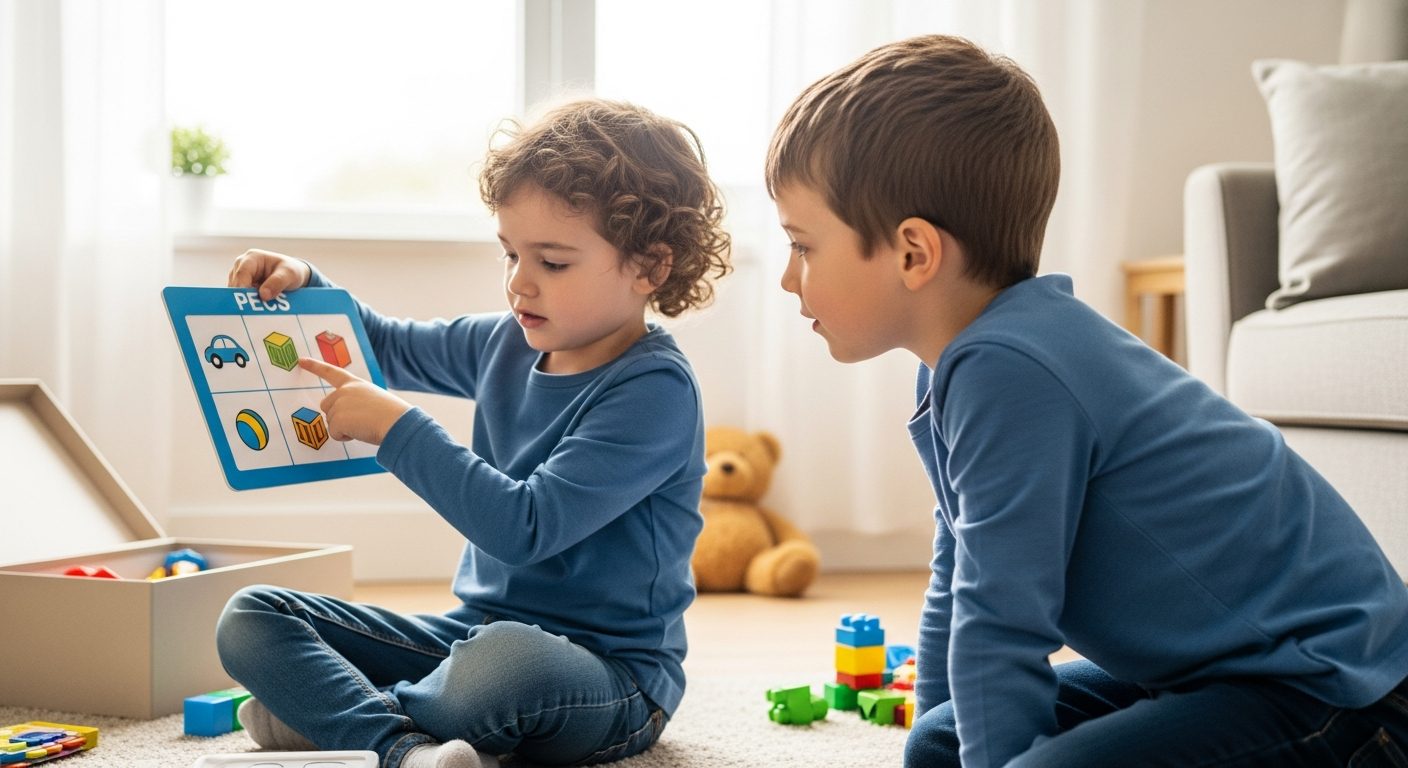
Table of Contents
- Introduction
- Understanding Autism in the Preschool Years
- Signs of Autism in a 4-Year-Old
- Typical Development vs. Autism in 4-Year-Olds
- Communication Red Flags to Watch For
- The Science of Video Modeling
- Sensory Sensitivities in 4-Year-Olds
- Social Interaction and Play
- Emotional Regulation and "Behavior"
- Physical and Motor Development
- Unlocking the Best Value for Your Family
- How to Support Your 4-Year-Old at Home
- The Importance of Early Intervention
- Setting Realistic Expectations
- FAQ: Frequently Asked Questions
- Conclusion
Introduction
Have you ever sat on the living room floor, watching your four-year-old play with their favorite blocks, and felt a quiet tug of worry because the chatter you expected hasn't quite started yet? Perhaps they are perfectly content lining up those blocks in a precise, colorful row for the hundredth time, but they don't look up when you call their name. If you are navigating the complexities of an autism speech delay 4-year-old, please know that you are not alone. In fact, nearly one in four children needs some form of speech support during their early development.
At Speech Blubs, we understand this journey intimately because our founders grew up with speech challenges themselves. We are here to provide an empathetic, expert perspective on what an autism-related speech delay looks like at age four and, more importantly, how you can support your child’s unique voice. In this article, we will explore the specific signs of autism in preschoolers, the difference between typical delays and those on the spectrum, and practical strategies to foster communication. Our mission is to empower every child to speak their minds and hearts, turning "screen time" into a joyful, productive bridge to the real world.

Understanding Autism in the Preschool Years
Autism Spectrum Disorder (ASD) is a neurodevelopmental condition that shapes how a child perceives and interacts with the world. By the time a child reaches age four, the social and communicative expectations of the world increase. They might be starting preschool, attending birthday parties, or joining playgroups. This is often the stage where the gap between a child’s development and that of their peers becomes more visible to parents and educators.
It is important to remember that autism is a spectrum. This means that two children with the same diagnosis can have vastly different strengths and challenges. One 4-year-old might be non-verbal but highly skilled at complex puzzles, while another might speak in long, scripted sentences from their favorite movie but struggle to ask for a glass of water. Our goal at Speech Blubs is to meet every child exactly where they are, providing "smart screen time" that encourages them to move, mimic, and eventually, communicate with confidence.
Signs of Autism in a 4-Year-Old
Spotting the signs of an autism speech delay 4-year-old involves looking at the "whole child" rather than just a checklist of words. While a lack of speech is often the most prominent concern, autism affects social interaction, behavior, and sensory processing as well.
Common Behavioral Patterns
- Limited Verbal Communication: A child may use very few words, or they might have lost language skills they once possessed (regression).
- Minimal Eye Contact: They may avoid looking at faces or find eye contact uncomfortable, even when they are listening.
- Repetitive Behaviors: This can include "stimming" (self-stimulatory behavior) like hand-flapping, spinning in circles, or rocking back and forth.
- Rigid Routines: A 4-year-old might become extremely distressed if their blue cup is in the dishwasher or if you take a different route to the park.
- Unique Play Styles: Instead of "feeding" a doll or "driving" a car, they might focus on spinning the wheels of the car for long periods or lining up toys by size and color.
If you are noticing these patterns and feel unsure about the next steps, we recommend taking our quick 3-minute preliminary screener. It consists of 9 simple questions and provides an assessment and a next-steps plan to give you clarity and peace of mind.

Typical Development vs. Autism in 4-Year-Olds
It is natural to compare your child’s progress to their peers. At age four, most typically developing children are becoming "social butterflies." They ask "why" constantly, tell tall tales, and are beginning to understand the feelings of others. However, for a child with an autism speech delay 4-year-old, these milestones may look different.
Typical Development at Age 4Possible Signs of Autism
Initiates play with other children.
Prefers to play alone or observes from a distance.
Uses sentences of 4-5 words.
May be non-verbal or use "scripted" speech.
Follows two-step commands (e.g., "Get your shoes and wait by the door").
May appear to ignore directions or get overwhelmed.
Engages in imaginative pretend play.
Focuses on the physical properties of toys (texture, movement).
Responds consistently to their name.
Often does not respond when called, appearing "deaf" at times.
The key difference often lies in the intent to communicate. A child with a typical speech delay usually tries very hard to get their point across using gestures, tugging on your hand, or pointing. A child with an autism-related delay may not yet realize that they can use another person as a tool to get what they need or share a moment of joy.
Communication Red Flags to Watch For
When we look specifically at an autism speech delay 4-year-old, certain "red flags" in communication stand out. These aren't just about the number of words in a child's vocabulary, but how they use (or don't use) those words to connect.
Echolalia and Scripted Speech
Many children on the spectrum use echolalia, which is the repetition of words or phrases they have heard elsewhere. For example, if you ask, "Do you want juice?" the child might simply repeat "Do you want juice?" instead of saying "Yes." They might also recite entire scenes from movies or YouTube videos. While this can seem like "meaningless" talk, it is often a child’s way of practicing sounds or attempting to connect.
Flat or Robotic Prosody
Prosody refers to the rhythm and melody of speech. Some 4-year-olds with autism may speak in a monotone or "robotic" voice. Others might use an unusually high pitch or a sing-song rhythm that doesn't quite match the context of the conversation.
Lack of Joint Attention
Joint attention is the "golden key" of early communication. It’s when a child points at a bird in the sky and then looks at you to make sure you see it too. This shared experience is the foundation of language. A child with an autism speech delay often lacks this drive to share interests with others.
The Science of Video Modeling
At Speech Blubs, we use a unique, scientifically-backed methodology called video modeling. We know that children, especially those on the autism spectrum, are often visual learners. Our app features videos of other children performing speech exercises, making sounds, and saying words.
Why does this work? Research suggests that children are more likely to imitate their peers than adults. This activates "mirror neurons" in the brain, which are responsible for learning through observation. By watching a "peer model" blow bubbles or say "Lion," your child feels a natural, joyful urge to mimic that behavior. Our approach is backed by science, and you can read more about the research behind our method to see why we are considered a leader in the field.
"Our method blends scientific principles with play to create a one-of-a-kind 'smart screen time' experience that moves kids from passive viewing to active participation."
Sensory Sensitivities in 4-Year-Olds
Many children with an autism speech delay also struggle with sensory processing. The world can be a very loud, bright, and "itchy" place for them. A 4-year-old might have a meltdown at the sound of a vacuum cleaner or refuse to eat foods with certain textures.
These sensory issues are directly tied to speech. If a child is constantly overwhelmed by the tags on their shirt or the humming of the refrigerator, they don't have the "mental bandwidth" left to focus on learning new words. We advocate for creating a "sensory-friendly" environment where your child feels safe.
In our app, we provide a calm, engaging environment that avoids the over-stimulating "flash and bang" of typical cartoons. This allows a child to focus on the human face and the sounds of speech without being overwhelmed. You can see how this has helped other families by reading our parent testimonials.
Social Interaction and Play
For a 4-year-old, play is their "work." It is how they learn about social rules like turn-taking and empathy. However, social interaction can be incredibly confusing for a child with autism. They may not understand non-verbal cues like a frown or a wave.
Practical Scenario: Using "Animal Kingdom"
Imagine a 4-year-old named Leo who loves animals but rarely speaks. He often sits alone, spinning the wheels of his toy tractor. His mom introduces the "Animal Kingdom" section of Speech Blubs. Leo sees a young girl on the screen making a "Moo" sound while wearing a digital cow mask. The joy on the peer's face is infectious. Leo smiles and, for the first time that day, attempts a "Moo." This isn't just a sound; it’s a breakthrough in imitation and social engagement. By using our fun digital filters, kids like Leo feel like they are part of the play, rather than just watching it.
Ready to see your child make these connections? Download Speech Blubs on the App Store or Google Play to begin.
Emotional Regulation and "Behavior"
It is common for parents of a 4-year-old with an autism speech delay to deal with frequent meltdowns. It is vital to understand that these meltdowns are almost always a form of communication. When a child cannot say, "I am tired," or "The lights are too bright," they express that frustration through their behavior.
By building foundational communication skills, we help reduce this frustration. When a child gains the ability to use even a few signs or words to express their needs, their world opens up, and their stress levels drop. We focus on building confidence and a love for communication, rather than just "compliance."
Physical and Motor Development
While we often focus on the "speech" part of an autism speech delay 4-year-old, motor skills are also involved. Speech is a complex motor task that requires the coordination of the lips, tongue, jaw, and breath. Some children on the spectrum also show delays in gross motor skills (like jumping or climbing) or fine motor skills (like holding a crayon).
Activities that encourage "whole body" movement can actually support speech. This is why we encourage parents to engage in co-play. When you use Speech Blubs together, you can mimic the facial expressions and the physical movements shown in the app, turning it into a bonding experience that supports your child's overall development.
Unlocking the Best Value for Your Family
We believe that every child deserves access to high-quality speech support. While we are a powerful supplement to professional therapy, we also provide an affordable, immediate solution you can use at home every day. We want to be transparent about our pricing so you can choose the path that best fits your family’s needs.
We offer two main plans:
- Monthly Plan: $14.99 per month.
- Yearly Plan: $59.99 per year.
The Yearly Plan is the clear best choice for families committed to their child’s progress. Not only do you save 66% (bringing the cost down to just $4.99/month), but you also unlock exclusive features:
- 7-Day Free Trial: Try everything before you commit.
- Reading Blubs: A separate, high-value app included for free to help with literacy.
- Early Access: Be the first to try new updates and features.
- Priority Support: A 24-hour response time from our dedicated support team.
The Monthly plan does not include the free trial or the Reading Blubs app. To get the full suite of tools designed to help your child "speak their mind and heart," we highly recommend the Yearly option. You can create your account and start your 7-day free trial here.
How to Support Your 4-Year-Old at Home
Supporting a child with an autism speech delay 4-year-old doesn't require a classroom full of expensive equipment. It requires patience, presence, and a few "smart" strategies.
1. Follow Their Lead
If your child is obsessed with trains, talk about trains! Use their natural interests as a bridge to communication. In the Speech Blubs app, you'll find categories ranging from "Toy Box" to "Dino Powers," ensuring there is always something that matches your child's current fixation.
2. Narrate Your Day
Become a "sports caster" for your child’s life. "Mommy is pouring the milk. Cold milk! Mmm." Even if they don't respond, they are soaking up the vocabulary and the rhythm of your language.
3. Use Visual Aids
Since many 4-year-olds with autism are visual thinkers, use pictures, signs, and video modeling to help them understand what is coming next. This reduces anxiety and makes the world feel more predictable.
4. Create "Communication Temptations"
Place a favorite toy in a clear container that they can't open. This "tempts" them to come to you for help, creating a natural opportunity for a gesture, a sound, or a word.
The Importance of Early Intervention
The phrase "wait and see" is common, but when it comes to an autism speech delay 4-year-old, the science is clear: early intervention is key. A child’s brain is incredibly plastic at age four, meaning it is primed for learning and making new connections.
By providing support now, you are helping your child develop the foundational skills they will need for kindergarten and beyond. This isn't about "fixing" your child—it’s about giving them the tools they need to navigate a world that isn't always built for them. We are proud to be a part of that toolkit for thousands of families worldwide.
Setting Realistic Expectations
We want to be honest: Speech development is a marathon, not a sprint. While we have seen incredible "aha!" moments from our users, we don't promise that your child will be giving public speeches in a month. Every child’s timeline is unique.
What we do promise is a tool that makes the process joyful. We focus on building the "building blocks" of communication:
- Improving imitation skills.
- Increasing the variety of sounds.
- Building confidence in social interaction.
- Reducing the frustration that leads to meltdowns.
Think of Speech Blubs as a powerful supplement to your child’s overall development plan. Whether you are working with a professional Speech-Language Pathologist (SLP) or are just beginning your journey, our app provides a consistent, fun way to practice every single day.
FAQ: Frequently Asked Questions
1. Is an autism speech delay 4-year-old different from a regular speech delay?
Yes. While both involve a delay in reaching verbal milestones, an autism-related delay is usually accompanied by challenges in social interaction (like eye contact) and repetitive behaviors. A child with a "typical" delay usually has a strong desire to communicate through gestures, whereas a child with autism may not yet seek out social connection in the same way.
2. Can Speech Blubs replace traditional speech therapy?
We view Speech Blubs as a powerful supplement to professional therapy. It provides a way for kids to practice the skills they learn in therapy in a fun, low-pressure environment at home. Always consult with a professional for a formal diagnosis and a comprehensive treatment plan.
3. My child is non-verbal; is it too late to start?
It is never too late! Many 4-year-olds on the spectrum are "late talkers" and go on to develop robust communication skills. Our video modeling approach is specifically designed to engage children who aren't yet using words by focusing on imitation and basic sounds first.
4. Why is the Yearly plan better than the Monthly plan?
The Yearly plan is designed for long-term success. It is 66% cheaper than the monthly rate and includes a 7-day free trial, the Reading Blubs app, and priority support. Since speech development takes time and consistency, the Yearly plan provides the best value and the most comprehensive set of tools for your child’s journey.
Conclusion
Navigating an autism speech delay 4-year-old can feel like wandering through a maze without a map. But remember, your child’s voice is there—it just might be waiting for the right spark to let it out. By focusing on joyful imitation, sensory-friendly environments, and peer-led learning, you are building a bridge toward a more connected future.
At Speech Blubs, we are honored to walk this path with you. Our founders’ own experiences remind us every day why this work matters. We want to help your child not just talk, but truly connect with the people they love.
Don't wait for another milestone to pass. Start your journey today with the best possible support. We encourage you to choose the Yearly plan to take advantage of the 7-day free trial and the Reading Blubs app. Let’s work together to help your child speak their mind and heart.
Ready to get started? Create your account and begin your 7-day free trial today or download the app on the App Store or Google Play.
Sobre el autor