
Busy Toddler Travel Activities: Tips for Stress-Free Trips
 Por Speech Blubs Team•18 mar 2026•14 min.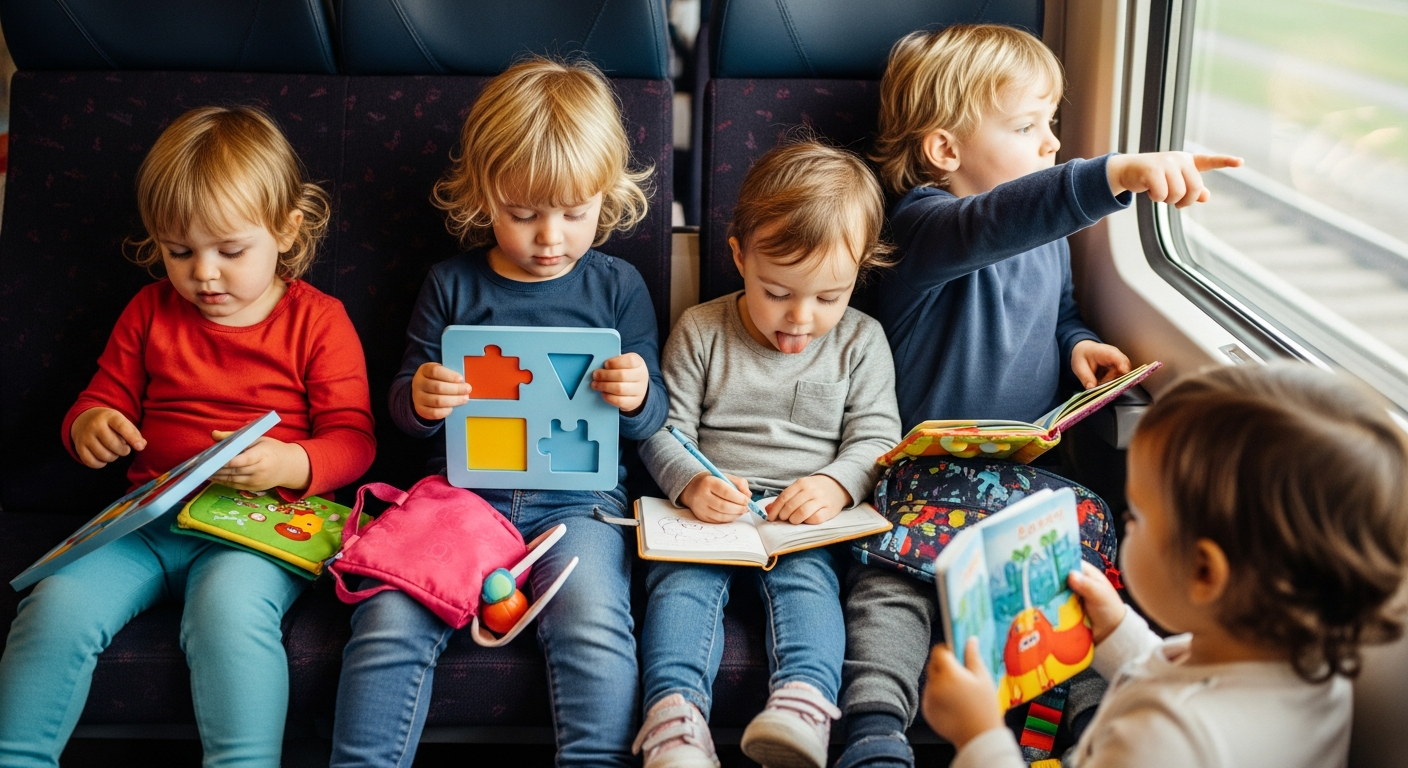
Table of Contents
- Introduction
- The Mindset of Success: Travel Parenting vs. Home Parenting
- Engaging the Senses: Tactile and Fidget Activities
- Smart Screen Time: The Speech Blubs Difference
- Creative Arts and Crafts (Without the Mess)
- Verbal Games and Vocabulary Building
- Pre-Travel Preparation: Building Background Knowledge
- The Logistics of Travel Toys: How to Pack
- Managing the "Wiggles": Incorporating Movement
- Realistic Expectations and the Power of Play
- Choosing the Right Plan for Your Family
- Conclusion
- Frequently Asked Questions
Introduction
Have you ever found yourself trapped in a "metal tube" at 30,000 feet, or buckled into the driver’s seat for hour six of a cross-country trek, while a tiny human behind you begins the slow, rhythmic kick of your seat? If so, you know the unique mixture of adrenaline and desperation that defines traveling with a toddler. It is a situation that can test even the most patient caregiver. However, at Speech Blubs, we believe that these moments of transition don’t have to be purely about survival. In fact, with the right strategy, travel can become a powerful window for connection, confidence-building, and language development.
Our mission is to empower every child to "speak their minds and hearts." This goal is deeply personal to us; our founders grew up navigating their own speech challenges and created the very tool they wished they had as children. We know that 1 in 4 children will face a speech or language delay, and for these families, travel can feel particularly daunting. How do you keep a "late talker" engaged? How do you encourage communication when routines are upended?

In this post, we will explore a comprehensive range of busy toddler travel activities designed to keep little hands occupied and little minds growing. We will cover everything from tactile sensory toys to "smart screen time" strategies that leverage our unique video modeling methodology. By the end of this article, you will have a robust toolkit to transform your next family adventure from a stressful chore into a joyful learning experience.
The Mindset of Success: Travel Parenting vs. Home Parenting
Before we dive into the specific toys and tools, it is essential to adjust our expectations. At home, you likely have a rhythm—strict nap times, limited treats, and structured play. On the road, we advocate for "Travel Parenting." This doesn’t mean throwing your values out the window; it means being flexible enough to keep the peace while still fostering growth.
On a travel day, the goal is to reduce frustration. High frustration levels often lead to communication breakdowns. When a child is overwhelmed, they are less likely to practice new words or sounds. By using high-engagement activities, we keep their "cognitive load" manageable.
We also encourage parents to view screen time differently during travel. While passive viewing of loud, fast-paced cartoons can sometimes lead to overstimulation and "zombie-like" behavior, there is a better way. We provide a "smart screen time" experience that acts as a powerful supplement to a child’s development. Instead of just watching, children are invited to participate, imitate, and interact.
Engaging the Senses: Tactile and Fidget Activities
Toddlers are sensory-driven creatures. Their brains are hardwired to learn through touch and manipulation. When they are confined to a car seat or a plane chair, they lose their primary way of exploring the world: movement. To compensate, we need to provide "fidget" activities that engage their fine motor skills.
1. The Magic of Fidget Worms and Tangles
Simple, silent, and endlessly manipulatable, toys like fidget worms or Tangles are travel gold. These items allow children to twist, bend, and pull without making a sound. For a child who is easily overstimulated by noise, these silent sensory tools are a lifesaver. They keep the hands busy, which often helps the brain focus on language.

2. Sensory Robots and Window Clings
If you are traveling by plane or train, the window is your best friend. Gel window clings or small suction-cup robots can be stuck and re-stuck dozens of times. This activity promotes "environmental print" awareness and spatial reasoning. You can narrate the play: "The blue robot is up high! Now he is down low." This simple narration builds prepositional vocabulary in a natural, low-stress way.
3. Magnetic Tiles and "MagMen"
While full-sized magnetic tiles might be too bulky for a carry-on, mini magnetic tiles or "MagMen" are perfect. They store flat and offer infinite building possibilities. If your child is working on specific speech sounds, you can even incorporate them into the build. "Let’s build a house for the horse!"
Smart Screen Time: The Speech Blubs Difference
When the physical toys have lost their luster, many parents turn to tablets. This is where Speech Blubs becomes your most valuable travel companion. Unlike passive entertainment, our app is built on the scientific principle of video modeling.
The Power of Video Modeling
Research shows that children learn best by watching their peers. Our scientific research highlights how "mirror neurons" in the brain fire when a child watches another child perform an action or make a sound. In the app, children see "peer models"—real kids, not cartoons—demonstrating facial movements, word formations, and social cues.
Practical Scenario: The Animal Kingdom
Imagine you are stuck in a long security line. Your 3-year-old, who loves dogs but is still struggling to vocalize "D" sounds, is starting to get restless. You open the "Animal Kingdom" section of the app. Your child sees another child on the screen wearing a digital puppy filter, happily saying "Woof! Woof!" and "Dog."
Because the model is a peer, your child is naturally motivated to imitate. They aren't just staring; they are practicing mouth shapes and vocalizations. This is a "joyful solution" that turns a boring wait into a mini-therapy session. This approach has earned us high ratings on the MARS scale, placing us among the top tier of educational apps worldwide.
To see how this has worked for thousands of other families, you can read our parent testimonials. If you are unsure where to start, we recommend taking our 3-minute preliminary screener. It consists of 9 simple questions and provides you with a personalized assessment and next-steps plan.
Creative Arts and Crafts (Without the Mess)
Art is a fantastic way to pass the time, but traditional markers and glitter are a nightmare in a rental car or an airplane. We need mess-free alternatives that still allow for creative expression.
1. LCD Doodle Boards
These monochrome writing tablets are lightweight and allow for endless drawing without a single scrap of paper. You can play games like "Pictionary" with your toddler. Draw a simple circle and ask, "What is this?" If they say "Ball," you've just created a functional communication moment.
2. Water-Based Coloring Books
The "Water Wow!" style of books is a classic for a reason. Using a refillable water pen, the colors appear on the page and then disappear as they dry. These are excellent for practicing "turn-taking." You color one part, then hand the pen to your child. This foundational social skill is a precursor to conversational turn-taking.
3. Sticker Stories
Dot stickers or puffy stickers are incredible for fine motor development. Instead of just sticking them randomly, try creating a story. "The red dot is a car. Where is it going? Is it going to the park?" This encourages narrative thinking and expands their "MLU" (Mean Length of Utterance).
Verbal Games and Vocabulary Building
Travel provides a constantly changing backdrop, which is a goldmine for vocabulary building. You don't need any supplies for these activities—just your voice and your child’s curiosity.
1. The "I Spy" Variation
For younger toddlers, traditional "I Spy" can be too difficult. Instead, try "I See Something..." Focus on colors or categories. "I see something blue." "I see something with wheels." This helps with categorization skills and keeps their eyes focused on the world outside the window.
2. Sound Scavenger Hunt
If your child is working on specific phonemes, turn it into a game. "On this highway, let’s look for things that start with the 'B' sound." (Bus, Billboard, Blue car, Bridge). This phonological awareness is the bedrock of reading and clear speech.
3. The "Why" Game
If you have a preschooler, you are likely already playing this, whether you want to or not! Embrace the "why." Use travel to explain how things work. Why is the plane in the sky? Why do we have to wear seatbelts? This builds complex language structures and logical reasoning.
Pre-Travel Preparation: Building Background Knowledge
One of the most effective ways to reduce travel anxiety in toddlers is to build "background knowledge" before you leave. Children feel more confident when they know what to expect.
- Watch Videos Together: Before a flight, watch a short, kid-friendly video about how an airport works.
- Read Books: Visit the library and find books about the destination. If you are going to the beach, find books about sand, shells, and waves.
- Role Play: Use your child’s stuffed animals to "act out" the travel day. The bear has to wait in line. The elephant has to sit still in his seat.
This preparation gives kids "buy-in." They aren't just being dragged along; they are part of an adventure they understand. During these prep sessions, keep an eye on how your child is communicating. If you feel like they are lagging behind their peers, create your account and start using our tools to build those foundational skills early.
The Logistics of Travel Toys: How to Pack
Organization is the secret ingredient to a successful trip. If you dump twenty toys into a backpack, your child will likely dump them all out on the floor of the plane within five minutes, looking for one specific item.
The "Bags within Bags" Strategy
We recommend using clear zipper pouches or mesh bags to categorize activities.
- The "Art Bag": LCD board, water-wow pen, stickers.
- The "Fidget Bag": Tangles, fidget worms, MagMen.
- The "Animal Bag": A few small plastic animals for imaginary play.
By presenting only one bag at a time, you keep the "novelty" alive. When the child gets bored with the animals, that bag goes away, and the art bag comes out. This staggered approach helps extend the lifespan of your activities and keeps the environment (and your stress levels) organized.
Managing the "Wiggles": Incorporating Movement
A "busy" toddler isn't just someone who is occupied; it's someone who needs to burn off physical energy. Long bouts of sitting are hard for everyone, but for a toddler, it can be physically painful.
The Playground Pitstop
If you are road-tripping, don't just stop for gas and fast food. Use apps to find local playgrounds along your route. Even fifteen minutes of climbing and sliding can reset a child’s mood for the next three hours of driving.
Terminal Exercises
In an airport, find an empty gate and let your child "march like a penguin" or "hop like a frog." This heavy muscle work (proprioceptive input) is incredibly grounding and can help prevent the "meltdown" that often occurs during boarding.
Realistic Expectations and the Power of Play
At Speech Blubs, we want to be very clear: we do not promise that your child will be giving public speeches after a month of using our app. We don't believe in "guaranteed outcomes" because every child is a unique individual with their own developmental timeline.
Instead, we focus on the benefits of the process. Our goal is to:
- Foster a genuine love for communication.
- Build the confidence to try new sounds and words.
- Reduce the frustration that comes from being misunderstood.
- Create joyful family learning moments, even in the middle of a hectic travel day.
Our app is a powerful supplement to your child's overall development plan. If your child is already seeing a professional speech therapist, Speech Blubs is the perfect "homework" tool to keep them practicing between sessions. Our use of adult co-play is essential; the app is most effective when you are there to cheer them on, repeat the words with them, and celebrate their progress.
Choosing the Right Plan for Your Family
We believe in being transparent and providing the best possible value for our community. We offer two main ways to join the Speech Blubs family, but one is the clear winner for families who are serious about their child's progress.
- Monthly Plan: For $14.99 per month, you get full access to the Speech Blubs app and its vast library of activities and video models.
- Yearly Plan: For $59.99 per year, you get the exact same content for a fraction of the price. This breaks down to just $4.99 per month—a 66% savings compared to the monthly rate.
The Yearly plan isn't just about the lower price; it includes exclusive features that help your child excel:
- A 7-Day Free Trial: You can explore everything we have to offer completely risk-free for a full week.
- The Reading Blubs App: As a Yearly subscriber, you get access to our companion app designed to bridge the gap between speech and literacy.
- Priority Support: You get early access to new updates and a guaranteed 24-hour response time from our support team.
The Monthly plan does not include the free trial, the Reading Blubs app, or priority support. For most families, the Yearly plan provides the comprehensive suite of tools needed to truly make a difference in their child's communication journey.
Conclusion
Traveling with a toddler doesn't have to be a gauntlet of stress and seat-kicking. By preparing with a mix of tactile busy toddler travel activities and high-quality, "smart screen time," you can turn those hours on the road into a productive and joyful experience. Remember to stay flexible, maintain a sense of humor, and focus on the small wins—like a new sound imitated or a few minutes of quiet, focused play.
At Speech Blubs, we are here to support you every step of the way. Whether you are dealing with a speech delay or simply want to give your child a head start in their communication skills, our peer-to-peer video modeling approach is designed to make learning fun and effective.
Ready to make your next trip a success? Download Speech Blubs on the App Store or Get it on Google Play to begin. To get the absolute best value—including the 7-day free trial, the Reading Blubs app, and early access to updates—be sure to select our Yearly plan. Your child has so much to say, and we can’t wait to help them find their voice.
Frequently Asked Questions
1. How long should screen time last during travel?
While we advocate for "smart screen time," balance is key. We suggest using Speech Blubs in short, 15-20 minute bursts followed by a tactile activity or a "wiggle break." This prevents overstimulation and keeps the learning fresh. During travel, you can be more flexible, but always aim for interactive use rather than passive staring.
2. What are the best mess-free art supplies for a plane?
LCD doodle boards, "Water Wow!" books, and puffy stickers are the gold standard. They require no cleanup, won't stain upholstery, and provide excellent fine motor engagement. Avoid anything with small parts that can roll under seats or liquids that can spill.
3. How can I support a late talker while on the go?
Focus on "parallel talk"—narrate what you are doing and what your child is doing without demanding a response. Use the Speech Blubs app to provide peer models for imitation. When your child makes an attempt at a sound or word, celebrate it enthusiastically to build their confidence.
4. Why choose the Yearly plan over the Monthly plan?
The Yearly plan is designed for maximum impact and value. At $59.99 per year ($4.99/month), you save 66% compared to the monthly rate. More importantly, it is the only plan that includes the 7-day free trial and the Reading Blubs app, providing a much more comprehensive developmental experience for your child.
Sobre el autor