
Can Screen Time Cause Speech Delay? What Parents Need to Know
 Por Speech Blubs Team•9 mar 2026•16 min.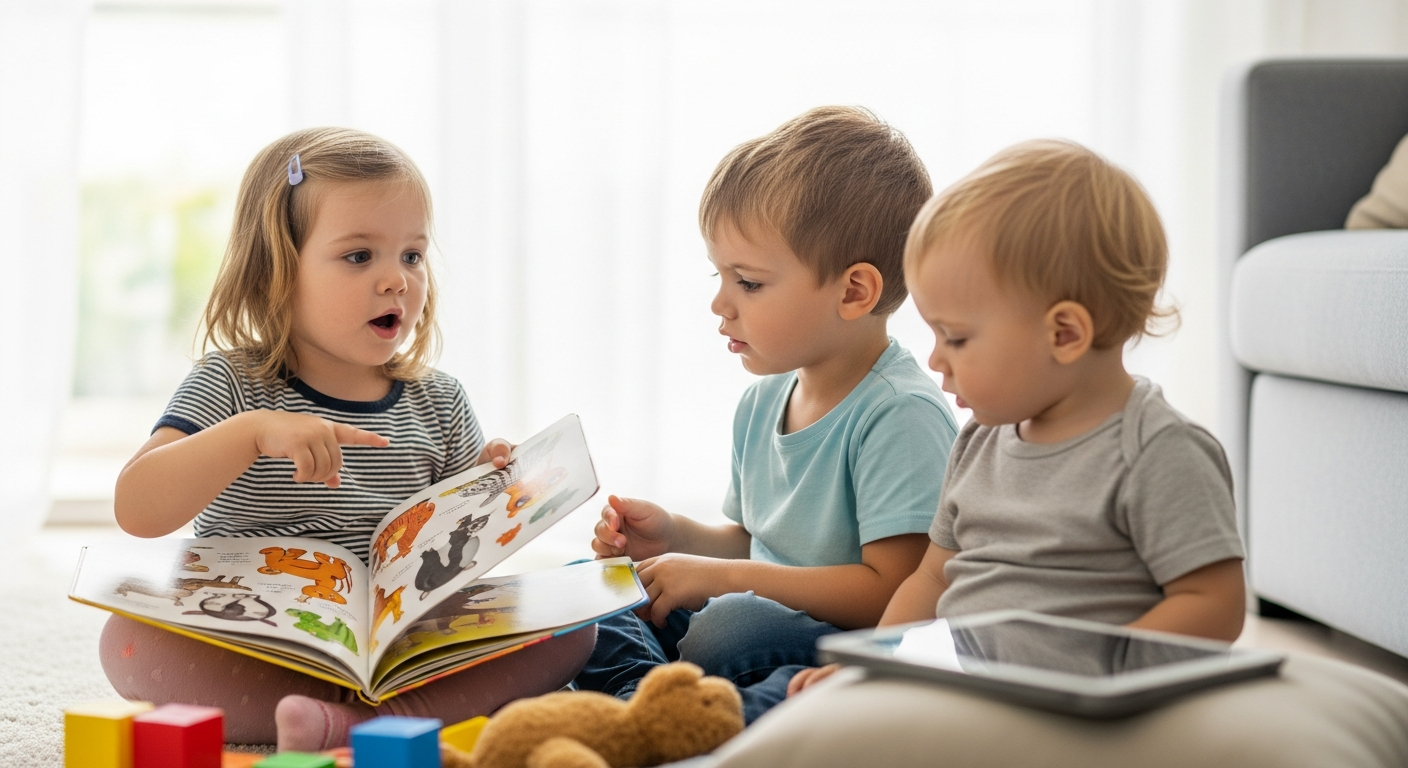
Table of Contents
- Introduction
- Understanding the Screen Time and Speech Delay Connection
- The Science of "Joint Attention" and Why It Matters
- Passive vs. Active Screen Time: Not All Minutes Are Equal
- The Impact of Background TV
- How to Manage a Healthy "Screen Diet"
- Practical Scenarios: Turning Challenges into Wins
- Why Speech Blubs is a "Smart Screen Time" Choice
- Building a Language-Rich Environment at Home
- When Should You Be Concerned?
- Transforming Your Perspective on Technology
- Frequently Asked Questions (FAQ)
- Conclusion
Introduction
Did you know that for every additional 30 minutes of daily screen time, a toddler’s risk of an expressive speech delay increases by nearly 49%? This statistic from recent pediatric research is enough to make any parent pause. If you have ever felt a pang of guilt while handing your phone to your child so you could finish making dinner or answer an urgent email, you are certainly not alone. We live in a world where digital devices are everywhere, and for many families, screens have become a standard part of the daily routine. However, as more children are being referred for speech and language services than ever before, the question on every parent’s mind is: can screen time cause speech delay?
At Speech Blubs, we understand this dilemma deeply. Our mission is to empower children to "speak their minds and hearts," a goal born from the personal experiences of our founders who grew up with speech challenges themselves. They created the tool they wished they’d had—a way to blend scientific principles with the joy of play. We believe that technology doesn't have to be the "enemy" of development; instead, it can be transformed into a "smart screen time" experience that fosters connection rather than isolation.

In this post, we are going to dive deep into the research surrounding screen time and language development. We will explore the difference between passive and active viewing, explain the science of how children actually learn to talk, and provide you with practical, realistic strategies to manage your home environment. Our goal is not to shame, but to provide an empathetic, expert roadmap for your child's communication journey. By the end of this article, you will understand how to turn the screen into a powerful supplement for your child’s growth rather than a distraction from it.
Understanding the Screen Time and Speech Delay Connection
The link between digital media and language development is a hot topic in the scientific community. To answer the core question—can screen time cause speech delay—we have to look at how a child’s brain develops in the first few years of life. Toddlers are like little sponges, soaking up every interaction, sound, and facial expression they encounter.
Research published in the Journal of the American Medical Association (JAMA) Pediatrics has shown a clear "dose-response" relationship. This means that the more screen time a one-year-old is exposed to, the more likely they are to experience developmental delays in communication and problem-solving by ages two through four. Specifically, children who watched up to two hours of daily screen time at age one were 61% more likely to have delays at age two. Those watching more than four hours were five times more likely to face these challenges.
But why does this happen? It isn't necessarily that the light from the screen is "damaging" the brain directly. Instead, it’s about what the screen is replacing. Every minute a child spends silently staring at a passive video is a minute they are not practicing "joint attention"—the act of sharing an experience with another person, like pointing at a bird or looking at a book together. These face-to-face interactions are the primary engine of language learning.

The Science of "Joint Attention" and Why It Matters
Language isn't just about hearing words; it’s about the social dance of communication. When you look into a baby’s eyes and make a "goo-goo-ga-ga" sound, and they try to mimic you, they are learning the mechanics of speech. They see how your lips move to create a "G" sound. They feel the rhythm of conversation. This is what experts call "joint attention."
Screens, particularly when used passively, often lack this back-and-forth. If a child is watching an "unboxing" video on YouTube where they only see a pair of hands opening a toy, they aren't seeing a full face. They aren't getting the social cues that tell them why we communicate. This is why the American Academy of Pediatrics (AAP) suggests avoiding all screens for children under 18 months, with the exception of video chatting with family, because video chatting still involves that vital human connection.
If you are worried that your child might be falling behind, you aren't alone. We offer a quick 3-minute preliminary screener consisting of 9 simple questions. It provides an immediate assessment and a next-steps plan to help you understand where your child stands and how you can support them.
Passive vs. Active Screen Time: Not All Minutes Are Equal
It is important to distinguish between "passive" and "active" screen time. Passive screen time is when a child sits alone, staring at a show that requires nothing from them. Programs that are fast-paced, loud, and constantly changing scenes can be overstimulating and don't allow the child time to process what they are seeing.
Active screen time, on the other hand, is interactive. It encourages the child to participate, think, and—most importantly—vocalize. This is where "smart screen time" comes in. Instead of a child being a passive observer, they become an active participant.
At Speech Blubs, we utilize a unique "video modeling" methodology. In our app, children watch videos of other children (their peers) making sounds and saying words. This is backed by the science of "mirror neurons"—specialized brain cells that fire both when we perform an action and when we see someone else perform that same action. When a toddler sees a peer on a screen making a "moo" sound, their brain is primed to imitate it. This is a far cry from a cartoon animal that doesn't look or move like a real human.
For example, for a parent whose 3-year-old "late talker" loves animals, the "Animal Kingdom" section of our app offers a fun, motivating way to practice "moo" and "baa" sounds. By watching a real child mimic a cow, your little one feels encouraged to join in the fun. This turns a digital experience into a joyful learning moment that reduces the frustration often associated with speech delays.
The Impact of Background TV
Many parents are surprised to learn that even "background TV"—a television that is on while the child is playing with something else—can impact development. Research has linked consistent background noise from a TV to lower language scores when children reach kindergarten age.
Background noise can be incredibly distracting for a developing brain. To learn a new word, a child needs to be able to isolate the sounds you are making from the surrounding environment. When a TV is constantly droning in the background, it creates "noise" that makes it harder for the child to focus on your voice. It also tends to decrease the amount of talking parents do. If the TV is on, we naturally speak fewer words to our children, which means they are hearing less of the high-quality, "live" language they need to thrive.
How to Manage a Healthy "Screen Diet"
Since a 100% screen-free life is often unrealistic for modern families, the goal should be a balanced "screen diet." Here are some expert-backed tips to help you manage screen time while boosting your child's communication:
- Practice Co-Viewing: Whenever possible, sit with your child while they use a device. Ask questions like, "What color is that?" or "What do you think will happen next?" Even five minutes of co-play can transform a passive experience into a learning one.
- Establish Media-Free Zones: Designate the dinner table and bedrooms as screen-free zones. Mealtimes are one of the best opportunities for "joint attention" and conversation.
- Set Consistent Routines: Use screens at the same time every day—perhaps while you are preparing a meal—and use a timer to let the child know when it's time to transition to a different activity.
- Narrate Your Day: When the screens are off, fill the silence with your own voice. Describe what you are doing: "I am washing the blue bowl," or "Now we are putting on your red socks." This provides a constant stream of "live" language modeling.
- Choose Quality Over Quantity: If you are going to use a screen, ensure the content is educational and encourages interaction.
Our method is backed by science, placing us in the top tier of speech apps worldwide. We focus on building foundational skills and fostering a love for communication, rather than just keeping a child occupied. You can read how other families have successfully integrated our "smart screen time" into their lives by visiting our testimonials page.
Practical Scenarios: Turning Challenges into Wins
Let's look at how you can apply these principles in real-world situations.
Imagine you are at a restaurant and your toddler is starting to get restless. Instead of immediately pulling up a cartoon that will keep them silent and zoned out, you could open Speech Blubs and go to the "Yummy Time" section. You can use the app together for five minutes, watching other kids name different foods, and then transition back to the "real world" by talking about the food on your own table. "Look, the boy in the app had an apple! Do we have an apple on our plate?" This maintains the connection between the screen and real-life interaction.
For a child who struggles with specific sounds, like the "B" sound, you might spend a few minutes in the "Early Sounds" section. By watching another child say "Ba-Ba-Ba" and using our fun face filters, your child gets the visual and auditory input they need in a way that feels like a game. This builds their confidence and reduces the frustration that often leads to tantrums.
Why Speech Blubs is a "Smart Screen Time" Choice
At Speech Blubs, we don't just want to "fix" a delay; we want to create joyful family learning moments. Our app is designed to be a powerful supplement to your child's development plan. We provide a screen-free alternative to passive viewing by ensuring that every interaction in the app requires a response, a movement, or a sound from the child.
We are transparent about our commitment to quality and want to make our tools as accessible as possible. To get the most out of our platform, we recommend our Yearly plan, which offers the best overall value for your family's journey.
Our Pricing Plans:
- Monthly Plan: $14.99 per month. This is a great way to test the waters.
- Yearly Plan: $59.99 per year. This breaks down to just $4.99 per month, saving you 66% compared to the monthly rate.
The Yearly plan is the clear best choice for families committed to seeing progress. It includes:
- A 7-day free trial so you can explore the app risk-free.
- The extra Reading Blubs app, which helps transition those hard-earned speech skills into early literacy.
- Early access to new updates and features.
- 24-hour support response time to ensure you always have help when you need it.
Please note that the Monthly plan does not include the free trial, the Reading Blubs app, or priority support. Ready to start? You can create your account and begin your 7-day free trial today.
Building a Language-Rich Environment at Home
While we are proud of the "smart screen time" we provide, we also want to empower you to be the best "speech therapist" your child has ever had. Here are several screen-free ways to boost language at home:
1. The O.W.L. Method: Observe, Wait, and Listen
Oftentimes, as parents, we are so eager to help that we speak for our children. If they point at a cup, we immediately say, "Oh, you want your water? Here you go." Instead, try to Observe what they want, Wait (count to five in your head), and Listen to see if they try to make a sound or use a word first. Giving them that space to try is crucial.
2. Follow Their Lead
If your child is obsessed with trucks, talk about trucks. If they are fascinated by the way water flows out of the tap, talk about "wet," "splash," and "run." When you follow their interest, they are much more motivated to communicate.
3. Use "Self-Talk" and "Parallel Talk"
"Self-talk" is when you describe what you are doing. "Parallel talk" is when you act like a sports commentator for your child’s life. "You are building a big tower! Uh oh, it fell down!" This provides a rich vocabulary without putting the pressure on the child to answer a direct question.
4. Reading Together
Reading is one of the most powerful tools for language development. But you don't always have to read the words on the page. You can simply look at the pictures and talk about what you see. For families on our Yearly plan, the Reading Blubs app is a fantastic companion to physical books, helping to bridge the gap between spoken words and written letters.
When Should You Be Concerned?
Every child develops at their own pace, but there are certain milestones to keep an eye on. Generally, by 12 months, a child should be babbling and using simple gestures like waving "bye-bye." By 18 months, they should have a handful of single words. By age two, they should be starting to put two words together (e.g., "more juice").
If your child isn't meeting these milestones, or if you feel that their excessive screen time has caused them to become withdrawn or frustrated, it is always a good idea to speak with your pediatrician. Speech Blubs is a powerful tool to use alongside professional therapy, providing extra practice and motivation in a fun, digital format.
You can download Speech Blubs on the App Store or get it on Google Play to begin incorporating these "smart" exercises into your routine today.
Transforming Your Perspective on Technology
It’s easy to get caught up in the "screen time wars," but the reality is that technology is a tool. Just like a hammer can be used to build a house or break a window, a screen can be used to isolate a child or to engage them.
The concern that "can screen time cause speech delay" is valid because passive consumption replaces the vital, human, social interactions that the developing brain craves. However, when we shift the focus to "active engagement" and "video modeling," we can use that same screen to provide high-quality language models that might not be available in every household every minute of the day.
Our founders knew this when they started Speech Blubs. They didn't want to create another "digital babysitter." They wanted to create a bridge—a way for parents and children to play together, laugh together, and eventually, speak together. By choosing high-quality, peer-led content, you are giving your child the best of both worlds: the engagement of modern technology and the scientific backing of proven speech therapy techniques.
Frequently Asked Questions (FAQ)
1. Is all screen time equally likely to cause a speech delay?
No. Research distinguishes between passive and active screen time. Passive screen time—where a child sits alone watching repetitive or non-educational videos—is most strongly associated with speech delays. "Smart screen time," which involves peer-modeling, interactive requests for vocalization, and co-viewing with a parent, can actually be a helpful tool for language practice.
2. How many hours of screen time are safe for my toddler?
The American Academy of Pediatrics (AAP) recommends no screen time for children under 18 months (except video chat). For children 18 to 24 months, if you choose to introduce digital media, it should be high-quality and used with an adult. For children ages 2 to 5, screen time should be limited to one hour per day of high-quality, interactive programming.
3. What is "video modeling" and how does it help with speech?
Video modeling is a teaching method where a child learns a behavior or skill by watching a video of someone else performing that skill. Speech Blubs uses "peer modeling," where your child watches other children their age. This triggers "mirror neurons" in the brain, making your child more likely to imitate the sounds and words they see their peers making.
4. Can Speech Blubs replace a professional speech therapist?
Speech Blubs is designed to be a powerful supplement to a child's overall development plan. While it is highly effective at fostering a love for communication and building foundational skills, it is not a replacement for a clinical diagnosis or professional therapy from a licensed Speech-Language Pathologist (SLP). It is, however, an excellent tool for "home carryover," providing the extra practice kids need between therapy sessions.
Conclusion
So, can screen time cause speech delay? The science suggests that excessive, passive screen time is indeed a significant risk factor for communication delays in young children. By replacing vital face-to-face interactions and "joint attention," screens can inadvertently slow down a child’s natural language acquisition process. However, the solution isn't necessarily to ban screens forever, but to be intentional about the quality and quantity of the media your child consumes.
At Speech Blubs, we are dedicated to helping your child find their voice. We believe in the power of "smart screen time" to reduce frustration, build confidence, and create those precious moments of connection that every family deserves. Whether your child is a "late talker" or you just want to give them a head start, our peer-modeling approach is designed to make learning to talk a joyful, interactive adventure.
Don't wait to give your child the support they need. We invite you to download Speech Blubs on the App Store or Google Play to begin. For the best experience and the most comprehensive toolset, choose our Yearly plan. Not only will you save 66%—paying just $4.99 per month—but you will also gain access to our 7-day free trial, the Reading Blubs app, and priority support. Let's work together to help your child speak their mind and heart.
Sobre el autor