
Creative Math Toddler Activities for Early Learning
 Por Speech Blubs Team•18 mar 2026•14 min.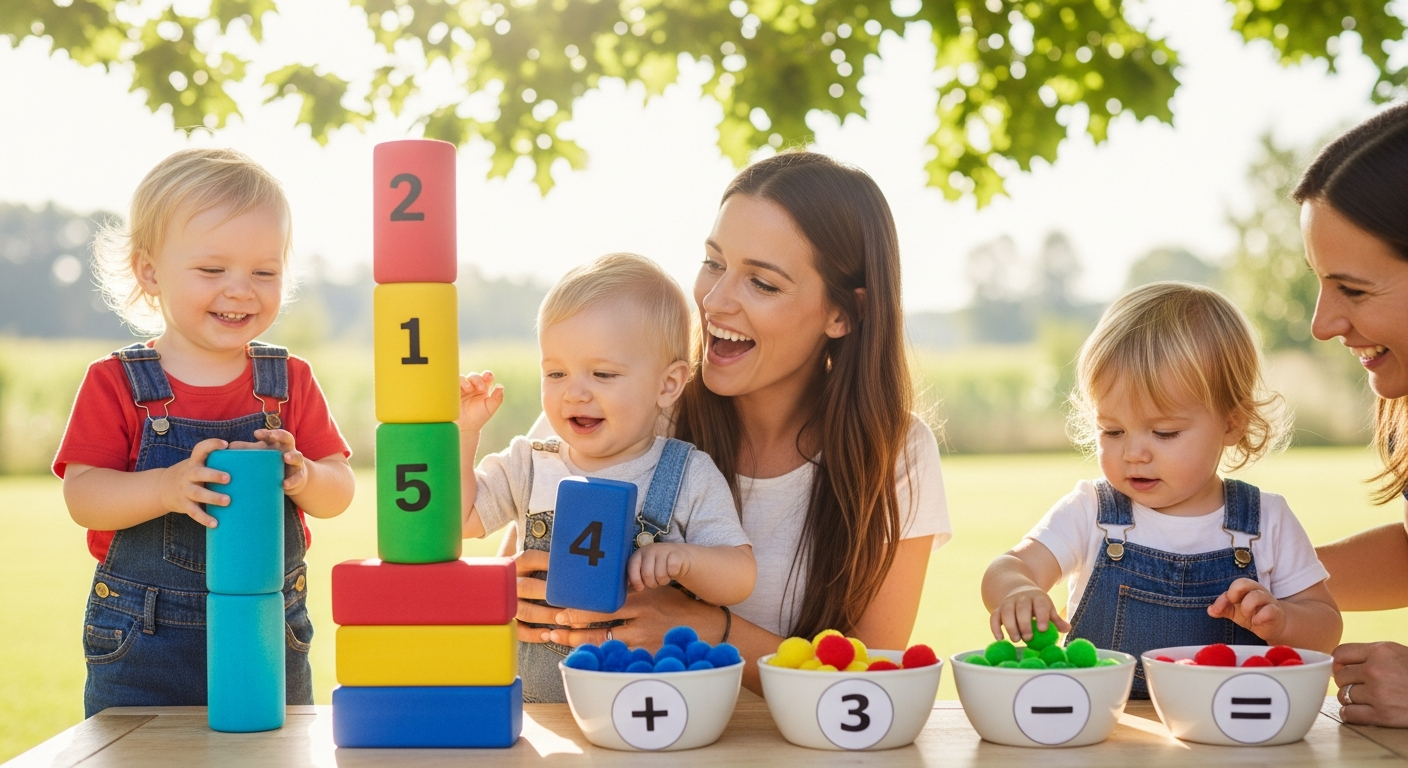
Table of Contents
- Introduction
- The Foundations of Early Math
- Counting Activities with Everyday Objects
- Shape Recognition and Sorting
- Pattern Play and Sequencing
- Measurement and Volume
- The Connection Between Speech and Math
- Outdoor Math Activities
- Creating a Positive Math Environment
- Speech Blubs: Your Partner in Early Development
- Summary of Math Toddler Activities
- Conclusion
- Frequently Asked Questions
Introduction
Imagine your three-year-old standing in the kitchen, carefully handing you three potatoes one by one, counting "one, two, three" with a look of intense concentration and a beaming smile. That moment isn't just about helping with dinner; it is a fundamental building block of mathematical thinking. Many parents feel a surge of anxiety when they hear the word "math," perhaps recalling dusty chalkboards or complex equations from their own school days. However, for a toddler, math isn't about worksheets or memorizing formulas. It is about the joy of discovery, the thrill of patterns, and the satisfaction of understanding how the world fits together.
In this post, we will explore a wide variety of engaging, play-based math toddler activities that you can easily integrate into your daily routine. We will cover everything from simple counting and shape recognition to more advanced concepts like spatial awareness and measurement. We’ll also discuss how language development and mathematical thinking are deeply intertwined, and how our mission at Speech Blubs is to support your child’s journey toward confident communication and cognitive growth. Our goal is to show you that math is already all around you, and by making it a fun, shared experience, you are helping your child foster a lifelong love for learning.

The Foundations of Early Math
Before we dive into specific activities, it is important to understand what "math" looks like for a child between the ages of two and four. At this stage, we are focused on "number sense." This is the fluid understanding of what numbers represent and how they relate to one another.
At Speech Blubs, we believe in empowering children to "speak their minds and hearts." This begins with providing them the tools to understand their environment. When a child learns that the word "two" corresponds to two physical blocks, they aren't just learning a math fact; they are learning to categorize and communicate about the physical world. Our company was born from the personal experiences of our founders, who all grew up with speech problems and created the tool they wished they had. We know that every developmental milestone—whether it’s a first word or a first time counting to ten—is a victory worth celebrating.
Mathematical development in toddlers typically covers six key areas:
- Number Sense and Counting: Understanding quantities and the order of numbers.
- Representation: Using symbols, words, or objects to represent numbers.
- Spatial Awareness: Understanding shapes, sizes, and where objects are in relation to each other.
- Measurement: Comparing height, weight, length, and volume.
- Patterns: Recognizing repetitions and sequences.
- Problem Solving: Using logic to complete puzzles or build structures.
Counting Activities with Everyday Objects
Counting is the most visible sign of early math, but it’s more complex than it seems. Toddlers often learn to "rote count" (saying numbers in order like a song) before they understand "one-to-one correspondence" (touching one object for every number said).
Snack Time Math
Snack time is perhaps the most motivating time for a toddler to practice counting. If your child loves blueberries or small crackers, ask them to help you plate them. "Can you put five blueberries on your plate?" As they move each berry, encourage them to say the number.

For a child who is just beginning to speak or who may be a "late talker," this activity provides a perfect opportunity for imitation. You might use the Speech Blubs app to watch peer models say number words. Seeing another child’s face and mouth move as they say "one" or "two" can be the "spark" that helps your toddler find their own voice.
Toy Car Parking Lot
If your toddler is obsessed with vehicles, create a "parking lot" using a piece of cardboard or masking tape on the floor. Draw numbered parking spots from 1 to 5. Ask your child to park one car in each spot. This helps them visualize the order of numbers and understand that "3" comes after "2."
Key Takeaway: Real-world counting is always more effective than flashcards. Use objects your child already loves to keep them engaged and motivated.
Shape Recognition and Sorting
Shapes are the foundation of geometry and spatial reasoning. Recognizing that a wheel is a circle or a window is a rectangle helps toddlers organize visual information.
The Indoor Shape Hunt
You don't need fancy toys to teach shapes. Take a "shape walk" through your living room. Ask, "I see something that is a rectangle and we watch shows on it. What is it?" When they point to the TV, celebrate that connection!
If you want to take this further, we recommend taking our quick 3-minute preliminary screener. It consists of 9 simple questions that help you see where your child stands in their development, including how they follow directions and identify objects. It’s a great way to get a personalized assessment and a free 7-day trial of our full suite of tools.
Shape Sorting with Laundry
Sorting is a high-level math skill that involves identifying attributes. When you are folding laundry, give your toddler a pile of socks. Ask them to find all the "small" socks and all the "big" socks. Or, ask them to find all the blue clothes and put them in one pile. This simple chore is actually a lesson in categorization and set theory!
Pattern Play and Sequencing
Patterns are essentially "rules" that repeat. Recognizing patterns helps children predict what comes next, which is a vital skill for both math and reading.
Stacking and Building Blocks
Building towers is a classic math activity. Encourage your child to build a pattern: "Let's do red block, blue block, red block. What comes next?" This introduces the concept of ABAB patterns.
For a parent whose child is very active and has a hard time sitting still for "lessons," block play is a "smart screen time" alternative. You can use the Google Play Store link to download Speech Blubs and find the "Building" or "Colors" sections. Our video modeling methodology allows your child to watch their peers engage in these activities, which triggers mirror neurons in the brain and encourages them to mimic both the actions and the words they see on the screen.
Music and Rhythms
Math is also found in music. Clap out a simple beat: clap, clap, pause, clap, clap, pause. Ask your toddler to copy you. This helps them understand sequences and timing, which are mathematical concepts disguised as a fun game.
Measurement and Volume
Toddlers are fascinated by how things fit together. Measurement at this age is all about comparison: which is bigger, which is heavier, and which holds more?
Bath Time Science
The bathtub is the ultimate math lab. Give your child various containers—a large yogurt tub, a small cup, a funnel. Let them pour water from one to the other. They will begin to see that even though the yogurt tub is wider, it might hold the same amount of water as a tall, skinny bottle. Use words like "full," "empty," "heavy," and "light" to build their math vocabulary.
Kitchen Help
Involve your toddler in baking. Let them scoop a "cup" of flour or "three spoons" of sugar. This hands-on experience with volume is much more impactful than looking at a picture of a measuring cup in a book. It also creates joyful family learning moments, which is at the heart of what we do. We aim to provide a powerful tool for family connection, moving away from passive viewing like cartoons and toward active, co-play experiences.
The Connection Between Speech and Math
You might wonder why a speech app is talking about math. The truth is, cognitive development doesn't happen in silos. To succeed in math, a child needs to understand comparative language (more/less, bigger/smaller), spatial prepositions (on, under, beside), and sequential logic (first, then, last).
Our scientific methodology is rooted in the idea that children learn best from other children. When a toddler sees a peer on Speech Blubs successfully identifying a "square" or counting "three ducks," they feel a sense of "If they can do it, I can too!" This builds the confidence needed to tackle new challenges, whether they are linguistic or mathematical. Our method is backed by science and has earned us a high rating on the MARS scale, placing us among the top tier of educational apps worldwide.
Consider a scenario where a parent has a 3-year-old "late talker" who loves animals. In the "Animal Kingdom" section of our app, the child can practice the sounds animals make while also counting how many legs a cow has or identifying the "big" elephant versus the "small" mouse. This integration of language and logic helps the child "speak their minds and hearts" with clarity and confidence.
Outdoor Math Activities
Nature provides an endless supply of "manipulatives" (objects children can move to learn math).
The Nature Collection
On your next walk, bring a small bucket. Ask your child to collect five "treasures." Once you get home, spread them out.
- Sorting: Put the leaves in one pile and the stones in another.
- Comparing: Find the longest stick and the shortest stick.
- Counting: How many total items did we find?
This activity connects math to the real world and everyday life. It shows your child that math isn't something that only happens at a desk; it’s a tool for exploring the forest or the park.
Hopscotch Number Line
If you have some sidewalk chalk, draw a simple hopscotch grid with numbers 1 through 5. As your child jumps into each square, have them shout the number. This combines gross motor skills with number recognition. For toddlers who have a lot of energy, adding movement to learning is a game-changer.
Creating a Positive Math Environment
As a parent, your attitude toward math will shape your child’s perspective. If you frame math as a fun puzzle or a way to solve problems, they will approach it with curiosity rather than fear.
- Avoid Overpromising: We don't expect your child to be doing multiplication by age four. Our goal is to foster a love for communication and foundational skills. Set realistic expectations and focus on the joy of the process.
- Encourage "Trial and Error": If your child says there are four crackers when there are actually five, don't just say "No." Instead, say, "Let's count them again together! One, two, three, four... and one more makes five!"
- Use Social Proof: Sometimes, seeing other families succeed can give you the boost you need. You can read testimonials from other parents who have used Speech Blubs to help their children overcome developmental hurdles and find joy in learning.
Speech Blubs: Your Partner in Early Development
We know that parenting can be overwhelming, especially when you are worried about your child hitting their milestones. That’s why we’ve designed Speech Blubs to be an immediate, effective, and joyful solution for the 1 in 4 children who need extra support.
While there are many activities you can do at home, sometimes having a structured, expert-led tool can make all the difference. Our app blends scientific principles with play into one-of-a-kind "smart screen time" experiences. We provide a screen-free alternative to passive viewing, encouraging your child to interact, vocalize, and think critically.
Choosing the Right Plan for Your Family
We want to be transparent about our pricing to help you make the best decision for your child’s future. We offer two main paths:
- The Monthly Plan ($14.99 per month): This is a great way to test the waters and see how your child responds to our video modeling methodology.
- The Yearly Plan ($59.99 per year): This is our best value choice, breaking down to just $4.99 per month (a savings of 66%).
The Yearly plan isn't just more affordable; it includes exclusive, high-value features that the monthly plan does not:
- A 7-day free trial so you can explore everything risk-free.
- The Reading Blubs app, which extends the learning from speech to literacy.
- Early access to all new updates and features.
- Priority 24-hour support response time from our dedicated team.
We strongly encourage parents to choose the Yearly plan to ensure their child has the full suite of tools needed to thrive.
Summary of Math Toddler Activities
To wrap up, here is a quick reference list of the activities we’ve discussed:
- Counting: Blueberries at snack time, cars in a "parking lot," or steps up the stairs.
- Shapes: Indoor shape hunts, sorting laundry by size or color, and using the "Shapes" section in Speech Blubs.
- Patterns: Building colored block towers and clapping rhythmic patterns.
- Measurement: Pouring water in the bath and scooping ingredients in the kitchen.
- Nature: Collecting and sorting leaves, stones, and sticks.
- Movement: Jumping on a chalk number line or "I Spy" for quantities.
By incorporating these into your week, you are doing more than just "teaching math." You are building your child's confidence, reducing frustration through better understanding, and creating beautiful memories of learning together.
Conclusion
Early childhood is a magical time of rapid brain development. By introducing math toddler activities through play, you are laying a sturdy foundation for all the academic and life skills your child will need in the years to come. Remember, the goal isn't perfection; it’s about fostering a love for discovery.
Whether you are counting pebbles on a walk or watching a peer model "circle" on the Speech Blubs app, you are providing your child with the "smart screen time" and real-world experiences they need to "speak their minds and hearts." We are honored to be a part of your family’s journey.
Ready to see your child's confidence soar? Download Speech Blubs on the App Store or Google Play to begin today. For the best experience and the most comprehensive toolset—including our bonus Reading Blubs app—be sure to select the Yearly plan. Start your 7-day free trial now and join the thousands of families who have found joy and success with our unique, peer-led approach.
Frequently Asked Questions
1. At what age should I start doing math activities with my toddler?
You can start as early as 18 months with very simple concepts! At that age, it’s mostly about exposure—pointing out "one ball" or "big dog." By age 2 or 3, children are usually ready for more intentional play, like sorting by color or counting to three. The key is to keep it light and follow your child's interest.
2. My child has a speech delay. Will math activities be too hard for them?
Not at all! In fact, math activities can often be easier for children with speech delays because they are so visual and tactile. Concepts like sorting blocks or finishing a puzzle don't require many words, which can help a child feel successful and confident while they are still working on their verbal communication.
3. Do I need to buy expensive Montessori toys to teach math?
Absolutely not. Some of the best math "toys" are already in your house: measuring cups, socks, plastic containers, and even rocks from the backyard. The "math" happens in the interaction between you and your child, not in the price tag of the toy.
4. How does Speech Blubs specifically help with mathematical thinking?
Speech Blubs focuses on language, which is the vehicle for math. By teaching children the names of shapes, numbers, and comparative words (like "more" or "under") through our peer-modeling videos, we give them the vocabulary they need to process mathematical concepts. Plus, our interactive games often require children to identify patterns or count along with the peer on screen!
Sobre el autor