
Creative Toddler Homeschool Activities for Early Learning
 Por Speech Blubs Team•25 mar 2026•14 min.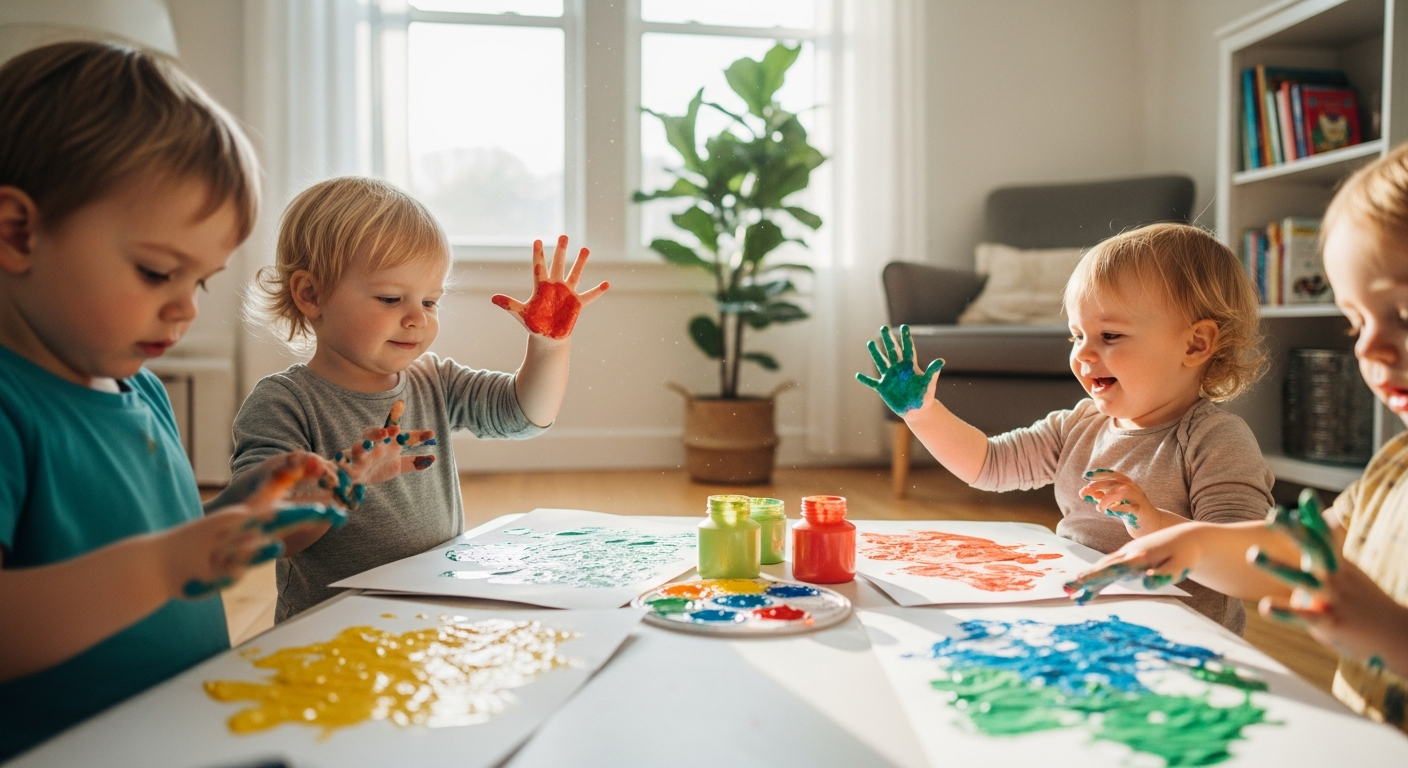
Table of Contents
- Introduction
- The Philosophy of Toddler Homeschooling: Learning Through Play
- Literacy and Language Activities
- Math and Logic Toddler Homeschool Activities
- Low-Prep Sensory and Fine Motor Activities
- Creative Arts and Expression
- Structuring Your Toddler’s Homeschool Day
- Why Speech Blubs is the Perfect Homeschool Companion
- Practical Tips for Success
- Conclusion
- FAQs
Introduction
Did you know that by the time a child turns three, their brain has already reached roughly 80% of its adult volume? This staggering statistic highlights just how critical these early years are for cognitive, emotional, and linguistic development. For many parents, the idea of "homeschooling" a two or three-year-old sounds like a daunting task filled with rigid schedules and complex lesson plans. However, at Speech Blubs, we believe that for toddlers, homeschooling isn’t about desks and textbooks—it’s about fostering a natural love for discovery through play.
The purpose of this guide is to provide you with a comprehensive toolkit of toddler homeschool activities that are engaging, educational, and, most importantly, fun. We will cover everything from literacy and numeracy to sensory play and fine motor development. We’ll also discuss how to integrate "smart screen time" into your routine to supplement your child’s growth without falling into the trap of passive viewing. Our mission is to empower children to speak their minds and hearts, and that journey starts with the simple, joyful moments of learning you create at home.

By the end of this post, you will have a clear roadmap for nurturing your child’s curiosity, building their confidence, and creating a foundational love for communication that will last a lifetime.
The Philosophy of Toddler Homeschooling: Learning Through Play
When we talk about toddler homeschool activities, the most important thing to remember is that play is a child's work. At this age, children are biological "learning machines." They don't need formal lectures; they need experiences. They need to touch, taste, see, and hear the world around them.
Our founders at Speech Blubs understand this deeply. Having grown up with speech challenges themselves, they created the tool they wished they had—one that blends scientific principles with the sheer joy of play. This same philosophy should guide your home learning. Your goal isn't to create a mini-academic, but to foster a love for communication and exploration.
Why Focus on Language and Communication?
Language is the gateway to all other learning. If a child can express their needs, ask questions, and describe their world, they are better equipped to tackle math, science, and social interactions later on. For a parent whose 3-year-old "late talker" loves animals, simple activities like mimicking animal sounds or naming pets can be the spark that ignites a verbal explosion. This is why we focus so heavily on video modeling, where children learn by watching and imitating their peers—a method that feels like a game but is rooted in neuroscientific research on mirror neurons.
Setting Realistic Expectations
It is essential to set realistic expectations for your toddler’s "school" day. A two-year-old has an attention span that typically lasts between three and six minutes. If an activity lasts ten minutes, consider it a massive success! Homeschooling at this age is about the process, not the product. It’s about the messy finger painting, the giggles during a song, and the pride they feel when they finally stack three blocks. If you are ever unsure where your child stands in their development, you can take our quick 3-minute preliminary screener to get a simple assessment and a personalized next-steps plan.

Literacy and Language Activities
Building a strong foundation in literacy starts long before a child reads their first word. It begins with "phonological awareness"—the ability to hear and manipulate the sounds in spoken language.
1. The Name Unscramble
One of the most powerful words for a toddler is their own name. This activity helps with letter recognition and the concept that letters form specific meanings.
- How to do it: Write your child’s name on a sturdy piece of cardboard. Then, write each individual letter of their name on separate clothespins or small cards.
- The Goal: Encourage your child to match the individual letters to the letters on the board. As they match each one, say the letter name and the sound it makes. This builds a connection between the visual symbol and the spoken sound.
2. The "Animal Kingdom" Sound Match
For kids who are just beginning to find their voice, animal sounds are the perfect entry point. They are "protowords"—simple, repetitive sounds that are easier to produce than complex vocabulary.
- How to do it: Use plastic animal figures or picture cards. Ask your child, "What does the cow say?" When they respond with "Moo," celebrate enthusiastically!
- Speech Blubs Connection: Within the Speech Blubs app, the "Animal Kingdom" section uses real children (peers) to model these sounds. Watching another child say "Moo" or "Baa" triggers a natural imitative response in toddlers, making it a powerful tool for building speech confidence. Download Speech Blubs on the App Store to see this in action.
3. Sensory Letter Tracing
Instead of using a pencil and paper, which requires fine motor skills many toddlers haven't mastered yet, try sensory tracing.
- How to do it: Fill a shallow tray with salt, sugar, or sand. Draw a large letter in the tray and have your child use their finger to "trace" over it.
- Why it works: The tactile feedback helps the brain "lock in" the shape of the letter, bypassing the frustration of trying to grip a crayon correctly.
Math and Logic Toddler Homeschool Activities
Early math isn't about equations; it's about patterns, sorting, and understanding "one-to-one correspondence" (the idea that one object equals the number one).
4. Color and Size Sorting
Sorting is a foundational logic skill. It teaches children to observe characteristics and categorize information.
- How to do it: Gather a variety of household objects (buttons, socks, plastic blocks). Provide two or three bowls and ask your child to "put all the red things here" or "put all the big things here."
- Practical Scenario: If you’re folding laundry, have your toddler "help" by finding all the small socks and putting them in a pile. It’s a real-world task that doubles as a math lesson!
5. The Counting Drop
Many toddlers can "rote count" (saying 1, 2, 3, 4, 5 in order) without actually understanding what the numbers mean.
- How to do it: Use an empty egg carton and write the numbers 1 through 12 in the bottom of each cup. Give your child a bowl of large beans, pom-poms, or pebbles.
- The Activity: Have them place the correct number of items into each cup. "Let’s put two beans in the number two cup!" This connects the spoken number to a physical quantity.
6. Pattern Building with Snacks
Snack time is a great time for math. Using goldfish crackers and grapes, you can start building simple "AB" patterns (cracker, grape, cracker, grape). Ask your child, "What comes next?" This develops the ability to predict and understand sequences, which is a precursor to higher-level logical thinking.
Low-Prep Sensory and Fine Motor Activities
Fine motor skills involve the small muscles in the hands and fingers. These are the muscles your child will eventually use to write, button their shirt, and use a fork.
7. The Colander Pipe Cleaner Push
This is a classic "keep them busy" activity that is secretly a workout for hand-eye coordination.
- How to do it: Turn a kitchen colander upside down. Give your child a pack of colorful pipe cleaners.
- The Goal: Show them how to poke the pipe cleaners through the holes. It requires focus and precision, and many toddlers find the process incredibly soothing.
8. Sticker Collages
Peeling stickers is one of the best ways to develop the "pincer grasp" (the thumb and forefinger pinch).
- How to do it: Give your child a sheet of stickers and a piece of paper. If they struggle to peel the stickers, peel off the "background" of the sticker sheet (the sticky part around the shapes) so the stickers stand alone on the backing. This makes it much easier for little fingers to grab the edges.
9. Water Play: The "Toy Wash"
Toddlers love water. It’s a sensory experience that can keep them engaged for long periods.
- How to do it: Fill a plastic bin with a little bit of soapy water. Give your child a toothbrush or a small cloth and their plastic cars or animals.
- The Lesson: This teaches "functional play"—using tools for a purpose—and provides a rich environment for language. You can talk about "bubbles," "scrubbing," "wet," and "dry."
Creative Arts and Expression
Art for toddlers should be "process-oriented," meaning we care more about the act of creating than the final masterpiece.
10. No-Mess Finger Painting
If the thought of paint on your carpet gives you anxiety, try this trick.
- How to do it: Put a few squirts of paint inside a large Ziploc bag. Seal it tightly (you can even tape it to a table or window).
- The Activity: Your child can "paint" by squishing the paint around from the outside of the bag. They get the visual and tactile satisfaction of color mixing without the cleanup.
11. Playdough Engineering
Playdough isn't just for making "snakes." It’s a tool for strengthening hand muscles.
- The Activity: Give your child plastic knives, rollers, and even dry spaghetti noodles. Encourage them to stick the noodles into the dough to make "towers" or "porcupines." This combination of soft and hard textures is great for sensory processing.
Structuring Your Toddler’s Homeschool Day
You don't need a 9-to-5 schedule. In fact, that would be counterproductive! A successful toddler homeschool day is built on a "rhythm" rather than a rigid timeline.
A Sample Daily Rhythm:
- Morning Basket (15 mins): Read 2-3 favorite books, sing a "Good Morning" song, and look out the window to talk about the weather.
- Active Play (30 mins): Go outside! Run, jump, and explore. Physical activity helps "wake up" the brain for learning.
- Focused Activity (10-15 mins): Choose one of the literacy or math activities mentioned above.
- Smart Screen Time (15-20 mins): This is where a tool like Speech Blubs fits perfectly. It provides a structured, educational break that engages the child’s communication skills.
- Creative/Sensory Play (20 mins): Water play, playdough, or stickers.
- Quiet Time/Nap: Essential for processing everything they’ve learned.
The Role of "Smart Screen Time"
We live in a digital age, and while we want to avoid "zombie-like" passive viewing of cartoons, we can embrace "smart screen time." Speech Blubs is designed to be a powerful tool for family connection. We encourage parents to sit with their children, watch the video models together, and practice the sounds and words. It’s not a digital babysitter; it’s a digital classroom that fosters real-world interaction.
Many parents have shared how this approach has reduced frustration for their children. When a child can’t communicate, they often resort to tantrums. By building their "communication toolbox," you are giving them the gift of confidence. You can read testimonials from other parents to see how this approach has transformed their daily routines.
Why Speech Blubs is the Perfect Homeschool Companion
Integrating a dedicated speech and language tool into your toddler homeschool activities can take the pressure off you as a parent. You don't have to be a speech therapist to support your child’s development; you just need the right tools.
Scientific Methodology
Our app is built on the principle of video modeling. Research shows that children are more likely to imitate other children than they are to imitate adults. Our "peer-to-peer" approach uses high-quality video of kids performing speech exercises, which activates mirror neurons in your toddler's brain. This isn't just entertainment—it's a scientifically-backed way to encourage vocalization.
High Value for Families
We are committed to making high-quality speech support accessible. We offer two clear paths for families:
- Monthly Plan: For $14.99 per month, you get full access to our library of over 1,500 activities.
- Yearly Plan (Best Value): For $59.99 per year—which breaks down to just $4.99 per month—you receive a comprehensive suite of benefits that the monthly plan doesn't offer.
The Yearly Plan includes:
- A 7-day free trial so you can explore the app risk-free.
- The Reading Blubs app, which extends the learning into early literacy and phonics.
- Early access to all new updates and content releases.
- Priority 24-hour support response time from our team.
By choosing the yearly plan, you save 66% and ensure your child has a consistent, long-term resource for their development. You can create your account and start your free trial here.
Practical Tips for Success
As you embark on these toddler homeschool activities, keep these three tips in mind:
- Follow the Child: If you set up a counting activity but your child just wants to talk about the colors of the beans, go with it! The goal is engagement, not the specific completion of your plan.
- Narrate Everything: Become a sportscaster for your child’s life. "You are picking up the blue block! Now you are putting it on top of the red block. Oh no, it fell down!" This constant stream of language helps them map words to actions.
- Celebrate Small Wins: Did they try a new sound? Did they stay focused for four minutes instead of three? Celebrate it! Positive reinforcement is the most powerful motivator for a young learner.
For more insights into the science behind our methods, you can explore our research page.
Conclusion
Homeschooling a toddler is a journey of a thousand tiny steps. It’s found in the soapy bubbles of a toy wash, the sticky fingerprints on a collage, and the proud "Moo" of a child mimicking a cow. By engaging in these toddler homeschool activities, you aren't just "passing the time"—you are building the neural pathways that will support your child’s future academic and social success.
At Speech Blubs, we are honored to be a part of that journey. Our mission is to help every child "speak their minds and hearts," providing a joyful, effective solution for those who need a little extra support. Remember, you don't have to do this alone. Our app is designed to be a supplement to your love and a partner in your child's growth.
Ready to take the next step? We invite you to join our community of over 5 million parents. The best way to start is with our Yearly plan, which offers the best value and the most comprehensive features for your child's learning.
Start your journey today:
- Download on the Apple App Store
- Get it on Google Play
- Sign up on our website to begin your 7-day free trial
Choose the Yearly plan at checkout to unlock Reading Blubs, early updates, and the best possible price for your family. Let’s make learning a joyful, lifelong adventure!
FAQs
1. How much time should I spend on toddler homeschool activities each day?
For toddlers (ages 2-3), "formal" or parent-led activities should only take about 30 to 60 minutes of your total day, broken into very small 5-10 minute chunks. The rest of the day should be dedicated to free play, outdoor exploration, and rest. Quality is much more important than quantity at this age.
2. My child has a short attention span. Is homeschooling still worth it?
Absolutely! A short attention span is developmentally appropriate for a toddler. Homeschooling at this age is about creating a "learning-rich environment." Even if they only engage with an activity for three minutes, their brain is still absorbing information. Using engaging tools like Speech Blubs can help capture their interest for slightly longer periods through interactive video modeling.
3. Do I need to buy an expensive curriculum for my 2-year-old?
No. Most of the best toddler homeschool activities use basic household items like colanders, pipe cleaners, and snacks. Instead of an expensive paper curriculum, many parents find better value in a "smart screen time" tool like Speech Blubs, which provides structured, scientifically-backed language support for a fraction of the cost of traditional kits.
4. How can I tell if my child's speech is on track during homeschooling?
While every child develops at their own pace, there are general milestones to look for. If you're concerned about a potential delay, we recommend taking our 3-minute preliminary screener. It’s a great way to get a baseline assessment and see if your child could benefit from the targeted practice our app provides.
Sobre el autor