
Educational Activities for Toddlers to Spark Joyful Learning
 Por Speech Blubs Team•25 mar 2026•13 min.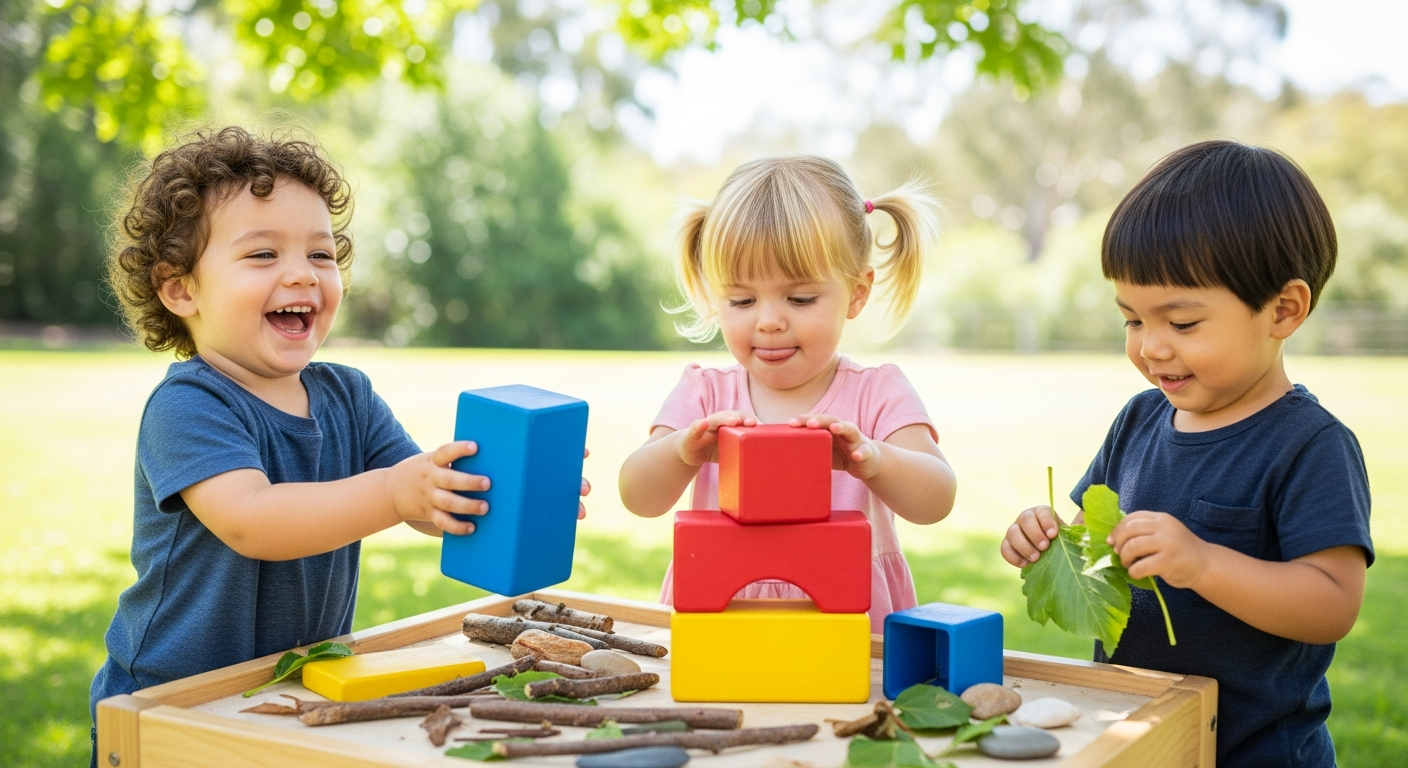
Table of Contents
- Introduction
- The Power of Play in Toddler Development
- Sensory Play: Engaging the Five Senses
- Building Cognitive Skills Through Everyday Games
- Nurturing Language and Communication Skills
- Fine and Gross Motor Skill Activities
- Making Screen Time "Smart" with Speech Blubs
- Practical Tips for Parents: Managing Learning Time
- Conclusion
- Frequently Asked Questions (FAQ)
Introduction
Did you know that by the age of three, a child’s brain has already formed about 1,000 trillion neural connections? That is double the amount an adult has! This incredible window of growth is why the toddler years are often referred to as the "sponge stage." Every song you sing, every block you stack, and every messy finger-painting session is literally building the architecture of your child’s mind.
At Speech Blubs, we understand the beauty and the occasionally overwhelming nature of this stage. Our mission is to empower children to "speak their minds and hearts," a goal born from the personal experiences of our founders who grew up with speech challenges themselves. We know that as a parent, you want to provide the best possible start for your little one, but you also need realistic, low-prep solutions that fit into your busy day.
In this post, we will explore a wide range of toddler educational activities that balance high-impact learning with pure, unadulterated fun. We will cover sensory play, cognitive games, language-building strategies, and how to use "smart screen time" to support your child’s development. Whether your child is a "late talker" or simply a bundle of curious energy, our goal is to help you foster a love for communication and build foundational skills through joyful family moments.

If you are curious about where your child stands in their development, you can take our quick 3-minute preliminary screener to get a simple assessment and start your journey with a free 7-day trial. Our thesis is simple: when learning feels like play, the possibilities for growth are endless.
The Power of Play in Toddler Development
Before we dive into the specific activities, it is important to understand why "play" is the primary vehicle for learning at this age. For a toddler, play is work. It is how they test hypotheses, learn cause and effect, and develop the social-emotional skills they will need for a lifetime.
When we engage in toddler educational activities, we aren't just looking for academic outcomes like counting to ten or reciting the alphabet. We are looking to build "foundational skills." These include:
- Executive Function: The ability to focus, remember instructions, and juggle multiple tasks.
- Self-Regulation: Learning how to manage emotions during a challenging game.
- Confidence: The "I can do it!" spirit that comes from successfully completing a task.
We believe in providing an immediate, effective, and joyful solution for the 1 in 4 children who need speech support. By blending scientific principles with play, we can create experiences that reduce frustration for both the child and the parent. This is the heart of Speech Blubs—making sure every child feels heard.
Sensory Play: Engaging the Five Senses
Sensory play is any activity that stimulates a child’s senses: touch, smell, taste, sight, and hearing. It is crucial because sensory experiences send signals to the brain that help strengthen neural pathways.
The Magic of Sensory Bins
One of the easiest and most versatile toddler educational activities is the sensory bin. A sensory bin is essentially a container filled with a "filler" material and various objects for your child to find, scoop, or pour.
- The Noodle Bin: Fill a plastic tub with dry pasta of different shapes (penne, fusilli, bowties). Add scoops, funnels, and small toy animals.
- The Snacking Bin: If you are worried about your toddler putting things in their mouth, use a cereal filler like Cheerios or puffed rice. This creates a "snacking bin" where they can play and taste safely while you handle household tasks.
- Developmental Benefit: These bins help with fine motor skills and "tactile discrimination"—the ability to understand the difference between textures.
Water Play: Simple and Effective
Water is perhaps the most captivating sensory material for a toddler. You don’t need a pool; a kitchen sink or a shallow bin will do.

- Toy Wash: Fill a bin with soapy water and give your child a scrub brush to "wash" their plastic dinosaurs or cars.
- Color Mixing: Use clear cups and a few drops of food coloring. Let your child pour yellow water into blue water to "magically" create green.
- Popsicle Bath: A fan-favorite "low-energy" parent hack is the popsicle bath. Give your toddler a popsicle while they are in the tub. It’s a sensory delight of cold vs. warm, and the cleanup is built right in!
Building Cognitive Skills Through Everyday Games
Cognitive development refers to how a child perceives, thinks, and gains an understanding of their world. You don’t need expensive "brain-boosting" toys to encourage this growth; you just need items already in your pantry or toy box.
Sorting and Categorizing at Home
The ability to group objects by their characteristics is a precursor to math and logical reasoning.
- Laundry Sorting: While you fold clothes, have your toddler find all the "small socks" or all the "blue shirts."
- Nature Sorting: On your next walk, collect leaves, rocks, and sticks. When you get home, ask your child to put the "crunchy things" in one pile and the "smooth things" in another.
- Practical Scenario: For a parent whose child is obsessed with vehicles, you can use the 'Transportation' section of our app to learn the sounds of a fire truck or a boat, and then find toy versions in your house to "sort" by whether they travel on land, water, or air.
Memory and Object Permanence
Memory games for toddlers should be physical and interactive rather than based on rote memorization.
- The "What’s Missing?" Game: Place three familiar objects on a tray (e.g., a spoon, a ball, and a toy cat). Have your child close their eyes, remove one object, and see if they can identify what is gone.
- Hide-and-Seek Toys: Hide a noisy toy (like a ticking kitchen timer or a toy that makes sound) under a blanket and have your child "track" it using their ears.
Our unique approach is backed by rigorous scientific research, which shows that these types of engaging, interactive play sessions are far more effective than passive learning.
Nurturing Language and Communication Skills
Language development is one of the most exciting milestones of the toddler years. It’s the shift from "pointing and grunting" to "speaking their minds and hearts."
The Role of Video Modeling in Speech
At Speech Blubs, we use a powerful methodology called video modeling. This is based on the science of mirror neurons—the brain cells that fire both when we perform an action and when we see someone else performing that same action.
In our app, children watch videos of other children making sounds and saying words. Because toddlers naturally want to imitate their peers, this triggers a "monkey see, monkey do" response that is incredibly effective for speech development.
- Imitation Games: Try making silly faces in a mirror with your child. Stick out your tongue, puff out your cheeks, or make a "fish face." This builds the oral-motor muscles needed for clear speech.
- Animal Sounds: Animal sounds are often the building blocks of speech because they are easier to replicate than complex words. For a parent whose 3-year-old "late talker" loves animals, the 'Animal Kingdom' section in Speech Blubs offers a fun, motivating way to practice 'moo' and 'baa' sounds.
To start practicing these skills today, you can download Speech Blubs on the Apple App Store or Google Play Store.
Storytelling and Narrative Skills
You don’t have to just read the words on the page. Use books as a springboard for conversation.
- The "Wait and See" Method: When reading a familiar book, stop before a predictable word or the end of a rhyme and wait for your child to fill it in.
- Dialogic Reading: Ask open-ended questions like, "Why do you think the bear is sad?" or "What would you do if you had a magic hat?" Even if their answer is just one word, you are teaching them the back-and-forth flow of conversation.
Fine and Gross Motor Skill Activities
A child’s physical development is closely linked to their cognitive abilities. "Fine motor" refers to small muscle movements (like fingers), while "gross motor" refers to large movements (like jumping).
Creative Arts and Crafts
Art is one of the best toddler educational activities for developing finger dexterity, which is later essential for writing.
- Dot Marker Art: Dot markers are easier for tiny hands to grip than thin crayons. They allow toddlers to practice "aiming" and pressure.
- Tape Pulling: Stick pieces of painter’s tape to a high-chair tray or table and let your toddler peel them off. It’s surprisingly addictive for them and builds significant finger strength.
- Playdough Monsters: Give your child playdough and a handful of "loose parts" like googly eyes, pipe cleaners, and beads. Let them create a "monster" and describe its features to you.
Movement-Based Learning
Toddlers have a physiological need to move. Instead of fighting it, incorporate it into your learning routine.
- The Alphabet Scavenger Hunt: Tape letters around the room and have your child "race" to find the letter 'B' or the letter that makes the 'Sss' sound.
- Indoor Obstacle Course: Use pillows to crawl over, painters' tape lines to balance on, and a cardboard box to crawl through. This builds "proprioception"—the sense of where one's body is in space.
Making Screen Time "Smart" with Speech Blubs
We know that "screen time" is often a source of guilt for parents. However, there is a massive difference between passive viewing (like sitting mesmerized by a bright cartoon) and active engagement.
Speech Blubs is designed as "smart screen time." It is a tool for family connection, not a digital babysitter. We encourage "co-play," where the parent sits with the child, repeats the sounds together, and celebrates every attempt at a new word.
Our app provides a screen-free alternative to passive consumption by turning the screen into a mirror and a classroom. We focus on:
- Building confidence through peer imitation.
- Developing foundational communication skills.
- Creating joyful family learning moments.
See what other parents are saying about their child’s success by reading our latest testimonials.
Value and Pricing: The Best Way to Start
We believe in being transparent with our community. To give your child the best experience, we offer two main paths:
- Yearly Plan ($59.99 per year): This is the clear best choice for families. It breaks down to just $4.99/month, saving you 66% compared to the monthly option. Most importantly, the Yearly plan includes:
- A 7-day free trial to explore everything risk-free.
- The bonus Reading Blubs app to help with early literacy.
- Early access to new updates and a 24-hour support response time.
- Monthly Plan ($14.99 per month): This is a flexible, month-to-month option, but it does not include the free trial, the Reading Blubs app, or the priority support.
We encourage you to create your account and start your 7-day free trial on our web platform to see the value for yourself.
Practical Tips for Parents: Managing Learning Time
Implementing toddler educational activities shouldn't feel like a chore. Here are some "expert secrets" to keeping things stress-free:
- Follow the Child’s Lead: If you set up a beautiful sensory bin but your child just wants to play with the cardboard box it came in—let them! The box is also a learning tool.
- Keep it Short: A toddler’s attention span is typically 2–3 minutes per year of age. If an activity lasts 10 minutes, consider it a huge success.
- Embrace the Mess: Messy play is often the most educational. If you're worried about the carpet, take the activity outside or lay down a cheap shower curtain liner first.
- Consistency over Intensity: Five minutes of intentional play every day is better than an hour-long "lesson" once a week.
Key Takeaway: The goal of these activities is to foster a love for learning and communication. Don't worry about "perfect" execution; focus on the connection and the joy you share with your child.
Conclusion
The toddler years are a fleeting, magical, and sometimes exhausting time of life. By incorporating these toddler educational activities into your daily routine, you are doing more than just keeping your child busy—you are building a foundation for their future success. Whether it's through the tactile fun of a sensory bin, the cognitive challenge of a sorting game, or the science-backed power of video modeling in Speech Blubs, every moment of engagement counts.
Remember, our mission at Speech Blubs is to help your child "speak their minds and hearts." We provide the tools, but you provide the love and encouragement that makes those tools work. We don’t promise overnight miracles, but we do promise a process that fosters confidence, reduces frustration, and creates joyful learning moments for your whole family.
Ready to take the next step? We invite you to join the Speech Blubs family. Download Speech Blubs today on the App Store or Google Play. For the best value, choose our Yearly plan to unlock your 7-day free trial, the Reading Blubs app, and exclusive updates. Let’s start this journey together!
Frequently Asked Questions (FAQ)
1. How do I know if my child is behind in their speech development? Every child develops at their own pace, but there are certain milestones to look for, such as using at least 50 words by age two. If you are uncertain, the best first step is to take our quick 3-minute preliminary screener. It involves 9 simple questions and provides an assessment and next-steps plan. It’s a great way to gain peace of mind or identify if professional support is needed.
2. Can Speech Blubs replace traditional speech therapy? Speech Blubs is a powerful supplement to a child’s overall development plan and can be an excellent tool to use alongside professional therapy. It provides a way to practice skills at home in a fun, low-pressure way. However, it is not a replacement for a clinical diagnosis or one-on-one sessions with a licensed Speech-Language Pathologist (SLP) if your child has a diagnosed delay or disorder.
3. What makes the Yearly plan better than the Monthly plan? The Yearly plan is designed to provide the most comprehensive support for your child’s journey. Not only is it significantly more affordable (saving you 66%), but it is the only plan that includes the 7-day free trial. It also grants access to our Reading Blubs app, which focuses on early literacy, and ensures you get 24-hour support response times and early access to all our latest content updates.
4. Is it okay for my toddler to have screen time if it's educational? The American Academy of Pediatrics suggests that for children ages 2 to 5, screen time should be limited to one hour per day of high-quality programming. At Speech Blubs, we focus on "active" or "smart" screen time. Our app is designed for co-play, meaning it’s a tool you use with your child to encourage imitation and interaction, rather than a passive experience where they just sit and watch. This active engagement is key to making screen time a positive developmental tool.
Sobre el autor