
Engaging Activity Board for Toddler Play and Learning
 Por Speech Blubs Team•25 mar 2026•14 min.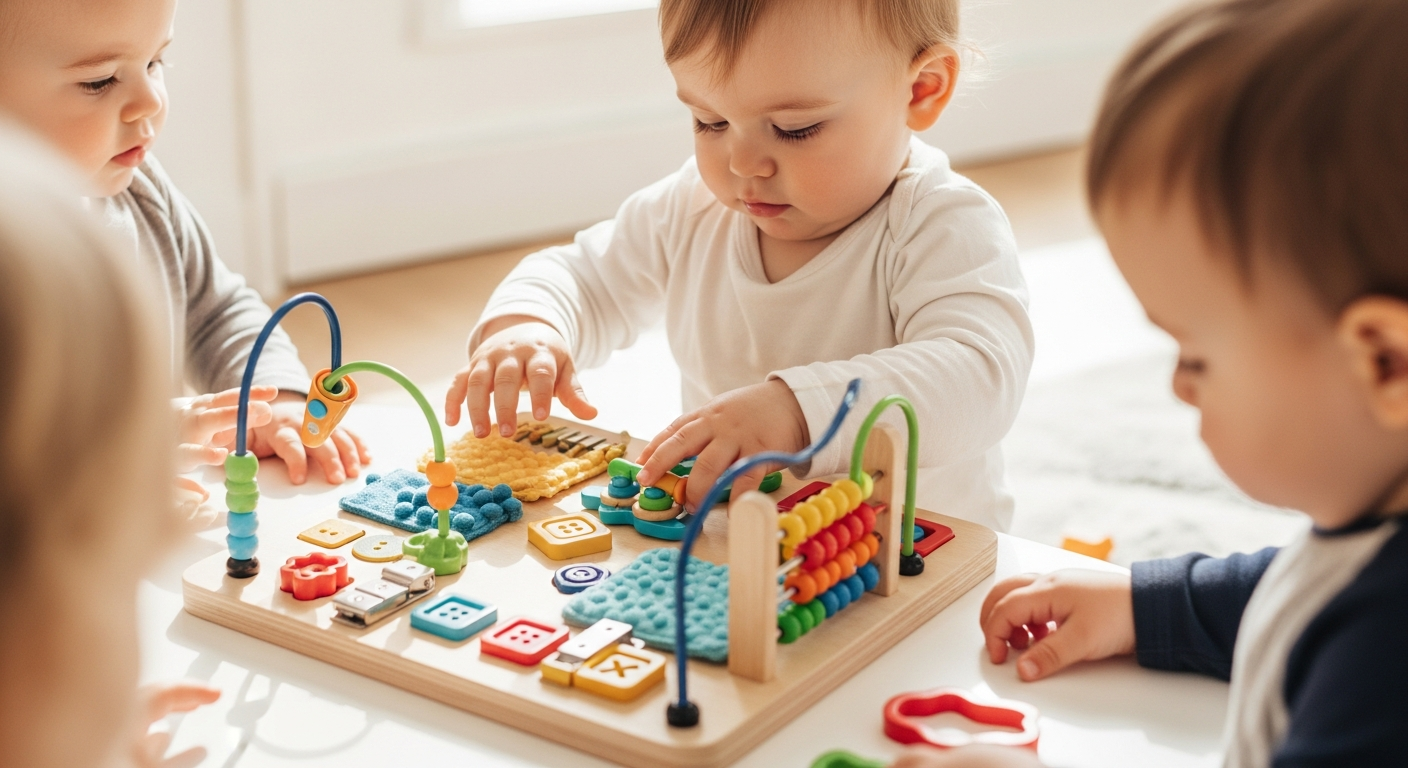
Table of Contents
- Introduction
- Understanding the Activity Board for Toddler Development
- How Fine Motor Skills Support Language
- Choosing the Best Activity Board for Your Child
- Integrating Physical Play with Speech Blubs
- Practical Tips for Parent-Child Interaction
- DIY vs. Store-Bought Activity Boards
- Why Speech Blubs is the Perfect Companion
- Building Confidence and Reducing Frustration
- The Role of Peers in Learning
- Setting Realistic Expectations
- Summary of Key Takeaways
- Conclusion
- FAQ
Introduction
Have you ever noticed how a toddler can ignore a room full of expensive, flashing toys only to spend forty-five minutes trying to figure out how the buckle on a high chair works? This innate curiosity isn't just a quirk of childhood; it is a fundamental driving force in their neurological development. At Speech Blubs, we understand that for a young child, the world is one giant puzzle waiting to be solved, and every latch, zipper, and button is a lesson in how the physical world functions. The right activity board for toddler exploration provides a concentrated, safe environment where these natural impulses can flourish.
Our mission is to empower children to speak their minds and hearts, and we know that communication begins long before the first word is spoken. It starts with curiosity, fine motor control, and the confidence to interact with one’s surroundings. This blog post will dive deep into why activity boards are essential tools for development, how they bridge the gap between physical play and language skills, and how you can choose the best one for your little explorer. We will also explore how combining tactile play with our unique "smart screen time" can accelerate your child's progress. We believe that by fostering a love for exploration and communication through play, we can support the 1 in 4 children who need a little extra help finding their voice.

Understanding the Activity Board for Toddler Development
An activity board, often called a "busy board," is a Montessori-inspired tool designed to engage a child’s senses and fine motor skills. These boards are typically outfitted with everyday objects—things like switches, gears, locks, laces, and textures—that allow toddlers to practice "real-world" tasks in a safe, controlled setting.
The magic of an activity board lies in its simplicity. It doesn’t require batteries to be effective; rather, it relies on the child's internal motivation to master a task. When a toddler successfully slides a bolt or clicks a button, they receive immediate sensory feedback. This builds a sense of "self-efficacy," the internal belief that they can influence their environment. At Speech Blubs, we mirror this philosophy by creating interactive experiences where children aren't just passive viewers but active participants in their learning journey.
The Sensory Connection
Toddlers learn through their hands. The tactile input they receive from different materials—the coldness of a metal zipper versus the softness of a felt flap—sends vital signals to the brain. This sensory integration is the foundation for more complex cognitive tasks. When a child is focused on an activity board, they are practicing "joint attention" and "sustained focus," both of which are critical precursors to language development. If a child can focus on a mechanical task, they are developing the neural pathways needed to focus on the sounds and mouth movements required for speech.
How Fine Motor Skills Support Language
It might seem strange to link finger movements to talking, but the brain's motor cortex (which controls movement) and Broca's area (which handles speech production) are closely connected. Research suggests that as a child refines their fine motor skills, they are simultaneously laying the groundwork for the precision required to form complex speech sounds.
Using an activity board for toddler play encourages the "pincer grasp" and hand-eye coordination. As your child maneuvers a small key into a lock or pulls a string through a hole, they are exercising the same neural discipline needed to control the muscles of the tongue, lips, and jaw. Our team at Speech Blubs, which includes experts who personally navigated speech challenges in childhood, designed our platform to leverage these scientific principles. We know that play is the "work" of the child, and by making that work joyful, we reduce the frustration often associated with learning to communicate.

Scientific Foundations: Mirror Neurons and Play
One of the reasons activity boards are so effective is that they encourage imitation. You might show your child how to flip a switch, and then they try to copy you. This triggers "mirror neurons" in the brain—cells that fire both when we perform an action and when we watch someone else do it.
This is the exact same scientific methodology we use in our app through "video modeling." In Speech Blubs, children watch videos of their peers performing speech exercises. Because the "teachers" are other kids, the child's mirror neurons are highly activated, making them much more likely to imitate the sounds and movements they see. To see how these scientific principles have helped thousands of families, you can explore our research page for more details on our evidence-based approach.
Choosing the Best Activity Board for Your Child
When searching for the perfect activity board for toddler needs, you will encounter a vast array of options. From large wooden wall-mounted units to portable felt "busy books," the choices can be overwhelming. Here are the key factors to consider to ensure you’re providing a high-value learning tool.
Safety First
Since these boards often contain small parts and moving pieces, safety is paramount.
- Smooth Edges: Ensure the board itself is made of high-quality wood or plastic with no sharp corners.
- Secure Attachments: Every lock, button, and gear should be firmly attached. Give them a "tug test" before letting your toddler play.
- Non-Toxic Materials: Look for BPA-free plastics and lead-free paints.
Age-Appropriate Challenges
An activity board should be challenging but not discouraging.
- For 12-18 Months: Focus on simple "cause and effect" items like large buttons, peek-a-boo doors, and mirrors.
- For 2-3 Years: Introduce more complex tasks like buckles, zippers, shoelaces, and counting elements.
Portability and Travel
If you’re looking for a way to keep your child engaged during long car rides or flights, a soft, felt-based activity board is an excellent choice. These are lightweight and usually fold up like a book. They offer a "screen-free" alternative to passive cartoons, much like how Speech Blubs offers a "smart screen time" alternative that promotes active learning. If you want to see if your child is hitting their developmental milestones before choosing your tools, you can take our quick 3-minute preliminary screener to get a simple assessment and a free 7-day trial.
Integrating Physical Play with Speech Blubs
While a physical activity board is fantastic for tactile development, pairing it with targeted language practice can create a holistic learning environment. We recommend using the activity board as a "conversation starter."
For a parent whose 3-year-old "late talker" loves animals, the "Animal Kingdom" section of Speech Blubs offers a fun, motivating way to practice "moo" and "baa" sounds. You can find an activity board that features a farm theme with little doors. As your child opens a door to reveal a cow, you can use the app to show them a peer making the "moo" sound. This creates a multi-sensory loop: they touch the door (tactile), see the animal (visual), see a child make the sound (imitation), and then try the sound themselves (vocal).
Scenario: The Frustrated Fast-Learner
Imagine a toddler who is incredibly skilled with their hands—they can solve any puzzle on their activity board—but they struggle to express their needs, leading to frequent tantrums. This is a common challenge. By using the app’s "Early Sounds" section, you can bridge the gap. While they are busy spinning gears on their board, you can sit with them and engage in co-play. The app provides the verbal models they need, while the board provides the physical outlet for their energy. This combination reduces frustration and builds the foundational skills for complex communication.
To see how other parents have successfully used these strategies to help their children "speak their minds and hearts," take a look at our parent testimonials.
Practical Tips for Parent-Child Interaction
An activity board for toddler play is not just a "babysitter." While it can provide much-needed moments of independent play, its value is doubled when an adult joins in. Here is how you can maximize the educational value of these boards:
- Narrate Everything: As your child plays, describe what they are doing. "You are pulling the blue zipper up! Now it's going down." This builds their receptive vocabulary.
- Ask Open-Ended Questions: Instead of asking "Is that a lock?", try asking "How do you think we can open this door?"
- Wait and Observe: Give your child time to problem-solve. Resist the urge to "fix" the puzzle for them. The struggle is where the learning happens!
- Incorporate Speech Blubs Sessions: Use the app for 10-15 minutes a day alongside physical play. This "smart screen time" acts as a powerful supplement to their overall development plan. You can Download Speech Blubs on the App Store to begin this journey today.
DIY vs. Store-Bought Activity Boards
Many parents wonder if they should build their own activity board or buy a pre-made one. Both have their merits.
The DIY Path
Creating a custom activity board for toddler play can be a rewarding project. You can tailor it specifically to your child's interests. If they love your keychain, you can mount safe, old keys to a board. If they are obsessed with light switches, you can buy a few from a hardware store.
- Pro: Fully customizable and often cheaper.
- Con: Time-consuming and requires careful attention to safety (ensuring no small parts can be swallowed).
The Store-Bought Path
Professional manufacturers often put their boards through rigorous safety testing that is hard to replicate at home.
- Pro: Immediate use, certified safe, and often designed by educational experts to cover a range of developmental milestones.
- Con: Can be more expensive and may include elements your child isn't interested in.
Regardless of which path you choose, the goal is the same: providing a rich environment for exploration.
Why Speech Blubs is the Perfect Companion
At Speech Blubs, we don't just provide an app; we provide a tool for family connection. Our founders created the tool they wished they had when they were struggling with speech problems themselves. We believe in providing an immediate, effective, and joyful solution.
Our app is designed to be used with a parent. When you sit down with your child and explore our "Smart Screen Time," you are engaging in a shared experience. This is vastly different from letting a child watch a cartoon alone. With Speech Blubs, you are both active. You watch the peer model, you try the sound, and you celebrate the success together.
The Value of Our Yearly Plan
We want to make our solution as accessible and effective as possible. While we offer a monthly plan for $14.99, our Yearly plan is the clear best choice for families committed to their child's progress. For $59.99 per year (which breaks down to just $4.99/month), you receive:
- A 7-day free trial to ensure it's the right fit for your family.
- The Reading Blubs app, which extends the learning into literacy and phonics.
- Early access to all new updates and features.
- Priority 24-hour support response time.
The monthly plan does not include these additional high-value features. By choosing the yearly plan, you are saving 66% and giving your child the full suite of tools they need to thrive. Ready to get started? Create your account and begin your 7-day free trial today.
Building Confidence and Reducing Frustration
One of the biggest hurdles for children with speech delays is the frustration of not being understood. This frustration often manifests as "behavioral issues" or tantrums. An activity board for toddler use provides a safe space where they are in control. They decide which button to press and which gear to turn. This builds their confidence.
When you add Speech Blubs to the mix, you are giving them the specific tools they need to move that confidence from their hands to their mouth. We focus on fostering a love for communication rather than just "drilling" sounds. We want every child to experience the joy of being understood. Whether they are imitating a peer in the app or showing you how they solved the lock on their board, these are the small victories that lead to lifelong communication skills.
The Role of Peers in Learning
Traditional speech therapy is often adult-led. While this is incredibly valuable, children naturally respond better to other children. This is the heart of our methodology. When a toddler sees another child—someone who looks like them and talks like them—successfully making a sound, the psychological barrier of "this is too hard" disappears.
This peer-to-peer connection is something a physical toy alone cannot provide. By integrating an activity board for toddler motor skills with our peer-modeling technology, you are addressing both the physical and social-emotional aspects of development. You can find our app on the Google Play Store to see the peer models in action.
Setting Realistic Expectations
It’s important to remember that every child develops at their own pace. We do not suggest that an activity board or an app will lead to guaranteed, overnight outcomes like public speaking in a month. Instead, we focus on the process.
The goal is to build key foundational skills:
- Improved hand-eye coordination.
- Increased vocabulary (both receptive and expressive).
- Higher levels of confidence.
- More joyful family learning moments.
By viewing Speech Blubs as a powerful supplement to your child's overall development plan and professional therapy, you can create a supportive environment where your child feels safe to take risks and try new things.
Summary of Key Takeaways
The journey of development is multifaceted. An activity board for toddler play serves as a vital physical tool, while Speech Blubs provides the scientific, peer-led framework for language.
- Tactile Play is Brain Play: Motor skills and speech are neurologically linked.
- Imitation is Key: Use peer modeling (via Speech Blubs) to trigger mirror neurons.
- Co-Play Matters: Your involvement as a parent turns a toy into a learning experience.
- Choose Quality: Whether DIY or store-bought, focus on safety and age-appropriateness.
- Smart Screen Time: Replace passive viewing with interactive, science-based apps.
Conclusion
Finding the right activity board for toddler exploration is a fantastic step in supporting your child’s growth. These boards satisfy the natural urge to touch, move, and discover, all while building the motor skills necessary for future communication. At Speech Blubs, we are honored to be a part of this journey with you. We believe that play is the most powerful way to learn, and we are dedicated to providing the tools that help your child finally "speak their minds and hearts."
Don't wait to start building these joyful learning moments. We encourage you to choose the Yearly plan to get the best value, including the 7-day free trial and the Reading Blubs app. Download Speech Blubs on the App Store or Google Play Store today and join the thousands of families who are turning screen time into smart time.
FAQ
At what age should I introduce an activity board for my toddler?
Most children can start benefiting from a simple activity board around 12 months of age, once they have basic sitting balance and can grasp objects. As they grow toward age 2 and 3, you can introduce boards with more complex mechanisms like buckles, laces, and latches to keep them challenged.
Can an activity board really help with speech delay?
While an activity board primarily targets fine motor skills, these skills are neurologically linked to the brain regions responsible for speech production. Furthermore, using a board as a tool for co-play—where a parent narrates the child's actions—helps build vocabulary and joint attention, both of which are foundational for language.
Is the Speech Blubs app a replacement for professional speech therapy?
No, Speech Blubs is designed to be a powerful supplement to professional therapy and overall child development. It provides a fun, engaging way for children to practice sounds at home through peer modeling, but it should be used in conjunction with, not instead of, professional medical advice if your child has a diagnosed delay.
What makes the Yearly plan a better value than the Monthly plan?
The Yearly plan at $59.99 (just $4.99/month) offers a 66% savings over the $14.99 monthly plan. Additionally, the Yearly plan includes a 7-day free trial, the Reading Blubs app for literacy, early access to new content, and faster customer support response times—features not available on the monthly plan.
Sobre el autor