
Fun and Easy Science Toddler Activities for Home
 Por Speech Blubs Team•18 mar 2026•14 min.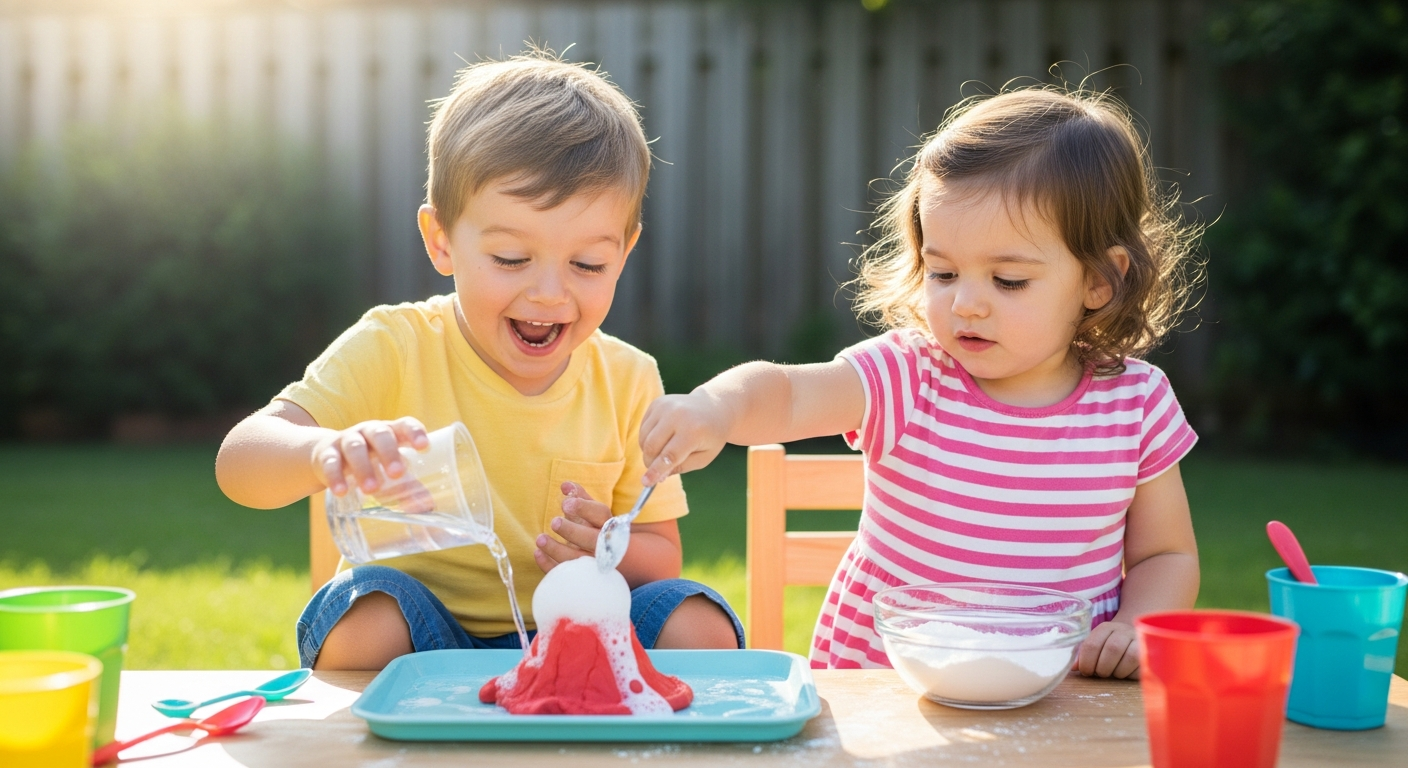
Table of Contents
- Introduction
- Why Science Matters for Toddler Development
- The Speech Blubs Connection: Learning Through Observation
- Category 1: Water and Buoyancy Experiments
- Category 2: Chemical Reactions (The "Fizz" Factor)
- Category 3: Biology and the Natural World
- Category 4: Physics and Light
- "Smart Screen Time": Enhancing Science Activities with Speech Blubs
- Transparent Pricing: Investing in Your Child’s Future
- Tips for Success with Science Toddler Activities
- Practical Scenario: The Water-Loving Toddler
- Conclusion
- Frequently Asked Questions
Introduction
Did you know that by the time a child reaches age three, their brain has formed about 1,000 trillion connections—roughly double the amount found in an adult brain? This explosive period of neural growth is why toddlers seem to be in a constant state of "doing": poking, pouring, tasting, and testing everything in their path. For a toddler, the world isn't just a place to live; it’s a giant laboratory. When we lean into this natural curiosity with intentional science toddler activities, we aren't just keeping them busy; we are laying the groundwork for critical thinking, language development, and a lifelong love of discovery.
At Speech Blubs, we believe that every moment is an opportunity for a child to "speak their minds and hearts." Our founders, who navigated their own speech challenges as children, designed our tools to be the joyful, effective solutions they wished they had. We know that for the 1 in 4 children who require speech support, traditional methods can sometimes feel like a chore. That’s why we advocate for "smart screen time" that mimics the way children learn best: through play and peer imitation.

In this post, we will explore a wide array of hands-on science experiments tailored for the shortest scientists. We’ll dive into why these activities are vital for speech development, how you can facilitate them at home with minimal mess, and how our unique video modeling methodology can help your child find the words to describe their amazing discoveries. Our goal is to provide you with a roadmap for creating joyful family learning moments that foster confidence and reduce communication frustration.
Why Science Matters for Toddler Development
Before we jump into the "how," let’s look at the "why." Science for toddlers isn't about memorizing the periodic table or understanding complex physics. It’s about the scientific method in its most raw form: observation, experimentation, and conclusion.
Building Foundational Cognitive Skills
When a toddler drops a heavy wooden block into a bucket of water and watches it sink, they are learning about gravity and buoyancy. When they mix yellow and blue paint to make green, they are witnessing a chemical-like transformation. These experiences build "schemas"—mental frameworks that help children organize and interpret information.
Enhancing Sensory Processing
Many science toddler activities are inherently sensory. Whether it’s the coldness of ice, the fizzing sound of baking soda reacting with vinegar, or the sticky texture of homemade slime, these activities help children regulate their sensory systems. This is particularly beneficial for children who may be over- or under-responsive to environmental stimuli.
Fostering Language and Vocabulary
Science provides a rich context for "new" words. Instead of just learning "ball" or "car," children engaged in science activities learn descriptive words like float, sink, dissolve, reaction, cold, slimy, transparent, and heavy. Using these words in context makes them much stickier in a child's memory.
If you are curious about how your child’s speech and language milestones are progressing during these play sessions, we invite you to take our quick 3-minute preliminary screener. It involves just 9 simple questions and provides an immediate assessment and a personalized next-steps plan for your little one.

The Speech Blubs Connection: Learning Through Observation
At Speech Blubs, our mission is to empower children by using a scientific approach called "video modeling." This is based on the concept of mirror neurons—the brain cells that fire both when we perform an action and when we observe someone else performing that same action.
When your toddler watches a peer in our app make a "b" sound for "bubbles," their brain is essentially practicing that sound along with them. This is why we call our app "smart screen time." Unlike passive cartoons that children simply watch, our app encourages active participation and imitation.
For a parent whose toddler is a "late talker" but loves water play, the "Splashy Time" section of our app is a perfect companion to the water-based science activities listed below. By seeing other children splash, blow bubbles, and name the objects in the water, your child gains the confidence to try those words themselves. You can download Speech Blubs on the App Store to see this methodology in action.
Category 1: Water and Buoyancy Experiments
Water is perhaps the most accessible "scientific material" in any home. It’s safe, inexpensive, and provides endless opportunities for exploration.
1. The Classic "Sink or Float" Station
This is the quintessential science toddler activity. It teaches observation and prediction.
- The Setup: Fill a large, clear plastic bin with water. Gather various household items: a plastic toy, a metal spoon, a cork, a rock, a leaf, and a piece of fruit.
- The Process: Before dropping each item, ask your child, "Will it sink or float?" Use hand gestures to indicate "down" for sink and "up" for float.
- The Speech Connection: Focus on the "f" sound in float and the "s" sound in sink. If your child is non-verbal, encourage them to point to the bottom of the bin or the surface of the water to make their prediction.
2. Colorful Ice Cube Melt
This activity introduces the concept of states of matter (solid to liquid) and color mixing.
- The Setup: Freeze water with different food colorings in an ice cube tray. Once frozen, place the cubes in a white bowl or on a light-colored tray.
- The Process: Let your toddler touch the ice. Discuss how it feels (cold, hard, slippery). As the ice melts, watch the colors bleed together to create new colors.
- The Speech Connection: This is a great time to practice color names. If you use red and blue ice, you can excitedly exclaim, "Look! Purple!" to encourage imitation.
Category 2: Chemical Reactions (The "Fizz" Factor)
Toddlers love a dramatic reaction. Using simple kitchen staples like baking soda and vinegar can create moments of genuine wonder.
1. Baking Soda Volcanoes
- The Setup: Place a small cup in the center of a tray. Fill it halfway with baking soda. In a separate cup, mix vinegar with a few drops of red food coloring.
- The Process: Give your child a dropper or a small spoon. Let them add the vinegar to the baking soda cup and watch the "lava" erupt.
- The Speech Connection: Focus on the "v" sound in volcano or the "p" sound in pop. The "shhh" sound of the fizzing is also a great phoneme to practice together.
2. Fizzing Dinosaur Eggs
For a toddler who loves prehistoric creatures, this activity is a guaranteed hit.
- The Setup: Mix baking soda with a little bit of water and food coloring until it forms a paste. Mold the paste around small plastic dinosaur figures to create "eggs." Let them dry overnight.
- The Process: Give your toddler a spray bottle filled with vinegar. As they spray the eggs, the "shells" will fizz away to reveal the dinosaur inside.
- The Speech Connection: For a child who loves animals, the "Animal Kingdom" section of Speech Blubs offers a fun, motivating way to practice sounds like "roar" or "stomp" while they play with their newly discovered dinosaurs.
Category 3: Biology and the Natural World
Science toddler activities don't have to stay in the kitchen. Heading outside or bringing nature indoors helps children understand the environment.
1. The Color-Changing Celery
This experiment demonstrates how plants "drink" water (capillary action).
- The Setup: Place a few stalks of celery (with leaves) into glasses of water heavily tinted with food coloring (blue and red work best).
- The Process: Check back every few hours. Over 24 hours, the leaves will begin to change color as the plant pulls the dyed water up through its stalks.
- The Speech Connection: Use this to talk about "drinking" and "growing." You can compare the celery drinking to your child drinking from their straw.
2. Nature Texture Rubbings
- The Setup: Go on a "science walk" and collect items with distinct textures: bark, dry leaves, flat stones, or even a coin.
- The Process: Place a piece of paper over the item and have your child rub a large crayon over it to reveal the texture.
- The Speech Connection: This is perfect for practicing adjectives like bumpy, smooth, rough, and hard.
Category 4: Physics and Light
Exploring how things move and how light behaves is a fantastic way to engage a toddler’s curiosity about the physical world.
1. Shadow Puppets and Light
- The Setup: Darken a room and use a bright flashlight against a plain wall.
- The Process: Show your child how moving their hand closer to the light makes the shadow bigger, and further away makes it smaller. Create simple animal shapes.
- The Speech Connection: This is an excellent opportunity for "vocal play." Make the sounds of the animals you are creating with shadows. You can even find these animals in our app to see how other kids make those sounds. See what other parents are saying about their child's success with this kind of play on our testimonials page.
2. Magnet Fishing
- The Setup: Tie a strong magnet to a string attached to a stick. Fill a box with various items (some magnetic, like paper clips or metal spoons, and some non-magnetic, like plastic blocks).
- The Process: Let your child "fish" and see what sticks.
- The Speech Connection: Use the word "stuck!" with emphasis. "Oh no, it’s stuck!" or "It didn't stick!" These are functional phrases that children can use in everyday life when they need help.
"Smart Screen Time": Enhancing Science Activities with Speech Blubs
While we love hands-on play, we also recognize that parents need a break, and children benefit from structured learning. Our app is designed to be a powerful supplement to these activities. Unlike traditional screen time, which is passive, Speech Blubs is an interactive experience designed to be used with an adult.
Our method is backed by science, placing us in the top tier of speech apps worldwide. You can read more about the research behind our video modeling methodology and why it’s so effective for developing communication skills.
Making it a Family Moment
We encourage "co-play." While your child is interacting with the app, sit with them. Repeat the sounds, mimic the facial expressions of the children on the screen, and connect what they see to the science toddler activities you did earlier in the day. If they see a child blowing a bubble on the screen, remind them of the bubble experiment you did in the backyard. This "bridging" helps solidify their learning.
Transparent Pricing: Investing in Your Child’s Future
We want to be clear and transparent about how you can access the full suite of Speech Blubs tools. We believe in providing value that grows with your child.
Our Subscription Plans
- Monthly Plan: $14.99 per month. This is a great way to test the waters and see how your child responds to our "smart screen time."
- Yearly Plan: $59.99 per year. This is the clear best choice for families committed to their child's development. At just $4.99 per month, you save 66% compared to the monthly plan.
Why the Yearly Plan is the Best Value
The Yearly plan isn't just about saving money; it’s about providing a more comprehensive educational experience. When you choose the Yearly plan, you receive:
- A 7-day free trial: Experience the full power of the app risk-free.
- The Reading Blubs App: An additional app specifically designed to bridge the gap between speech and early literacy.
- Early Access: Be the first to try new updates and features.
- Priority Support: Enjoy a 24-hour response time from our dedicated support team.
Please note that the Monthly plan does not include the free trial, the Reading Blubs app, or priority support. We highly recommend starting with the Yearly plan to ensure your child has every tool they need to succeed. Ready to get started? Create your account and begin your 7-day free trial today.
Tips for Success with Science Toddler Activities
To make these activities as stress-free and productive as possible, keep these tips in mind:
- Focus on the Process, Not the Result: Your toddler might not care if the "volcano" erupts perfectly. They might be more interested in feeling the wet baking soda. That’s okay! Science at this age is about exploration.
- Keep it Short: Toddlers have short attention spans. If an activity lasts five minutes, that’s a success.
- Narrate Everything: Use a technique called "parallel talk." Describe what your child is doing as they do it. "You are pouring the blue water. Splash! Now the water is all blue."
- Safety First: Always supervise your child during these activities, especially when using small items or liquids.
- Embrace the Mess: Science is messy. Lay down a plastic tablecloth or do the activities in the bathtub or outside to minimize cleanup stress.
Practical Scenario: The Water-Loving Toddler
Consider a parent whose 2-year-old, Leo, is obsessed with the garden hose but hasn't started using many words yet. Leo’s mom decides to set up a "Water Science Lab" on the back patio. She brings out different containers, some sponges, and a few "sink or float" items.
As Leo plays, Mom uses Speech Blubs on her phone. They open the "Big Mouth" section, and Leo watches a peer make the "w" sound for "water" and "wet." Mom mimics the "w-w-w" sound while Leo squeezes a wet sponge. Later, they move to the "Splashy Time" section. Because Leo has just been playing with water, he is highly motivated to imitate the children on the screen. He isn't just watching a video; he’s connecting a digital experience with a real-world sensory one. Within a few weeks of this combined approach, Leo starts saying "wawa" and "wet" during his bath time. This is the power of blending hands-on science toddler activities with purposeful, smart screen time.
Conclusion
Science toddler activities are more than just a way to pass a rainy afternoon. they are a gateway to understanding the world and a powerful tool for language development. By engaging your child’s senses and encouraging them to observe, predict, and experiment, you are helping them build the confidence to "speak their minds and hearts."
At Speech Blubs, we are honored to be a part of your family’s journey. Our app is built on the belief that learning should be joyful, peer-led, and scientifically sound. Whether your child is just starting to find their voice or needs a little extra support to reach their next milestone, our video modeling methodology offers a unique and effective solution.
Don't wait to start fostering your child's love for communication and discovery. Download Speech Blubs on the Google Play Store or the App Store today. Remember to choose the Yearly plan to take advantage of the 7-day free trial, the bonus Reading Blubs app, and the best overall value for your child’s growth. Together, we can make every discovery a reason to celebrate.
Frequently Asked Questions
1. Are science activities safe for toddlers who still put things in their mouths?
Yes, but you must choose your materials wisely. Stick to food-based science activities like using water, ice, flour, or vinegar and baking soda. Avoid small items like marbles, uninflated balloons, or toxic chemicals. Always provide 100% active supervision during any science activity.
2. My toddler has a very short attention span. Will these activities still work?
Absolutely! Science for toddlers isn't meant to be a long, sit-down lesson. If an activity captures their attention for 3 to 5 minutes, it has done its job. The goal is to spark a moment of curiosity, not to complete a complex project.
3. How do science activities help with a speech delay?
Science activities provide "functional language" opportunities. They give children a reason to communicate—to ask for more vinegar, to exclaim when something floats, or to describe a cold sensation. When children are excited by a scientific reaction, they are more motivated to try to name what they are seeing.
4. Can Speech Blubs replace professional speech therapy?
Speech Blubs is a powerful tool designed to supplement a child's overall development and, where applicable, professional therapy. It is an excellent way to practice at home between sessions, but it is not a replacement for the personalized care of a licensed Speech-Language Pathologist (SLP) if your child has a diagnosed delay.
Sobre el autor