
Fun and Easy Toddler Dot Sticker Activities for Early Learning
 Por Speech Blubs Team•18 mar 2026•14 min.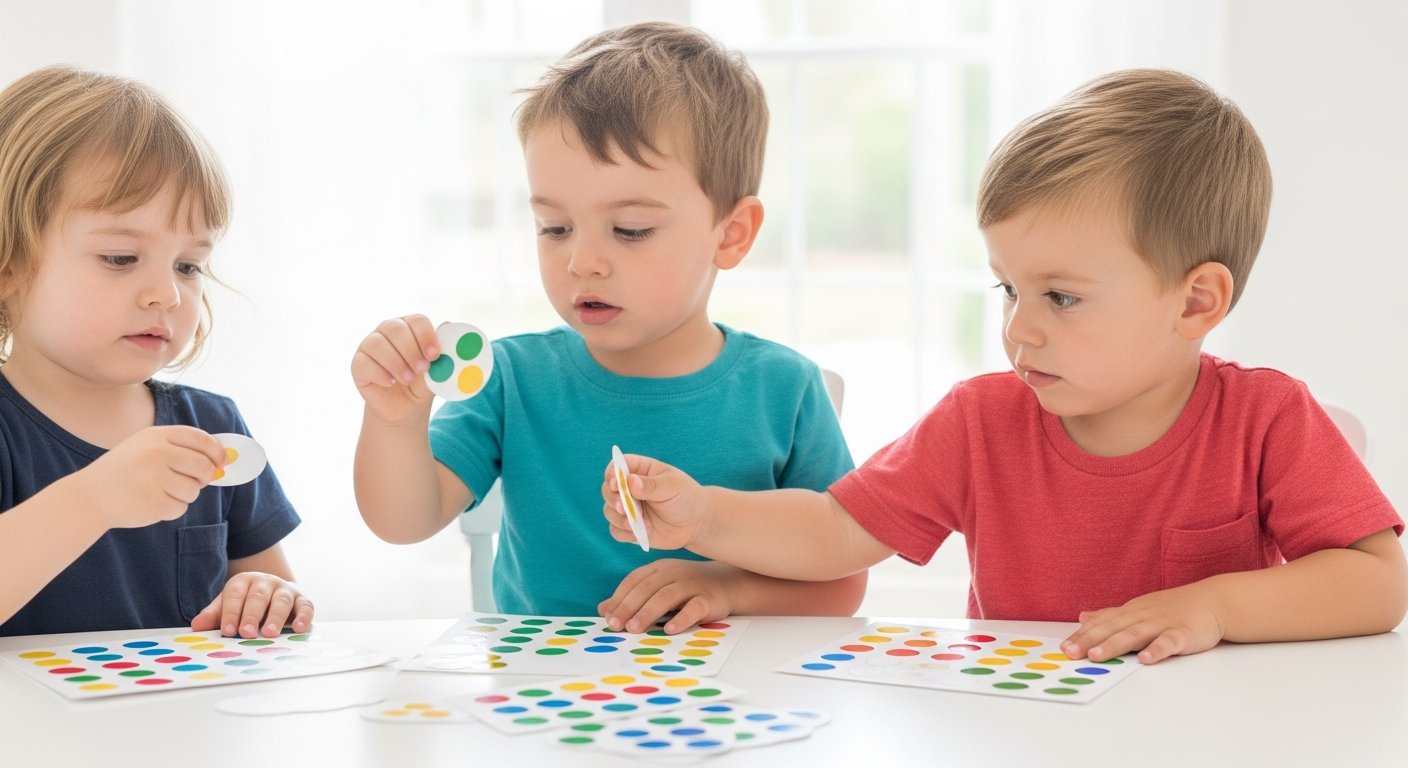
Table of Contents
- Introduction
- The Developmental Power of the Pincer Grasp
- The "Golden Pro-Tip" for Frustration-Free Play
- Literacy and Language Toddler Dot Sticker Activities
- Early Math and Logic with Dot Stickers
- Fine Motor Mastery and Process Art
- Why "Smart Screen Time" Matters
- Science-Backed Play: The Speech Blubs Difference
- Integrating Dot Stickers into Your Daily Routine
- Choosing the Right Plan for Your Family
- Building Confidence through Repetition
- Toddler Dot Sticker Activities for Sensory Explorers
- How Speech Blubs Complements Physical Play
- Practical Scenarios: Connecting Play to Speech
- A Note on Adult Co-Play
- Conclusion
- FAQ
Introduction
Have you ever handed your toddler a sheet of stickers, only to find them stuck to the dog, the underside of the coffee table, and somehow, the back of your own shirt five minutes later? If so, you already know the magnetic pull stickers have on little hands. But what if those tiny colored circles could be more than just household decorations? At Speech Blubs, we believe that the simplest tools often provide the most profound opportunities for growth. For the 1 in 4 children who may need extra support in their communication journey, these small "dot stickers" (also known as garage sale labels or coding dots) are an absolute powerhouse for development.

The purpose of this guide is to transform a basic office supply into a comprehensive developmental toolkit. We will explore a wide variety of toddler dot sticker activities designed to boost fine motor skills, encourage letter and number recognition, and most importantly, foster the communication skills that help your child "speak their mind and heart." Whether your child is a "late talker" or simply a curious explorer, these activities provide a bridge between physical play and cognitive milestones.
By the end of this post, you will have a library of low-prep, high-impact ideas that turn a rainy afternoon into a session of "smart play." We’ll show you how to pair these tactile experiences with the digital learning power of Speech Blubs to create a well-rounded environment for your little one.
The Developmental Power of the Pincer Grasp
Before we dive into the activities, it is essential to understand why we, as child development experts, are so obsessed with dot stickers. It all comes down to the "pincer grasp." This is the ability to use the thumb and index finger to pick up small objects. It might look simple, but it is a major neurological milestone.
The pincer grasp is the precursor to holding a pencil, buttoning a coat, and using a fork. When your toddler peels a dot sticker off a sheet, they are performing a high-level coordination task that requires focus and muscle control. At Speech Blubs, our mission is to provide an immediate and joyful solution for developmental hurdles. We know that building these foundational physical skills directly supports the brain's ability to process more complex tasks, like speech and language.
If you are curious about where your child stands in their developmental journey, we invite you to take our quick 3-minute preliminary screener. It consists of 9 simple questions and provides an assessment and next-steps plan to help you support your child's unique needs.
The "Golden Pro-Tip" for Frustration-Free Play
One common challenge parents face with toddler dot sticker activities is the "peel problem." Standard sticker sheets can be tight, making it difficult for tiny fingers to get under the edge of the sticker. This often leads to frustration and a quick end to the activity.

Here is the secret: Remove the matrix. The "matrix" is the white outline or the sticky "negative space" surrounding the circles on the sticker sheet. Once you peel away that border, the dot stickers sit independently on the slick backing paper. This makes them 100% easier for a toddler to grab on their own. This small step promotes independence, allowing your child to lead the play while you provide the linguistic "narration" that builds their vocabulary.
Literacy and Language Toddler Dot Sticker Activities
Communication is at the heart of everything we do. Our founders at Speech Blubs grew up with speech problems themselves, and they created the tool they wished they had—one that blends science with play. You can use dot stickers to mirror this approach by turning literacy into a tactile game.
1. The Name Ice Cream Cone
Draw a large triangle (the cone) and several circles (the scoops) on a piece of paper. Inside each scoop, write one letter of your child’s name. On individual dot stickers, write those same letters. Ask your child to match the "sprinkle" (the sticker) to the correct "scoop" (the letter on the paper).
Speech Tip: As they place each sticker, encourage them to say the sound of the letter. If your child is working on specific sounds, our video modeling methodology in the Speech Blubs app can help. They can watch other children make the same sounds, which triggers mirror neurons and encourages imitation.
2. Spotty Snakes for the "S" Sound
Draw a long, curvy snake on a sheet of paper. Write the letter "S" or "s" along its body. Have your child cover the snake in "spots" using the dot stickers. This is a fantastic way to associate the visual shape of the letter with its sound. For a child who loves animals, this activity becomes even more motivating when paired with the "Animal Kingdom" section of our app.
3. Letter Hunt and Match
Write uppercase letters on a piece of paper and lowercase letters on the dot stickers. This "search and rescue" mission for matching letters helps with visual discrimination—a key skill for reading later on.
Early Math and Logic with Dot Stickers
Mathematics in the toddler years isn't about equations; it's about patterns, sorting, and "one-to-one correspondence" (the understanding that one sticker equals the number one).
4. Caterpillar Counting
Draw a caterpillar head and then a series of empty circles for the body. Number each circle from 1 to 10. Give your child dot stickers and have them place one sticker in each circle while you count aloud together. This helps them visualize the sequence of numbers.
5. Color Sorting Graphs
Draw three or four columns on a piece of paper and mark the bottom of each with a different colored marker (red, blue, green, yellow). Give your child a mixed sheet of dot stickers and ask them to "park" the stickers in the correct "garage" based on color.
Practical Scenario: For a parent whose 3-year-old "late talker" is obsessed with cars, you can frame this as a car wash. "The red car is going to the red wash!" This type of narrating play is exactly how we foster a love for communication and reduce the frustration of not being able to express complex thoughts yet.
6. Dot Pattern Copying
Create a row of dots in a specific pattern (e.g., Red-Blue-Red-Blue). Ask your child to recreate that pattern underneath your row. Patterning is a foundational logic skill that helps children understand the structure of language and music.
Fine Motor Mastery and Process Art
Sometimes, the best activity is one with no "correct" answer. Process art focuses on the doing rather than the end result.
7. The Great Dot Sticker Line-Up
Draw various lines on a large piece of butcher paper—straight lines, zig-zags, and loops. Encourage your child to "drive" their stickers along the lines. This is incredible practice for hand-eye coordination.
8. Sticker Symmetry
Draw half of a butterfly or a heart and place a few stickers on one side. Ask your child to "copy" you on the other side. This introduces the concept of symmetry and balance in a very visual way.
9. Paper Chain Decorating
Before looping strips of construction paper into a chain, let your toddler go wild with the dot stickers. Once the chain is hung up, they can see their hard work displayed in the room, which builds confidence and a sense of pride in their creations.
Why "Smart Screen Time" Matters
We often hear from parents who are concerned about screen time. At Speech Blubs, we advocate for "smart screen time" as a powerful supplement to physical activities like dot sticker play. Unlike passive viewing—where a child might sit slumped watching cartoons—our app requires active participation.
Download Speech Blubs on the App Store or Google Play to see the difference. Our methodology is built on peer-to-peer modeling. When a child sees another child on the screen performing a task or making a sound, they are much more likely to attempt it themselves. It transforms the screen into a mirror of their own potential.
Science-Backed Play: The Speech Blubs Difference
Our approach isn't just about fun; it's rooted in scientific principles. We’ve designed our platform to be a joyful, screen-free alternative to passive consumption, but when the screen is on, we make sure every second counts. Our app has a high rating on the MARS scale (Mobile App Rating Scale) and is trusted by thousands of speech-language pathologists worldwide.
If you want to read more about the impact we’ve had on families, you can explore our parent testimonials. Many parents find that using the app for just 10-15 minutes a day, followed by a tactile activity like the ones mentioned above, creates the perfect environment for language "explosions."
Integrating Dot Stickers into Your Daily Routine
The beauty of toddler dot sticker activities is their portability. You don't need a designated "craft room" to make these work.
- In the Car: Keep a small notebook and a sheet of dots in the seat pocket for long rides.
- At a Restaurant: Dot stickers are much less messy than crayons and can keep a toddler occupied while waiting for their meal.
- During "Big Kid" Homework: If you have older children, give your toddler their "homework" (a sticker matching sheet) so they feel included in the family's learning time.
Choosing the Right Plan for Your Family
We want to make our resources as accessible as possible while providing the highest value to our community. When you decide to join the Speech Blubs family, we offer two main paths:
- Monthly Plan: For $14.99 per month, you get full access to our speech-boosting activities.
- Yearly Plan (Best Value): This is the clear choice for families committed to their child's long-term progress. At $59.99 per year, it breaks down to just $4.99 per month—a massive 66% savings compared to the monthly rate.
The Yearly Plan also includes exclusive benefits not found in the monthly option:
- A 7-day free trial to explore everything we offer risk-free.
- The Reading Blubs app, specifically designed to take your child from speech to reading.
- Early access to all new updates and features.
- Priority 24-hour support response time.
To get the full suite of features and start your journey with a free trial, we recommend signing up via our Web Account Creation page.
Building Confidence through Repetition
One thing you might notice is that your toddler wants to do the same activity over and over again. This is actually a fantastic sign! Repetition is how children "wire" their brains. When they peel that 50th sticker, they aren't just being repetitive; they are mastering a skill.
At Speech Blubs, we embrace this. Our activities are designed to be played multiple times, with each interaction building more confidence. We don't promise that your child will be giving public speeches in a month, but we do promise a journey filled with more "joyful learning moments" and fewer frustrations. We focus on building the foundational skills—like focus, imitation, and fine motor control—that make communication possible.
Toddler Dot Sticker Activities for Sensory Explorers
For some children, the sensation of the sticker is the most interesting part. You can lean into this by experimenting with different surfaces.
10. The Adhesion Science Lab
Create a "testing station" with different materials: a piece of aluminum foil, a scrap of felt, a piece of sandpaper, and a plastic lid. Ask your child to see which surface the stickers like the most. Does it stick to the fuzzy felt? Does it slide off the shiny foil? This builds "scientific thinking" and descriptive vocabulary (sticky, rough, smooth, shiny).
11. 3D Dot Art
Instead of paper, give your child an empty cardboard box or a clean plastic milk jug. Placing stickers on a curved or vertical surface requires a different set of motor skills than working on a flat table. It encourages them to move their bodies and adjust their grip.
How Speech Blubs Complements Physical Play
You might wonder how a "smart screen time" app fits with these physical activities. Think of Speech Blubs as the "coach" and the dot stickers as the "practice field."
In the app, your child might engage with the "Mouth Gym" or "First Words" sections, learning how to position their tongue and lips. Then, during a dot sticker activity, you can reinforce those same sounds. If they are placing a yellow sticker, you can emphasize the "Y" sound they just practiced in the app. This multi-sensory approach is why we are a leader in speech therapy tools for kids.
Practical Scenarios: Connecting Play to Speech
Let’s look at a common scenario. A parent, Sarah, noticed her 2-year-old was struggling to use more than single words. She started using the "Daily Routine" section in Speech Blubs to help him learn words like "brush," "eat," and "wash."
To reinforce this, she created a "Sticker Schedule." Every time her son finished a part of his morning routine, he got to put a dot sticker on a chart. This didn't just track his chores; it gave them a specific reason to talk. "You brushed your teeth! Where does the green sticker go?" This combination of visual, tactile, and digital learning helped bridge the gap in his communication.
A Note on Adult Co-Play
While we encourage independence, the most significant gains happen when you are right there with them. You don't need to lead the activity, but your presence as a "narrator" is invaluable. When you describe what they are doing ("You’re putting the blue dot next to the red dot!"), you are providing a rich linguistic environment. Our app is designed with this in mind—it's a tool for family connection, not a replacement for it.
Conclusion
Toddler dot sticker activities are more than just a way to keep your little one busy while you drink a cup of coffee. They are a gateway to fine motor mastery, early literacy, and confident communication. By taking a simple sheet of office supplies and adding a bit of creativity, you are supporting your child's brain in ways that will pay off for years to come.
At Speech Blubs, we are honored to be a part of your parenting journey. Whether you are using our app to help a late talker find their voice or looking for ways to make screen time more "smart," we are here to support you with scientific methodology and a heart for play.
Ready to take the next step in your child's development? Download Speech Blubs today on the App Store or Google Play. Remember to choose the Yearly plan to unlock your 7-day free trial, the Reading Blubs app, and the best value for your family. Let’s help your child speak their mind and heart, one dot at a time!
FAQ
1. What age is best for toddler dot sticker activities?
Most children can begin attempting these activities around 18 to 24 months, as their pincer grasp begins to refine. By removing the "matrix" (the sticky border) from the sheet, you can help younger toddlers be successful earlier. Always supervise your child to ensure they do not put the stickers in their mouth.
2. Can dot stickers really help with speech delays?
While dot stickers themselves are a motor skill tool, the interaction you have with your child while using them is what supports speech. By narrating their actions, practicing letter sounds, and following their lead, you create a low-pressure environment for language practice. For specific speech support, we recommend using these activities alongside our app.
3. Which dot stickers are best for toddlers?
We recommend the standard 3/4 inch (19mm) circular "coding labels" or "garage sale stickers." They are the perfect size for little fingers—not so small that they are impossible to handle, but small enough to require a precise pincer grasp. Neon colors are often especially engaging for young children.
4. How does Speech Blubs differ from other apps or cartoons?
Unlike cartoons, which are passive, Speech Blubs is an active, "smart screen time" experience. We use peer-to-peer video modeling, which is a scientifically proven method to encourage children to imitate sounds and words. It is designed to be a tool for connection and learning rather than just a distraction.
Sobre el autor