
Fun and Educational Easter Toddler Activities
 Por Speech Blubs Team•25 mar 2026•15 min.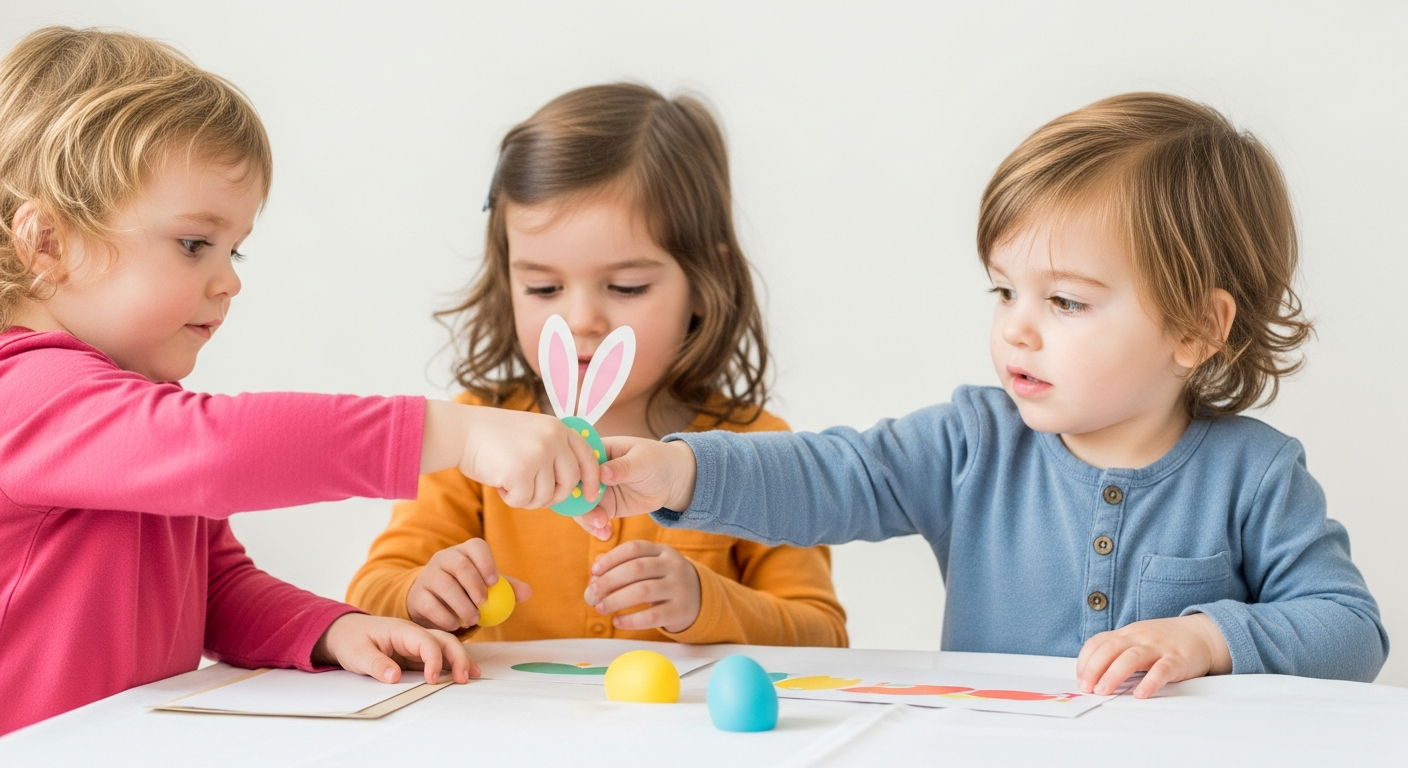
Table of Contents
- Introduction
- The Developmental Magic of Holiday Themes
- Fine Motor Easter Toddler Activities
- Sensory Exploration: Easter in a Bin
- Gross Motor Games: Hop, Skip, and Jump
- Cognitive and Language-Based Activities
- Integrating Speech Blubs into Your Holiday Routine
- Creative Crafts for Little Hands
- Setting Realistic Expectations
- Planning Your Easter Week
- Conclusion
- Frequently Asked Questions
Introduction
Have you ever watched a toddler spot a bright plastic egg hidden in the grass? That moment of pure, unadulterated joy—eyes wide, hands reaching, a triumphant squeal—is more than just a holiday highlight. It is a snapshot of a child’s brain in high gear. For a little one, an Easter egg isn’t just a plastic shell; it is a mystery to be solved, a sensory experience to be felt, and a linguistic opportunity to be seized. At Speech Blubs, we believe that these festive moments are the perfect laboratory for growth.
Easter presents a unique opportunity to engage your child in themed play that supports vital developmental milestones. Whether your child is a "late talker," a sensory seeker, or simply a busy bee, the right activities can bridge the gap between holiday fun and foundational learning. In this post, we will explore a wide variety of Easter toddler activities designed to boost fine motor skills, encourage sensory exploration, and—most importantly—foster a love for communication.

Our mission is to empower children to speak their minds and hearts. We know that the best learning happens through play, which is why we’ve curated these activities to be low-stress for you and high-engagement for them. From DIY sensory bins to gross motor games that get the whole family moving, we’ll show you how to turn this spring season into a developmental springboard. We’ll also discuss how to integrate "smart screen time" with the Speech Blubs app to reinforce these real-world experiences.
By the end of this guide, you will have a toolkit of playful strategies to make this Easter memorable and educationally rich. Let’s dive into how we can make this holiday a joyful step forward in your child's journey.
The Developmental Magic of Holiday Themes
Themed activities are not just about "cute" photos for the scrapbook. In the world of early childhood development, themes provide a cohesive framework that helps children organize new information. When a toddler sees a bunny in a book, then hops like a bunny in the living room, and finally watches a peer imitate a bunny on the Speech Blubs app, their brain is building a robust "schema" or mental map for that concept.
We prioritize this holistic approach because we know that 1 in 4 children will face a speech or developmental delay. Our founders, who all grew up with speech challenges themselves, created Speech Blubs to be the tool they wish they had: something that turns practice into a game. By pairing physical Easter toddler activities with our scientifically-backed video modeling, you are giving your child multiple "touchpoints" for learning.
Scientific research into "mirror neurons" shows that children learn best by watching and imitating. This is why our app features videos of real children—not cartoons—performing speech exercises. When you combine this "smart screen time" with hands-on Easter play, you are creating a powerful environment for your child to thrive. If you are curious about where your child currently stands, you can take our quick 3-minute preliminary screener to get an assessment and a personalized next-steps plan.

Fine Motor Easter Toddler Activities
Fine motor skills involve the coordination of small muscles in the hands and fingers. These skills are essential for future tasks like writing and buttoning clothes, but they are also deeply connected to speech development. The same areas of the brain that control hand movements are closely linked to the areas that control the mouth and tongue.
1. The Great Egg Stacking Challenge
This is one of the simplest yet most effective Easter toddler activities. Take a dozen plastic Easter eggs and pull them apart into halves. Encourage your toddler to stack the halves on top of one another.
- The Benefit: This builds hand-eye coordination and spatial awareness.
- Speech Integration: Use words like "up," "more," "tall," and "uh-oh!" when the tower inevitably falls. For a child working on the "U" sound, the "Animal Kingdom" section of our app can be a great way to practice the "ooo" sound in "Up" while they play.
2. Dot Sticker Egg Decorating
Instead of messy dyes, give your toddler a sheet of colorful dot stickers and a few paper egg cutouts. Ask them to peel and stick the dots onto the eggs.
- The Benefit: Peeling stickers requires the "pincer grasp" (using the thumb and index finger), which is a major milestone for toddlers.
- The Twist: If your child is ready for a challenge, draw circles on the paper egg and ask them to match the sticker to the circle.
3. Bunny Pom-Pom Drop
Find a clean, empty plastic bottle and tape a picture of a bunny over it, with the mouth of the bunny aligned with the opening of the bottle. Give your toddler a bowl of colorful pom-poms and let them "feed" the bunny.
- The Benefit: This activity focuses on precision and control.
- Real-World Scenario: For a parent whose 2-year-old is just starting to use "functional" language, this activity is a goldmine. As they drop a pom-pom in, you can model the phrase "Bunny eat!" or "Yum, yum!" This mimics our approach of encouraging simple, repetitive, and joyful communication.
Sensory Exploration: Easter in a Bin
Sensory play allows children to explore the world through touch, sight, and sound. It can be particularly grounding for children who get easily overwhelmed or frustrated by traditional learning methods.
4. The Classic Easter Sensory Bin
Fill a large plastic bin with green "Easter grass" (paper or plastic). Hide various objects inside: plastic eggs, small toy chicks, carrots, and smooth stones. Give your child spoons, tongs, or cups to dig through the grass.
- Speech Connection: As they find an object, name it together. "You found a yellow chick! Peep, peep!"
- Safety Tip: Always supervise sensory play to ensure no small parts become choking hazards.
5. Shaving Cream Egg Painting
Spray a layer of shaving cream onto a tray and drop in a few plastic eggs. Add drops of food coloring or liquid watercolors. Let your toddler roll the eggs around to "paint" them.
- The Benefit: This is a high-input sensory activity. The texture of the shaving cream combined with the visual of colors swirling is highly engaging.
- Our Method: At Speech Blubs, we focus on making "smart screen time" an active experience. After a messy sensory session, you can transition to the "Colors" section of the app to reinforce the names of the colors they just saw in the tray.
6. Kinetic Sand Egg Hunt
If you have kinetic sand at home, bury small Easter treasures inside a pile of it. Let your child "excavate" the items. The unique texture of the sand provides a calming sensory input that can help a child focus better on language tasks afterward.
Gross Motor Games: Hop, Skip, and Jump
Gross motor skills involve the large muscles of the body. Movement is essential for brain development and helps children burn off energy so they can better engage in focused learning later in the day.
7. The "Egg on a Spoon" Walk
This classic game is perfect for toddlers. Use a large wooden spoon and a plastic egg. Mark a "start" and "finish" line with painter's tape. Encourage your child to walk from one line to the other without dropping the egg.
- Modifying for Success: For younger toddlers, let them hold the egg with their hand on the spoon. The goal is the movement and the focus, not perfection.
- Encouraging Confidence: We often tell parents that building confidence is just as important as the skill itself. Celebrate every attempt with "You did it!" to build that vital self-esteem.
8. Bunny Hopscotch
Use painter's tape or chalk to create a simple hopscotch grid on the floor. Instead of numbers, draw a bunny or an egg in each square. Tell your child to "Hop like a bunny!" to each shape.
- Speech Integration: Each time they hop, have them say "Hop!" This correlates the physical action with the verbal command, a key principle we use to help children understand the power of their words.
- Deep Dive: Our research page explains how these types of multi-sensory associations are backed by science and place Speech Blubs in the top tier of educational apps.
9. Glow-in-the-Dark Egg Hunt
For a fun twist on the traditional hunt, put a small LED tea light or a glow-stick bracelet inside plastic eggs and hide them in a dimmed room.
- The Benefit: It changes the visual environment, making the search more exciting and requiring different visual tracking skills.
Cognitive and Language-Based Activities
Cognitive skills include memory, problem-solving, and the ability to categorize information. These Easter toddler activities are designed to "stretch" your child's thinking.
10. Easter Color and Shape Sorting
Gather a variety of plastic eggs in different colors. Set out colored bowls or pieces of construction paper that match the eggs. Help your child sort the blue eggs into the blue bowl, yellow into yellow, and so on.
- Advanced Version: If you have eggs with different patterns (stripes, dots), try sorting by pattern instead of color.
- The Learning Curve: Sorting is a pre-math skill that also helps with language categorization. In our app, we use similar "matching" mechanics to help children identify sounds and their corresponding objects.
11. "Where is the Bunny?" Hide and Seek
Hide a stuffed bunny or a large paper egg somewhere in the room. Give your child "hot or cold" clues.
- The Goal: This practices prepositional language: "under the chair," "on top of the table," "behind the curtain."
- Speech Tip: For kids who are non-verbal or using single words, use gestures alongside your words to help them understand the meaning.
12. Easter Storytime with a Twist
Read an Easter-themed board book together, but don't just read the words. Point to the pictures and ask open-ended questions. "What is the bunny doing?" "Where is his carrot?"
- Interactive Play: After reading, see if you can find a similar character in the Speech Blubs app. Watching another child "be" a bunny in our video modeling sections helps transition the story from the page to real life.
Integrating Speech Blubs into Your Holiday Routine
While hands-on play is the gold standard for development, we understand that modern parents need tools that provide high-quality, "smart screen time." This is where Speech Blubs becomes a powerful supplement to your Easter toddler activities.
Our app is designed to be a co-play experience. We don't want your child to sit passively in front of a screen. Instead, we use video modeling—the most effective way for kids to learn—to encourage them to interact. When a child on the screen makes a "pop" sound with a plastic egg, your child is much more likely to try it too.
Why Choose the Yearly Plan?
If you're ready to commit to your child's developmental progress, we highly recommend our Yearly Plan. At $59.99 per year, it breaks down to just $4.99/month, which is a 66% savings compared to our $14.99 Monthly Plan.
The Yearly Plan isn't just a better price; it includes premium features designed to give your child the best start:
- A 7-day free trial to explore all our content risk-free.
- The Reading Blubs app, which focuses on early literacy and phonics.
- Early access to all new updates and activities.
- 24-hour support response time from our dedicated team.
Create your account and begin your 7-day free trial today to see how our library of over 1,500 activities can turn your child’s holiday play into a year-round learning adventure.
Creative Crafts for Little Hands
Crafting is a wonderful way for toddlers to express themselves. At Speech Blubs, we want every child to "speak their minds and hearts," and sometimes, that expression comes through a paintbrush or a piece of construction paper.
13. Paper Plate Chick
Have your child paint a paper plate bright yellow. Once dry, help them glue on orange paper triangles for a beak, large googly eyes, and yellow feathers for wings.
- The Conversation: Talk about the texture of the feathers. Is it soft? Fluffy? This expands their descriptive vocabulary.
14. Tape Resist Egg Art
Place pieces of painter's tape in a pattern across a large paper egg. Let your child paint over the whole thing with watercolors or sponges. Once the paint is dry, peel off the tape to reveal the white lines underneath.
- The Surprise Factor: The "reveal" moment is a great time to practice "Wow!" or "Look!"
- Scenario: If your 3-year-old "late talker" loves art, this activity is a perfect way to build "joint attention"—the ability to focus on an object together with another person—which is a foundational building block for communication.
Setting Realistic Expectations
It’s important to remember that every child develops at their own pace. While these Easter toddler activities are designed to be educational, the primary goal is to create joyful family learning moments and reduce frustration. Don't worry if your child doesn't want to stack the eggs or if they prefer to dump the sensory bin rather than sort the items.
"At Speech Blubs, we don't focus on guaranteed outcomes like 'speaking in sentences by Monday.' Instead, we focus on fostering a love for communication and building the foundational skills that make that communication possible."
The beauty of play-based learning is that there is no "wrong" way to do it. If your child is engaged, they are learning. Our app serves as a powerful supplement to these moments, providing a structured yet playful way to practice speech sounds and social cues. You can read testimonials from other parents to see how this low-pressure, high-fun approach has worked for thousands of families worldwide.
Planning Your Easter Week
If you're feeling overwhelmed by all these ideas, try a "themed week" approach. You don't have to do everything in one day!
- Monday: Fine Motor Day (Egg stacking and stickers).
- Tuesday: Sensory Day (The Easter grass bin).
- Wednesday: Gross Motor Day (The egg on a spoon walk).
- Thursday: Cognitive Day (Color and shape sorting).
- Friday: Craft Day (Paper plate chicks).
- Saturday: Integration Day (Use Speech Blubs to review the sounds and words from the week).
- Easter Sunday: The Big Hunt!
This structured yet flexible schedule keeps things fresh and gives your child something to look forward to each morning.
Conclusion
Easter is a season of growth and new beginnings, making it the perfect time to focus on your child’s developmental journey. By engaging in these Easter toddler activities, you aren't just filling time; you are actively building the brain connections your child needs to communicate, move, and think effectively. Whether you’re sorting colorful eggs or hopping like a bunny across the living room, you are providing the "fuel" for their development.
At Speech Blubs, we are honored to be a part of that journey. We believe in the power of "smart screen time" to supplement real-world play, offering a joyful, effective, and scientifically-grounded way for children to find their voices. Our mission is to ensure that no child is left without the support they need to express themselves.
Ready to take the next step? Give your child the gift of communication this Easter. Download Speech Blubs on the App Store or Google Play to begin. We highly recommend choosing the Yearly Plan to unlock the full suite of features, including Reading Blubs and a 7-day free trial. Let’s work together to help your little one speak their mind and heart!
Frequently Asked Questions
1. How can I adapt Easter toddler activities for a child with a speech delay?
Focus on "functional language" and repetition. Instead of asking your child to say complex sentences, focus on single words or sounds that accompany an action. For example, say "Hop!" every time they jump, or "Pop!" every time they open a plastic egg. Using the Speech Blubs app alongside these activities can provide the video modeling they need to see how other children form those same sounds.
2. Are these activities safe for 18-month-olds?
Most of these activities can be adapted for younger toddlers. However, you must always be mindful of choking hazards, especially with small plastic eggs, pom-poms, or sensory bin fillers. Always supervise play and choose larger items if your child is still in the "mouthing" phase.
3. Why is "smart screen time" better than regular cartoons?
Passive screen time, like watching cartoons, doesn't require the child to engage or respond. "Smart screen time," like Speech Blubs, uses active video modeling. It encourages the child to imitate, interact, and participate in the learning process. This turns the screen into a tool for connection rather than a distraction.
4. What is the best value for a Speech Blubs subscription?
The Yearly Plan is the best choice for families. At $59.99 per year, you save 66% compared to the monthly rate. It also includes exclusive benefits like a 7-day free trial, the Reading Blubs app for early literacy, and 24-hour support response times, ensuring you have everything you need for your child's success.
Sobre el autor