
Fun and Engaging Busy Toddler 2 Year Old Activities
 Por Speech Blubs Team•18 mar 2026•16 min.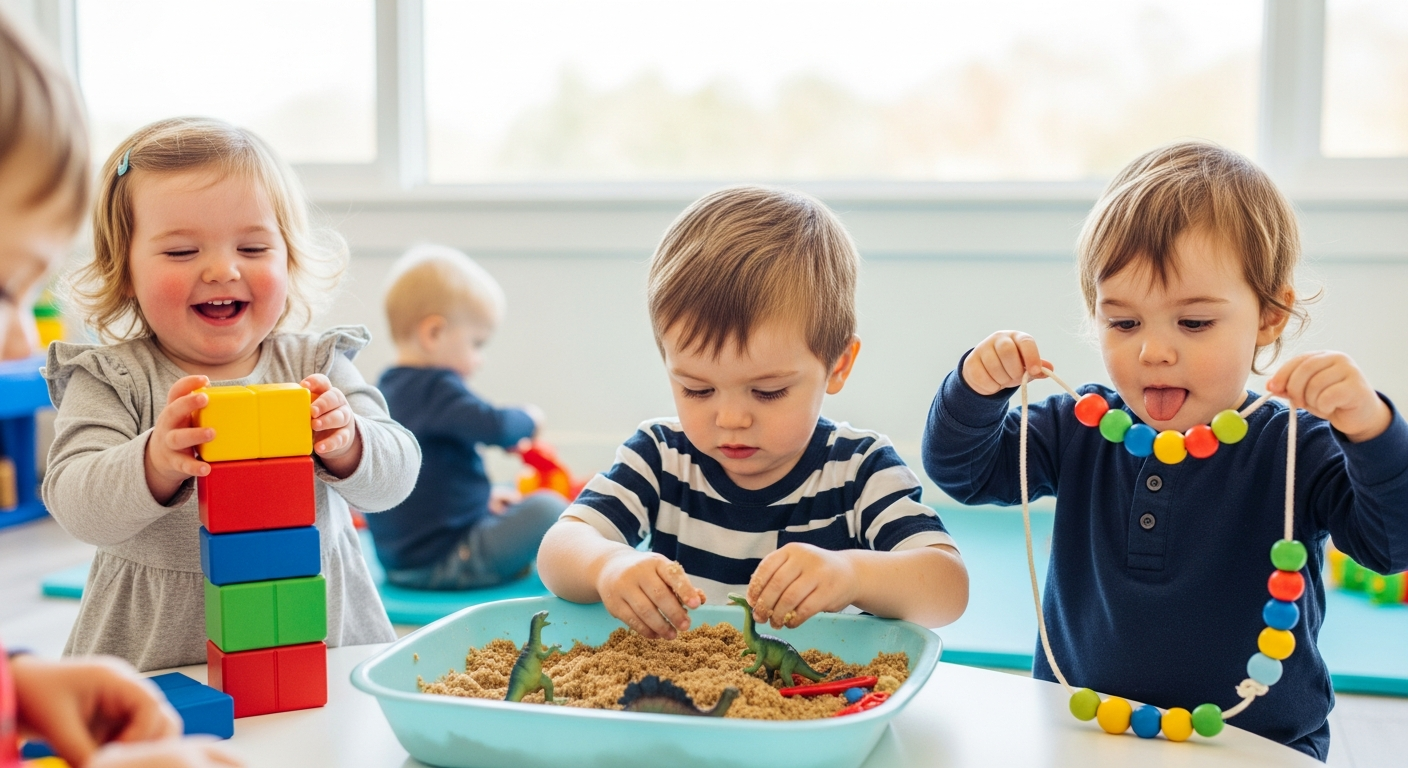
Table of Contents
- Introduction
- The Science of Play and Language at Age Two
- Sensory Play: The Foundation of Learning
- Fine Motor Activities for Busy Hands
- Gross Motor Play: Burning That Energy
- Integrating Smart Screen Time
- Practical Strategies for "Sittervising"
- Building Confidence and Reducing Frustration
- Choosing the Right Plan for Your Family
- Practical Scenarios: Real-World Challenges
- Why 1 in 4 Children Need Support
- Summary of Key Takeaways
- Conclusion
- Frequently Asked Questions
Introduction
Did you know that a typical two-year-old takes about 17,000 steps every single day? That is roughly the equivalent of walking a few miles for an adult, all contained within the boundaries of your living room, the park, and the grocery store. If you feel exhausted just watching your little one zoom from the toy box to the kitchen and back again, you aren’t alone. This age is a whirlwind of physical growth, emotional discovery, and a massive "language explosion" that can leave even the most prepared parents feeling a step behind.
At Speech Blubs, we understand this whirlwind intimately. Our company was born from the personal experiences of our founders, who all grew up with speech challenges. They created the very tool they wished they had as children—a way to make learning to talk as joyful and natural as play itself. We know that for the 1 in 4 children who need speech support, the right activities can make all the difference. Our mission is to empower children to "speak their minds and hearts" by blending scientific principles with play.

In this post, we are going to dive deep into a variety of busy toddler 2 year old activities that do more than just "fill time" until nap time. We will explore sensory play, fine motor tasks, and "smart screen time" solutions that foster communication, build confidence, and reduce the frustration that often leads to those famous toddler tantrums. Whether you are looking for a way to encourage a "late talker" or simply need five minutes to drink a cup of coffee while your child learns, we have you covered. Our goal is to help you create joyful family learning moments that build the foundation for a lifetime of confident communication.
The Science of Play and Language at Age Two
Before we jump into the specific activities, it is helpful to understand what is happening inside that busy toddler brain. At age two, children are transitioning from being "babies" to "little people." They are starting to understand that they are separate individuals from their parents, which leads to a fierce desire for independence. This is also when "mirror neurons" are firing at an incredible rate.
Mirror neurons are special brain cells that fire both when an individual performs an action and when they observe someone else performing that same action. This is why children are such natural imitators. This biological reality is the cornerstone of our scientific methodology at Speech Blubs. We utilize "video modeling," where children watch their peers—other kids—performing speech sounds and facial movements. Seeing a "peer" do it makes the task feel achievable and fun, which is far more effective than just watching an adult.
When you engage in the activities listed below, remember that you are your child’s primary model. By narrating what you are doing, using simple words, and showing enthusiasm, you are feeding their brain the data it needs to start talking.
Sensory Play: The Foundation of Learning
Sensory play is any activity that stimulates a child’s senses: touch, smell, taste, sight, and hearing. For a two-year-old, the world is one giant sensory bin. Sensory play is crucial because it helps build nerve connections in the brain’s pathways, which lead to the child’s ability to complete more complex learning tasks.

The Classic Rice Bin
A simple plastic tub filled with dried rice is a toddler's paradise. It offers a unique tactile experience that is both calming and stimulating.
- How to do it: Fill a shallow bin with a few bags of inexpensive white rice. Add measuring cups, funnels, and small toy animals.
- Speech Connection: Use descriptive words like "pour," "crunchy," "hide," and "find." If your child loves animals, hide them in the rice and practice their sounds. For example, for a parent whose 2-year-old "late talker" loves farm life, the "Animal Kingdom" section of our app offers a fun, motivating way to practice "moo" and "baa" sounds before finding those same animals in the rice bin.
The "Popsicle Bath"
This is a favorite among the Speech Blubs homepage community because it solves two problems at once: it keeps a toddler busy and cleans up a sticky mess.
- How to do it: Simply give your child a popsicle while they are in a lukewarm bath.
- Why it works: The sensory contrast between the cold popsicle and the warm water is fascinating to a toddler. It keeps them stationary and engaged for a significant amount of time, giving you a chance to sit nearby and interact.
- Speech Connection: Talk about "cold" and "warm," "sticky" and "wet." These basic opposites are foundational vocabulary words.
Bubble Foam Fun
Bubble foam is a more structured version of soap suds that holds its shape, making it perfect for sensory exploration.
- How to do it: Mix two parts water with one part tear-free bubble bath or dish soap in a blender. Add a drop of food coloring and blend until it forms stiff peaks. Dump it into a large tray.
- Speech Connection: Practice blowing the foam. This strengthens the "oral-motor" muscles needed for clear speech. Encourage your child to say "pop" every time a bubble disappears.
Fine Motor Activities for Busy Hands
Fine motor skills involve the use of the small muscles in the hands and wrists. Developing these muscles is essential for future tasks like writing and buttoning clothes, but it also has a surprising link to speech. The parts of the brain responsible for fine motor control and language production are located right next to each other and often develop in tandem.
The Sticker Wall
Two-year-olds often struggle with the "pincer grasp" (using the thumb and index finger). Peeling stickers is the ultimate workout for these muscles.
- How to do it: Tape a large piece of butcher paper or the back of a wrapping paper roll to the wall at your child's eye level. Give them a sheet of "dot stickers" or any inexpensive stickers.
- Speech Connection: As they peel and stick, narrate the colors. "Red sticker! Blue sticker!" If your child is struggling with certain sounds, you can draw a large letter on the paper and have them "trace" the letter by placing stickers along the lines.
Card Slot Drop
This is a brilliant activity for the 18-to-24-month crowd, often called "tabies." It requires focus and precision.
- How to do it: Take an old oatmeal container or a plastic tub with a lid. Cut a thin slit in the top, just wide enough for a playing card. Give your child a deck of cards and let them drop them in one by one.
- Why it works: Toddlers at this age are obsessed with "enveloping" and "containing"—putting things inside other things.
- Speech Connection: Every time a card drops, say "in!" or "gone!" This reinforces the concept of object permanence and basic functional language.
Tape Rescue
If you need a low-prep activity that keeps a child focused, tape rescue is your best friend.
- How to do it: Tape several of your child’s plastic animals or cars to a cookie sheet using painter’s tape (which is easy to remove and won't leave a residue). Challenge your child to "rescue" the toys by peeling the tape off.
- Speech Connection: Use verbs like "pull," "help," "stuck," and "free." This mimics the problem-solving language we use in daily life.
Gross Motor Play: Burning That Energy
Since two-year-olds have seemingly infinite energy, we need activities that allow them to move their whole bodies. Gross motor play builds core strength and coordination.
The Painter’s Tape Track
Transform your hallway into a raceway or a balance beam using nothing but blue painter's tape.
- How to do it: Create long lines, zig-zags, and squares on your floor.
- Activity ideas: Tell your child to "walk on the line" like a tightrope walker, or drive their toy cars along the "road."
- Speech Connection: This is great for teaching prepositions. "Go around the corner," "Walk over the tape," or "Stand inside the square."
Indoor Scavenger Hunt
You don't need a map or a treasure chest to go on a hunt.
- How to do it: Ask your child to find something "red," something "soft," or something "loud."
- Speech Connection: This activity builds "receptive language"—the ability to understand and follow directions. If you want to see how your child's language skills compare to typical milestones, you can take our quick 3-minute preliminary screener. It involves 9 simple questions and provides an assessment and a next-steps plan.
Integrating Smart Screen Time
We live in a digital world, and while passive viewing (like watching endless loops of cartoons) can sometimes lead to "zombie mode," we believe in the power of "smart screen time." At Speech Blubs, we’ve created a tool that encourages active participation rather than passive consumption.
Our app is designed to be a "screen-free alternative" in spirit—it’s a digital tool that inspires real-world action. When a child uses Speech Blubs, they aren't just looking at a screen; they are making faces, practicing sounds, and interacting with you. This is why we always frame our app's use with an implicit understanding of adult co-play.
For example, if you are using the "Early Words" section, don't just hand the phone to your toddler. Sit with them. When the child on the screen says "Bubba," you say "Bubba," and encourage your toddler to do the same. This creates a powerful feedback loop. You can read more success stories from other parents to see how this interactive approach has helped thousands of families.
The Difference of Video Modeling
Most "educational" apps use cartoons. While colorful, cartoons don't provide the same neurological "mapping" as a real human face. When a 2-year-old sees another child's lips move to make a "P" sound, their brain recognizes that "that person looks like me," which triggers those mirror neurons we discussed earlier. This is the "smart" in our smart screen time.
Practical Strategies for "Sittervising"
As parents, we are often told we need to be "on" 24/7, playing on the floor with our children. While co-play is essential, "sittervising"—the act of supervising your child while you sit nearby—is also a valid and necessary parenting tool. It allows your child to develop independent play skills while you get a much-needed moment of rest.
To make sittervising work for busy toddler 2 year old activities:
- Set up the environment: Ensure the area is safe and the activity is self-contained (like a sensory bin on a towel).
- Be the "Sportscaster": You don't have to be holding the toy to be involved. Narrate what they are doing from your seat. "Oh, you put the blue block on top! It's getting tall!"
- Use Speech Blubs as a Bridge: If you are feeling particularly drained, the app can act as the "model" for a few minutes while you supervise. To get started, download Speech Blubs on the App Store or get it on Google Play.
Building Confidence and Reducing Frustration
One of the biggest challenges with two-year-olds is the frustration that comes from having big thoughts but not yet having the words to express them. This is often the root cause of tantrums. By engaging in these activities, you are giving your child "functional communication" tools.
Instead of focusing on "perfect" speech, focus on the benefits of the process:
- Fostering a love for communication: If a child feels successful in a game, they are more likely to try talking in other settings.
- Building confidence: Every time they "rescue" a toy or finish a puzzle, they learn that they are capable.
- Developing foundational skills: Eye contact, turn-taking, and following simple directions are all precursors to verbal speech.
Choosing the Right Plan for Your Family
We want to be transparent and helpful when it comes to bringing Speech Blubs into your home. We offer two main paths to support your child's development, and we want to ensure you choose the one that provides the most value for your journey.
Our Monthly Plan is $14.99 per month. It’s a great way to test the waters if you are curious about how your child will respond to video modeling.
However, the Yearly Plan is the clear best choice for most families, and here is why:
- Superior Value: At $59.99 per year, it breaks down to just $4.99 per month—a 66% savings compared to the monthly option.
- 7-Day Free Trial: You can explore the entire app with your child risk-free for a full week to see the "joyful learning" in action.
- Reading Blubs Included: The yearly plan includes our companion app, Reading Blubs, which helps transition those early speech skills into literacy.
- Priority Support: You get 24-hour support response times and early access to all our new updates and features.
The Monthly plan does not include the free trial, the Reading Blubs app, or priority support. We encourage parents to sign up on the web for the Yearly plan to ensure they have every tool available to help their child succeed.
Practical Scenarios: Real-World Challenges
Let's look at how these activities and tools work in a real household.
Scenario A: The High-Energy "Runner" If your 2-year-old refuses to sit still for even a minute, don't force it. Use the "Painter's Tape Track" mentioned earlier. While they are "zooming" along the track, use Speech Blubs on your tablet or phone. Stop them at various "stations" on the tape track and ask them to mimic a sound from the "Wild Animals" section before they can continue their "race." This turns speech practice into a high-energy game.
Scenario B: The Quiet "Late Talker" For a child who is more observant and hesitant to speak, sensory bins are a low-pressure entry point. While they are focused on the tactile sensation of the rice or water, they are in a "flow state" where they are more relaxed. This is the perfect time to introduce the peer-to-peer video modeling in our app. Watching another child their age have fun making sounds can be the spark that encourages them to try it themselves.
Why 1 in 4 Children Need Support
It is a common myth that children will "just grow out of it" if they are late talkers. While every child develops at their own pace, the "wait and see" approach can often lead to unnecessary frustration for both the parent and the child. Early intervention is the most effective way to ensure a child reaches their full potential.
Speech Blubs isn't a replacement for professional therapy—if you have concerns, we always recommend speaking with a licensed Speech-Language Pathologist (SLP). However, our app is a powerful supplement that can be used at home every day. It provides the repetition and engagement that children need to build those foundational skills in a way that feels like a "treat" rather than "work."
Summary of Key Takeaways
Creating a stimulating environment for a two-year-old doesn't require expensive toys or a degree in early childhood education. It requires a little bit of creativity and an understanding of how toddlers learn.
- Prioritize Sensory Play: Use household items like rice, water, and bubbles to build brain connections.
- Focus on Fine Motor: Peel stickers and drop cards to strengthen the hands and the speech centers of the brain.
- Move Your Body: Use tape tracks and scavenger hunts to burn energy and teach prepositions.
- Embrace Smart Screen Time: Use tools like Speech Blubs to provide peer-to-peer modeling that inspires imitation.
- Be a "Sportscaster": Narrate your child's world to build their vocabulary.
Conclusion
The "busy" in "busy toddler" isn't a challenge to be overcome—it's a sign of a healthy, curious mind eager to understand the world. By providing your two-year-old with a variety of engaging activities, you are doing more than just keeping them occupied. You are building their confidence, fostering a love for learning, and helping them find their voice.
At Speech Blubs, we are honored to be a part of that journey. We invite you to join our community of parents who are transforming screen time into a joyful, educational experience. Remember, the goal isn't to create a child who can give a public speech by next month; it’s about creating moments of connection and reducing the hurdles between your child’s heart and their words.
Ready to start this exciting chapter? We recommend downloading the app and choosing the Yearly plan to get the absolute best value, including your 7-day free trial and the Reading Blubs app. You can start your journey here and see for yourself how joyful speech therapy can be.
Frequently Asked Questions
1. How much time should my 2-year-old spend on "smart screen time" apps? We recommend keeping sessions short and interactive. For a two-year-old, 10 to 15 minutes of "smart screen time" with an adult present is usually the sweet spot. The goal is to use the app as a "spark" for real-world interaction and imitation, rather than a long-term distraction.
2. My child isn't talking much yet. Will these activities really help? Yes! Language development starts with "receptive language" (understanding) and "pre-verbal skills" (pointing, eye contact, imitation). Activities like sensory bins and gross motor games build these foundational skills. Our app uses peer-to-peer modeling specifically to encourage children who are hesitant to speak by showing them that other kids can do it.
3. What is the difference between the Speech Blubs Monthly and Yearly plans? The Monthly plan is $14.99 and provides basic access. The Yearly plan is much more cost-effective at $59.99 (about $4.99/month). Most importantly, the Yearly plan includes a 7-day free trial, the Reading Blubs app for early literacy, and priority support. We always recommend the Yearly plan for families looking for a comprehensive development tool.
4. Can I use these activities if my child is already in speech therapy? Absolutely. Many SLPs actually recommend Speech Blubs as a way to practice at home between sessions. These activities are designed to be a "powerful supplement" to a child's overall development plan. They provide the repetition and "play-based" practice that reinforces what they learn in a clinical setting.
Sobre el autor