
Fun Proprioceptive Activities for Your Busy Toddler
 Por Speech Blubs Team•18 mar 2026•14 min.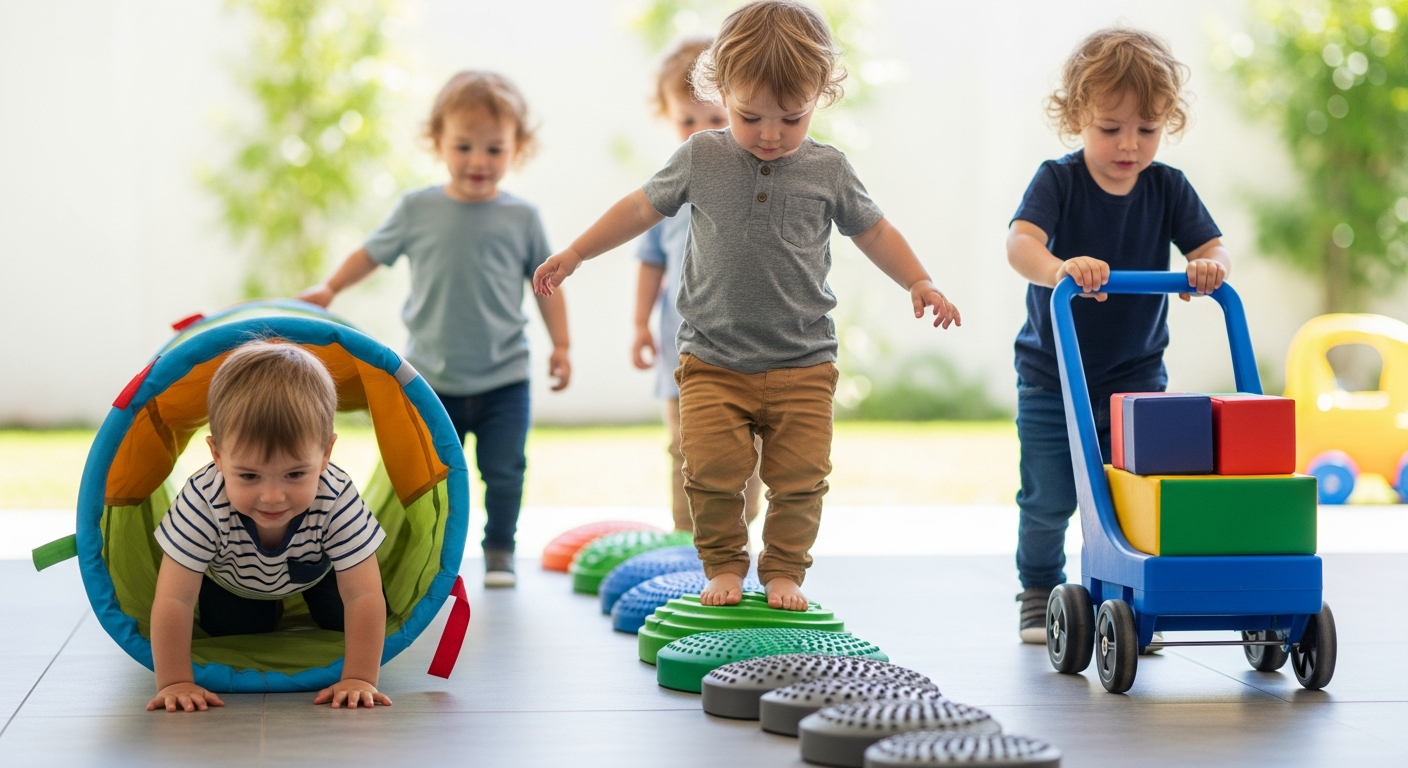
Table of Contents
- Introduction
- What Exactly is Proprioception?
- Why Your Toddler Needs "Heavy Work"
- Signs Your Child is Seeking Proprioceptive Input
- 25 Practical Proprioceptive Activities for Home
- The Speech Blubs Approach: Connecting Movement and Voice
- How to Build a "Sensory Diet" into Your Daily Routine
- Realistic Expectations for Sensory Progress
- Choosing the Right Plan for Your Family’s Journey
- Conclusion
- FAQ
Introduction
Have you ever noticed your toddler intentionally "crashing" into the sofa at full speed, or perhaps they seem to have a never-ending urge to jump on the bed? Maybe they tend to hold your hand just a little too tightly, or they constantly seek out the smallest, tightest spaces to crawl into. If these scenarios sound familiar, you aren’t just looking at a "high-energy" child—you are witnessing a child seeking proprioceptive input.
At Speech Blubs, we believe that understanding your child’s sensory needs is a fundamental step in helping them "speak their minds and hearts." Our mission is to empower children by providing joyful, effective tools that support their overall development. Because our founders grew up with speech challenges themselves, they created the very tool they wished they had: a way to blend scientific principles with the power of play.

In this article, we will dive deep into the world of the proprioceptive system. We will explore why this "sixth sense" is vital for your toddler's coordination and self-regulation, and we will provide you with a comprehensive list of proprioceptive activities for toddlers that you can start today. Our goal is to give you practical, empathetic advice that moves beyond the screen to foster real-world family connections. We want to help you turn "wild" moments into "smart" learning opportunities.
By the end of this guide, you will understand how movement and speech are intertwined, and how you can support your child’s growth through simple, heavy-work activities.
What Exactly is Proprioception?
While we are all familiar with the five basic senses—sight, smell, taste, touch, and hearing—there are actually other systems working behind the scenes. One of the most important for a growing toddler is proprioception.
In simple terms, proprioception is your body’s ability to know where its parts are in space without you having to look at them. This information comes from tiny receptors located in our muscles, joints, and connective tissues. When your child pushes, pulls, jumps, or even chews, these receptors send messages to the brain about pressure, stretch, and position.
Think of it as the body's internal GPS. It allows us to:
- Walk up the stairs without staring at our feet.
- Judge how much force is needed to pick up a delicate egg versus a heavy gallon of milk.
- Sit upright in a chair without sliding off.
- Coordinate complex movements like throwing a ball or, eventually, forming the intricate mouth movements required for speech.
For the 1 in 4 children who may need extra support in their development, the proprioceptive system is often a key area of focus. At Speech Blubs, we view this sensory system as a foundation for communication. After all, speech itself is a motor activity that requires intense "oral-motor" proprioception. To learn more about how our approach is backed by these scientific principles, you can explore our research page.

Why Your Toddler Needs "Heavy Work"
In the world of occupational therapy, you will often hear the term "heavy work." These are activities that provide significant resistance to the muscles and joints. Heavy work is the primary way we feed the proprioceptive system.
The benefits of these activities are vast. For many toddlers, proprioceptive input is naturally organizing and calming. If a child is feeling overstimulated or "revved up," a few minutes of pushing a heavy laundry basket or jumping on a trampoline can help reset their nervous system.
Key Takeaway: Proprioceptive input is unique because it is "bi-directional." It can help calm a child who is anxious or hyperactive, and it can help alert a child who feels sluggish or "low energy."
When you integrate heavy work into your toddler's day, you are helping them:
- Develop Body Awareness: They learn where their body ends and the world begins.
- Improve Force Grading: They learn not to accidentally break their crayons or squeeze the cat too hard.
- Enhance Postural Stability: This makes it easier for them to sit and focus during mealtime or when using educational tools like Speech Blubs.
- Reduce Frustration: A child who feels "grounded" in their body is often less prone to sensory-driven meltdowns.
If you are curious about how your child’s sensory and communication skills are developing, we invite you to take our quick 3-minute preliminary screener. It consists of 9 simple questions and provides an assessment and a next-steps plan tailored to your family.
Signs Your Child is Seeking Proprioceptive Input
Every child processes sensory information differently. Some toddlers are "seekers"—their bodies need a lot of input to feel regulated. Others may have "low registration," meaning they are a bit clumsy because their brain isn't getting clear signals from their joints.
The Proprioceptive Seeker
You might have a seeker on your hands if your toddler:
- Constantly jumps on furniture or crashes into the floor.
- Loves being squeezed in "bear hugs" or wrapped tightly in blankets.
- Chews on their sleeves, toys, or non-food items.
- Plays "rough" with other children without meaning to cause harm.
- Walks heavily or prefers to stamp their feet.
The Under-Responsive Toddler
You might notice low registration if your toddler:
- Appears clumsy or frequently bumps into doorframes and tables.
- Slumps in their chair or prefers to lie on the floor while playing.
- Has a very high pain tolerance (they fall, but don't seem to notice).
- Struggles with fine motor tasks like using a spoon or putting on socks.
By recognizing these signs, you can proactively offer activities that meet their needs. For example, for a parent whose 3-year-old "late talker" loves animals but struggles to stay still, the "Animal Kingdom" section of our app offers a fun, motivating way to practice "moo" and "baa" sounds while you encourage them to do "Bear Crawls" around the room. You can download Speech Blubs on the App Store to see these peer-led videos in action.
25 Practical Proprioceptive Activities for Home
You don't need expensive equipment to provide great sensory input. Most of the best heavy-work activities use items you already have.
Weight-Bearing and Resistance
Weight-bearing activities put pressure on the joints, which is highly regulating.
- Animal Walks: Have a race! Try "Bear Crawls" (hands and feet), "Crab Walks" (tummy up, hands and feet), or "Frog Jumps."
- Wall Push-Ups: See how many "pushes" your toddler can do against a sturdy wall.
- Tug-of-War: Use a soft scarf or a rope. Let them pull against your resistance.
- Wheelbarrow Walking: Hold your toddler's ankles while they walk forward on their hands.
- The "Mummy Wrap": Wrap them snugly in a beach towel or blanket (ensure their face is clear) and let them try to "wiggle out" or walk like a mummy.
Pushing, Pulling, and Lifting (The "Helpful" Chores)
Toddlers love to feel like they are contributing. These chores are actually hidden sensory therapy. 6. Laundry Basket Push: Fill a basket with books or damp towels and have them push it across the carpet. 7. Groceries Helper: Let them carry the "heavy" (but unbreakable) items like boxes of pasta or a bag of oranges from the car. 8. Watering the Plants: A full watering can provides great weight for their small arms. 9. Wiping the Table: Using firm, circular motions to "clean" is excellent for shoulder stability. 10. Garden Digging: If you have a sandbox or a garden, letting them dig with a shovel provides resistance that satisfies the joints.
Jumping, Crashing, and Squeezing
- Pillow Pile Jump: Create a "landing pad" of couch cushions and pillows for them to jump into.
- The "Human Sandwich": Place your child between two large cushions (the "bread") and give gentle "squishes" (the "condiments"). Always check for comfort!
- Trampoline Time: Even 5 minutes on a small indoor trampoline can change a toddler's mood.
- Stomping Bubble Wrap: The resistance and the "pop" provide both proprioceptive and auditory feedback.
- Playdough Squeezing: Encourage them to roll "snakes" or "pancakes," which works the small muscles in the hands.
Simple Oral-Motor Input
Since the mouth is full of proprioceptors, these can help with speech readiness: 16. Drinking through a Straw: Thicker liquids like smoothies or yogurt require more "sucking" force, which is very calming. 17. Blowing Bubbles: This requires controlled breath and lip positioning. 18. Crunchy Snacks: Carrots, apples, or pretzels provide deep pressure to the jaw. 19. Humming: The vibration of humming provides internal sensory feedback. 20. Making "Funny Faces": Mirror your child as they stretch their mouth wide or pucker their lips.
Calm and Cozy Input
- Weighted Blankets: Use a child-safe weighted blanket during storytime.
- Tight Hugs: A firm, 10-second hug can lower cortisol levels.
- The "Burrito" Roll: Roll them up snugly in a yoga mat or heavy blanket.
- Crawl Spaces: Build a fort with chairs and blankets. The confined space feels safe and grounded.
- Deep Pressure Massage: Firmly (but gently) squeeze down their arms and legs before bed.
The Speech Blubs Approach: Connecting Movement and Voice
At Speech Blubs, we don't just focus on the screen; we focus on the child behind the screen. Our methodology is rooted in "video modeling." This is a scientifically proven technique where children learn by watching and imitating their peers.
When a toddler sees another child making a "Pop-pop-pop" sound on the screen, their brain’s mirror neurons fire. This makes them more likely to try the movement themselves. But we know that for many children, especially those with sensory processing challenges, movement and speech go hand-in-hand.
That is why we encourage "active viewing." Instead of passively sitting, we want your child to be jumping, gesturing, and interacting. By combining a "Bear Walk" with an animal sound from the app, you are engaging the proprioceptive system and the speech centers of the brain simultaneously. This "smart screen time" is a powerful tool for family connection, moving away from the "zombie-like" state often induced by mindless cartoons.
How to Build a "Sensory Diet" into Your Daily Routine
A "sensory diet" isn't about food; it's a carefully planned set of physical activities designed to meet a child's unique sensory needs throughout the day. You don't need a rigid schedule, but adding proprioceptive "snacks" can make a world of difference.
- Morning Wake-Up: Start with some "stretchy" yoga poses or a quick round of "Animal Walks" to get the body ready for the day.
- Before Learning Time: If you are about to sit down for a Speech Blubs session or a coloring book, do 2 minutes of wall push-ups first. This "grounds" the body so the brain can focus.
- The Afternoon Slump: If your child is getting cranky or "wild" around 3:00 PM, try the "Laundry Basket Push" or some heavy jumping to help them reorganize.
- Bedtime Prep: Switch from "alerting" activities (jumping) to "calming" ones (the "Burrito Roll" or deep pressure hugs). This signals to the nervous system that it is time to wind down.
Many parents find that once they start these routines, their child's frustration levels drop significantly. You can see how other families have successfully integrated these strategies by reading our user testimonials.
Realistic Expectations for Sensory Progress
It’s important to remember that every child’s sensory journey is unique. We are not suggesting that doing three crab walks will result in your child giving public speeches by next month. Instead, we focus on the benefits of the process.
By providing consistent proprioceptive input, you are:
- Fostering a love for communication.
- Building the physical confidence your child needs to explore their world.
- Reducing the frustration that comes from feeling "out of sync" with their own body.
- Developing the key foundational skills required for more complex language later on.
Think of Speech Blubs as a powerful supplement to your child’s overall development plan. Whether you are using it alongside professional therapy or as a proactive tool for a "late talker," the goal is joyful, family-centered learning.
Choosing the Right Plan for Your Family’s Journey
We want to be transparent about how you can access our full suite of tools. To build trust with our community, we offer two straightforward paths to help your child thrive.
The Monthly Plan: $14.99 per month
This is a great option if you want to test the waters and see how your child responds to our video modeling methodology.
The Yearly Plan: $59.99 per year (The Best Value)
We highly recommend the Yearly plan for families committed to long-term progress. When you break it down, it costs just $4.99 per month—a 66% savings compared to the monthly option.
When you choose the Yearly plan, you get exclusive, high-value features that are not included in the monthly subscription:
- 7-Day Free Trial: Try everything risk-free before you commit.
- Reading Blubs App: Access our additional app designed to help toddlers transition from speech to early literacy.
- Early Access: Be the first to try our new updates and features.
- Priority Support: Enjoy a 24-hour response time from our dedicated support team.
Ready to start your journey? You can create your account and begin your 7-day free trial today on our web portal, or find us on the Google Play Store.
Conclusion
Proprioceptive activities for toddlers are more than just a way to burn off energy; they are a vital tool for emotional regulation, body awareness, and communication. By understanding that your child’s "crashing and bashing" is actually a request for sensory input, you can transform your daily routine into a supportive, calming environment.
Whether it’s pushing a heavy basket, enjoying a "Human Sandwich" squish, or following along with the peer-led videos in Speech Blubs, these moments of "heavy work" build the foundation for a confident, expressive child. Remember, our goal is to help your child find their voice while having the most fun possible.
Don’t wait to start supporting your child’s sensory and speech development. We encourage you to choose our Yearly plan to get the best value, including the 7-day free trial and the Reading Blubs app. Download Speech Blubs on the App Store or Google Play today and join our global community of empowered families!
FAQ
1. How often should my toddler do proprioceptive activities? There is no "too much" when it comes to safe proprioceptive input, as the body naturally self-regulates this sense. However, for the best results, try to incorporate 5-10 minutes of heavy work every 2 to 3 hours. This helps keep the nervous system "level" throughout the day rather than waiting for a meltdown to occur.
2. Can proprioceptive activities really help with my child's speech delay? Yes, indirectly. Speech is a motor skill that requires awareness of the muscles in the jaw, tongue, and lips (oral proprioception). Furthermore, a child who is sensory-regulated is in a much better "state" to learn and imitate sounds. When the body feels calm and grounded, the brain can focus its energy on communication.
3. My child hates being touched or hugged. Should I still try these activities? If your child is "tactile defensive" (sensitive to touch), you should never force hugs or "mummy wraps." Instead, focus on "active" proprioception where they are in control, such as jumping, pushing a heavy cart, or chewing on a crunchy apple. This provides the joint input they need without the "unexpected" touch they dislike.
4. Is Speech Blubs considered "passive" screen time? Absolutely not. Unlike cartoons, Speech Blubs is designed to be an interactive, "smart" screen time experience. We use video modeling to encourage your child to move, make sounds, and interact with you. We always recommend "co-play," where an adult sits with the child to mirror the actions and sounds shown in the app, turning it into a powerful bonding tool.
Sobre el autor