
Fun Toddler Halloween Activities for Learning and Play
 Por Speech Blubs Team•25 mar 2026•13 min.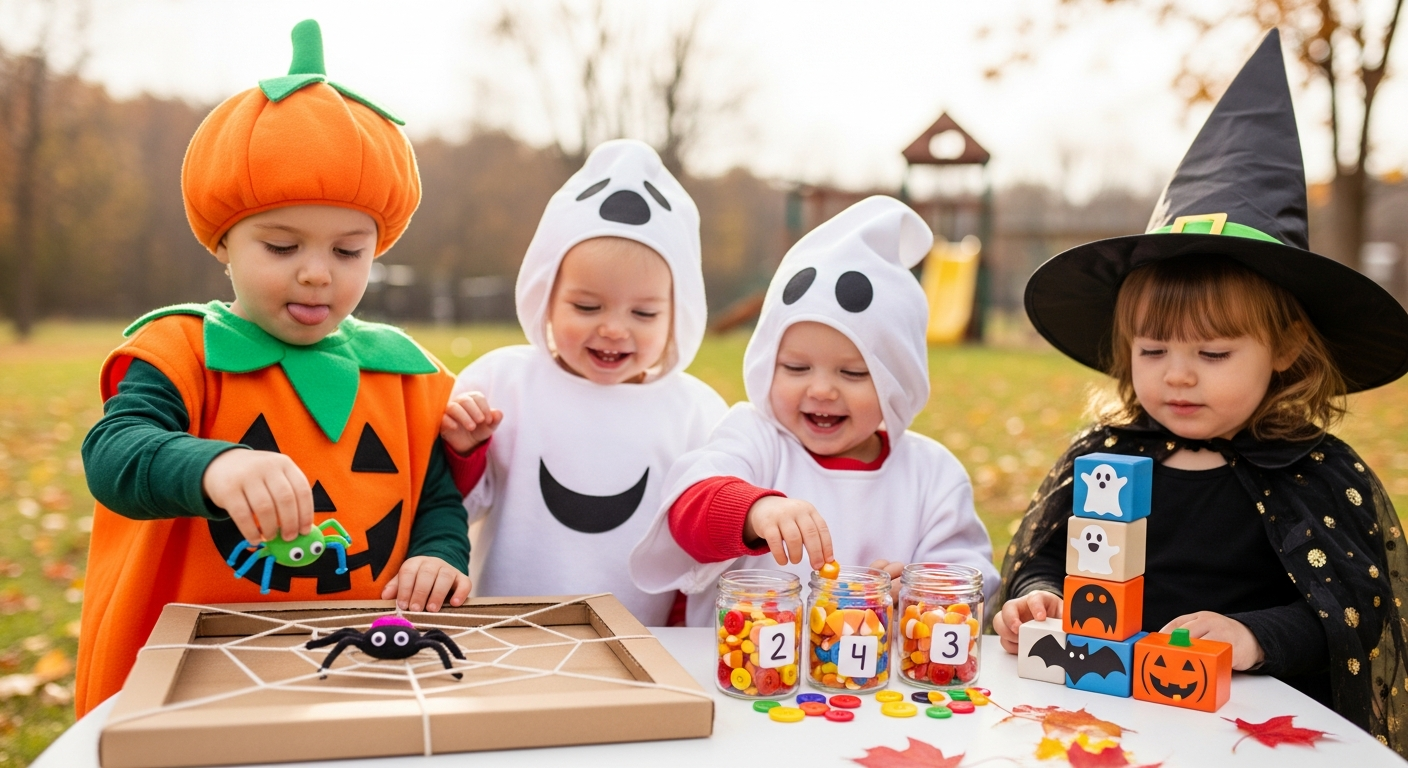
Table of Contents
- Introduction
- Why Halloween is a Powerhouse for Speech Development
- Sensory-Rich Toddler Halloween Activities
- Educational Halloween Games for Speech and Literacy
- Movement-Based Toddler Halloween Activities
- Creative Arts and Crafts for Fine Motor Skills
- Smart Screen Time: The Speech Blubs Approach
- Integrating Speech Blubs into Your Halloween Routine
- Spooky Snacks for Little Ghouls
- Frequently Asked Questions
- Conclusion
Introduction
Did you know that by the age of three, a child’s brain is twice as active as an adult’s brain? Every pumpkin carved, every sticky handful of "ghost slime," and every "boo!" whispered in the hallway is more than just festive fun—it is a massive developmental milestone in the making. For a toddler, the world is a giant laboratory, and October provides the most colorful, textured, and exciting experiments imaginable.
At Speech Blubs, we believe that every holiday is an opportunity to empower children to speak their minds and hearts. Our founders, who navigated their own speech challenges as children, created our platform to be the joyful tool they wished they had. We know that for the 1 in 4 children who need speech support, activities that blend sensory play with language are the key to unlocking confidence. In this guide, we will explore a variety of toddler halloween activities that prioritize "smart screen time," physical movement, and sensory exploration. From fizzy cauldrons to letter-matching bats, we’ve gathered the best ways to celebrate the season while building foundational communication skills.

Our goal is to help you turn this spooky season into a language-rich environment where your little one can thrive. Whether you are looking for low-mess crafts or high-energy games, this post covers everything you need to know to keep your toddler engaged and learning all month long.
Why Halloween is a Powerhouse for Speech Development
Before we dive into the specific toddler halloween activities, it is helpful to understand why this season is so beneficial for early childhood development. Toddlers learn best through imitation and sensory input. Think about the word "sticky." You can say it a hundred times, but a toddler truly understands it when their fingers are covered in pumpkin guts.
The Power of Peer Imitation
Our unique approach at Speech Blubs relies on "video modeling." This is a scientifically backed method where children learn by watching and imitating their peers. On Halloween, this happens naturally! Toddlers watch other kids say "Trick or Treat," put on costumes, and navigate social interactions. This mimicry is the building block of complex communication. When your child watches a peer in our app make a specific mouth movement or sound, they feel empowered to try it themselves. You can see how this science works by visiting our research page.
Building Vocabulary Through Themes
Halloween introduces a specific set of vocabulary that is fun and easy to pronounce. Words like "Boo," "Bat," "Cat," and "Moon" use early-developing sounds that are perfect for late talkers. By engaging in themed activities, you are giving your child a reason to use these new words in a motivating, joyful context.
Sensory-Rich Toddler Halloween Activities
Sensory play is the "work" of a toddler. It helps build nerve connections in the brain’s pathways, which leads to the child’s ability to complete more complex learning tasks.
1. The Classic Black Bean Sensory Bin
This is one of our favorite low-effort, high-reward activities.
- What you need: A shallow plastic bin, several bags of dried black beans, googly eyes of various sizes, plastic spiders, and small orange scoops.
- The Setup: Fill the bin with beans and "hide" the spiders and googly eyes.
- The Learning Goal: As your child digs, narrate their actions. "You found a big eye!" or "The spider is under the beans." This builds spatial vocabulary.
- Speech Blubs Tip: For a child who is shy about making sounds, use the spiders to practice the "s-s-s" sound or the "p" sound in "pop." You can find similar sound-building exercises when you download Speech Blubs on the App Store.
2. The Puking Pumpkin (Science Meets Play)
If you want a "wow" moment that encourages your child to use exclamation words (like "Wow!" "Look!" and "Uh-oh!"), this is it.

- What you need: A small carved jack-o'-lantern, baking soda, vinegar, dish soap, and green food coloring.
- The Setup: Place the pumpkin on a tray. Put a generous amount of baking soda and a squirt of dish soap inside. Mix the vinegar with food coloring in a separate cup.
- The Action: Let your toddler pour the vinegar into the pumpkin and watch the foam ooze out of the mouth and eyes.
- The Benefit: This activity is excellent for practicing "cause and effect" language. Ask your child, "What will happen?" and encourage them to describe the foam (e.g., "bubbly," "green," "messy").
3. Glow-in-the-Dark Ectoplasm (Slime)
For a parent whose 3-year-old is a "sensory seeker," tactile activities like slime are incredibly motivating.
- What you need: Clear school glue, baking soda, saline solution, and glow-in-the-dark paint.
- The Setup: Mix the glue and paint, add baking soda, and slowly stir in saline until it becomes a stretchy glob.
- The Goal: Use the slime to practice verbs. "Stretch," "pull," "squeeze," and "drop." These action words are foundational for building sentences later on.
Educational Halloween Games for Speech and Literacy
Learning doesn't have to be a chore. These toddler halloween activities focus on letter recognition, counting, and matching, all while keeping the "spooky" vibes high.
4. Bat Letter Match
This is a fantastic way to introduce literacy in a non-intimidating way.
- Instructions: Cut out several bat shapes from black paper. On each bat, write an uppercase letter. On white circular stickers (the "moon"), write the corresponding lowercase letters.
- The Game: Invite your child to "help the bats find their moon" by matching the stickers to the bats.
- Developmental Insight: Matching is a pre-reading skill. It requires visual discrimination, the same skill used to tell the difference between a "b" and a "d" later in life.
5. Spider Web Counting
Turn a simple doorway into a math lesson.
- What you need: Painter's tape and plastic spiders (or cotton balls).
- The Setup: Create a "web" across a hallway or doorway using the sticky side of the painter's tape facing the child.
- The Action: Call out a number and ask your child to throw that many "bugs" (cotton balls) onto the web.
- Speech Connection: Counting aloud helps with rhythm and pacing in speech. If your child is struggling with certain numbers, check out our "Number Lane" section in the app to see how other kids say them.
6. Pumpkin Emotion Faces
Social-emotional learning is just as important as ABCs.
- What you need: Construction paper pumpkins or real pumpkins and washable markers.
- The Game: Draw different faces—happy, sad, scared, and surprised.
- The Discussion: Ask your child, "Why is this pumpkin sad?" or "Can you make a surprised face like the pumpkin?"
- The Value: Learning to identify and name emotions helps reduce toddler frustration, as they gain the words to tell you how they feel rather than relying on tantrums.
Movement-Based Toddler Halloween Activities
Toddlers have endless energy. Channeling that into structured play helps with gross motor skills and following directions.
7. The Ghost Walk (Musical Statues)
- The Setup: Play some festive, kid-friendly Halloween music.
- The Action: Encourage your child to "float" like a ghost around the room. When the music stops, they must "freeze" and yell "Boo!"
- The Benefit: This teaches "inhibitory control"—the ability to stop an action on command. This is a vital executive function skill that helps with behavior and focus.
8. Pumpkin Patch Pretend Play
- The Setup: Scatter several mini-pumpkins (or orange socks rolled into balls) around the living room. Give your child a small basket or bag.
- The Game: Tell them they are "farmers" and need to harvest the pumpkins before the "friendly monster" (you) comes to help.
- Speech Goal: Use prepositions! "Look under the chair," "Go behind the couch," or "Put it in the basket."
Creative Arts and Crafts for Fine Motor Skills
Fine motor skills—the coordination of small muscles in the hands and fingers—are closely linked to the brain regions responsible for speech. Strengthening these muscles through crafts can actually support vocal development.
9. Chalk Pumpkin Creations
Many parents find that their toddlers aren't quite ready for the sharp tools required for pumpkin carving. Chalk is the perfect alternative.
- The Activity: Give your child a real pumpkin and a box of colorful sidewalk chalk.
- The Benefit: The texture of the pumpkin skin provides unique sensory feedback. It’s also a "reset" activity; if they don't like what they drew, wipe it off with a damp cloth and start again. This teaches resilience and that "mistakes" are okay.
10. Dryer Sheet Ghosts
This is a classic for a reason—it’s simple and uses household items.
- What you need: Used dryer sheets (or tissues), cotton balls, and a black marker.
- The Setup: Wrap a dryer sheet around a cotton ball and secure it with a rubber band or string. Let your child draw eyes on the ghost.
- The Use: These are lightweight and perfect for a "Ghost Toss" game into a laundry basket, which builds hand-eye coordination.
Smart Screen Time: The Speech Blubs Approach
In the midst of all these physical toddler halloween activities, you might find you need a moment of calm—or what we call "productive peace." This is where Speech Blubs comes in. We understand that many parents feel guilty about screen time. However, our app is designed to be the opposite of passive cartoon watching.
At Speech Blubs, we provide a "smart screen time" experience. Our content is based on the science of mirror neurons—the brain cells that fire both when an individual performs an action and when they observe someone else performing it. By watching real children in our app, your toddler is more likely to engage and imitate.
If you are unsure if your child could benefit, we encourage you to take our quick 3-minute preliminary screener. It involves 9 simple questions and provides an assessment and a next-steps plan tailored to your child's needs.
Why Choose Our Yearly Plan?
While we offer a monthly subscription, our Yearly plan is designed for families committed to long-term growth. When you choose the yearly option, you aren't just getting a discount (though you do save 66% compared to the monthly rate!), you are getting a comprehensive developmental suite.
- Cost: $59.99 per year (breaks down to just $4.99/month).
- Exclusive Benefits:
- 7-Day Free Trial: Try everything before you commit.
- Reading Blubs: Our companion app that bridges the gap between speaking and reading.
- Priority Support: 24-hour response time for any questions you have.
- Early Updates: Be the first to try new themes and features.
The monthly plan ($14.99) is available but does not include the free trial or the Reading Blubs app. For the best value and the most tools to help your child "speak their mind and heart," the Yearly plan is the way to go. You can create your account and start your trial today.
Integrating Speech Blubs into Your Halloween Routine
To get the most out of our app during the holidays, try these strategies:
- Co-Play is Key: Sit with your child while they use Speech Blubs. If they see a peer on screen making a "Ghost face," you make it too! This reinforces the "video modeling" and turns screen time into a bonding moment.
- Thematic Reinforcement: After doing the "Bat Letter Match" activity, find the "B" sound or the "Animal" section in Speech Blubs to reinforce what they just learned physically.
- Celebrate the Small Wins: Did your child attempt to say "Pumpkin" for the first time while playing? That is a huge victory! Use the app to show them other kids succeeding, which builds their confidence. You can read more about how other families have found success on our testimonials page.
Spooky Snacks for Little Ghouls
Food play is another fantastic way to engage a toddler's senses. These snacks are healthy, easy to make, and perfect for working on fine motor skills like "pincer grasp."
11. Mandarin "Pumpkins"
- The Snack: Peel a mandarin orange and stick a tiny piece of celery or a green grape in the top for a stem.
- Language Tip: Work on the word "peel." It’s a great word for practicing the "p" and "l" sounds.
12. Spider Crackers
- The Snack: Put a dollop of cream cheese or peanut butter on a round cracker. Top with another cracker. Stick four pretzel sticks into each side for "legs." Use two small raisins for eyes.
- The Action: Count the legs together. "One, two, three..." This integrates math into snack time seamlessly.
Frequently Asked Questions
What are the best toddler halloween activities for kids with sensory sensitivities?
For children who are easily overstimulated, focus on low-impact sensory bins like the dried black bean bin or "mess-free" painting (placing paper and paint inside a Ziploc bag and letting them squish it from the outside). Avoid loud musical games or strobe lights, and let them explore textures at their own pace.
How can I help my "late talker" enjoy Halloween?
Focus on simple, high-frequency words. Use "Boo," "Go," "My," and "No." If the traditional "Trick or Treat" is too complex, encourage them to use a gesture (like a wave) or a single word ("Candy"). Using a tool like Speech Blubs can also help them practice these social scripts in a safe, low-pressure environment before the big night. Download Speech Blubs on Google Play to get started.
Are these activities safe for 2-year-olds?
Most of these activities are designed for toddlers, but adult supervision is always required, especially with small items like googly eyes, dried beans, or plastic spiders which can be choking hazards. Always tailor the activity to your child's specific developmental stage and safety needs.
How do I know if my child’s speech is on track for their age?
Every child develops at their own pace, but there are certain milestones to look for. By age two, most children have about 50 words and are starting to put two words together. If you have concerns, our 3-minute screener is a great place to start, followed by a consultation with a licensed Speech-Language Pathologist.
Conclusion
Halloween is a magical time for toddlers, filled with new sights, sounds, and textures. By incorporating these toddler halloween activities into your October routine, you are doing much more than just keeping your child busy; you are building the vital foundational skills they need for a lifetime of successful communication. From the tactile joy of a sensory bin to the "smart screen time" provided by Speech Blubs, every moment is an opportunity for growth.
Remember, our mission at Speech Blubs is to help your child find their voice. We don't promise overnight miracles, but we do promise a process rooted in joy, science, and family connection. We want to help your child develop the confidence to speak their mind and heart, one "boo" at a time.
Ready to make this the most impactful Halloween yet? Download Speech Blubs on the App Store or Google Play today. For the best experience and the full suite of features—including Reading Blubs and a 7-day free trial—be sure to select our Yearly Plan. Let’s start this journey together and turn screen time into your child's favorite learning time!
Sobre el autor