
Fun Toddler STEM Activities to Spark Early Learning
 Por Speech Blubs Team•25 mar 2026•15 min.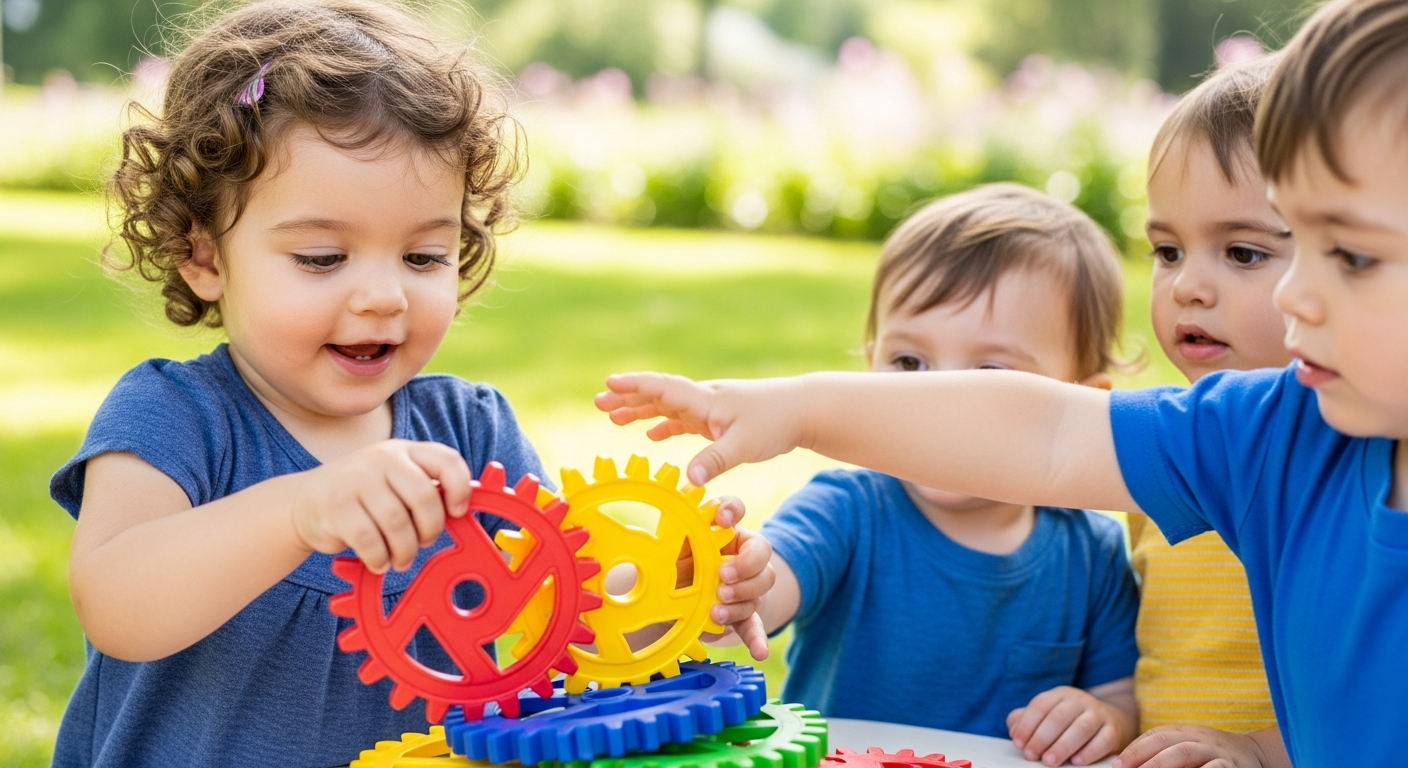
Table of Contents
- Introduction
- What Does STEM Look Like for a Toddler?
- The Power of Science: Exploring the Natural World
- Engineering and Technology: Building and Tools
- Math: More Than Just Counting
- Integrating STEM with Speech Development
- Why Speech Blubs is the Perfect Supplement
- Practical Scenarios: A Day in the Life
- Common Myths About Toddler STEM
- Starting Your Journey Today
- Conclusion
- FAQ
Introduction
Did you know that a child’s brain develops more rapidly during the first five years of life than at any other time? It’s true! While we often associate STEM—science, technology, engineering, and math—with high school laboratories or complex computer coding, the foundations of these subjects are actually laid in the nursery and the backyard. For a toddler, the world is one giant laboratory. Every time they drop a spoon from a high chair to see it hit the floor, they are experimenting with gravity. Every time they try to fit a square block into a round hole, they are practicing engineering and geometry.
At Speech Blubs, our mission is to empower children to "speak their minds and hearts." We know that curiosity is the spark that ignites communication. Our company was born from the personal experiences of our founders, who all grew up with speech challenges and created the tool they wished they had. We are committed to providing an immediate, effective, and joyful solution for the 1 in 4 children who need speech support. By blending scientific principles with play, we’ve created a "smart screen time" experience that encourages children to move from passive viewing to active learning.

In this post, we will explore a wide variety of toddler STEM activities that you can do at home with everyday items. We’ll look at how these activities build critical thinking, fine motor skills, and, most importantly, language. We will also discuss how our unique video modeling methodology helps children learn complex communication skills by watching and imitating their peers. By the end of this article, you’ll have a toolkit of ideas to foster a love for discovery in your little one while building the confidence they need to succeed.
What Does STEM Look Like for a Toddler?
When we talk about toddler STEM activities, we aren't talking about sitting at a desk with a pencil and paper. For children aged one to four, STEM is a multisensory, whole-body experience. It is about "doing" rather than "memorizing."
- Science is about observing the world. It’s noticing that ice is cold and melts into water, or that a ball rolls while a block stays still.
- Technology for toddlers is about using tools. This includes simple machines like a spoon to scoop sand, a magnifying glass to look at a bug, or even "smart screen time" apps that encourage interaction rather than passive watching.
- Engineering is about solving problems and building. It’s stacking cups to make a tower or figuring out how to bridge a gap between two pillows.
- Math is about patterns, shapes, and numbers. It’s counting the blueberries on a plate or sorting laundry by color.
If you are ever unsure if your child is reaching their developmental milestones in these areas or in their speech, you can take our quick 3-minute preliminary screener. It involves just 9 simple questions and provides an assessment and a next-steps plan to help you support your child's growth.
The Power of Science: Exploring the Natural World
Science for toddlers is all about the "Five Senses." By encouraging your child to use their sight, smell, touch, hearing, and (safely) taste, you are helping them build "mirror neurons" and cognitive pathways that last a lifetime.

1. The Magic of Sink or Float
This is a classic for a reason. Fill a large plastic bin or your bathtub with water. Collect various household items: a plastic toy, a metal spoon, a cork, a rock, and an apple.
- The Activity: Before dropping each item, ask your child, "Do you think this will stay on top or go to the bottom?"
- The Learning: This introduces the concept of density and buoyancy.
- Speech Connection: For a parent whose 3-year-old "late talker" loves the water, this is a perfect time to practice "up" and "down." In the Speech Blubs app, our "Early Logopedics" section features peer models making these exact mouth shapes, which can help your child find the words to describe their experiment.
2. Nature Scavenger Hunt
Head outside to a park or even just your backyard. Give your toddler a small basket and ask them to find things with different textures.
- The Activity: Ask them to find something "crunchy" (a dry leaf), something "smooth" (a pebble), and something "soft" (a flower petal).
- The Learning: This is biology and earth science in its simplest form. They are categorizing the natural world.
- The Speech Blubs Way: We believe in screen-free alternatives to passive viewing. Use the app to learn the names of animals in our "Animal Kingdom" section, and then go outside to see if you can find any birds or bugs that match! Download Speech Blubs on the App Store to get your child excited about the animals they might find in nature.
3. Kitchen Chemistry: Mixing Colors
Toddlers love to see things change. Use three clear glasses filled with water and add a few drops of primary food coloring (red, blue, yellow) to each.
- The Activity: Let your child use a dropper or a small spoon to mix the colors in a fourth glass. "What happens when we mix red and yellow?"
- The Learning: This is a basic introduction to chemistry and the concept of "cause and effect."
- Building Confidence: Seeing the water change color gives a child a sense of agency. This builds the foundational skills needed for more complex problem-solving later in life.
Engineering and Technology: Building and Tools
Engineering is often the most "physical" of the toddler STEM activities. It involves fine motor skills—the small movements of the hands and fingers—which are closely linked to the areas of the brain responsible for speech.
4. The Cardboard Ramp Challenge
Don't throw away those delivery boxes! A flat piece of cardboard can become a high-speed physics laboratory.
- The Activity: Lean the cardboard against a couch or chair to create a ramp. Provide your toddler with various objects: a toy car, a round ball, and a square block.
- The Learning: They will quickly learn that round things roll and flat things slide (or stay put). You can even change the "steepness" of the ramp to see how it affects speed.
- Realistic Expectations: Remember, we aren't expecting a two-year-old to explain acceleration. The goal is to foster a love for communication and discovery. If they point and say "Fast!" that is a huge win!
5. Stacking and Stability
Whether you use wooden blocks, plastic Tupperware, or even sponges, stacking is pure engineering.
- The Activity: Challenge your toddler to build the tallest tower they can. When it inevitably falls, don't just say "Oh no!" Instead, ask, "What happened? Why did it fall?"
- The Learning: They are learning about gravity and balance.
- Social Proof: Many parents in our community have shared how these simple play moments, combined with our app, have helped their children find their voice. You can read our testimonials to see how other families have used play-based learning to overcome speech delays.
6. "Smart Screen Time" as a Tool
At Speech Blubs, we view technology as a tool for connection, not a digital babysitter. Unlike passive cartoons that can lead to "zoning out," our app uses video modeling.
- The Activity: Sit with your child while they use Speech Blubs. When they see a peer on the screen making a "buh-buh" sound for a bubble, imitate it together.
- The Learning: This uses the science of "mirror neurons"—the brain cells that fire both when we perform an action and when we see someone else perform it.
- Call to Action: To give your child the full suite of "smart screen time" tools, sign up for a 7-day free trial on our website.
Math: More Than Just Counting
Early math skills are about understanding relationships between objects. Toddlers who engage in math-based play develop a strong foundation for logic and literacy.
7. The Great Sock Sort
Laundry day doesn't have to be a chore; it can be one of your favorite toddler STEM activities!
- The Activity: Dump a pile of clean socks on the floor. Ask your toddler to find the "matches" or group them by color.
- The Learning: This is "set theory" in action. Sorting and classifying are essential mathematical skills.
- The Speech Connection: Use this time to practice descriptive words like "big," "small," "blue," and "striped."
8. Counting in the Real World
Instead of just reciting numbers, count objects that have meaning to your child.
- The Activity: Count the steps as you walk up to bed. Count the pieces of apple on their snack plate. Count the buttons on their shirt.
- The Learning: This teaches "one-to-one correspondence"—the idea that one number word represents exactly one object.
- Pro Tip: If your child is struggling with the sounds of numbers, the "Numbers & Shapes" section in Speech Blubs provides a fun, repetitive way to hear and practice these words with other kids. Download on Google Play to start practicing today.
9. Shape Hunt in the Kitchen
Shapes are the building blocks of geometry. Your kitchen is full of them!
- The Activity: Show your child a circular lid and ask them to find other "circles" in the room (a clock, a plate, a cheerio).
- The Learning: This develops spatial awareness and visual discrimination.
Integrating STEM with Speech Development
You might wonder how building a block tower or mixing colors helps a child "speak their minds and hearts." The connection is actually quite deep. STEM activities provide a "context" for language. It is much easier for a child to learn the word "sticky" if they are actually touching a piece of tape during an engineering project than if they just see a picture of it in a book.
Creating Joyful Family Learning Moments
At Speech Blubs, we emphasize adult co-play. Our app is designed to be a bridge between you and your child. When you engage in toddler STEM activities together, you are creating a "joint attention" environment. This is the gold standard for language learning. You are both looking at the same thing, talking about the same thing, and sharing a joyful moment of discovery.
Reducing Frustration
Many children with speech delays experience frustration because they have big ideas but lack the words to express them. STEM activities allow children to express their intelligence through their hands. When a child successfully builds a bridge or predicts that a rock will sink, they feel a sense of competence. This confidence often overflows into their willingness to try new sounds and words.
Why Speech Blubs is the Perfect Supplement
While these "offline" activities are vital, Speech Blubs provides a structured way to reinforce the language used during STEM play. We offer a powerful tool for family connection that fits right in your pocket.
The Science of Video Modeling
Our app is unique because it doesn't use cartoons. Instead, it uses "video modeling," where real children—not animations—demonstrate how to make sounds and say words. Science shows that children are much more likely to imitate other children than they are to imitate adults. This peer-to-peer connection is the "secret sauce" of our methodology. It’s effective, it’s research-backed, and most importantly, it’s fun!
Transparent Pricing for Families
We want every family to have access to the best tools. We offer two simple plans:
- Monthly Plan: $14.99 per month. This is a great way to test the waters.
- Yearly Plan (Best Value): $59.99 per year. This breaks down to just $4.99 per month—a 66% savings!
Why the Yearly Plan is the clear winner:
- It includes a 7-day free trial so you can explore everything risk-free.
- It gives you access to the Reading Blubs app, helping your child transition from speech to literacy.
- You get early access to all new updates and content.
- You receive 24-hour support response time from our dedicated team.
The monthly plan does not include the free trial or the Reading Blubs app, so we always recommend the yearly option for the most comprehensive experience.
Practical Scenarios: A Day in the Life
Let’s look at how you can weave these concepts together. Imagine you have a toddler who loves trains.
Morning: You use the "Things That Go" section in Speech Blubs. Your child watches a peer say "Choo-choo" and imitates the sound. Mid-Morning: You head to the playroom for some "engineering." You use books and pillows to create a tunnel for their toy train. You talk about "through," "over," and "under." Lunch: You practice some "math" by counting the "wheels" (round crackers) on their plate. Afternoon: You do a "science" experiment by seeing if the wooden train or the plastic train goes down a ramp faster.
By the end of the day, your child hasn't just "played"—they have been a scientist, an engineer, and a mathematician. Most importantly, they have been communicating with you all day long.
Common Myths About Toddler STEM
Myth 1: STEM is too hard for toddlers. As we’ve shown, STEM isn't about calculus; it’s about curiosity. If they are asking "Why?" or "Look!", they are doing STEM.
Myth 2: You need expensive kits. The best toddler STEM activities use what you already have: water, dirt, socks, and cardboard. Your most valuable resource is your own engagement and a little bit of "smart screen time" to guide the way.
Myth 3: Screen time is always bad for speech. Passive screen time (watching endless cartoons) can be detrimental. However, active, "smart screen time" like Speech Blubs is designed by experts to encourage verbalization and imitation. It’s a tool, not a distraction.
Starting Your Journey Today
The beauty of STEM is that it never ends. As your child grows, their experiments will become more complex, their structures taller, and their vocabulary richer. By starting with these simple toddler STEM activities now, you are giving them the gift of a "positive STEM identity." They will grow up believing that they are the kind of person who can solve problems and understand the world.
At Speech Blubs, we are honored to be a part of that journey. We invite you to join the thousands of families who have made us a part of their daily routine. Whether your child is a "late talker," has a diagnosed delay, or is simply a curious learner, our app provides the joyful support they need to thrive.
Conclusion
Toddler STEM activities are about much more than science and math. They are about fostering a love for learning, building confidence, and creating a world where your child feels empowered to "speak their minds and hearts." From the "Sink or Float" experiments in the bathtub to the peer-to-peer video modeling in our app, every moment is an opportunity for growth.
We’ve explored how simple household items can become powerful teaching tools and how "smart screen time" can supplement your child’s overall development plan. Remember, the goal is not to create a mini-genius overnight, but to foster foundational skills that will serve them for a lifetime.
Ready to see the difference for yourself? Download Speech Blubs on the App Store or Google Play today. We highly recommend choosing our Yearly Plan to take advantage of the 7-day free trial and the extra Reading Blubs app. It’s the best value for your family and the most effective way to support your child's communication journey. Let's start exploring, building, and speaking—together!
FAQ
1. What age is best to start toddler STEM activities?
You can start as early as 12 to 18 months! At this age, STEM is mostly sensory exploration—feeling different textures, watching water splash, or stacking two blocks. As they move toward ages 3 and 4, you can introduce more complex concepts like making predictions or sorting by multiple attributes.
2. My child has a speech delay; will STEM activities be too frustrating?
Actually, many parents find the opposite! STEM activities are hands-on, which allows children to show what they know without needing a large vocabulary. This success builds the confidence they need to keep trying with their speech. Using Speech Blubs alongside these activities provides them with the specific words they need to describe their discoveries.
3. How long should a STEM activity last for a toddler?
Toddlers have short attention spans, usually between 5 and 15 minutes. Don't worry if they want to move on quickly! The goal is a "joyful learning moment," not a long lesson. Even a few minutes of "smart screen time" or a quick "Sink or Float" experiment is beneficial.
4. Why does Speech Blubs use real children instead of cartoons?
This is based on the science of video modeling. Research shows that children are naturally drawn to other children. When they see a peer successfully making a sound or saying a word, their "mirror neurons" fire, making them much more likely to imitate that behavior. It creates a sense of "If they can do it, I can too!"
Sobre el autor