
Heartfelt Play: Fun Toddler Valentine's Activities
 Por Speech Blubs Team•25 mar 2026•14 min.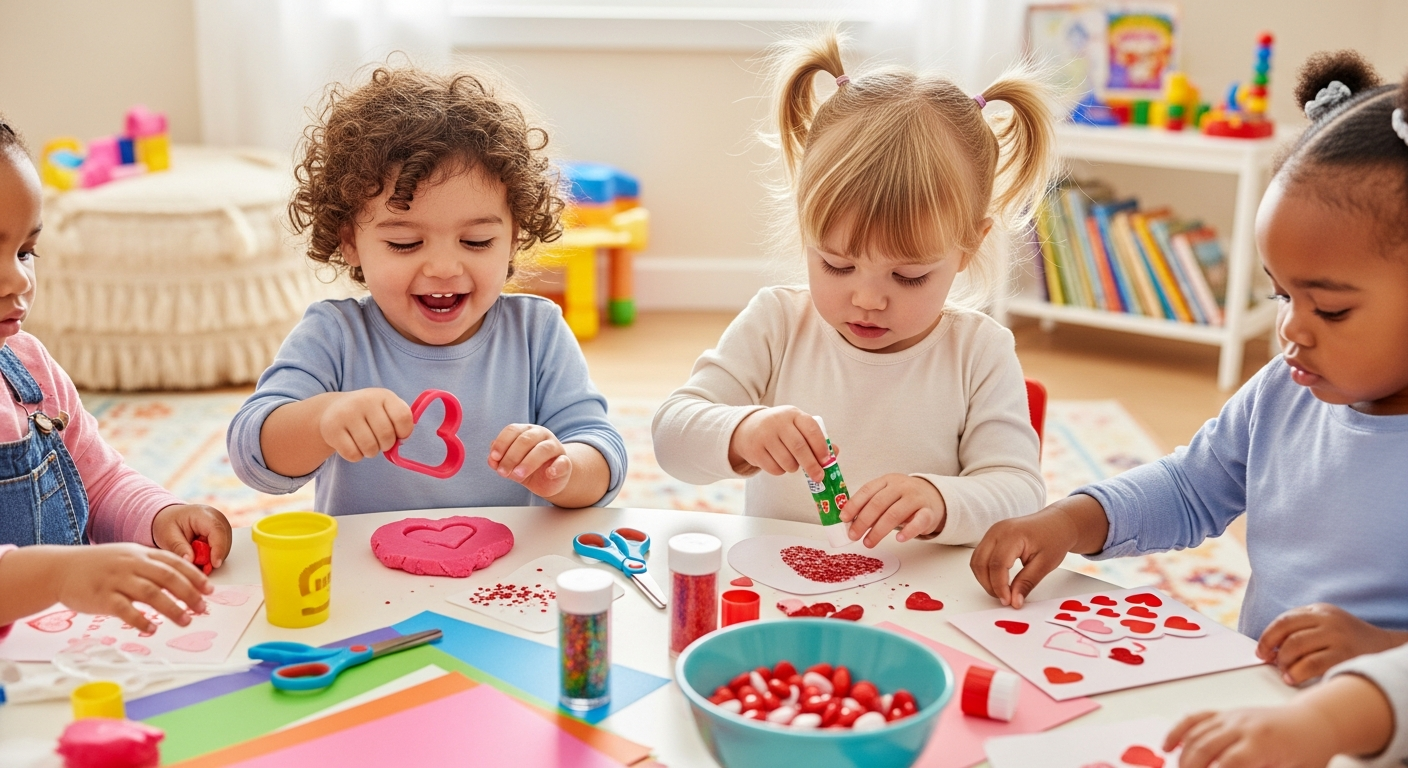
Table of Contents
- Introduction
- Why Valentine’s Day Matters for Toddlers
- Sensory Play Activities for Little Sweethearts
- Fine Motor Fun: Developing Little Hands
- Gross Motor and Active Valentine’s Games
- Art and Keepsakes: Making Memories
- Speech and Language Development Through Play
- The Power of Video Modeling in Communication
- Choosing the Right Tools for Your Child's Journey
- Practical Scenarios for Everyday Success
- Building a Foundation of Kindness
- Frequently Asked Questions
- Conclusion
Introduction
Did you know that by the time a child turns three, their brain is twice as active as an adult’s? Every single interaction, texture, and new word is a building block for their future. As February approaches, many parents find themselves wondering how to explain a concept as abstract as "love" to a two-year-old. While Valentine’s Day might seem like just another "Hallmark holiday" to some, for a toddler, it is a vibrant opportunity to explore colors, textures, and the joy of connection. At Speech Blubs, our mission is to empower children to speak their minds and hearts, and there is no better time to foster that communication than during a season dedicated to expressing affection.
In this post, we are going to dive deep into a variety of toddler Valentine's activities that go far beyond simple paper cards. We will cover sensory play that ignites the imagination, fine motor crafts that build essential physical coordination, and gross motor games that get little bodies moving. Most importantly, we will show you how to weave speech and language development into every activity, turning simple playtime into a powerful developmental tool. Our goal is to provide you with realistic, joyful ways to connect with your child while building the foundational skills they need to thrive.

Valentine’s Day is about more than just chocolate; it’s about creating moments of shared attention and discovery that help your child understand the world and their place in it.
Why Valentine’s Day Matters for Toddlers
For a young child, holidays are the milestones of their early years. They provide context for the passage of time and introduce them to social norms like kindness, sharing, and friendship. When we engage in toddler Valentine's activities, we aren't just making a mess with glitter—though that is certainly part of the fun—we are engaging in "smart screen time" and active play that builds their cognitive map.
At Speech Blubs, we believe that play is the work of childhood. Our founders all grew up with speech challenges and created the very tool they wished they had as children. This personal experience drives our commitment to providing effective, joyful solutions for the 1 in 4 children who need speech support. By integrating themes of love and friendship into your daily routine, you are helping your child develop the emotional intelligence required to navigate social interactions later in life.
Sensory Play Activities for Little Sweethearts
Sensory play is the gold standard for early childhood education. It encourages children to use their five senses to explore the world, which builds nerve connections in the brain’s pathways.
The Ultimate Valentine’s Sensory Bin
Sensory bins are a staple in many households because they are versatile and incredibly engaging. To create a Valentine’s-themed bin, start with a base like dyed rice, pasta, or chickpeas.
- Materials: A large plastic bin, 4 cups of white rice, red and pink food coloring, vinegar, and small Valentine’s trinkets (plastic hearts, scoops, small bowls).
- How to prepare: Mix the rice with a teaspoon of vinegar and a few drops of food coloring in a sealed bag. Shake it up and let it dry on a tray. Once dry, toss it in the bin with your trinkets.
Developmental Tip: As your child scoops and pours, use descriptive language. "Look at the red heart!" or "The rice feels crunchy." This builds their vocabulary through direct experience.
For a parent whose 3-year-old "late talker" loves textures, this sensory bin is the perfect companion to the "Early Sounds" section of our app. While your child touches the rice, you can model the sounds of the objects they find, mirroring the video modeling methodology we use, where children learn by watching and imitating their peers.

Candy Heart Oobleck and Science
Oobleck is a "non-Newtonian" fluid, meaning it acts like both a liquid and a solid. It’s messy, fascinating, and a wonderful way to introduce basic scientific concepts.
- Materials: 2 parts cornstarch, 1 part water, pink food coloring, and a box of conversation hearts.
- The Activity: Mix the cornstarch and water until it reaches a "goopy" consistency. Add the pink coloring and drop in the candy hearts. Let your toddler try to grab the hearts. When they squeeze the Oobleck, it stays solid; when they let go, it melts through their fingers.
This activity is fantastic for reducing frustration. Many toddlers feel frustrated when they can't express themselves, and sensory play provides a safe outlet for that energy. If you're unsure where your child stands developmentally, you can take our quick 3-minute preliminary screener to get a simple assessment and a tailored next-steps plan.
Fine Motor Fun: Developing Little Hands
Fine motor skills involve the small muscles in the hands and wrists. These skills are essential for later tasks like writing, buttoning clothes, and using utensils.
Heart Threading and Lacing
Lacing activities require focus and hand-eye coordination.
- Materials: Cardboard heart cut-outs with holes punched around the edges, and colorful yarn or shoelaces.
- The Activity: Show your child how to "sew" the yarn through the holes. For younger toddlers, you can use stiff pipe cleaners and large plastic beads instead of yarn.
This activity mimics the "brain-building" exercises we value at Speech Blubs. While they focus on the physical task, their brain is working hard on spatial awareness. To see how other families have used these types of activities alongside our app to reach milestones, you can read our latest testimonials.
Stickers, Glue, and Collages
Toddlers love the "sticky" factor.
- Materials: Contact paper, tissue paper squares, heart stickers, and construction paper.
- The Activity: Tape a piece of contact paper to the wall (sticky side out). Let your child press tissue paper and stickers onto the surface to create a "stained glass" heart.
Practical Scenario: For a parent whose child is obsessed with colors, you can use this collage time to practice color identification. While they pick up a pink sticker, you can encourage them to say "pink." To reinforce this, you can later download Speech Blubs on the App Store and explore the "Colors" section, where they will see other children naming the same colors they just used in their art.
Gross Motor and Active Valentine’s Games
Don't forget to involve the "big muscles." Gross motor activities help with balance, strength, and overall physical confidence.
Heart Hopscotch and Stair Walk
Winter months often mean more time indoors, so finding ways to move is crucial.
- Heart Hopscotch: Use painter's tape to create heart shapes on the floor. Number them 1 through 5. Encourage your child to jump from heart to heart as you count aloud.
- Color Match Stair Walk: If you have stairs, tape a different colored paper heart to each step. Ask your child to "climb to the red heart" or "step on the blue heart."
These activities are perfect for practicing prepositions and directions—up, down, on, and over. These are foundational language skills that help children describe their movements and needs.
Art and Keepsakes: Making Memories
Creating something tangible allows toddlers to feel a sense of accomplishment. It also gives you a keepsake to look back on as they grow.
Handprint Art and Suncatchers
There is nothing quite as precious as a tiny handprint.
- Handprint Trees: Paint your child’s hand and forearm brown to represent a tree trunk and branches. Once dry, let them use red and pink thumbprints to create "leaves" in the shape of hearts.
- Heart Suncatchers: Use two pieces of clear contact paper and place bits of colored tissue paper in between. Cut the whole thing into a large heart shape and tape it to a sunny window.
While working on these crafts, you are providing a screen-free alternative to passive viewing. Instead of just watching a cartoon, your child is actively participating in a family connection moment. If you want to supplement these physical activities with high-quality, educational digital content, sign up for a free trial on our website.
Speech and Language Development Through Play
At Speech Blubs, we are often asked how a simple game of "Heart Hunt" can actually help a child talk. The answer lies in the concept of joint attention. When you and your child are both looking at and interacting with the same object, you are creating a prime environment for language learning.
Integrating Speech Blubs into Holiday Fun
Our app is designed to be a powerful supplement to your child's overall development plan. It’s not about sitting the child in front of a screen and walking away; it’s about "co-play."
For example, after a morning of toddler Valentine's activities like making "Love Potion" (water, food coloring, and glitter), you can open the app and find related words.
- Peer Modeling: Your child will see a video of another child saying "water" or "bubbles."
- Mirror Neurons: When your child sees a peer making a sound, their mirror neurons fire, making them more likely to try and imitate that sound.
This approach is rooted in science and has helped thousands of families find joy in the learning process. You can start your journey on Google Play to see the difference peer modeling makes.
The Power of Video Modeling in Communication
Why do we use other children in our videos instead of animations or adults? Because children are naturally more interested in other children. This is the core of our "video modeling" methodology. When a toddler sees a peer successfully performing a task—like blowing a kiss or saying "I love you"—they feel a sense of "I can do that too!"
This builds confidence and reduces the frustration often associated with speech delays. We aren't promising that your child will be giving public speeches in a month, but we are fostering a lifelong love for communication. Our app is a "smart screen" experience that encourages vocalization and facial mimicry, rather than the "zombie-like" state that often comes with passive cartoons.
Choosing the Right Tools for Your Child's Journey
We know that as a parent, you want the best for your child, and that includes being smart about the tools and subscriptions you choose. At Speech Blubs, we want to be transparent about how we provide value to your family.
We offer two main plans to fit your needs:
- Monthly Plan: $14.99 per month. This is a great way to test the waters and see how your child responds to the video modeling.
- Yearly Plan: $59.99 per year. This is our best value option, breaking down to just $4.99 per month.
When you choose the Yearly Plan, you don't just save 66% compared to the monthly rate; you also unlock exclusive features:
- 7-Day Free Trial: Try everything for a full week before you are charged.
- Reading Blubs: You get access to our companion app, Reading Blubs, which helps transition speech skills into early literacy.
- Priority Support: Enjoy a 24-hour support response time and early access to new updates.
Please note that the Monthly Plan does not include the free trial or the extra Reading Blubs app. To give your child the full suite of tools, we highly recommend the Yearly Plan. You can create your account and start your 7-day free trial today.
Practical Scenarios for Everyday Success
Let’s look at how these toddler Valentine's activities can solve common real-world challenges:
- The "Wiggles" Challenge: Your toddler has too much energy and can't focus on a book.
- The Activity: Heart Hopscotch.
- The Speech Connection: Use the "Action Words" section in Speech Blubs to practice words like "jump," "hop," and "stop" after they've burned off that physical energy.
- The "Mealtime Meltdown" Challenge: Your child is a picky eater and refuses to try new things.
- The Activity: Valentine’s Fruit Kabobs. Let them slide strawberry hearts onto a dull skewer.
- The Speech Connection: Use the "Yummy Time" section in the app to look at different fruits and mimic the "munching" sounds.
- The "Quiet Time" Struggle: You need 15 minutes to finish a task, but you don't want to use mindless TV.
- The Activity: Sticker Heart Matching.
- The Speech Connection: This is the perfect time for a session of Speech Blubs. It’s "smart screen time" that keeps them engaged and learning, rather than just zoning out.
Building a Foundation of Kindness
Beyond the physical and lingual benefits, toddler Valentine's activities are about teaching the "why" behind the holiday. We want our children to grow up knowing how to express their hearts. Whether it's through a hand-drawn card for Grandma or learning how to say "hug" in the app, these small steps build a foundation of empathy.
At Speech Blubs, we believe every child has a unique voice that deserves to be heard. We are here to support you in unlocking that voice through play, science, and a lot of heart.
Frequently Asked Questions
1. What are the best Valentine's activities for a toddler with a speech delay?
Sensory bins and physical activities like "Heart Hopscotch" are excellent because they provide a "low-pressure" environment for speech. Pair these with the video modeling found in the Speech Blubs app to give your child a peer to imitate. The key is to follow your child's lead and narrate their actions.
2. Is Speech Blubs considered "screen time"?
We like to call it "smart screen time." Unlike passive cartoons, our app is interactive and requires the child to vocalize and interact with the screen. It is designed for "co-play," meaning it works best when an adult is there to encourage and mirror the sounds alongside the child.
3. How do I choose between the Monthly and Yearly plans?
If you are looking for the best long-term value and the most features, the Yearly plan is the clear winner. It includes a 7-day free trial, the Reading Blubs app, and is significantly cheaper per month ($4.99 vs. $14.99). The Monthly plan is better if you only want to use the app for a very short period and don't mind missing out on the trial or extra app.
4. Can these activities replace professional speech therapy?
While our activities and app are powerful tools for development, they are intended to be a supplement to, not a replacement for, professional medical advice or therapy. If you have concerns about your child's development, we always recommend consulting with a pediatrician or a licensed Speech-Language Pathologist (SLP).
Conclusion
Valentine’s Day is a wonderful season to slow down and focus on the connections that matter most. By engaging in these toddler Valentine's activities, you are doing so much more than just filling an afternoon; you are building your child’s brain, strengthening their muscles, and fostering their ability to communicate with the world.
From the messy joy of pink Oobleck to the focused quiet of heart lacing, every moment is an opportunity for growth. We invite you to make Speech Blubs a part of your family’s learning journey. Our unique approach, rooted in the lived experiences of our founders and backed by the science of mirror neurons, is designed to bring more "joyful learning moments" into your home.
Ready to see your child speak their mind and heart? Download Speech Blubs on the App Store or Google Play Store to begin. For the best experience and the most features—including a 7-day free trial and the Reading Blubs app—be sure to select our Yearly Plan. Let’s make this Valentine’s Day a milestone in your child’s communication journey!
Sobre el autor