
Signs Speech Delay 18 Months: What Parents Need to Know
 Por Speech Blubs Team•9 mar 2026•15 min.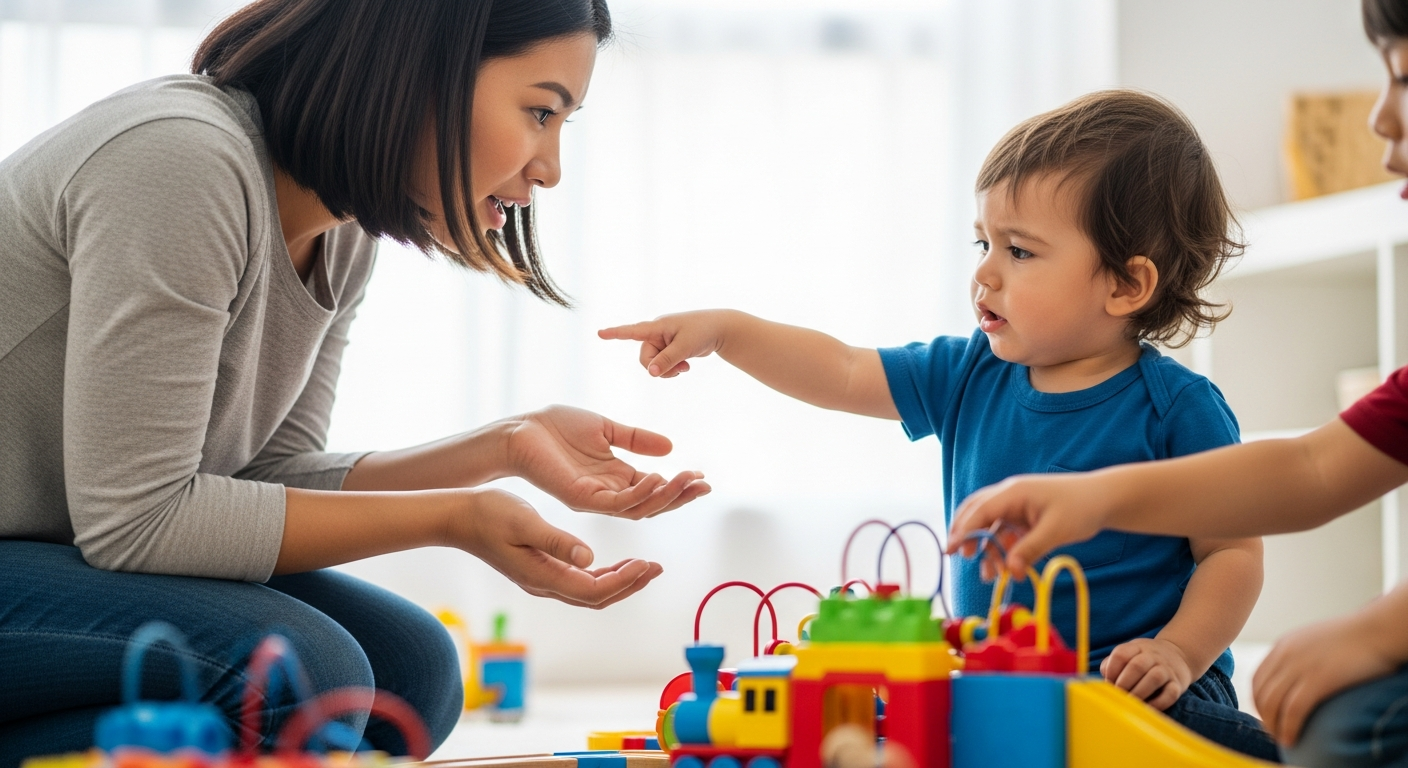
Table of Contents
- Introduction
- Understanding the 18-Month Communication Milestone
- Common Signs Speech Delay 18 Months
- Speech vs. Language: What is the Difference?
- Possible Causes for Speech and Language Delays
- The Speech Blubs Approach: Science and Play
- Practical Scenarios: Bringing Speech Blubs into Your Daily Routine
- How to Support Speech Development at Home
- Choosing the Right Plan for Your Family
- When to See a Professional
- Frequently Asked Questions
- Conclusion
Introduction
Did you know that approximately one in four children will face some form of speech or language challenge during their early development? It is a startling statistic for any parent, especially when you are sitting on the living room floor, watching your 18-month-old play, and wondering why those first "real" words haven't quite blossomed into the chatter you expected. Perhaps you’ve noticed that while other children at the park are shouting "Ball!" or "Mama!", your little one is relying mostly on tugging at your sleeve or pointing to get what they need. If you are feeling a mix of concern, confusion, or even a little bit of anxiety, please know that you are not alone.
At Speech Blubs, we understand exactly how you feel because our mission is rooted in personal experience. Our founders all grew up with speech problems themselves, and they created the very tool they wished they had as children. We are here to empower children to "speak their minds and hearts," turning what can be a stressful time into a journey of joyful connection.

In this post, we are going to dive deep into the world of toddler communication. We will explore the specific milestones expected at this age, identify the red flags and signs speech delay 18 months, and discuss the difference between speech and language. Most importantly, we will provide you with practical, science-backed strategies to support your child’s growth. Our goal is to move past the "wait and see" approach and give you the confidence to take proactive steps for your child’s future.
Understanding the 18-Month Communication Milestone
By the time a child reaches 18 months, they are typically in a phase of rapid cognitive and motor discovery. They are learning how the world works, how to navigate their environment on two feet, and how to influence the people around them. Communication is the bridge that connects all these skills. To understand if there is a delay, we first have to understand what "typical" looks like—keeping in mind that every child is an individual.
Receptive vs. Expressive Language
When we talk about language, we divide it into two main categories: receptive and expressive.
- Receptive Language: This is what your child understands. By 18 months, a child should be able to follow simple, one-step directions like "Go get your shoes" or "Sit down, please," even without you using hand gestures. They should also be able to point to at least one or two familiar body parts (like their nose or tummy) when asked.
- Expressive Language: This is what your child says or produces. At this stage, most children have a handful of functional words—usually between 6 and 20—though the range of "normal" is quite wide. These words might not be perfectly articulated; "baba" for bottle or "wa-wa" for water counts as a word if it is used consistently to mean that specific thing.
At Speech Blubs, we believe in looking at the whole child. While the number of words is important, we also look at how a child uses their body and voice to interact. If your child has strong receptive language but is struggling with expressive speech, they might be what professionals call a "late talker." Download Speech Blubs on the App Store or Google Play to begin exploring activities that bridge this gap through fun, peer-led imitation.

Common Signs Speech Delay 18 Months
If you are concerned about your toddler’s progress, it helps to have a specific checklist. Recognizing the signs speech delay 18 months early is one of the greatest gifts you can give your child, as early intervention is incredibly effective.
The Absence of Gestures
While we want to hear words, gestures are the foundational building blocks of speech. By 18 months, a child should be an expert at waving "bye-bye," nodding "yes," or shaking their head "no." Most importantly, they should be using their index finger to point. Pointing is a massive developmental milestone; it shows "joint attention," meaning the child wants to share an experience with you. If your child reaches with their whole hand or pulls you toward an object without pointing, it is a sign worth noting.
Reliance on Physical Communication
Is your child communicating primarily by grunting, crying, or pulling your hand toward what they want? While all toddlers do this occasionally, by 18 months, they should be attempting to pair these actions with sounds or word-like approximations. If they prefer gestures over any attempt at vocalization, it may indicate they are struggling to coordinate the sounds needed for speech.
Difficulty Imitating Sounds
Imitation is how children learn. If you make a "vroom" sound with a toy car or "moo" like a cow, does your child try to copy you? A child who has trouble imitating simple sounds or facial expressions may have a delay in the motor planning required for speech.
Limited Vocabulary
While the "average" 18-month-old has about 10 to 50 words, clinicians generally look for a minimum of 6 to 10 functional words (besides "Mama" and "Dada"). If your child has fewer than this, or if they had words and then "lost" them, it is time to speak with a professional.
If these signs sound familiar, don’t wait. You can take our quick 3-minute preliminary screener to get a simple assessment and a free 7-day trial of our tools.
Speech vs. Language: What is the Difference?
It is common to use these terms interchangeably, but they actually refer to different parts of the communication process. Understanding the difference can help you better describe your child's behavior to a pediatrician or speech-language pathologist (SLP).
What is Speech?
Speech is the physical act of producing sounds. It involves the coordination of the breath, the vocal cords, the tongue, the lips, and the jaw.
- Articulation: How we make individual sounds (e.g., the "b" sound in "ball").
- Voice: How we use our vocal folds and breath to make sounds (is it too loud, too quiet, or raspy?).
- Fluency: The rhythm of speech (stuttering, for example, is a fluency issue).
A child with a speech delay might know exactly what they want to say but can’t physically get the sounds out in a way that others can understand.
What is Language?
Language is the system of symbols (words, signs, or pictures) that we use to share meaning.
- Receptive Language: Understanding what others say.
- Expressive Language: Sharing our own thoughts and needs.
- Pragmatic Language: The social rules of communication (eye contact, taking turns in a conversation).
A child with a language delay might be able to pronounce words perfectly but only have two words in their entire vocabulary, or they may struggle to understand a simple request like "Give me the block."
Possible Causes for Speech and Language Delays
When a child isn't hitting milestones, parents often ask, "Why?" It is rarely caused by one single thing, and it is almost never the parent's fault. Here are some of the most common reasons we see:
- Oral-Motor Issues: Some children have difficulty coordinating the muscles in their mouth. This could be due to a physical impairment like a "tongue-tie" (a short frenulum) or a neurological condition where the brain has trouble sending the right signals to the mouth muscles (childhood apraxia of speech).
- Hearing Loss: This is a very common and often overlooked cause. Even if your child seems to hear loud noises, they might have "muffled" hearing due to chronic ear infections or fluid behind the eardrum. If they can't hear the nuances of speech sounds, they can't imitate them.
- Developmental Disorders: Speech delays are often one of the first signs of broader developmental challenges, such as Autism Spectrum Disorder (ASD) or Global Developmental Delay.
- Prematurity: Children born early often hit milestones based on their "adjusted age" rather than their birth date, and it can take until age two or three to fully catch up.
- Environment: While less common as a primary cause, children need a "language-rich" environment. If a child spends a lot of time in front of passive screens (like cartoons) without interactive play, they may miss out on the crucial "back-and-forth" of human conversation.
The Speech Blubs Approach: Science and Play
At Speech Blubs, we have developed a unique way to support children through these challenges. We don't believe in passive screen time. Instead, we offer "smart screen time" that encourages active participation.
The Power of Video Modeling
Our app is based on a scientific principle called video modeling. Research shows that children are highly motivated by watching their peers. In Speech Blubs, your child doesn't watch a cartoon; they watch real children—our "Blubers"—performing speech exercises, making animal sounds, and saying words.
When your toddler sees another child making a "fish face" or saying "Pop!", it activates "mirror neurons" in their brain. These neurons fire both when a child performs an action and when they see someone else perform that same action. This creates a natural, joyful urge to imitate. Our method is backed by science, placing us in the top tier of speech apps worldwide with a high rating on the MARS scale.
Realistic Expectations
We want to be clear: Speech Blubs is a powerful tool, but it is not a "magic wand." We don't promise that your child will be giving public speeches in a month. Instead, we focus on the foundational building blocks:
- Fostering a love for communication.
- Building the confidence to try new sounds.
- Reducing the frustration that comes from not being understood.
- Creating joyful family learning moments where you and your child play together.
Practical Scenarios: Bringing Speech Blubs into Your Daily Routine
The best way to help a child with signs speech delay 18 months is to weave learning into your everyday life. Here is how you can use our app to tackle real-world challenges:
Scenario 1: The Animal Lover
Imagine your toddler loves the family dog but hasn't yet tried to say "dog" or "woof." Instead of pressuring them to "Say dog!", open the "Animal Kingdom" section in Speech Blubs. Sit with your child and watch a peer make a barking sound. The app uses fun filters—your child might even see themselves with dog ears on the screen! This low-pressure environment encourages them to experiment with the "w" and "f" sounds through play.
Scenario 2: Mealtime Frustration
If your child gets upset because they can't tell you they want more juice, use the "Early Sounds" or "Yummy Time" sections. By practicing the sounds of eating and drinking with other kids on the screen, your child builds the oral-motor strength and the vocabulary needed to express their needs at the table.
Scenario 3: The "Wait and See" Parent
Perhaps you’ve been told to "just wait," but your gut says otherwise. Use our app as a supplement to your daily reading and talking. Many parents find that the structure of the app helps them realize exactly where their child is struggling. See what other parents are saying about how this proactive approach changed their child's trajectory.
How to Support Speech Development at Home
Beyond using the app, there are several simple habits you can adopt today to boost your toddler's communication.
1. Be a Sportscaster
Narrate your day as if you are a commentator. "Now Mommy is picking up the red cup. I am pouring the milk. Splash, splash! Now I am giving the milk to you." This provides a constant stream of language tied to immediate, physical actions.
2. Follow Their Lead
If your child is interested in a leaf on the ground, stop and talk about the leaf. "Look! A green leaf. It's crunchy. Crunch, crunch!" When you follow their interest, they are much more likely to pay attention to your words.
3. Read (and Re-read)
Books are amazing for language, but you don't always have to read the words on the page. Point to the pictures and talk about them. Choose books with repetitive phrases or animal sounds. Children love the predictability of a story they have heard ten times before.
4. Pause and Wait
This is the hardest one for parents! When you ask a question or want your child to say something, wait for 5 to 10 seconds. Toddlers need a lot of time to process what they heard and figure out how to respond. Often, we jump in too soon, "answering" for them and taking away their chance to speak.
Choosing the Right Plan for Your Family
We are committed to providing an immediate, effective, and joyful solution for families. To ensure you have access to everything your child needs, we offer two clear paths:
- Monthly Plan: For $14.99 per month, you get access to our core speech therapy tools and video modeling library.
- Yearly Plan: This is our best value at $59.99 per year, which breaks down to just $4.99 per month.
We strongly recommend the Yearly Plan because it is designed to support your child’s long-term growth. It isn’t just about the 66% savings; the Yearly Plan includes exclusive, high-value features that the monthly plan does not:
- A 7-day free trial so you can explore the app risk-free.
- Reading Blubs: A dedicated app to help your child transition from speech to early literacy.
- Early Access: You will be the first to receive new updates and content.
- Priority Support: A 24-hour response time from our support team to help you with any questions.
Ready to get started? Create your account and begin your 7-day free trial today by choosing the Yearly Plan.
When to See a Professional
While tools like Speech Blubs are powerful supplements, they do not replace the expertise of a professional. If you notice several signs speech delay 18 months, your first stop should be your pediatrician.
A pediatrician can:
- Perform a physical exam to rule out structural issues.
- Order a hearing test (audiology exam).
- Provide a referral to a Speech-Language Pathologist (SLP).
An SLP will conduct a formal evaluation, looking at your child's receptive and expressive language, their articulation, and their social communication skills. They will then create a personalized therapy plan. Many of our users find that Speech Blubs is the perfect "homework" to use between therapy sessions, as it keeps children engaged and practicing the skills they learn in the clinic.
Frequently Asked Questions
1. How many words should an 18-month-old have?
While there is a range, most 18-month-olds have between 10 and 50 words. However, specialists become concerned if a child has fewer than 6 to 10 functional words. It is also important to look at whether they are using gestures like pointing and waving, as these are foundational for later speech.
2. Can ear infections really cause a speech delay?
Yes. Chronic ear infections or fluid behind the eardrum can cause temporary hearing loss. Think of it like trying to learn a language while underwater—the sounds are muffled and unclear. If a child cannot hear the "s," "f," or "th" sounds clearly, they will struggle to reproduce them.
3. Is all screen time bad for speech development?
Not all screen time is created equal. Passive screen time, like watching cartoons, is a one-way street where the child just sits and watches. "Smart screen time," like Speech Blubs, is interactive. It uses video modeling to encourage the child to mimic sounds, make faces, and engage in a "back-and-forth" interaction, which is how language is actually learned.
4. What if my child understands everything but just won't talk?
This is common and often points to an "expressive language delay." These children are sometimes called "late talkers." While their receptive skills (understanding) are on track, they struggle to produce the words. Using tools that focus on imitation and oral-motor fun can help bridge this gap.
Conclusion
Noticing the signs speech delay 18 months can feel like a heavy burden, but it is also a moment of opportunity. By recognizing these signs early, you are already doing exactly what your child needs. Remember that your child’s path is unique, and while milestones are helpful guides, they are not the only measure of your child’s worth or potential.
At Speech Blubs, we are honored to be part of your family’s journey. Our app is more than just a tool; it is a bridge to help your child "speak their minds and hearts." Whether they are mimicking a peer's funny face or finally saying "More!" at the dinner table, these small victories are worth celebrating.
Don't wait to give your child the support they deserve. We encourage you to choose the Yearly Plan to get the full suite of features, including the extra Reading Blubs app and our priority support. Download Speech Blubs on the Google Play Store or the Apple App Store today and begin your 7-day free trial. Let’s turn screen time into "smart time" and help your little one find their voice.
Sobre el autor