
Speech Delay or Autism? How to Tell the Difference
 Por Speech Blubs Team•12 mar 2026•13 min.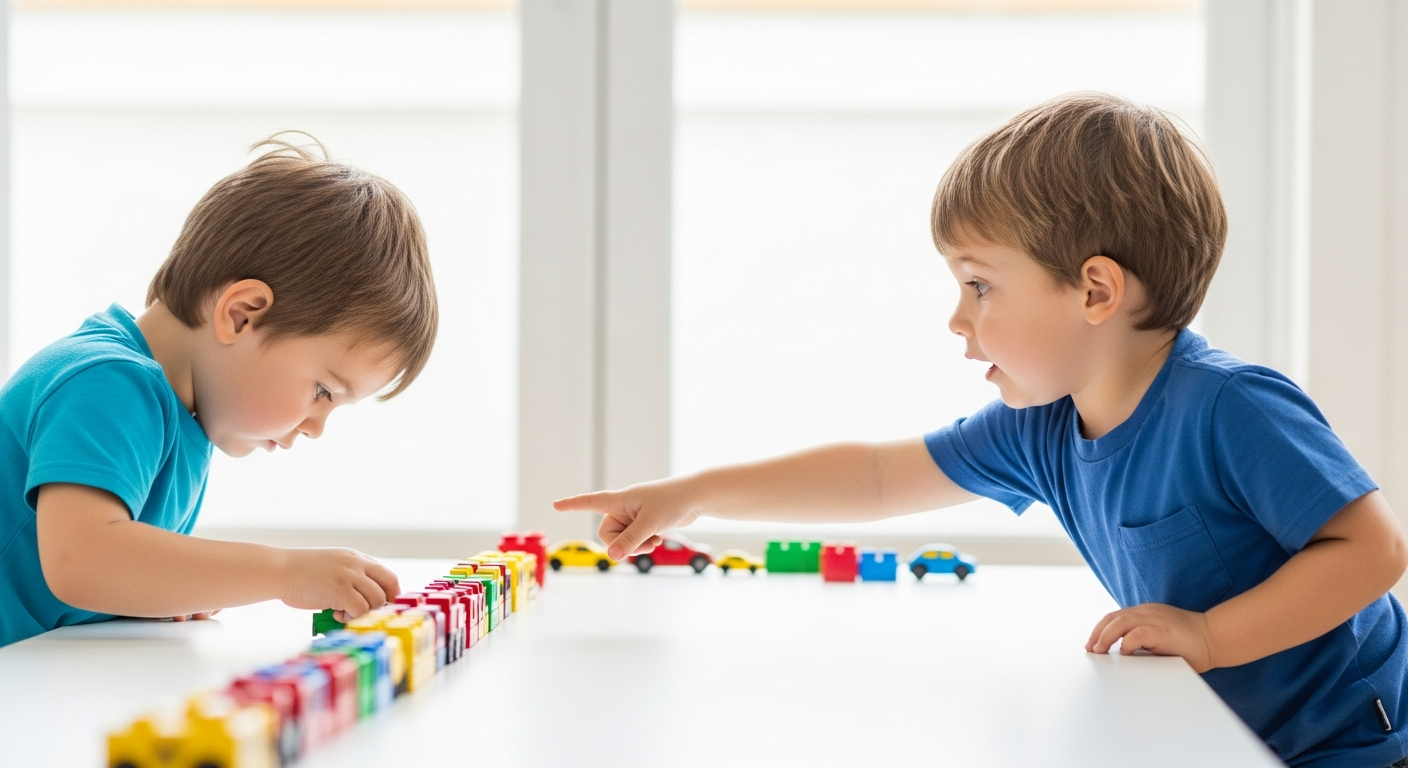
Table of Contents
- Introduction
- Defining the Basics: Speech vs. Language vs. Autism
- The Core Distinctions: How to Know if its Speech Delay or Autism
- Developmental Milestones: What to Watch For
- Other Common Causes of Speech Delay
- How Speech Blubs Supports Every Journey
- The Importance of Early Intervention
- Creating a Joyful Learning Environment at Home
- Understanding the Value of Your Support
- Final Thoughts: You Are the Expert on Your Child
- FAQ
- Start Your Journey Today
Introduction
Imagine you are sitting on the living room floor, surrounded by colorful blocks and plush toys. Your two-year-old is happily stacking a tower, but as you call their name to cheer them on, they don't look up. They haven't started using those precious first words like "mama," "dada," or "ball" yet, while your neighbor's child of the same age is already chatting away about their favorite snacks. This moment of silence can feel heavy with a thousand questions. Is it just a late start, or is it something more?
At Speech Blubs, we understand that every child’s developmental journey is unique, but we also know the deep-seated anxiety that comes when milestones seem to slip by. Statistics show that roughly 10% of preschool-aged children experience some form of speech or language delay. Furthermore, with 1 in 4 children requiring some form of speech support, the question of "how to know if its speech delay or autism" is one of the most common concerns parents bring to us.

The purpose of this post is to provide you with a clear, empathetic, and research-backed framework to understand the nuances between an isolated speech delay and Autism Spectrum Disorder (ASD). We will explore communication milestones, social engagement markers, and the specific "red flags" that can help you differentiate between the two. Most importantly, we want to empower you with the knowledge that early intervention is the most powerful tool in your parenting kit. Our mission is to help every child "speak their minds and hearts," and that starts with understanding exactly what support they need to thrive.
Defining the Basics: Speech vs. Language vs. Autism
Before we dive into the differences, it is helpful to clarify what we mean by these terms. Often, "speech" and "language" are used interchangeably, but in the world of child development, they represent different skills.
What is a Speech Delay?
Speech refers to the physical act of producing sounds. It involves the coordination of the lips, tongue, jaw, and breath to create words. A child with a speech delay might follow the typical developmental path but at a slower pace. They might struggle with specific sounds (like "s" or "r") or have difficulty coordinating the muscles needed for clear articulation.
What is a Language Delay?
Language is about the meaning behind the sounds. It is divided into two parts:
- Expressive Language: How a child uses words to communicate their thoughts and needs.
- Receptive Language: How a child understands what others are saying. A child could have a language delay if they can make sounds perfectly but can't put them together into a sentence to ask for a drink of water.
What is Autism Spectrum Disorder (ASD)?
Autism is a neurodevelopmental condition that affects how a person perceives the world and interacts with others. While speech and language delays are very common hallmarks of autism, they are not the only factors. Autism involves a broader range of characteristics, including challenges with social communication, repetitive behaviors, and sensory sensitivities.

The Core Distinctions: How to Know if its Speech Delay or Autism
When you are trying to figure out the root of your child’s quietness, the most important thing to look at isn't just if they are talking, but how they are trying to connect with you without words.
1. Social Motivation and Engagement
This is perhaps the biggest differentiator. Children with an isolated speech delay are typically very socially motivated. They want to be around you, they want your attention, and they get frustrated when they can't make you understand what they want.
- Speech Delay: A child might lead you to the fridge, point at the milk, look at you, and make a sound to show they are thirsty. They are using every tool in their "non-verbal toolkit" to bridge the gap.
- Autism: A child might not show the same drive for social connection. They might seem perfectly content playing alone for long periods or might lead you to the fridge by the hand (using your hand as a tool) without making eye contact or checking to see if you are looking at them.
2. Non-Verbal Communication (The Power of Pointing)
"Joint attention" is a fancy term for a very simple act: two people looking at the same thing together. If a plane flies overhead and your child points to it and then looks at you as if to say, "Did you see that?", that is joint attention.
- Speech Delay: These children usually have excellent joint attention. They use gestures, waving, nodding, and pointing to communicate beautifully.
- Autism: A significant red flag for autism is a lack of pointing to share interest. An autistic child might point to get something (like a cookie), but they are less likely to point just to show you something they find interesting.
3. Response to Name
Most children with a speech delay will turn their heads almost every time you call their name (assuming their hearing is fine). Children on the autism spectrum may respond inconsistently. It might seem like they have "selective hearing," where they ignore their name but run to the kitchen the second they hear a snack wrapper crinkling.
4. Repetitive Behaviors and Routines
Children with isolated speech delays typically play with toys in a "functional" way—they push a car, feed a doll, or build a tower. While they might have favorite toys, they are usually flexible.
Autism often involves:
- Repetitive Movements: Such as hand flapping, rocking, or spinning.
- Specific Play Patterns: Such as lining up cars in a perfect row rather than "driving" them, or focusing intensely on the wheels of a toy rather than the toy itself.
- Need for Sameness: Getting extremely distressed if the route to the park changes or if their blue cup is in the dishwasher.
Developmental Milestones: What to Watch For
While every child develops at their own rate, having a roadmap can help you identify when to seek professional advice. If you are unsure where your child stands, we highly recommend taking our 3-minute preliminary screener. It consists of 9 simple questions and provides you with a personalized next-steps plan.
By 12 Months
- Typical: Babbling with many sounds (ba-ba, da-da), using simple gestures like waving "bye-bye," and responding to their name.
- Red Flags: No babbling, no gesturing, or not looking when you call them.
By 18 Months
- Typical: Using at least 6-10 words, pointing to show you things, and following simple one-step directions ("Get your shoes").
- Red Flags: No pointing, fewer than 6 words, or losing skills they once had (regression).
By 24 Months
- Typical: Using about 50 words, starting to put two words together ("My ball," "More juice"), and engaging in simple pretend play.
- Red Flags: Fewer than 25 words, no two-word phrases, or a strong preference for playing alone.
Other Common Causes of Speech Delay
It is vital to remember that a delay doesn't automatically mean autism. Many other factors can influence how a child learns to speak:
- Hearing Issues: Even temporary hearing loss from chronic ear infections can cause a child to miss the subtle sounds of language.
- Oral-Motor Challenges: Some children have "Apraxia," where the brain has trouble planning the movements of the tongue and lips, making speech very difficult even though the child understands everything.
- Environmental Factors: A lack of verbal stimulation or, conversely, too much "passive" screen time (like watching cartoons for hours) can slow down the natural back-and-forth of language learning.
- Bilingual Households: Children growing up with two languages may start talking slightly later as they process two different systems, but they usually catch up quickly and have cognitive advantages later on.
How Speech Blubs Supports Every Journey
At Speech Blubs, we believe in "smart screen time." Our founders grew up with speech challenges themselves, and they wanted to create the joyful, effective tool they wish they had. We don't just put a video in front of a child; we invite them into a world of "video modeling."
The Science of Video Modeling
Our app is built on the scientific principle of mirror neurons. When a child watches another child (a peer) perform a task or say a word, their brain reacts as if they are doing it themselves. This peer-to-peer connection is incredibly powerful for both children with speech delays and those with autism.
Real-World Practice with Speech Blubs
Consider a parent whose 3-year-old "late talker" loves animals. In our "Animal Kingdom" section, the child doesn't just hear a "moo"—they see a real child making the "moo" sound, inviting them to imitate. This turns a struggle into a game. For a child with autism who might find adult faces overwhelming, the friendly, relatable faces of other children in the app can feel much more accessible and less intimidating.
Our methodology is highly rated on the MARS scale, placing us among the top tier of educational apps worldwide. You can read more about the scientific research that informs our approach and see how we blend play with therapy.
The Importance of Early Intervention
Whether it is an isolated speech delay or autism, the goal is the same: providing your child with the tools to communicate. The brain of a toddler is incredibly "plastic," meaning it is at its most receptive state for learning new patterns.
Waiting to "see if they grow out of it" can sometimes lead to increased frustration for the child. When a child can't express their needs, they might resort to tantrums or withdrawal. By intervening early—whether through professional speech therapy or supplemental tools like Speech Blubs—you are building their confidence and reducing that frustration.
Many parents have shared their success stories with us. You can read these parent testimonials to see how small daily victories can lead to massive developmental leaps.
Creating a Joyful Learning Environment at Home
While professional evaluation is key, the most important work happens in the hours you spend with your child. Here are a few ways to foster communication:
- Narrate Your Day: Talk about what you are doing as you do it. "I'm washing the red apple. Now I'm cutting the apple."
- Follow Their Lead: If they are looking at a bug, talk about the bug. Don't try to force them to look at a book if their interest is elsewhere.
- Use "Smart Screen Time": Use tools that require interaction. When you use Speech Blubs, sit with your child. Mimic the sounds together. Laugh when the fun face filters appear. This turns the screen into a bridge for connection, rather than a wall.
Understanding the Value of Your Support
We want to be transparent about how we can help your family. We offer two main paths to join our community, designed to fit different needs and budgets.
The Monthly Plan
At $14.99 per month, this plan is a great way to test the waters and see how your child responds to our video modeling technique.
The Yearly Plan (Best Value)
The Yearly plan is our most popular choice for a reason. At $59.99 per year, it breaks down to just $4.99 per month—a 66% saving compared to the monthly rate.
But the value isn't just in the price. The Yearly plan includes:
- A 7-Day Free Trial: You can explore the entire app with no risk.
- Reading Blubs: Access to our companion app designed to boost early literacy skills.
- Priority Support: 24-hour response time from our dedicated team.
- Early Access: Be the first to try new updates and features.
The Monthly plan does not include the free trial or the Reading Blubs app, so we always recommend the Yearly plan to ensure your child has the full suite of tools available to them.
Final Thoughts: You Are the Expert on Your Child
It is easy to get lost in medical jargon and search engine results when looking for "how to know if its speech delay or autism." However, remember that you are the ultimate expert on your child. You know the way they smile, the things that make them laugh, and the subtle ways they try to tell you they love you.
Whether your child is a "late talker" who just needs a little nudge or they are navigating the world through the lens of autism, they have a voice. Our job—and yours—is to help them find it. By seeking answers now, you are already doing the best possible thing for their future.
FAQ
1. Can a child have both a speech delay and autism?
Yes, it is very common. Many children on the autism spectrum also have a speech or language delay. In these cases, therapy usually focuses on both the physical act of speaking and the social communication skills needed to use that speech effectively.
2. If my child makes eye contact, does that mean they don't have autism?
Not necessarily. Autism is a spectrum, and every child is different. Some autistic children make great eye contact with their parents but struggle with peers, while others might avoid eye contact only when they are feeling overwhelmed or overstimulated.
3. Will using an app like Speech Blubs replace the need for a speech therapist?
We frame our app as a powerful supplement to your child's overall development plan. While many parents find it an incredible "jump start," it is not a replacement for professional clinical therapy if your child has a diagnosed condition. It is a tool designed to make the "homework" of speech practice fun and engaging for the whole family.
4. My child was talking and then suddenly stopped. Is this a sign of autism?
A "regression" of skills—where a child loses words or social skills they previously had—is a significant marker that warrants an immediate conversation with your pediatrician. While it can be associated with autism, it can also be linked to other medical or neurological factors that need professional evaluation.
Start Your Journey Today
You don't have to navigate this path alone. Whether you are looking for a way to boost your child's first words or seeking a tool that connects with your child's unique way of learning, we are here to support you.
Ready to see how video modeling can transform your child’s communication? Download Speech Blubs on the App Store or find us on the Google Play Store to begin.
For the best experience and the most comprehensive support, we invite you to create your account and select our Yearly Plan. This gives you a 7-day free trial, access to Reading Blubs, and the peace of mind that comes with having the best tools at your fingertips for just $4.99 a month. Let’s start building those joyful family learning moments today!
Sobre el autor