
Supporting Your Child: Montessori and Speech Delay
 Por Speech Blubs Team•9 mar 2026•14 min.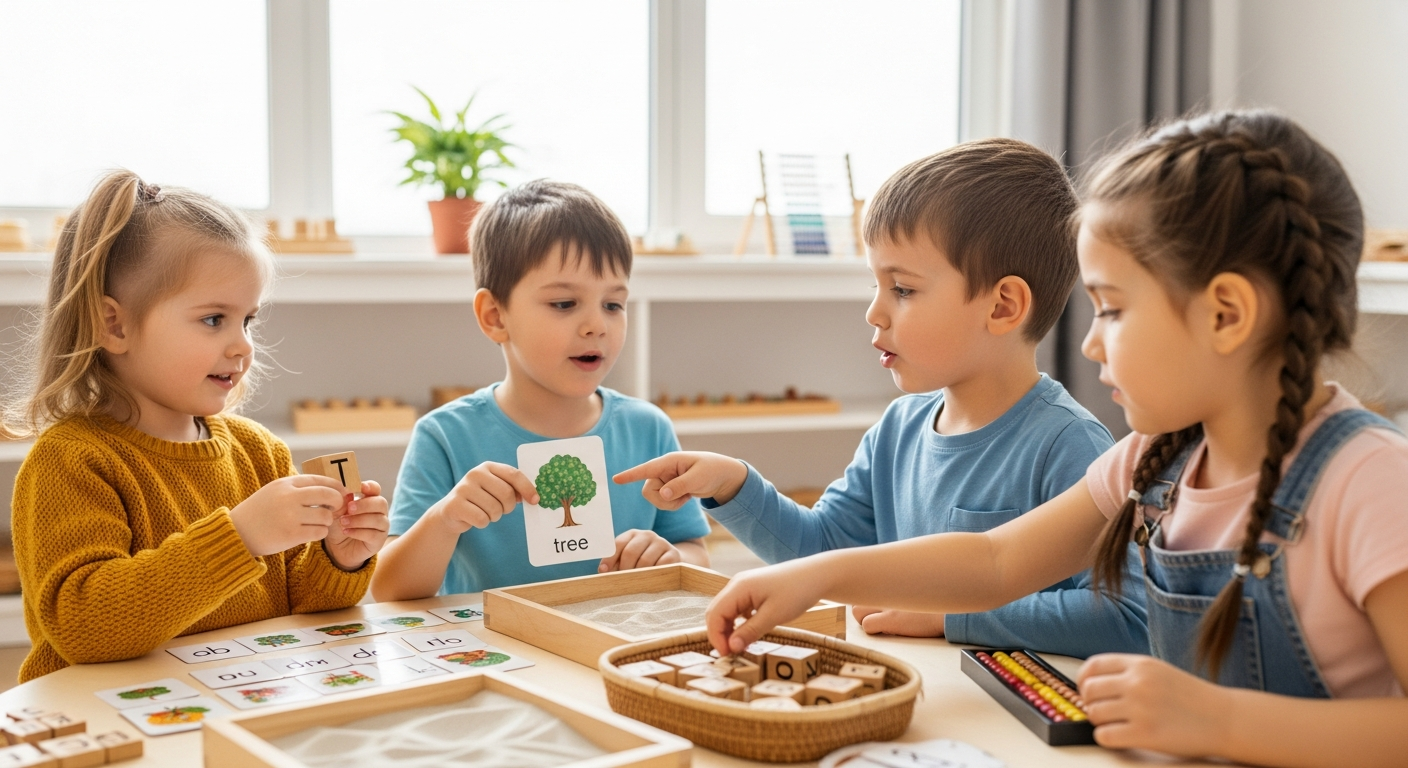
Table of Contents
- Introduction
- The Montessori Philosophy: A Natural Fit for Language
- Why Montessori Works for Speech Delay
- Connecting Fine Motor Skills and Speech
- Strategies for a Language-Rich Montessori Home
- Moving Beyond Passive Viewing
- The Yearly Plan: Investing in Your Child’s Journey
- Integrating Montessori and Professional Therapy
- Realistic Expectations and Small Wins
- The Role of Music and Rhythm
- Practical Scenario: The "Daily Routine"
- The Importance of Observation
- Conclusion
- FAQs
Introduction
Did you know that nearly one in twelve children in the United States between the ages of three and seventeen has a disorder related to voice, speech, language, or swallowing? If you are a parent observing your child struggle to find their words, these statistics aren’t just numbers—they represent the daily frustration of a little one trying to be understood. When a child experiences a speech delay, parents often search for an environment that fosters growth without adding pressure. This search frequently leads to the Montessori method, a child-centered educational philosophy that has gained worldwide recognition for its focus on independence, respect, and natural development.
The purpose of this blog post is to explore the profound synergy between Montessori principles and speech development. We will dive deep into how a "prepared environment" can reduce the anxiety of communication, why the Montessori focus on fine motor skills is scientifically linked to language, and how modern tools can bridge the gap between traditional learning and specialized support. We will also discuss how our unique approach at Speech Blubs complements these timeless principles by offering "smart screen time" rooted in peer imitation.

Our thesis is simple: While a speech delay can be a challenging hurdle, the combination of a supportive Montessori environment at home or school, paired with evidence-based tools like video modeling, can empower children to find their voice at their own pace. By focusing on the "whole child," we can turn the frustration of a delay into a journey of joyful discovery.
The Montessori Philosophy: A Natural Fit for Language
Dr. Maria Montessori, an Italian physician and educator, believed that children possess an "absorbent mind." From birth to age six, children are in a "sensitive period" for language, meaning their brains are uniquely wired to soak up sounds, structures, and vocabulary from their environment without formal instruction. For a child with a speech delay, this period is critical.
In a traditional classroom, a child might feel pressured to keep up with a group, which can lead to "shutting down" if they cannot articulate as quickly as their peers. Montessori flips this script. The focus is on individualized learning. If a child is working on expressive language, they aren't compared to the child next to them who might be reading full sentences. This lack of competition reduces the cortisol levels that can interfere with the brain’s language centers.
At Speech Blubs, we resonate deeply with this mission. Our company was born from the personal experiences of our founders, who all grew up with speech problems and created the tool they wished they had. Like the Montessori method, we believe in providing an immediate, effective, and joyful solution for the 1 in 4 children who need speech support, blending scientific principles with the power of play.
Why Montessori Works for Speech Delay
The Montessori method isn't just about wooden toys; it’s a systematic approach to building a child’s confidence. Here is why it is particularly effective for children facing speech challenges:
1. The Power of Peer Modeling
One of the hallmarks of a Montessori classroom is the mixed-age grouping. Younger children (the "observers") watch older children (the "models"). This is a natural form of peer-to-peer learning. Children are often more motivated to imitate someone who looks like them rather than an adult.

This is the exact scientific methodology we use at Speech Blubs. We utilize "video modeling," where children learn complex communication skills by watching and imitating their peers on screen. When a child sees another child successfully making a "B" sound or naming an animal, it triggers mirror neurons in the brain, making them more likely to attempt the sound themselves. You can see how this works by downloading Speech Blubs on the App Store or Google Play to begin.
2. A Stress-Free Environment
Anxiety is the enemy of speech. In Montessori, there is no "wrong" way to explore a material. A child who is hesitant to speak might find their voice while engaging in a "Practical Life" activity, such as washing a table or pouring water. Because the child is focused on the task, the pressure to "perform" linguistically is removed, allowing speech to emerge more naturally during the process.
3. Sensory-Rich Materials
Language in Montessori is tactile. Children don’t just look at letters; they feel them. Sandpaper letters allow a child to trace the shape of a letter while hearing its phonetic sound. This multi-sensory approach—combining touch, sight, and sound—creates stronger neural pathways for language than sight-reading alone.
Connecting Fine Motor Skills and Speech
It may seem surprising, but the way a child uses their hands is directly related to how they use their tongue. Research suggests that fine motor skills and language functions are controlled by overlapping areas in the brain. In the Montessori classroom, "Practical Life" activities like using tongs, buttoning, and pouring are not just about independence; they are neurological preparation for speech.
When a child refines the small muscles in their hands, they are also working on the brain's ability to sequence and control complex movements—the very same skills required to sequence sounds into words. This is why we encourage parents to engage in "co-play." Whether you are helping your child sort beads or using our app together, your active participation reinforces these connections.
If you are unsure where your child stands in their development, we recommend taking our quick 3-minute preliminary screener. It involves 9 simple questions and provides an assessment and a next-steps plan to help you understand how to best support your child’s unique path.
Strategies for a Language-Rich Montessori Home
You don't need a formal Montessori certification to implement these strategies at home. Here are practical ways to support a child with a speech delay using Montessori principles:
"Sportscasting" Daily Life
In Montessori, we avoid "baby talk." Instead, we use rich, precise vocabulary. "Sportscasting" is the act of narrating what you or your child is doing without demanding a response.
- Example: Instead of saying, "Want juice?", you might say, "I am pouring the cold, orange juice into your small glass pitcher." This exposes the child to complex sentence structures and descriptive adjectives in a natural context.
Prepare the Environment for Independence
If a child has to ask for everything, they may become frustrated if they can't find the words. By placing toys on low, open shelves and using front-facing bookshelves, you empower the child to choose. However, you can also use this for "communication temptations." Place a favorite toy slightly out of reach or in a clear container that is hard to open. This creates a natural, low-stress opportunity for the child to use a gesture, a sound, or a word to ask for help.
Real-World Scenarios with Speech Blubs
For a parent whose 3-year-old "late talker" loves animals, the "Animal Kingdom" section of our app offers a fun, motivating way to practice "moo" and "baa" sounds. In a Montessori home, you might pair this digital exploration with physical animal figurines.
- Watch the "Peer Model" in the app make the animal sound.
- Hold up the corresponding physical figurine.
- Encourage the child to "show" the animal what sound it makes. This bridges the gap between the digital "smart screen time" and the physical, tactile world that Montessori prizes.
Moving Beyond Passive Viewing
One of the biggest concerns parents have today is screen time. Montessori philosophy generally encourages limited screen use for young children, focusing instead on real-world experiences. At Speech Blubs, we agree that passive viewing—like sitting silently in front of high-speed cartoons—is not beneficial for language development.
However, we provide a powerful alternative. Our app is designed as an interactive tool for family connection. It isn't a "babysitter"; it’s a digital extension of the Montessori "Language Materials." Because our method is backed by science, we focus on active participation. The child is prompted to speak, move, and interact. This "smart screen time" is an effective supplement to a child's overall development plan and, when applicable, professional therapy.
"At Speech Blubs, our mission is to empower children to speak their minds and hearts. We provide a screen-free alternative to passive viewing and a tool that creates joyful family learning moments."
The Yearly Plan: Investing in Your Child’s Journey
Speech development is a marathon, not a sprint. Consistency is the most important factor in overcoming a speech delay. To support this long-term growth, we offer two primary subscription options.
While our Monthly plan is $14.99 per month, our Yearly plan is $59.99 per year, which breaks down to just $4.99 per month. We advocate for the Yearly plan because it offers the most comprehensive support for families committed to their child's progress.
The Yearly plan includes exclusive, high-value features not found in the Monthly plan:
- A 7-day free trial: To ensure the app is the right fit for your family.
- The Reading Blubs app: A powerful tool to transition from speech to early literacy, perfectly aligning with the Montessori focus on phonics.
- Early access to new updates: Be the first to try new activities and sections.
- 24-hour support response time: Our team is here to help you every step of the way.
Choosing the Yearly plan ensures that as your child progresses from simple sounds to complex sentences, they have the tools to keep growing. Ready to get started? Create your account and begin your 7-day free trial today.
Integrating Montessori and Professional Therapy
It is important to remember that Montessori is an educational approach, not a medical treatment. If your child has a diagnosed speech delay, Montessori can be a wonderful environment, but it should often work in tandem with a Speech-Language Pathologist (SLP).
Many Montessori schools are increasingly inclusive, bringing SLPs into the classroom to work with children in their natural environment. This "push-in" model is highly effective because the child learns to communicate in the same place they play and socialize. If your child is in therapy, you can show the Speech Blubs app to your therapist. Many professionals use our video modeling as a "homework" tool to keep children engaged between sessions. You can read testimonials from parents and professionals who have seen the benefits of this integrated approach.
Realistic Expectations and Small Wins
When dealing with a Montessori speech delay strategy, it’s vital to frame success correctly. We do not suggest guaranteed outcomes, such as your child giving public speeches in a month. Instead, we focus on the foundational benefits:
- Fostering a love for communication.
- Building the confidence to try new sounds.
- Reducing the frustration that comes from being misunderstood.
- Creating joyful family learning moments.
In a Montessori setting, a "win" might be a child choosing a language work independently. In Speech Blubs, a "win" might be your child finally imitating a "pop" sound after watching a peer do it on screen. These small steps are the building blocks of a lifetime of communication.
The Role of Music and Rhythm
Maria Montessori noticed that children have a natural affinity for music and rhythm. This is why many Montessori environments include singing and rhyming games. Rhythm helps children process the "cadence" of language. For a child with a speech delay, singing can often be easier than speaking because it uses different neural pathways.
At Speech Blubs, we incorporate rhythmic elements and songs to make sound production fun. If a child is struggling with a specific word, try singing it to a simple tune. This "melodic intonation" can help the brain bypass the stress of speech and find the flow of the word.
Practical Scenario: The "Daily Routine"
Imagine a morning in a Montessori-inspired home. A toddler is working on their "Practical Life" skills by helping to set the table.
- The Montessori Element: The parent provides a child-sized tray and clear instructions: "Carry the tray with two hands."
- The Speech Element: The parent labels the items: "Napkin. Spoon. Plate."
- The Speech Blubs Integration: After breakfast, the parent and child spend 10 minutes on Speech Blubs, focusing on the "Early Sounds" section. The child sees a peer model saying "Mmm" for "Yummy."
- The Connection: The parent reinforces this by saying, "The breakfast was yummy, mmm!"
This seamless integration of physical task, linguistic labeling, and peer imitation creates a "360-degree" learning environment. By choosing to download Speech Blubs on the Google Play Store or App Store, you are adding a scientifically-backed tool to this daily routine.
The Importance of Observation
One of the most valuable skills a Montessori parent can develop is the "art of observation." Instead of constantly prompting your child to "say it," take a step back. Observe what they are trying to communicate through their eyes, their hands, and their gestures.
When you observe, you learn what motivates your child. If they are obsessed with trains, that is your "way in." Use our "Things That Go" section to capture their interest. By following the child's lead—a core Montessori principle—you ensure that language learning is always relevant and exciting for them.
Conclusion
Navigating a speech delay can feel like a lonely journey, but you are not alone. By embracing the Montessori principles of independence, respect, and a prepared environment, you are giving your child a beautiful foundation for growth. When you supplement that foundation with "smart screen time" that utilizes peer modeling, you are giving them the extra spark they need to find their voice.
At Speech Blubs, we are committed to being your partner in this process. Our mission is to help your child speak their mind and heart, transforming the "work" of speech therapy into the "joy" of play. Remember, every child’s timeline is unique, and our goal is to foster a lifelong love for communication rather than rushing to a finish line.
To give your child the full suite of features—including the Reading Blubs app and 24-hour support—we highly recommend our Yearly plan. It is the most cost-effective way to ensure your child has consistent, high-quality support.
Ready to start this journey together? Download Speech Blubs on the App Store or Google Play and select the Yearly plan to begin your 7-day free trial. Let’s help your little one speak their heart!
FAQs
1. Can Montessori schools help a child who is non-verbal?
Yes, Montessori environments can be very supportive for non-verbal children. Because the method emphasizes "Practical Life" and sensory materials, the child can engage fully with the curriculum through movement and touch while their language develops. Montessori teachers are trained to observe a child's non-verbal cues and provide a "language-rich" environment that prepares the child for the moment they are ready to speak.
2. Is Speech Blubs considered "bad" screen time by Montessori standards?
While traditional Montessori encourages avoiding passive screen time (like cartoons), Speech Blubs is "smart screen time." It is an active, educational tool based on peer modeling and imitation. When used as a co-play activity where the parent and child interact together, it aligns with the Montessori goal of using tools to foster real-world skills and independence.
3. How do fine motor activities in Montessori help with speech?
The brain areas responsible for hand movements and mouth movements are closely linked. By practicing fine motor skills—like threading beads or using a pitcher—a child strengthens the neural pathways required for the complex coordination of speech. This is why "Practical Life" is often considered a precursor to language development in Montessori education.
4. What is the best way to use Speech Blubs at home for a speech delay?
The most effective way is through "co-play." Sit with your child, watch the peer models together, and encourage imitation in a fun, low-pressure way. Pair the digital activities with real-world objects. For example, if you are practicing the word "apple" in the app, have a real apple nearby for the child to touch, smell, and taste. Consistency is key, which is why we recommend the Yearly plan to make the app a regular, joyful part of your daily routine.
Sobre el autor