
Toddler Delayed Speech: Signs, Causes, and Solutions
 Por Speech Blubs Team•23 mar 2026•15 min.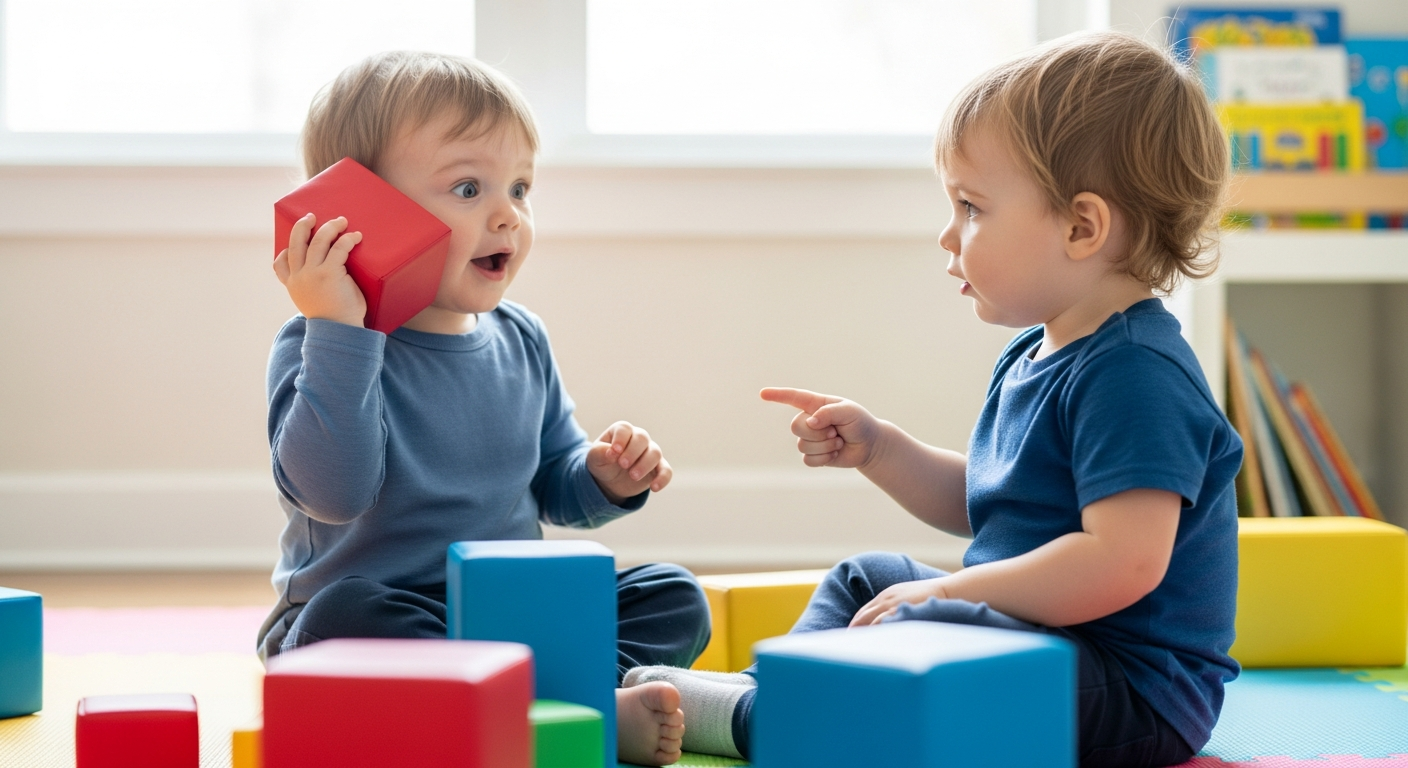
Table of Contents
- Introduction
- Understanding the Difference: Speech vs. Language
- Key Speech and Language Milestones
- Identifying Red Flags Early
- Common Causes of Toddler Delayed Speech
- How to Support Speech Development at Home
- The Speech Blubs Approach: Smart Screen Time
- Navigating the Path to Professional Help
- Realistic Expectations for Your Journey
- Why Choose Speech Blubs for Your Family?
- Creating a Joyful Learning Environment
- Conclusion
- Frequently Asked Questions
Introduction
Imagine you are at a playdate, watching your two-year-old navigate a pile of blocks. Beside them, another toddler is chatting away, requesting "more blue blocks" or telling their mom "look at the car!" Meanwhile, your little one is mostly quiet, perhaps pointing or tugging at your sleeve to get what they need. In that moment, a wave of worry might wash over you. Is this just a phase? Are they a "late talker"? Or is there something more to consider regarding toddler delayed speech?
At Speech Blubs, we understand exactly how heavy that feeling can be. Our mission is to empower children to "speak their minds and hearts," and this mission is deeply personal. Our founders all grew up with speech challenges themselves; they built the very tool they wished they had as children. We know that roughly one in four children will face some form of speech or language delay, and we believe that every child deserves an immediate, joyful, and effective way to find their voice.

In this guide, we will explore the nuances of speech and language development, identify the milestones that matter, and discuss common causes for delays. We will also provide practical strategies you can use at home and explain how our "smart screen time" approach can bridge the gap between frustration and communication. Whether you are just beginning to notice signs or are already looking for ways to supplement professional therapy, our goal is to help you foster a love for communication and build your child's confidence, one joyful word at a time.
Understanding the Difference: Speech vs. Language
Before diving into milestones, it is helpful to clarify two terms that are often used interchangeably but mean different things in the world of child development.
What is Speech?
Speech refers to the physical act of producing sounds and words. It involves articulation (how we form sounds with our mouth, tongue, and lips), voice (using our vocal folds and breath to make sound), and fluency (the rhythm of our speech). A child with a speech delay might understand everything you say and have complex ideas, but they struggle to physically form the words in a way that others can understand.
What is Language?
Language is much broader. it is the entire system we use to share and receive information. This includes "receptive language" (understanding what others say) and "expressive language" (using words, gestures, and symbols to communicate thoughts). A child with a language delay might be able to pronounce words perfectly but might only be able to put two words together when their peers are using full sentences.
Understanding this distinction helps us tailor our support. If you are unsure where your child stands, we recommend taking our quick 3-minute preliminary screener. It consists of nine simple questions that provide an assessment and a next-steps plan to help you navigate your journey.
Key Speech and Language Milestones
While every child develops at their own pace, there are general "guideposts" that help us understand if development is on track. At Speech Blubs, we focus on these milestones not to create pressure, but to provide a roadmap for joyful learning.

By 12 Months
At the one-year mark, communication is blossoming through sounds and gestures.
- Gestures: Your child should be waving "bye-bye" and pointing at things they want.
- Vocalizations: You should hear babbling that sounds like "sentences" (jargoning), even if the words aren't real yet.
- First Words: Most babies say "mama" or "dada" specifically to their parents and may have one other simple word.
- Response: They should look when you call their name and understand simple words like "no."
By 18 Months
This is often the age when parents first notice a toddler delayed speech pattern.
- Vocabulary: A typical 18-month-old uses between 10 and 25 words.
- Imitation: They should be trying to repeat sounds or words they hear you say.
- Body Parts: They can often point to a few body parts (like nose or eyes) when asked.
- Requests: They should use a combination of words and gestures to get their needs met, rather than just crying or pulling you.
By 24 Months (2 Years)
The second birthday is a major milestone for language "explosions."
- Vocabulary: Most toddlers have a vocabulary of 50 to 100 words.
- Phrases: They begin to combine two words, such as "more juice" or "doggy bark."
- Understanding: They can follow simple, one-step commands without you needing to gesture (e.g., "Put your shoes by the door").
- Intelligibility: Parents and regular caregivers should understand about 50% of what the child says.
By 36 Months (3 Years)
By age three, the world of communication opens up significantly.
- Sentences: They should be using three-word sentences regularly.
- Vocabulary: Their word count can range from 200 to 1,000 words.
- Intelligibility: About 75% of their speech should be understood by strangers.
- Pronouns: They begin using words like "I," "me," and "you" correctly.
Identifying Red Flags Early
If your child isn't hitting every milestone exactly on time, don't panic. However, there are certain "red flags" that suggest it is time to consult a pediatrician or a speech-language pathologist (SLP). Early intervention is the most effective way to help a child catch up.
Watch for these signs:
- At 12 months: No pointing, waving, or using gestures.
- At 15 months: No "mama" or "dada" or other specific words.
- At 18 months: Prefers using gestures exclusively over even attempting to make sounds.
- At 24 months: Cannot follow simple directions or only imitates speech without producing words spontaneously.
- At any age: A sudden loss of skills (regression) or an unusual tone of voice (raspy or very nasal).
If you are seeing these signs, it is a great time to explore professional resources. You can also see what other parents have experienced by reading our parent success stories to see how early action made a difference for their families.
Common Causes of Toddler Delayed Speech
When a child is a "late talker," parents often wonder if they did something wrong. We want to be very clear: it is not your fault. Speech and language delays are common and can stem from many different factors.
Oral-Motor Issues
In many cases, the brain has trouble coordinating the muscles used for speech—the lips, tongue, and jaw. This is often seen in a condition called Childhood Apraxia of Speech (CAS). For a child with CAS, the "map" from the brain to the mouth gets jumbled. They might also have difficulty with eating or swallowing.
Physical Impairments
Sometimes the delay is purely structural.
- Short Frenulum: This is the fold of skin under the tongue. If it is too short, it can limit tongue movement (often called "tongue-tie").
- Cleft Palate or Lip: Irregularities in the roof of the mouth can make it difficult to form certain sounds, especially "p," "b," and "t."
Hearing Loss
Speech is learned through imitation. If a child cannot hear clearly, they cannot reproduce sounds accurately. Even temporary hearing loss from chronic ear infections can cause a child to miss out on critical language input during the first two years of life. This is why an audiologist's evaluation is often the first step in diagnosing a speech delay.
Developmental and Learning Disorders
Speech delays can sometimes be a secondary symptom of a broader condition, such as Autism Spectrum Disorder (ASD) or a global developmental delay. In these cases, the delay often appears alongside challenges with social interaction or repetitive behaviors.
How to Support Speech Development at Home
While professional therapy is invaluable, the most important "therapy" happens in the joyful moments of your daily life. You are your child's first and best teacher.
1. Narrate Your Day
Think of yourself as a sports commentator for your child's life. As you go through your chores, talk about what you are doing. "Now I am putting the red socks in the basket. Look at the blue shirt!" For a parent whose 3-year-old 'late talker' loves helping in the kitchen, the "Yummy Time" section of our app offers a fun, motivating way to practice words like "apple," "banana," and "eat" while you actually prepare a snack together.
2. Focus on Imitation
Before a child can speak, they must learn to imitate. Start with gestures. If you clap, do they clap back? If you make a funny face, do they try to copy it? Move on to animal sounds. Our "Animal Kingdom" section is designed specifically for this. By watching other children make "moo" and "baa" sounds, your toddler is encouraged to join the fun.
3. Read and Sing
Books with repetitive phrases are excellent for speech development. When you read, stop before a predictable word and see if your child fills it in. Singing songs like "The Wheels on the Bus" also helps them understand the rhythm and melody of language.
4. Provide Wait Time
As parents, we are often so good at anticipating our children's needs that they don't need to talk. If your child points at the milk, wait a few seconds before giving it to them. Give them the space to try and say "milk" or make a sound. This "expectant waiting" is a powerful tool for encouraging communication.
The Speech Blubs Approach: Smart Screen Time
At Speech Blubs, we believe that screen time doesn't have to be passive or "mindless." We have created a "smart screen time" experience that is a screen-free alternative to passive viewing (like cartoons). Our app is built on a powerful, scientifically-proven methodology called video modeling.
The Power of Peer-to-Peer Learning
Our scientific methodology is based on the fact that children love to watch and imitate other children. In our app, your child won't see cartoons; they will see real kids—their peers—demonstrating how to make sounds and say words. This triggers "mirror neurons" in the brain, which are the cells that fire when we perform an action and when we see someone else perform that same action.
Making Therapy Feel Like Play
We blend speech therapy principles with pure joy. By using fun filters (like turning your child into a lion when they practice their "roar"), we reduce the frustration often associated with speech delays. We want to transform "practice" into "play."
Our app is a powerful supplement to your child's development plan. It is designed for adult co-play, meaning it’s a tool for you to use with your child, fostering connection while they learn foundational skills. To start this journey, you can Download Speech Blubs on the App Store or get it on the Google Play Store to begin today.
Navigating the Path to Professional Help
If you have concerns about toddler delayed speech, your first stop should be your pediatrician. They can rule out physical issues and provide referrals to specialists.
The Speech-Language Pathologist (SLP)
An SLP will conduct a comprehensive evaluation. They will look at:
- Receptive Language: What does your child understand?
- Expressive Language: What can your child say or communicate through gestures?
- Oral-Motor Status: How are the muscles in their mouth working?
- Articulation: Are they producing sounds correctly for their age?
Early Intervention Programs
In many regions, government-funded early intervention programs (often called "Birth to Three" programs) provide free or low-cost evaluations and therapy. You do not always need a doctor's referral to contact these programs; often, a parent's concern is enough to trigger an assessment.
Remember, the goal of therapy isn't to force a child to speak; it is to give them the tools to reduce frustration and find joy in connecting with others. Speech Blubs is a great way to keep that momentum going between therapy sessions.
Realistic Expectations for Your Journey
We often get asked, "How quickly will my child start talking?" While we wish we could give a guaranteed timeline, every child's brain is wired differently. Some children experience a "language burst" after a few weeks of focused work, while others take a more gradual path.
Our focus is on the benefits of the process:
- Building Confidence: When a child realizes they can make themselves understood, their confidence soars.
- Reducing Frustration: Most "toddler tantrums" stem from a child's inability to communicate their needs. Improving communication often leads to a calmer home.
- Foundational Skills: Even if they aren't speaking in full sentences yet, they are learning the building blocks of social interaction, turn-taking, and listening.
We are here to support you through the small wins—the first time they imitate a sound, the first time they use a new gesture, and eventually, that first clear word.
Why Choose Speech Blubs for Your Family?
With so many apps and tools available, why do millions of parents trust us? It’s because we prioritize transparency, science, and value.
Transparent Pricing and Best Value
We want to be a sustainable part of your child’s development. We offer two main plans:
- Monthly Plan: $14.99 per month. This is great for those who want to try the app on a short-term basis.
- Yearly Plan: $59.99 per year. This is our clear best choice and the most popular option among parents.
The Yearly Plan includes exclusive, high-value features that the Monthly plan does not:
- A 7-Day Free Trial: You can explore everything the app has to offer before committing.
- 66% Savings: The cost breaks down to just $4.99 per month.
- Reading Blubs: You get access to our companion app, Reading Blubs, which focuses on early literacy.
- Priority Support: You get 24-hour support response times and early access to all new updates.
Create your account today and select the Yearly plan to unlock the full suite of features and start your free trial.
Creating a Joyful Learning Environment
Communication is about more than just words; it’s about the "spark" that happens when two people connect. When working with your toddler on their speech, try to keep the mood light and encouraging.
- Follow Their Lead: If your child is obsessed with cars, use cars to teach language. "Fast car," "Blue car," "Beep beep!"
- Celebrate Every Effort: If they try to say a word but don't get it quite right, don't correct them harshly. Instead, model the correct word back to them. If they say "gaga" for water, say, "Yes, water! You want some water."
- Limit "Testing": Avoid constantly asking your child, "What's this?" or "Say apple." This can create pressure. Instead, simply name things for them and wait for them to join in when they feel ready.
By using Speech Blubs as a "smart screen time" tool, you are providing a structured yet playful way for them to see other kids succeeding. This peer modeling is incredibly motivating and helps remove the "performance anxiety" some toddlers feel when prompted by adults.
Conclusion
The journey through toddler delayed speech can feel like a marathon, but you don't have to run it alone. From the physical causes like ear infections to the developmental milestones of the second and third years, understanding the "why" and "how" of speech development is the first step toward progress. Remember that early intervention is key, and the most important work happens through play, reading, and everyday conversation.
At Speech Blubs, we are honored to be a part of your family’s story. Our mission is to provide you with the tools to turn screen time into a bridge for connection, helping your child find their voice in a way that is joyful and effective. We encourage you to take the next step in your child's communication journey today.
Ready to get started? Download Speech Blubs on the App Store or Google Play and begin your 7-day free trial. For the best value, be sure to choose our Yearly plan for just $59.99/year. This not only saves you 66% compared to the monthly plan but also gives you access to Reading Blubs, priority support, and all our latest updates. Let’s help your little one speak their mind and heart!
Frequently Asked Questions
1. Is it normal for a 2-year-old to not be talking yet?
While every child is different, most 2-year-olds should be able to say 50–100 words and use simple two-word phrases. If your child is not yet talking or has a very limited vocabulary at this age, it is a good idea to consult your pediatrician. Early intervention is very effective, and many "late talkers" catch up quickly with the right support.
2. Can too much screen time cause speech delays?
Passive screen time, such as watching cartoons for hours, does not provide the interactive "serve and return" communication that children need to develop language. However, "smart screen time" that uses video modeling and encourages imitation (like Speech Blubs) can actually be a powerful tool for speech development when used alongside a parent.
3. What is the difference between a speech delay and Autism?
A speech delay is specifically related to communication—the ability to produce sounds or use language. Autism Spectrum Disorder (ASD) is a broader developmental condition that includes speech delays as well as challenges with social interaction, eye contact, and repetitive behaviors. If you are concerned about ASD, your pediatrician can perform a specific screening.
4. How does Speech Blubs help with speech delays?
Speech Blubs uses a technique called "video modeling." Your child watches videos of other children saying words and making sounds. This triggers mirror neurons in their brain, making them more likely to imitate what they see. The app also uses fun filters and rewards to make practicing speech feel like a game rather than a chore.
Sobre el autor