
Toddler Small Group Activities: Playful Learning Ideas
 Por Speech Blubs Team•18 mar 2026•14 min.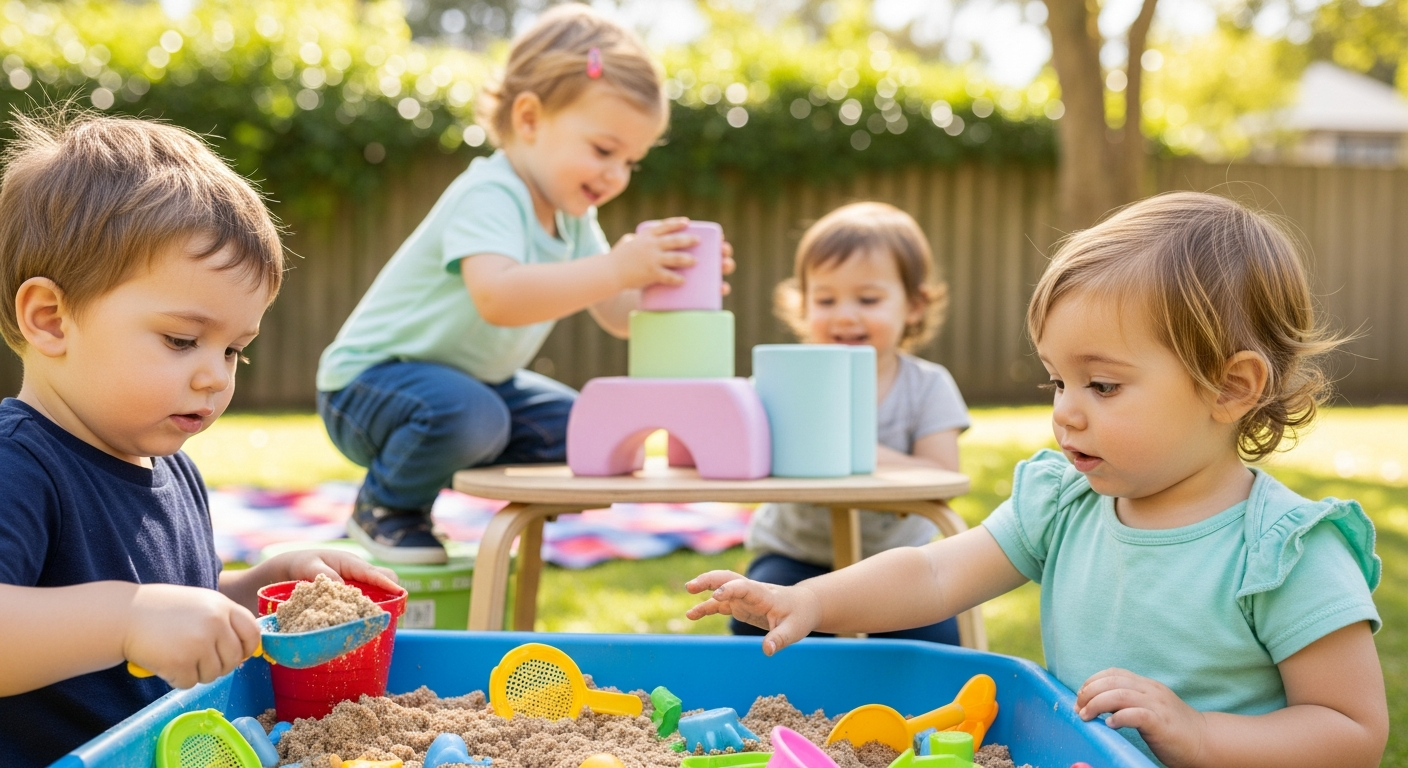
Table of Contents
- Introduction
- The Power of Small Group Interaction
- Sensory Play: Exploring the World Together
- Fine Motor Activities for Busy Hands
- Gross Motor and Movement: Energy in Action
- Creative Arts: Expressing Without Words
- Integrating Smart Screen Time
- Setting Up Your Small Group for Success
- Understanding the Value of Your Investment
- Fostering Emotional and Social Growth
- Practical Scenarios: Connecting Activities to Real Life
- Conclusion
- Frequently Asked Questions
Introduction
Have you ever watched a group of toddlers in a room together and wondered if there is a method to the beautiful, noisy chaos? One moment they are playing side-by-side in silence, and the next, they are erupting in giggles because someone discovered how to pop a bubble. These early interactions are more than just "playtime"; they are the foundational moments where communication, empathy, and social confidence begin to bloom.
As a parent or caregiver, you might feel the pressure to make every playdate "educational," but the truth is that the best learning happens when children are simply having fun together. At Speech Blubs, we believe that every child deserves the chance to "speak their minds and hearts." We know this because our founders lived it; they grew up with speech challenges and created the tool they wished they had. We’ve seen firsthand how toddler small group activities can serve as a bridge, helping children move from isolated play to meaningful connection.

In this post, we will explore a wide variety of engaging activities designed for small groups of toddlers. We will cover sensory play, fine and gross motor activities, and creative projects that foster social-emotional growth. We will also discuss how to integrate "smart screen time" into your routine to supplement these physical activities. Our goal is to provide you with a toolkit of ideas that turn ordinary afternoons into joyful learning moments, helping your little ones build the foundational skills they need to thrive.
The Power of Small Group Interaction
Toddlers are like tiny scientists, constantly observing and testing the world around them. When they participate in small group activities, they aren't just learning how to share a toy; they are learning the complex art of "video modeling" in real-time. This is the same scientific principle we use at Speech Blubs, where children watch their peers perform tasks or make sounds and then naturally imitate them.
In a small group setting, toddlers see a friend stack a block and think, “I can do that too!” This peer-to-peer inspiration is a powerful motivator. It reduces frustration because the "teacher" is someone just like them. By facilitating these interactions, we help children develop:
- Social Skills: Learning to take turns and recognize the emotions of others.
- Language Development: Hearing a wider variety of words and sounds in a natural context.
- Confidence: The "I did it!" moment is much sweeter when there’s a friend there to see it.
For a parent whose 3-year-old "late talker" loves animals, seeing a peer mimic a "roar" in a group setting can be the spark that encourages them to try the sound themselves. This is exactly why the "Animal Kingdom" section of our app is so popular—it uses real children to model these sounds, making the goal feel achievable and fun.
Sensory Play: Exploring the World Together
Sensory play is a toddler’s best friend. It engages their curiosity and provides endless opportunities for vocabulary building. When toddlers explore textures together, they naturally begin to use descriptive words like "cold," "squishy," "bumpy," or "wet."

1. The "5 Little Ducks" Water Table
Water play is a universal favorite. For a small group, fill a water table or a large shallow bin with water and plenty of bubbles. Add a few rubber ducks and some cups for pouring.
- Why it works: It’s a great way to practice counting and "preposition" words (the duck is under the bubbles, the water is in the cup).
- Pro Tip: If you notice the group getting restless, try singing the "5 Little Ducks" song to bring a sense of rhythm and routine to the play.
2. Frozen Pom Pom Excavation
Freeze colorful pom poms in ice cube trays or muffin tins. Give the toddlers small spoons or warm water droppers to "rescue" the pom poms.
- Why it works: This activity is fantastic for fine motor control and teaching the concept of cause and effect (ice melts into water). It’s a quiet, focused activity that allows toddlers to work side-by-side.
3. The Great Bean Construction Site
Fill a large container with dried beans (kidney beans, black beans, and chickpeas offer different colors and textures). Add small construction trucks and scoops.
- Why it works: Toddlers love the "crunchy" sound of the beans. In a group, they can practice "filling" and "dumping" into each other's trucks, which is an early form of cooperative play.
Fine Motor Activities for Busy Hands
Fine motor skills involve the small muscles in the fingers and hands. Strengthening these muscles is essential for future tasks like writing and using scissors. Small group activities that focus on these skills often lead to intense focus and a sense of shared accomplishment.
4. Collaborative Sticker Walls
Roll out a long piece of butcher paper and tape it to a wall at the toddlers' eye level. Give each child a sheet of stickers (we love dot stickers for this).
- Why it works: Peeling stickers is a major fine motor workout! When done on a wall, it also works their core and shoulder stability. As they work, they can talk about the colors and shapes they are placing.
- Speech Connection: This is a perfect time to use our preliminary screener to see if your child is hitting their age-appropriate milestones for following simple directions like "put the red sticker here."
5. Shape Monsters
Create "monsters" out of cardboard boxes with different shaped mouths (a circle, a square, a triangle). Give the toddlers corresponding felt or wooden shapes to "feed" the monsters.
- Why it works: Sorting is a key cognitive skill. In a group, you can encourage them to find all the "circles" together. This builds a sense of teamwork.
6. Pipe Cleaner Colander
Give each toddler a kitchen colander and a handful of colorful pipe cleaners. Show them how to poke the pipe cleaners through the holes.
- Why it works: It requires a surprising amount of hand-eye coordination. Watching a friend successfully thread a pipe cleaner often motivates the others to keep trying, even if it’s challenging at first.
Gross Motor and Movement: Energy in Action
Toddlers have a lot of energy, and providing a constructive outlet for that energy is key to a successful group session. Gross motor activities help them develop balance, coordination, and a sense of their own physical boundaries.
7. Bubble Wrap Roadway
Tape a long strip of bubble wrap to the floor. Let the toddlers walk, jump, or crawl across it.
- Why it works: The "pop-pop-pop" sound provides immediate sensory feedback. It’s a great way to practice verbs like "jump," "run," and "stop."
8. Animal Action Cards
Create simple cards with pictures of animals and an action (e.g., "Hop like a frog," "Stomp like an elephant").
- Why it works: This encourages imitation, which is a foundational skill for speech. If you are looking for more ways to encourage this, our research highlights how watching peers (video modeling) can trigger mirror neurons in the brain, helping children learn new movements and sounds more effectively.
9. The Soft Ball Toss
Use a laundry basket and several soft, colorful balls. Have the toddlers stand in a circle and take turns trying to throw the ball into the basket.
- Why it works: It teaches turn-taking in its simplest form. Celebrate every "basket" made to build group morale!
Creative Arts: Expressing Without Words
Artistic activities allow toddlers to express themselves before they have the full vocabulary to do so. In a small group, art can become a shared sensory experience.
10. Painting on Ice
Give each child a large block of ice on a tray and some non-toxic finger paints.
- Why it works: The paint behaves differently on ice than on paper—it slides and swirls. It’s a captivating visual experience that often leads to "oohs" and "aahs" from the group.
11. Handprint Family Tree
On a large piece of canvas or paper, have each child (and the caregivers!) leave a colorful handprint. Once dry, draw a tree trunk around them.
- Why it works: It creates a lasting memory of their time together. It also helps toddlers recognize their own handprint vs. their friend's, fostering self-awareness.
Integrating Smart Screen Time
While physical play is vital, we also recognize that we live in a digital world. The key is to move away from "passive" viewing—where a child sits silently watching a cartoon—and toward "active" or "smart" screen time.
At Speech Blubs, we’ve created an experience that acts as a digital extension of the toddler small group activities you do in person. In our app, your child doesn't just watch; they participate. They see a real child (not a cartoon) making a sound, and they are encouraged to mimic that sound. This "video modeling" method is what makes our tool so effective for the 1 in 4 children who need speech support.
Making Technology a Social Tool
You can even use Speech Blubs in a small group setting! Set a tablet in the center of the group and let the toddlers take turns interacting with the "Face Filters." Seeing their own faces transformed into a lion or a robot while they practice speech sounds can lead to a lot of group laughter and shared joy.
If you’re curious about how your child is progressing, we recommend taking our quick 3-minute screener. It involves 9 simple questions and provides you with a personalized assessment and next-steps plan. It’s a great way to see how the activities you are doing at home are supporting their overall development.
Setting Up Your Small Group for Success
To ensure your toddler small group activities go smoothly, a little bit of preparation goes a long way.
- Safety First: Ensure the area is "toddler-proofed." Use soft mats if you’re doing gross motor activities, and always supervise sensory play with small objects like beans or pom poms.
- Keep it Short: Toddlers have short attention spans. It’s better to have three 10-minute activities than one 30-minute activity.
- Embrace the Mess: Learning is messy! Have towels, wipes, and perhaps a "messy clothes" policy in place so everyone can relax and enjoy the process.
- Routine is Comfort: Start and end your sessions with the same song or ritual. This helps toddlers feel secure and understand the transition from "playtime" to "cleanup time."
Understanding the Value of Your Investment
We know that as a parent, you want the best tools for your child’s development. That’s why we are transparent about our pricing and committed to providing high-value content that grows with your child.
- Monthly Plan: $14.99 per month. This is a great way to test the waters and see how your child responds to our video modeling methodology.
- Yearly Plan: $59.99 per year. This is our best value choice, breaking down to just $4.99 per month—a 66% savings compared to the monthly plan.
When you choose the Yearly plan, you’re not just getting the Speech Blubs app. You’re also getting:
- A 7-day free trial to explore everything we offer.
- The Reading Blubs app, which focuses on early literacy and phonics.
- Early access to all new updates and features.
- Priority 24-hour support response time.
Ready to see the difference for yourself? Download Speech Blubs on the App Store or Google Play Store to begin your journey.
Fostering Emotional and Social Growth
Beyond the physical and cognitive benefits, small group activities are the primary way toddlers learn to navigate their emotions. When a child has to wait for their turn with the "Shape Monster," they are practicing impulse control. When they see a friend get upset because a tower fell, and they offer a hug or a pat on the back, they are developing empathy.
We often hear from parents in our testimonials that the biggest change they see isn't just more words—it's more confidence. A child who can communicate their needs and interact with their peers is a child who feels empowered.
At Speech Blubs, we don't just want your child to talk; we want them to feel heard. Our activities are designed to be fun and stress-free, reducing the frustration that often comes with speech delays. Whether you're using our app or doing a bean sensory bin, the focus should always be on the joy of the connection.
Practical Scenarios: Connecting Activities to Real Life
Imagine you have a group of three toddlers. One is very active, one is a bit shy, and one is just starting to use two-word phrases. How do you cater to all of them?
- For the Active Toddler: Let them be the "leader" of the Bubble Wrap Roadway. Their energy will encourage the others to participate.
- For the Shy Toddler: Offer them a focused fine motor task, like the Pipe Cleaner Colander. It allows them to participate in the group without the pressure of direct eye contact or intense social interaction.
- For the Developing Speaker: Use the Sticker Wall to model language. "I see a blue dot. Can you find a blue dot?"
By mixing and matching these toddler small group activities, you create an inclusive environment where every child can shine. You can then supplement these sessions with Speech Blubs at home. For example, if you spent the afternoon playing with water and rubber ducks, you can later explore the "Splashy" section of our app to reinforce those same concepts through video modeling.
Conclusion
Creating meaningful experiences for toddlers doesn't require expensive toys or a degree in early childhood education. It requires patience, a bit of creativity, and an understanding of how children learn through play and imitation. From the messy fun of frozen pom poms to the focused energy of a sticker wall, toddler small group activities are the building blocks of a bright future.
At Speech Blubs, we are honored to be a part of your child's developmental journey. Our mission is to empower children to speak their minds and hearts by blending scientific principles with the pure joy of play. We provide a screen-free alternative to passive viewing and a powerful tool for family connection.
Are you ready to give your child the tools they need to thrive? Create your account and begin your 7-day free trial today. For the best value and access to our full suite of features—including the Reading Blubs app and priority support—be sure to select our Yearly plan. Let's turn screen time into "smart time" and help your little one find their voice.
Frequently Asked Questions
What are some engaging indoor toddler small group activities for rainy days?
Indoor activities like building "forts" with blankets, sensory bins with dried pasta or rice, and "hallway bowling" with soft balls are excellent for rainy days. You can also use the Speech Blubs app to engage toddlers in interactive "Face Filter" play, which encourages them to move and make sounds together while staying dry indoors.
How can I encourage a toddler who is shy to participate in group activities?
The best approach for a shy toddler is to offer "low-pressure" activities where they can observe first. Fine motor tasks like sticker walls or pipe cleaner colanders allow them to work side-by-side with peers without feeling "on the spot." Over time, as they see their friends having fun, they will feel more comfortable joining in.
Are these activities suitable for toddlers with speech delays?
Yes, absolutely! In fact, group activities are highly beneficial for children with speech delays because they provide natural opportunities for imitation and social modeling. Combining these physical activities with a tool like Speech Blubs, which uses video modeling of real children, can significantly reduce frustration and build communication confidence.
How often should we do small group activities?
Consistency is more important than frequency. Even one or two scheduled "playdates" or group sessions a week can provide significant social and developmental benefits. The goal is to create a predictable routine where the child feels safe to explore and interact with their peers.
Sobre el autor