
Working with a Speech Therapist for Speech Delay
 Por Speech Blubs Team•5 mar 2026•15 min.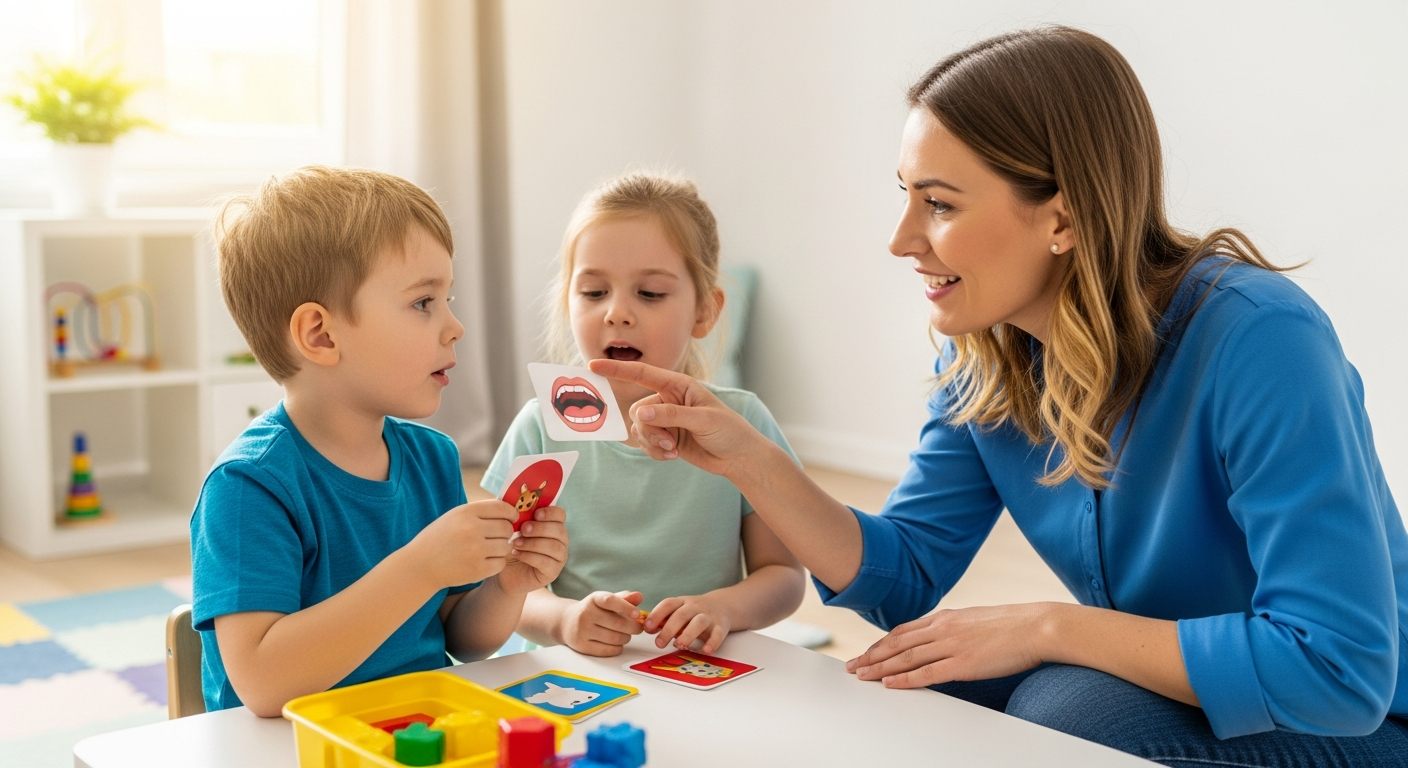
Table of Contents
- Introduction
- Understanding Speech vs. Language Delays
- The Role of a Speech-Language Pathologist (SLP)
- How Speech Blubs Complements Professional Therapy
- Practical Scenarios: Bringing Speech Therapy to Life
- Why Early Intervention is Critical
- Overcoming Barriers to Speech Support
- Choosing the Right Plan for Your Child's Success
- Tips for Parents: How to Support Speech at Home
- The Science of Success: Why Our Method Works
- Conclusion
- Frequently Asked Questions
Introduction
Did you know that approximately one in four children will experience some form of speech or language delay during their early development? For many parents, realizing that their little one isn't hitting communication milestones at the same time as their peers can be a source of significant anxiety and confusion. You might find yourself wondering if your child is just a "late bloomer" or if it is time to seek professional help. The journey of communication is one of the most vital paths a child takes, and navigating it requires the right map and the right partners.
The purpose of this blog post is to provide you with a comprehensive understanding of how a speech therapist for speech delay can transform your child’s communication journey. We will explore what speech and language disorders actually look like, how a professional Speech-Language Pathologist (SLP) evaluates a child, and the specific strategies they use to foster growth. Furthermore, we will discuss how we at Speech Blubs support this professional intervention through our unique "smart screen time" app, which uses peer-led video modeling to make learning joyful and effective.

Our main message is simple: while a speech delay can feel overwhelming, it is a challenge that can be met with confidence. By combining professional therapy with engaging, science-backed home tools, you can empower your child to speak their mind and heart, turning frustration into connection.
Understanding Speech vs. Language Delays
Before diving into therapy options, it is essential to distinguish between "speech" and "language." While these terms are often used interchangeably in casual conversation, they mean very different things in a clinical setting. Understanding this distinction helps you better communicate with a speech therapist for speech delay.
What are Speech Disorders?
A speech disorder specifically refers to difficulty producing the physical sounds of language. If your child has a speech disorder, they might know exactly what they want to say, but the sounds don't come out correctly. Common speech disorders include:
- Articulation Disorders: This is when a child has trouble making specific sounds in syllables or saying words incorrectly. For example, a child might say "wed" instead of "red" or "thith" instead of "this."
- Fluency Disorders: These involve problems with the flow of speech, such as stuttering. You might hear partial-word repetitions ("b-b-baby") or the prolonging of certain sounds ("ssssun").
- Resonance or Voice Disorders: These affect the pitch, volume, or quality of the voice. A child’s voice might sound overly nasal or breathy, which can make it difficult for others to understand them.
What are Language Disorders?
A language disorder, on the other hand, refers to difficulty understanding or putting words together to communicate ideas. This is more about the "code" of communication rather than the physical production of sound.
- Receptive Language Disorders: These involve trouble understanding or processing what others are saying. A child might struggle to follow simple directions or seem uninterested when someone is speaking to them.
- Expressive Language Disorders: These involve difficulty getting words out or conveying thoughts. A child might have a very limited vocabulary or struggle to use language in a socially appropriate way.
- Cognitive-Communication Disorders: These are problems with communication skills that involve memory, attention, perception, and problem-solving.
The Role of a Speech-Language Pathologist (SLP)
When you decide to see a speech therapist for speech delay, you are enlisting the help of a Speech-Language Pathologist. These professionals are highly trained, typically holding at least a master's degree and state licensure. They are experts in human communication and its development.

The Evaluation Process
The first step in any therapy journey is a comprehensive evaluation. An SLP will look at several factors to determine your child's needs. They will likely review your child’s medical history and observe how they interact with you and their environment. They may use standardized tests to compare your child's skills against age-appropriate norms.
During an evaluation, the therapist might:
- Check the anatomy of your child’s mouth and how their muscles move.
- Assess their ability to follow directions (receptive language).
- Observe their use of gestures, words, and sentences (expressive language).
- Evaluate how they produce specific speech sounds (articulation).
If you are unsure if your child needs this level of intervention, we recommend taking our quick 3-minute preliminary screener. It consists of 9 simple questions and provides you with a personalized assessment and next-steps plan to help you decide on the best course of action.
Therapeutic Strategies Used by SLPs
Once a delay is identified, the SLP will create a customized treatment plan. For children, this almost always involves play-based therapy. Kids learn best when they are having fun, and therapists use this to their advantage.
- Language Intervention Activities: The therapist will interact with the child using books, objects, or toys to stimulate language. They model correct vocabulary and use repetition to build the child's skills.
- Articulation Therapy: The SLP will show the child how to make specific sounds, often using a mirror so the child can see their own tongue and lip movements.
- Oral-Motor Therapy: If the delay is caused by weak muscles, the therapist might use facial massages or specific jaw and tongue exercises to strengthen the area.
How Speech Blubs Complements Professional Therapy
At Speech Blubs, we believe that the best results come from a collaborative approach. Our app was born from the personal experiences of our founders, who all grew up with speech problems themselves. They created the tool they wished they had—one that blends scientific principles with the joy of play.
The Power of Video Modeling
One of the most unique aspects of our approach is the use of video modeling. While a speech therapist for speech delay provides the clinical foundation, our app allows children to learn by watching and imitating their peers. Research shows that children are highly motivated to copy other children.
When a child sees another "Blubber" (one of the kids in our app) making a sound or saying a word, their mirror neurons fire, making it easier for them to replicate that behavior. This methodology is a core part of our "smart screen time" philosophy, which moves away from passive cartoon watching and toward active, educational engagement. To understand the depth of our approach, you can read more about our research and scientific methodology.
Bridging the Gap Between Sessions
Most children see a therapist once or twice a week for 30 to 45 minutes. While these sessions are vital, the real progress happens during the other 167 hours of the week. This is where Speech Blubs becomes a powerful supplement. It provides parents with a structured, fun way to practice speech at home, ensuring that the skills learned in therapy are reinforced daily.
Practical Scenarios: Bringing Speech Therapy to Life
To understand how a speech therapist for speech delay and Speech Blubs work together, let's look at some common real-world challenges.
The Late Talker Who Loves Animals
Imagine a 3-year-old who is a "late talker." They have a few words but mostly point and grunt to get what they want. However, this child absolutely loves animals. A speech therapist might use plastic farm animals during a session to encourage the child to say "moo" or "pig."
At home, the parents can open the "Animal Kingdom" section of Speech Blubs. The child sees a peer model making a "baa" sound for a sheep. Because the child is already motivated by animals, they are more likely to imitate the peer on the screen. This turns a potentially frustrating practice session into a joyful family learning moment.
The Child Struggling with Articulation
Consider a child who has trouble with the "B" and "P" sounds, often leaving them off the beginning of words. Their speech therapist might give them "homework" to practice these sounds in front of a mirror.
Using the Speech Blubs app, the child can use the built-in camera feature. This allows them to see their own face right next to the peer model. They can see how the "Blubber" purses their lips to make the "B" sound and try to match it. This immediate visual feedback is incredibly effective for building confidence and reducing the frustration that often comes with articulation disorders.
Why Early Intervention is Critical
When it comes to speech and language, time is of the essence. While every child develops at their own pace, the window for the most rapid brain development is during the first five years of life.
Better Outcomes Before Age Five
Studies consistently show that children who begin therapy before age five tend to have better long-term results than those who start later. Early intervention helps prevent the "gap" from widening between a child and their peers. When a child can't communicate, they may experience social isolation or behavioral issues like tantrums. By addressing the delay early with a speech therapist for speech delay, you are giving your child the tools to build relationships and succeed in school.
Building Foundational Skills
Speech isn't just about talking; it's about the foundational skills of communication. This includes eye contact, turn-taking, and the ability to follow a sequence of events. Early therapy focuses on these building blocks, creating a solid base for more complex language skills later in life.
If you are ready to start this journey today, you can create your account and begin your 7-day free trial on our website.
Overcoming Barriers to Speech Support
We understand that seeking help can be daunting. There are often barriers like high costs, long waitlists for specialists, and the general stress of adding one more "appointment" to a busy schedule.
Navigating Waitlists and Access
In many areas, the waitlist to see a speech therapist for speech delay can be months long. During this waiting period, many parents feel helpless. This is exactly why we created Speech Blubs—to provide an immediate, effective, and joyful solution for the 1 in 4 children who need support. While our app is not a replacement for professional therapy, it is an incredible tool to start using while you wait for an appointment or as a way to boost progress once therapy begins.
The Value of Smart Screen Time
Many parents are wary of screen time, and for good reason. Passive viewing of cartoons doesn't require a child to interact or respond. However, "smart screen time" is different. It is designed to be a co-play experience. When you sit with your child and use Speech Blubs, you are engaging in a shared activity. You are laughing together, imitating sounds together, and celebrating small victories. This strengthens the family connection while building essential skills.
Choosing the Right Plan for Your Child's Success
We want to be transparent about our pricing to help you make the best decision for your family. We offer two main plans to access our full suite of speech-building tools.
The Monthly Plan
At $14.99 per month, this plan offers a flexible way to try the app. It includes all the core speech therapy modules and activities. However, it does not include some of our most high-value features.
The Yearly Plan: The Best Value for Families
Our Yearly plan is the clear choice for parents who are serious about supporting their child's development over the long term. At $59.99 per year, the cost breaks down to just $4.99 per month. That is a 66% savings compared to the monthly rate.
Beyond the cost savings, the Yearly plan includes:
- A 7-day free trial so you can explore everything risk-free.
- Reading Blubs: Our dedicated app designed to help children transition from speech to reading.
- Early Access: Be the first to try new updates and modules.
- Priority Support: A 24-hour response time from our support team to help you with any questions.
Choosing the yearly plan ensures your child has a consistent, long-term resource to support their growth. You can download Speech Blubs on the Google Play Store to get started with the yearly plan today.
Tips for Parents: How to Support Speech at Home
While working with a speech therapist for speech delay, there are several simple habits you can adopt at home to create a language-rich environment.
1. Narrate Your Day
Think of yourself as a sports commentator for your child’s life. "Now I'm putting the blue socks on your feet. One, two! Now we are going to the kitchen to get a yummy apple." This constant exposure to language helps children connect words with actions and objects.
2. The Power of "Wait Time"
One of the most common mistakes parents make is jumping in too quickly to finish a child’s sentence or give them what they want. When you ask a question or wait for a response, count to five in your head. Giving your child that extra "wait time" encourages them to process the information and attempt to use their own words.
3. Read Together Daily
Reading isn't just about the words on the page. Point to the pictures, ask questions like "Where is the doggie?", and let your child turn the pages. This builds both receptive and expressive language skills in a low-pressure environment.
4. Use Peer Imitation
As we’ve discussed, kids love copying other kids. Whether it's an older sibling, a cousin, or the "Blubbers" in our app, use those moments of imitation to practice new sounds. You can see how this has worked for thousands of other families by visiting our testimonials page.
The Science of Success: Why Our Method Works
Our approach isn't just about fun and games; it's rooted in proven scientific principles. The high rating we receive on the MARS (Mobile App Rating Scale) reflects our commitment to quality and efficacy.
Mirror Neurons and Peer Modeling
When a child watches a peer in the app, their brain’s mirror neurons are activated. These neurons fire both when a child performs an action and when they observe someone else performing that same action. This creates a "neural blueprint" for the speech sound, making it significantly easier for the child to produce the sound themselves.
Encouraging "Smart" Interaction
Unlike many children's apps that use flashing lights and high-speed animation to capture attention, Speech Blubs uses a calm, focused interface. This ensures that the child is focusing on the peer’s mouth and the sound being produced, rather than being overstimulated by background noise. This focus is what makes it "smart screen time" that truly contributes to development.
Conclusion
Navigating a speech delay can be a journey filled with questions, but you don't have to walk it alone. Enlisting the help of a speech therapist for speech delay is a courageous and vital first step in ensuring your child can "speak their mind and heart." By combining professional expertise with consistent, joyful practice at home, you are creating an environment where your child can thrive.
At Speech Blubs, we are honored to be a part of your family’s story. Our mission is to empower your child to find their voice through play, science, and connection. Whether your child is a late talker, struggling with articulation, or simply needing a boost in confidence, we are here to provide the tools you wish you had.
Ready to take the next step? We invite you to download Speech Blubs on the App Store or Google Play today. Start your 7-day free trial and see why millions of parents trust us to help their children communicate. For the best experience and the most comprehensive support, be sure to select our Yearly plan, which includes the Reading Blubs app and priority support for just $4.99 a month. Let’s turn those first words into a lifetime of conversation!
Frequently Asked Questions
1. How do I know if my child actually needs a speech therapist for speech delay?
If your child is not meeting communication milestones for their age—such as using at least 50 words by age two or being understood by strangers by age three—it is worth seeking an evaluation. A good first step is to take our preliminary screener to get a better sense of where your child stands.
2. Can an app really help my child talk?
While an app should not replace a speech therapist for speech delay, it is a powerful supplement. Speech Blubs uses video modeling, a scientifically proven technique, to encourage imitation. When used with a parent (co-play), it transforms screen time into an active learning session that builds foundational skills and confidence.
3. What is the difference between the Monthly and Yearly plans?
The Monthly plan ($14.99/mo) provides access to the core Speech Blubs app. The Yearly plan ($59.99/yr) is the better value, breaking down to $4.99/mo. It includes a 7-day free trial, the Reading Blubs app, early access to new content, and 24-hour support response times.
4. How long will it take to see progress in my child’s speech?
Every child is unique, and progress depends on the severity of the delay and the consistency of practice. Our goal isn't to promise a specific timeline, but rather to foster a love for communication and reduce frustration. Many parents report seeing increased attempts at imitation and improved confidence within a few weeks of consistent use.
Sobre el autor